
Micron’s revenue roughly quadrupled year over year. Gross margins pushed into the low-to-mid eighties. The stock fell 6.69% on 29 June.
That contradiction sits at the centre of a broader fracture running through AI-linked equities right now. Chip demand is not in question. What has cracked is investor confidence in the path from that demand to actual returns. Apple rising 3.14% on the same session Micron dropped nearly 7% is not random noise. It reflects a deliberate rotation in how markets are sorting AI-era winners, and the sorting criteria have changed.
The contrasting moves in Micron, Apple, Nvidia, and Microsoft reveal where AI infrastructure value is actually being captured, and where it is still being spent without a clear payoff. Here is the framework for reading that divergence before positioning in any of these names.
The Micron paradox: when great earnings are not enough
Micron’s Q3 FY2026 results were, by any conventional measure, exceptional. Revenue reached approximately $41 billion, roughly quadrupling year over year. Gross margins rose into the 81-85% range, driven by surging demand for high-end memory used in AI data centres. This was not a company reporting modest beats. This was a company posting one of the strongest quarters in semiconductor history.
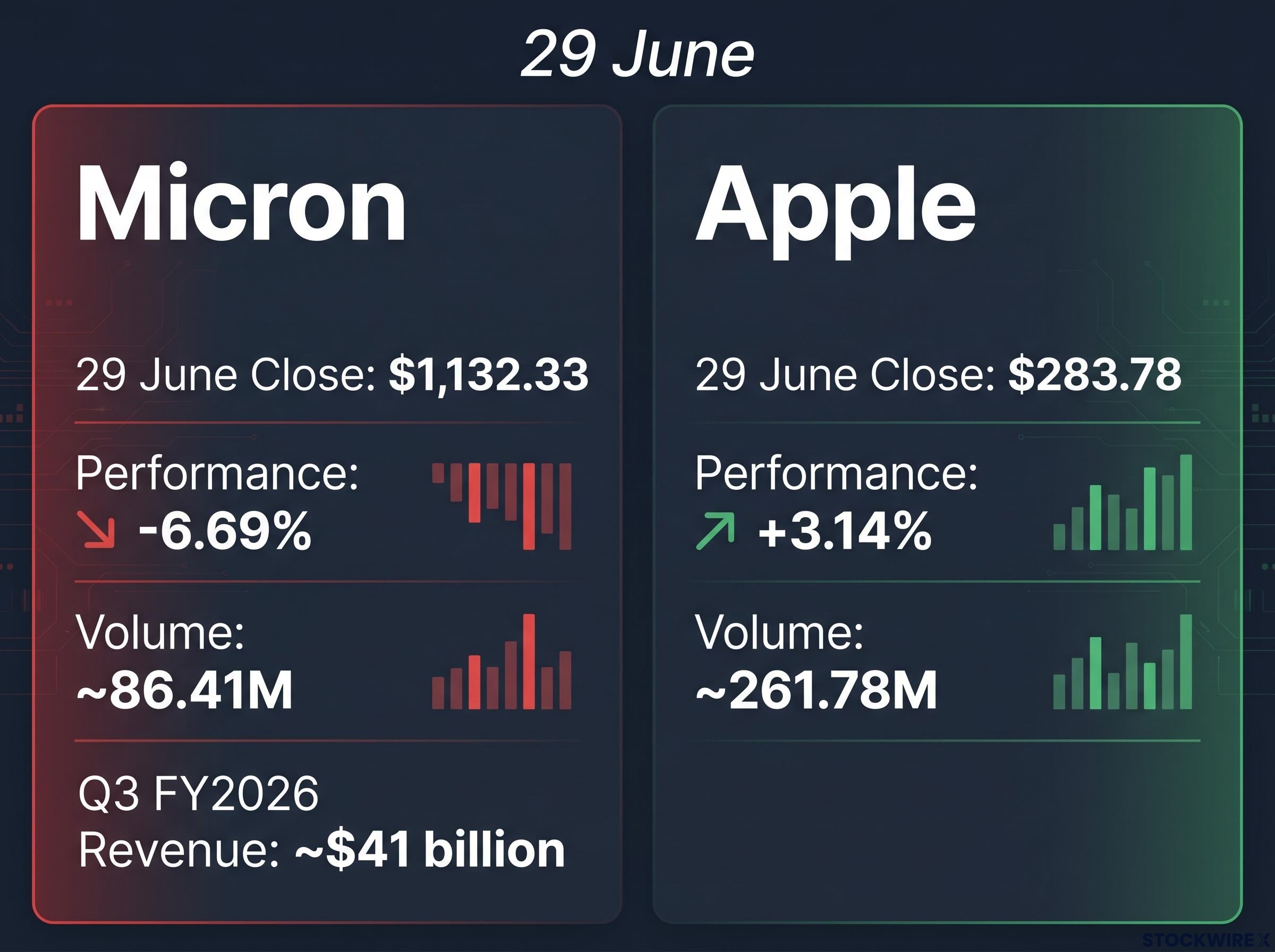
Revenue roughly quadrupled year over year. Gross margins hit the low-to-mid eighties. The stock then fell more than 20% from its post-earnings highs.
Why strong results triggered a selloff
The first pressure came from outside Micron entirely. Broadcom’s early June 2026 earnings, where management provided AI revenue guidance slightly below some analyst expectations, triggered a sector-wide reassessment of whether AI semiconductor spending is starting to plateau. That repricing hit every AI hardware name, but it hit Micron, trading at AI-era multiples, with particular force.
The second pressure was product-specific. Reports surfaced regarding potential adjustments to Nvidia memory configurations for some AI platforms, raising concerns about future demand for high-bandwidth memory (HBM), the specific high-margin product category driving Micron’s margin expansion.
Micron’s 16 non-cancellable HBM supply agreements, with pricing floors above any prior cycle peak, are the structural element most analysts cite when distinguishing the current memory upcycle from previous ones; those HBM supply agreements also explain why concerns about Nvidia configuration adjustments cut so sharply against a thesis built on locked-in contract visibility.
The third was technical. Micron has been heavily owned by retail traders. Some strategists argue that investors sold positions to free cash for high-profile IPOs such as SpaceX, adding mechanical selling pressure on top of fundamental doubts. By 29 June, shares closed at $1,132.33, down 6.69% on volume of approximately 86.41 million shares.
The results confirmed demand is real. The price action told a different story: the market has stopped treating strong chip demand as a sufficient reason to hold a stock trading at AI-era multiples.
When big ASX news breaks, our subscribers know first
Apple’s price hike and the case for pricing power as a refuge
The market did not simply reward Apple by default. The initial reaction to its price increases, announced around 25 June, was sharply negative. Shares fell more than 6%, their worst single day in over a year, as investors priced in the risk that higher sticker prices would compress consumer demand.
The increases were substantial:
| Product | Old Price | New Price |
|---|---|---|
| MacBook Air 512GB | $1,099 | $1,299 |
| iPad models (various) | Varied | +$100-$150 across range |
Apple cited AI-driven memory and storage cost inflation as the explicit rationale. Then the recovery came. By 29 June, shares closed at $283.78, up 3.14% on volume of approximately 261.78 million shares. Investor sentiment moved away from demand-risk concern toward a view that Apple can absorb rising component costs and transfer them to consumers without undermining its brand standing or the loyalty of its ecosystem.
Two dynamics explain why the market designated Apple a quality refuge:
- Demonstrated pricing power: The ability to raise prices $150-$200 per unit and recover from a 6% selloff within days signals durable brand economics that most AI-exposed companies cannot replicate.
- Balance sheet quality: A cash-generative, conservative balance sheet with a loyal installed base that can adjust pricing to protect margins offers a different risk profile than a company still accumulating infrastructure costs.
Apple’s arc from its own sharp selloff to a 29 June gain tells you the market is actively sorting companies by who absorbs AI costs versus who passes them through, and is placing a premium on the latter.
What the semiconductor sector selloff actually revealed
The context for Micron’s individual decline is a sector-level event that preceded it. In early June 2026, around 5-6 June, the SOX (Philadelphia Semiconductor Index) recorded its steepest single-session fall in years after Broadcom’s AI revenue guidance landed short of certain analyst forecasts, prompting a broad repricing across the sector.
The scale was severe. Nvidia alone lost approximately $300-$330 billion in market capitalisation at intraday lows. Broadcom and Marvell both saw sharp double-digit declines before partially recovering. The affected names tell you this was not about one company’s results:
The SOX historical data shows the Philadelphia Semiconductor Index has experienced several sharp single-session drawdowns during the current AI investment cycle, making the early June 2026 repricing severe but not without precedent in a sector prone to sentiment-driven dislocations at elevated valuation multiples.
- Nvidia: Approximately $300-$330 billion intraday market cap loss at lows
- Broadcom: Sharp double-digit decline, the catalyst for the broader repricing
- Marvell: Similar double-digit selloff before partial recovery
By 29 June, Nvidia had stabilised somewhat, closing at $192.53, down a comparatively modest 1.64% on approximately 179.30 million shares. But stabilisation is not restoration.
Nvidia’s CEO characterised the selloff as a buying opportunity, pointing to continued global AI infrastructure investment and arguing that underlying AI demand retains structural durability.
That management optimism sits in tension with the price action. The fact that even a partial recovery in Nvidia still left it down on 29 June signals that investor confidence in the AI hardware thesis has not been restored. It has only paused from active selling.
Understanding the AI spending return gap
Start with what is unambiguously true. Hyperscalers are committing tens of billions of dollars to data centres and specialised chips. Chip demand, as Micron’s results demonstrate, is genuine and growing. No serious market participant disputes this.
The problem is what comes after the spending.
From AI exposure trade to AI earnings quality trade
Each quarter in which AI-related spending grows faster than identifiable AI-driven revenue adds valuation strain to hardware and infrastructure names. That pattern, which investors are now actively testing as a thesis, has shifted the criteria for what counts as an attractive AI position.
Morningstar has quantified the capex-to-revenue lag at 18-24 months for AI infrastructure investments, a timeline that creates a structural problem for semiconductor names trading at AI-era multiples: each quarter that passes without monetisation evidence does not leave the valuation premium intact, it actively erodes the justification for holding it.
The distinction between the old trade and the new one is specific:
- AI exposure trade: Rewarded any company touching AI infrastructure. Favoured memory makers, GPU suppliers, data centre builders. Prioritised revenue growth, order backlogs, and market share. Micron and Nvidia sat squarely in this camp.
- AI earnings quality trade: Rewards companies that can demonstrate AI demand is generating cash flows justifying current prices. Favours pricing power, margin protection, and identifiable recurring revenue. Prioritises free cash flow conversion over revenue growth. Apple fits this profile.
Evidence like Micron’s exceptional margin and revenue performance is now read not simply as good news, but as a signal that customers’ rising costs may not be sustainable without commensurate end-user revenues. The market has moved from rewarding any AI exposure to demanding proof that AI projects generate cash flows sufficient to justify today’s prices.
For anyone evaluating an AI-linked position today, the central question is no longer “does this company benefit from AI demand?” It is “can this company show that AI demand is generating cash flows that justify its current price?”
This article is for informational purposes only and should not be considered financial advice. Investors should conduct their own research and consult with financial professionals before making investment decisions.
Broader market context: moderate indices, selective repricing
The broader market on 29 June was not panicking. That is precisely what makes the semiconductor repricing more significant, not less.
| Index | 29 June Level | Change | Signal |
|---|---|---|---|
| Dow Jones | 51,876.11 | -0.09% | Flat, no broad risk-off |
| S&P 500 | 7,354.02 | -0.05% | Near unchanged |
| Nasdaq Composite | 25,297.62 | -0.24% | Mild tech underperformance |
| VIX | 18.41 | -2.54% | Declining fear, selective repricing |
U.S. and European equity futures edged higher, partly lifted by easing Middle East tensions. Tech valuation concerns and a firming U.S. dollar kept Asian markets on the back foot.
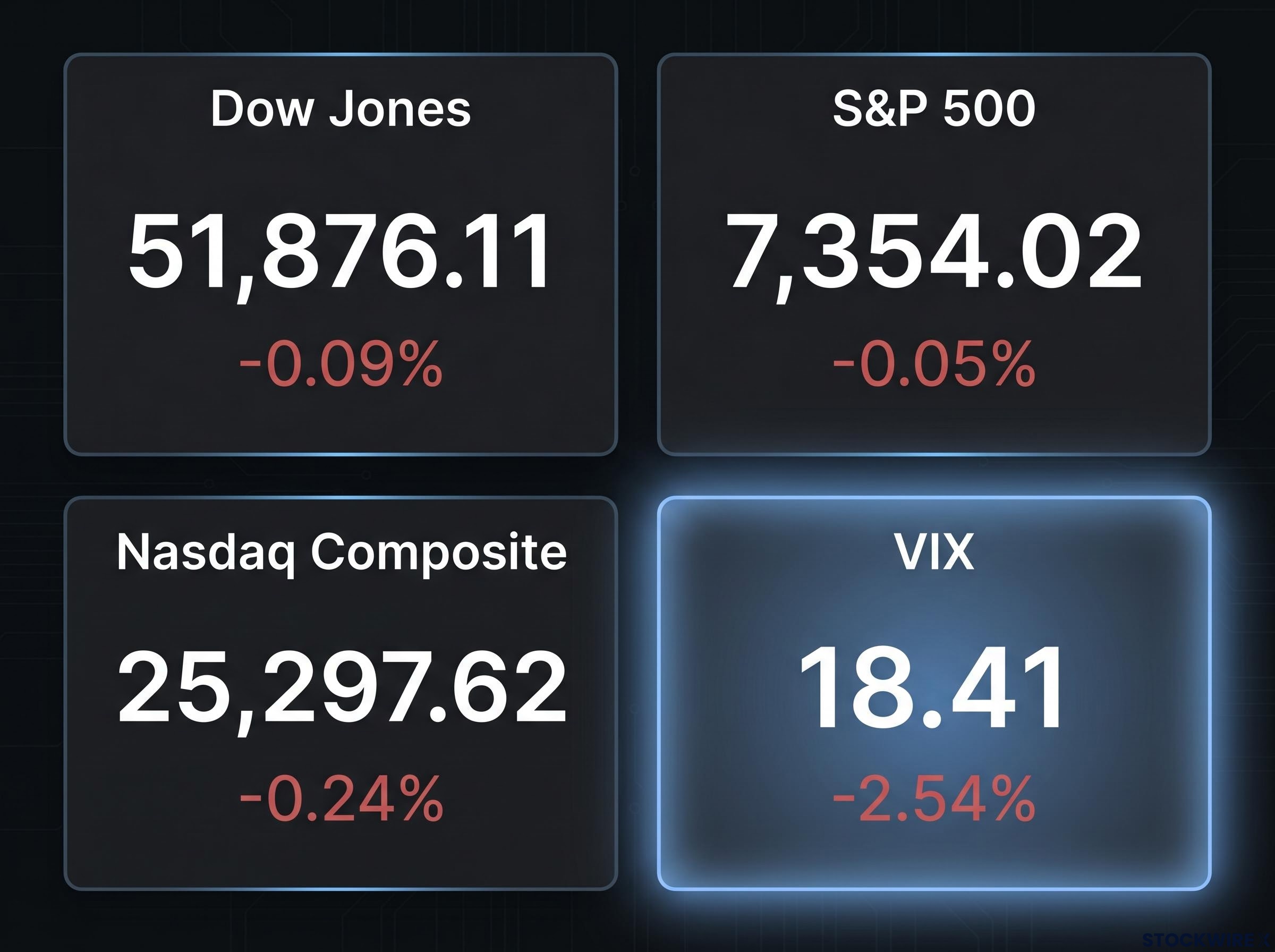
A VIX below 20 alongside individual semiconductor stocks moving 6-7% in a single session is the market’s way of telling you this is a deliberate, considered repricing of a specific thesis. Calm markets discriminating against specific narratives produce a more durable signal than broad risk-off moves. Investors rotating within tech are making an active choice, not reacting to external shock.
What the divergence tells you before your next move
The analytical work across this piece points to three distinct readings of the current environment, each flowing from the data rather than arriving as generic advice.
- Infrastructure and component plays face a new burden of proof. Strong fundamental results are no longer automatic catalysts for sustained price gains. Micron’s 6.69% decline on a quarter where revenue roughly quadrupled tells you that names like Micron and Nvidia are likely to remain volatile until monetisation evidence accumulates. Holding these positions requires conviction that the spending-to-revenue conversion timeline is shorter than the market currently believes.
- Cash-rich, brand-strong names with demonstrated pricing power have become relative safe havens. Apple’s arc from a 6% single-day selloff to a 3.14% gain by 29 June shows this dynamic in action. Even when the initial reaction to cost-related news is negative, markets are rewarding companies that can pass AI-related costs through to end customers while protecting margins.
- Stock selection within AI now turns on business model economics, not technology association. Who captures the value created by AI matters more than who is adjacent to it. Companies translating AI infrastructure investment into identifiable, recurring revenue will be differentiated from those still accumulating costs without a visible payoff timeline.
For investors wanting a structured framework to apply this logic to specific holdings, our deep-dive into moat-based AI stock selection examines how Morningstar’s economic moat ratings separate durable AI infrastructure winners from names whose recent gains rest on thematic association rather than structural competitive advantage.
The operating framework for this moment is no longer “AI exposure.” It is “AI earnings quality.” The divergence between Micron and Apple on 29 June is not a one-day anomaly. It is a preview of how the market is likely to sort the AI field for the next several quarters.
Past performance does not guarantee future results. Financial projections are subject to market conditions and various risk factors.