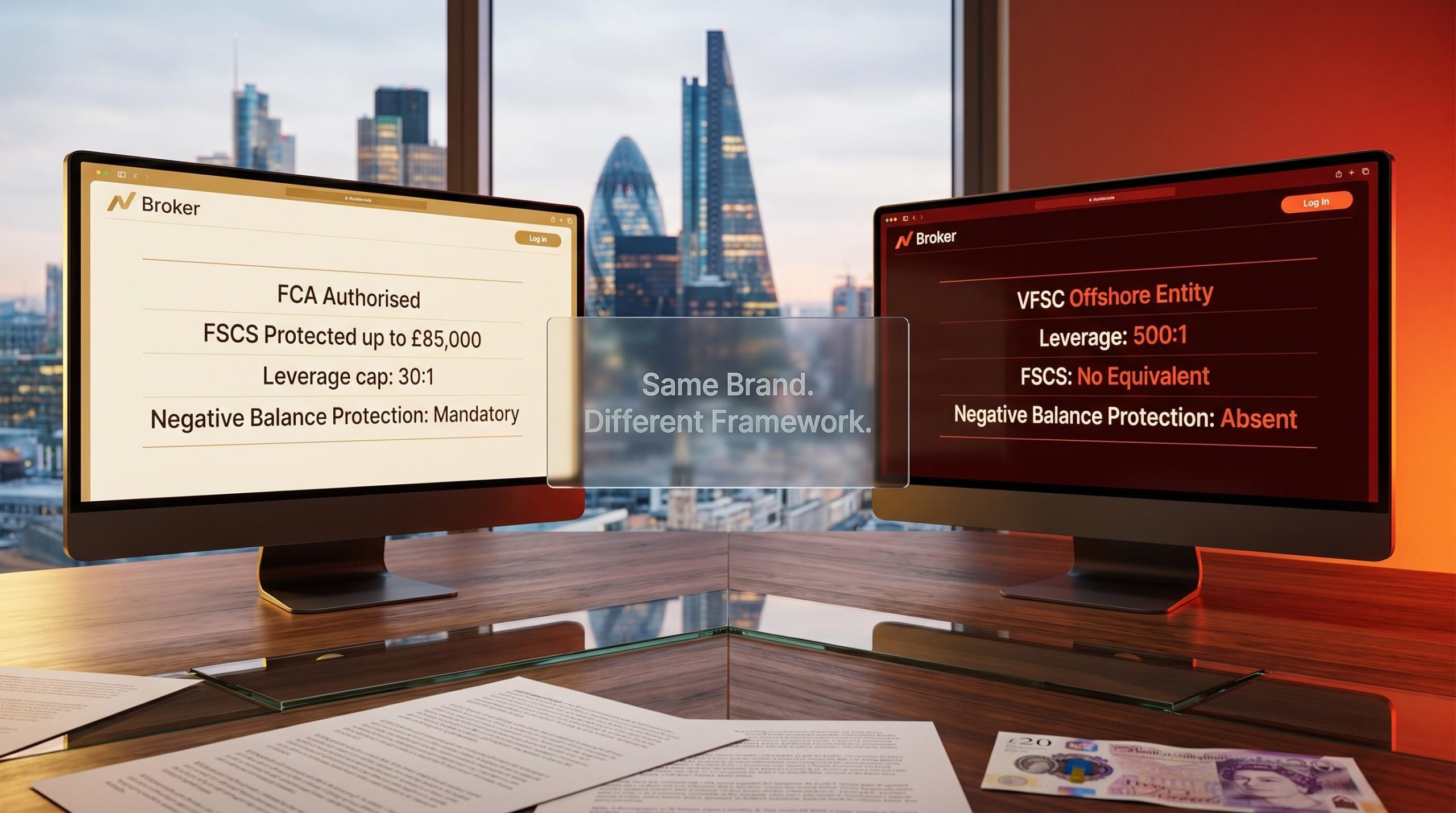
The sign-up process takes five minutes. The platform looks familiar, the branding matches what you have seen on comparison sites, and the spreads seem competitive. You deposit, place your first trade, and assume the same protections apply as they would with any UK-regulated broker.
That assumption is almost universally wrong when the account sits under an offshore entity rather than the broker’s FCA-authorised one. This is not primarily a story about fraudulent platforms. It is about a structural regulatory difference that strips away legal rights you may not realise you had, while the interface stays identical.
After reading this, you will know exactly which protections the FCA framework gives you as a retail trader, what disappears when your account falls under an offshore entity, and the specific steps to confirm which framework governs your money before you deposit a single pound.
What FCA authorisation actually gives UK retail traders
FCA authorisation creates legally enforceable obligations on brokers. It is not a badge of reputation or a marketing credential. For you as a retail trader, it means a specific set of rights that you can invoke, escalate, and, if necessary, enforce through independent bodies.
Those rights were not designed in the abstract. The protections were formalised through product-intervention rules from 2018-2019, following specific market events that demonstrated what happens without them. The Swiss National Bank’s January 2015 EUR/CHF shock, which removed the currency floor without warning, drove retail traders across Europe into catastrophic negative balances overnight. That single event accelerated regulators, including the FCA, toward the mandatory protections now in place.
The FCA policy statement PS19/18 formalised these protections for retail CFD clients, establishing the 30:1 leverage cap on FX majors, the 50% margin close-out rule, and the mandatory negative balance protection requirement that together form the baseline framework governing FCA-authorised CFD brokers today.
Here is what those protections look like in practice:
- Negative balance protection: You cannot lose more than your deposited funds, regardless of how violently a market moves against your position
- Leverage caps: 30:1 on FX majors; 20:1 on indices, gold, and major commodities; 5:1 on single equities
- Client money segregation: Your funds must be held separately from the broker’s own money under the FCA’s Client Assets Sourcebook (CASS), a set of rules governing how firms must protect client assets
- Margin close-out rule: Positions must be closed when your margin falls below approximately 50% of the required margin, preventing a slow drift into mounting debt
These protections work as an interconnected system. Leverage caps limit the speed of loss. Margin close-out rules prevent that loss from compounding. Negative balance protection provides a hard floor. CASS segregation ensures the broker cannot use your capital for its own purposes. Understanding this architecture is what allows you to recognise exactly what you are giving up when you step outside it.
The scale of CFD trading losses across regulated retail populations gives that architecture concrete weight: ESMA data from Q1 2026 places the proportion of retail accounts losing money at between 74% and 89%, with average losses reaching up to 29,000 euros per client across the jurisdictions where leverage caps and negative balance protection are already mandatory.
When big ASX news breaks, our subscribers know first
The full protection gap: FCA retail rules versus the offshore alternative
The difference between FCA regulation and a typical offshore framework is not a single missing feature. It is the removal of an entire layered system, where each component was built to address a distinct category of harm.
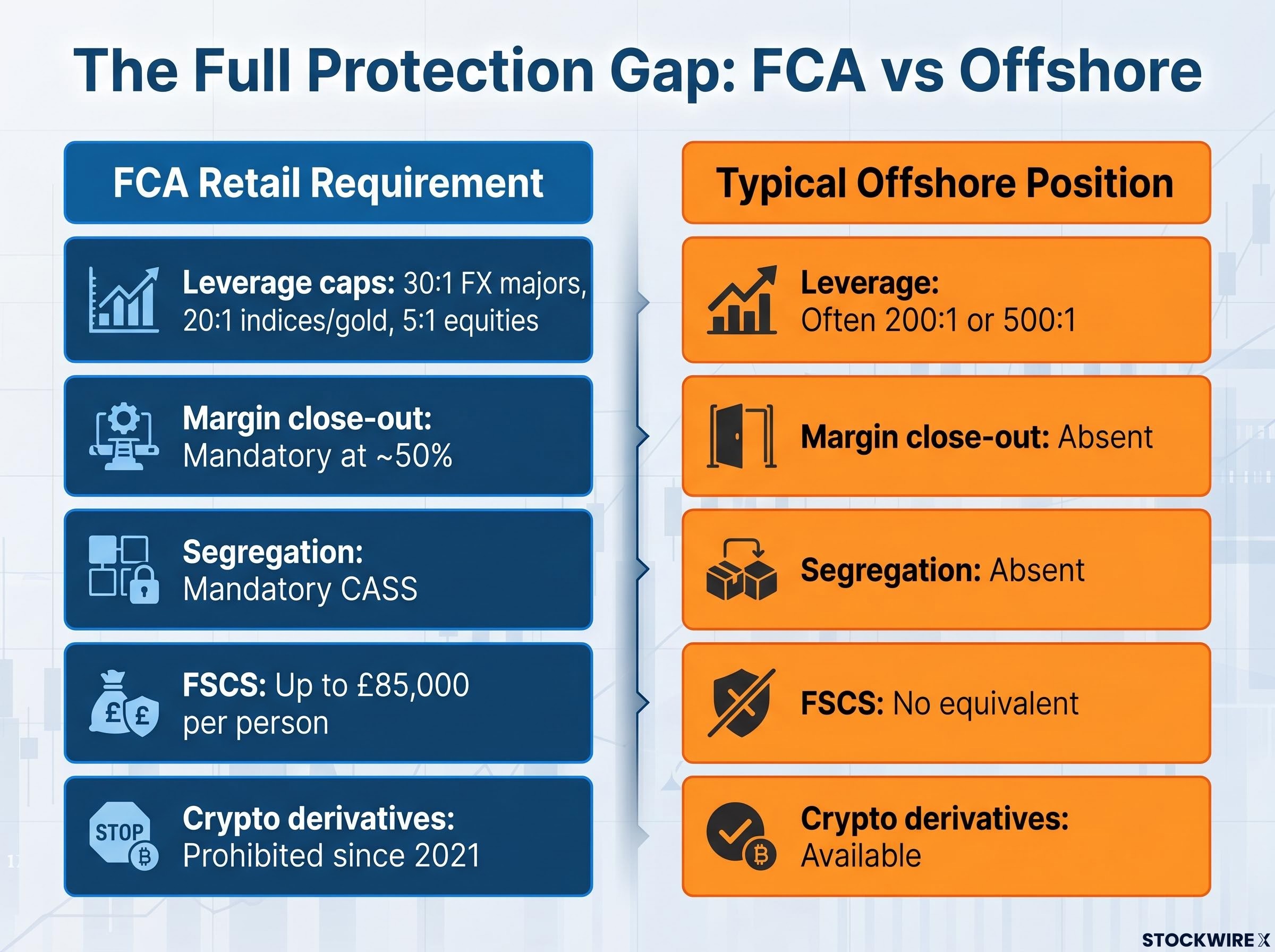
| Protection | FCA Retail Requirement | Typical Offshore Position |
|---|---|---|
| Negative balance protection | Mandatory | Absent or discretionary |
| Leverage caps | 30:1 FX majors; 20:1 indices/gold; 5:1 equities | Often 200:1, 500:1 or higher |
| Margin close-out rule | Mandatory at ~50% of required margin | Absent or not standardised |
| Client money segregation (CASS) | Mandatory | Absent or unenforceable |
| FSCS compensation | Up to £85,000 per person per firm (firm failure) | No equivalent |
| FOS dispute resolution | Mandatory; decisions binding on firm | No equivalent |
| Risk warnings (audited % losing money) | Mandatory and standardised | Generic disclaimers only |
| Bonus/incentive restrictions | Prohibited | Frequently used |
| Crypto-asset derivative access | Prohibited for retail clients (since 2021) | Available |
Two elements in the table deserve particular attention. The Financial Services Compensation Scheme (FSCS), the UK’s statutory compensation scheme, covers up to £85,000 per eligible claimant per firm. The Financial Ombudsman Service (FOS) provides a dispute resolution route whose decisions are binding on the firm. Neither has any equivalent under most offshore frameworks.
FSCS scope clarification: FSCS compensation applies when an FCA-authorised firm becomes insolvent and cannot return your money. It does not cover trading losses. CASS segregation greatly improves, but does not absolutely guarantee, full and immediate recovery in insolvency. The FSCS operates as the additional backstop in those scenarios.
The crypto-asset derivatives ban for UK retail clients, in place since 2021, remains in force as of June 2026. This is distinct from the lifting of the ban on crypto exchange-traded notes (ETNs) for retail clients in October 2025, which covers a separate instrument category.
Why the same broker can mean two completely different levels of protection
The abstract comparison becomes immediately concrete when you look at how a single broker group can operate under two entirely different regulatory frameworks, with the same branding on both.
Vantage Markets is a clear illustration. The group operates two entities:
- Vantage Global Prime LLP (vantagemarkets.co.uk): FCA-authorised, subject to all UK retail protections including negative balance protection, leverage caps, CASS segregation, FOS access, and FSCS eligibility
- Vantage Global Limited (international platform): Regulated by the Vanuatu Financial Services Commission (VFSC), and operating outside the FCA’s jurisdiction entirely, meaning its clients have no entitlement to FCA leverage limits, negative balance protection, CASS-compliant fund segregation, FOS dispute resolution, or FSCS compensation
The company’s own documentation makes clear that traders who sign up via the international platform do so without any solicitation from Vantage, with the firm characterising access as self-directed. The international platform is closed to individuals who hold US citizenship or residency. But for a UK-based trader who finds the international site through an ad or a search result, the distinction may not be obvious until after money has been deposited.
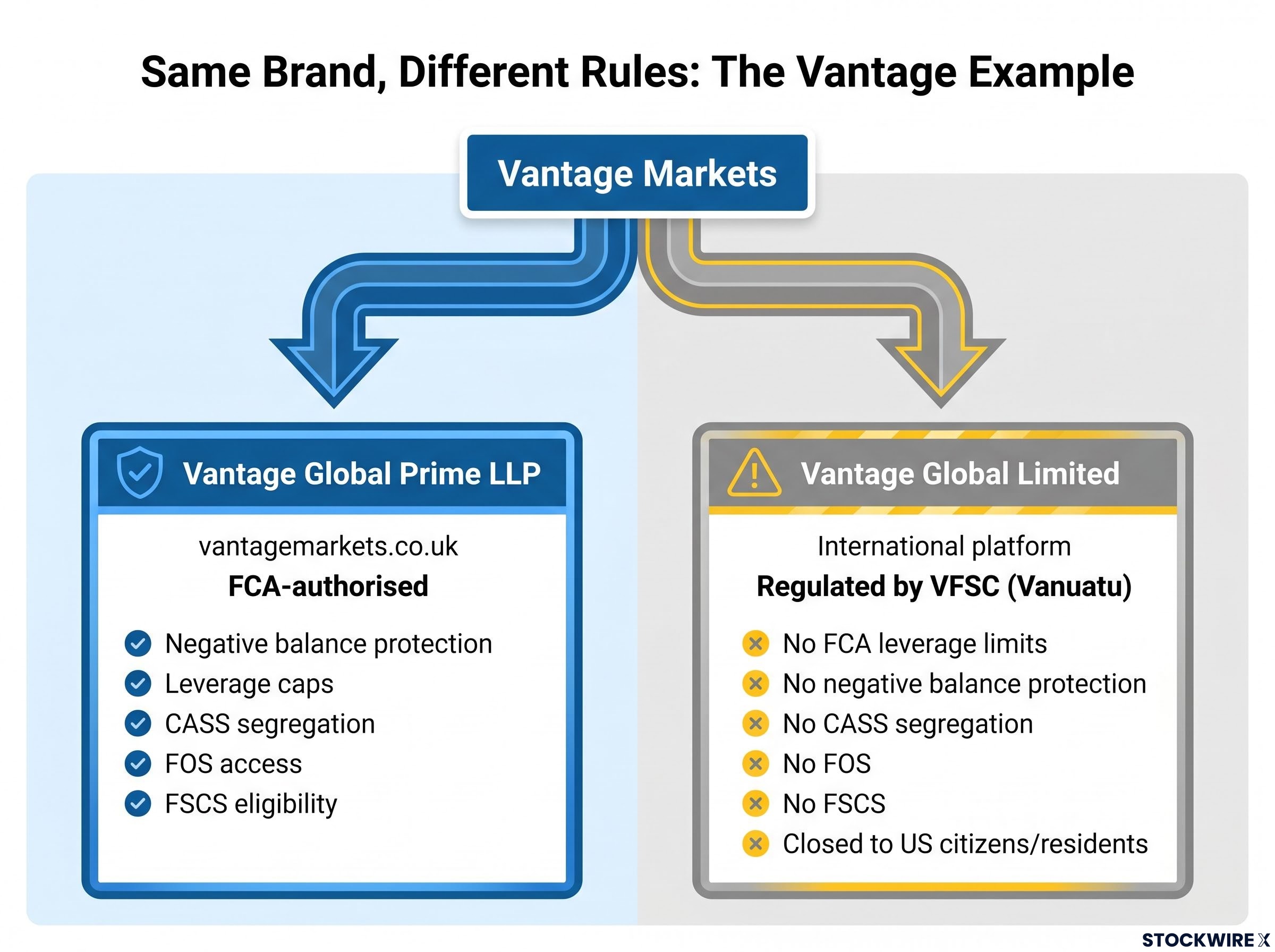
The principle to carry with you: Group-level FCA authorisation does not extend to accounts opened under the offshore entity. The question is never “does this broker have an FCA licence?” It is “under which entity is my account being opened?”
This pattern is not unique to Vantage. Many broker groups maintain both an FCA-authorised entity and a separate international entity under a less stringent regulator. The Vantage structure simply illustrates the mechanics in a way that makes the risk recognisable the next time you encounter it with any broker.
What draws traders to offshore platforms, and what that trade-off actually costs
The appeal of offshore CFD brokers is real, and treating it as irrational does not help you make a better decision. Here are the four primary pull factors, and the regulatory reason each one is absent from FCA platforms:
- Higher leverage: Offshore platforms commonly offer 200:1 or 500:1, versus FCA retail caps of 30:1 on FX majors. The FCA caps exist because higher leverage accelerates losses, and the 2015 EUR/CHF shock demonstrated how rapidly that acceleration can push retail traders into negative balances.
- Crypto-asset derivatives access: Prohibited for UK retail clients since 2021 under FCA rules. Available on many offshore platforms. The FCA ban reflects the regulator’s assessment that the combination of crypto volatility and leveraged derivatives poses disproportionate risk to retail traders.
- Lower account minimums: Some offshore platforms set deposit thresholds well below those of their FCA-regulated counterparts, lowering the barrier to entry.
- Deposit bonuses and incentive structures: Frequently used by offshore brokers and prohibited under FCA and ESMA rules for UK retail clients. The prohibition exists precisely because these structures push risk higher while appearing attractive; they incentivise you to trade more and with larger positions than you otherwise would.
The leverage and margin mechanics behind that acceleration are worth examining precisely, because the multiplicative relationship between leverage ratio and loss percentage is not intuitive: a 5% adverse price move on a 20:1 leveraged position produces a 100% loss on the margin deposit, not a 5% loss.
Each pull factor has a structural counterpart. Higher leverage means faster potential losses without the margin close-out backstop. Bonus structures create incentives to overtrade without the regulatory framework that limits those incentives because they are harmful.
There is also a fifth factor that is less about attraction and more about information: many traders simply do not realise they have moved outside FCA protection, particularly when the branding and interface are identical across a broker group’s FCA and offshore entities.
How to confirm which regulatory framework actually governs your account
These checks take less than ten minutes and determine whether the legal safety net the UK has built for retail traders actually applies to your money.
- Check the FCA Register at register.fca.org.uk. Search for the specific legal entity, not the brand name. The entity you are opening an account with must be authorised, not merely a related company within the same group.
- Identify the counterparty entity. Before you complete registration, confirm which legal entity will hold your account. The entity name appears in the sign-up flow, the terms and conditions, or the footer of the platform.
- Read the client agreement for governing jurisdiction. The agreement will specify which country’s law governs the contract. If it names a jurisdiction outside the UK, your account is not under FCA protection regardless of the brand name on the platform.
- Check leverage levels offered. If the broker is offering leverage substantially above 30:1 on FX majors, the account is almost certainly not under FCA retail protection. This is the fastest informal indicator available.
- Confirm FSCS eligibility information is provided. FCA-authorised firms are required to provide FSCS eligibility details during the onboarding process. If this information is absent at sign-up, that is a direct warning sign that the entity is not FCA-authorised.
Group-level FCA authorisation does not extend to accounts opened under a separate offshore entity within the same corporate structure. Verify the specific entity, not the brand.
This verification process works for any CFD broker you encounter, not just the examples discussed in this article.
Making an informed decision when the platform looks the same but the framework does not
The surface similarity between FCA-regulated and offshore CFD platforms obscures a difference that is not cosmetic but legal. The risk is structural, not necessarily a matter of broker intent. A well-intentioned offshore broker still cannot offer protections that do not exist under its regulatory framework.
For context, the FCA framework itself allows voluntary departures from certain retail protections. Traders who pursue elective professional client status with an FCA-authorised broker voluntarily reduce specific safeguards, including leverage caps and some disclosure requirements. This is a different mechanism from the offshore issue, but it illustrates the same principle: the FCA retail framework is the baseline, and any departure from it, whether through professional reclassification or through an offshore entity, reduces your protection.
The choice to trade with an offshore CFD broker is yours to make. The purpose of this article is to ensure that choice is made knowingly, with the trade-offs clearly understood. The five verification steps above are the foundation of any informed depositing decision; they cost you nothing but a few minutes, and they tell you everything about which legal framework stands behind your money.
For readers wanting to see how a comparable regulatory system handles the same structural risks, our full explainer on ASIC’s CFD framework examines the leverage caps, margin close-out rules, and negative balance protections that Australia introduced alongside the UK, including the compliance review that returned $40 million to more than 38,000 retail investors.
This article is for informational purposes only and should not be considered financial advice. Investors should conduct their own research and consult with financial professionals before making investment decisions.