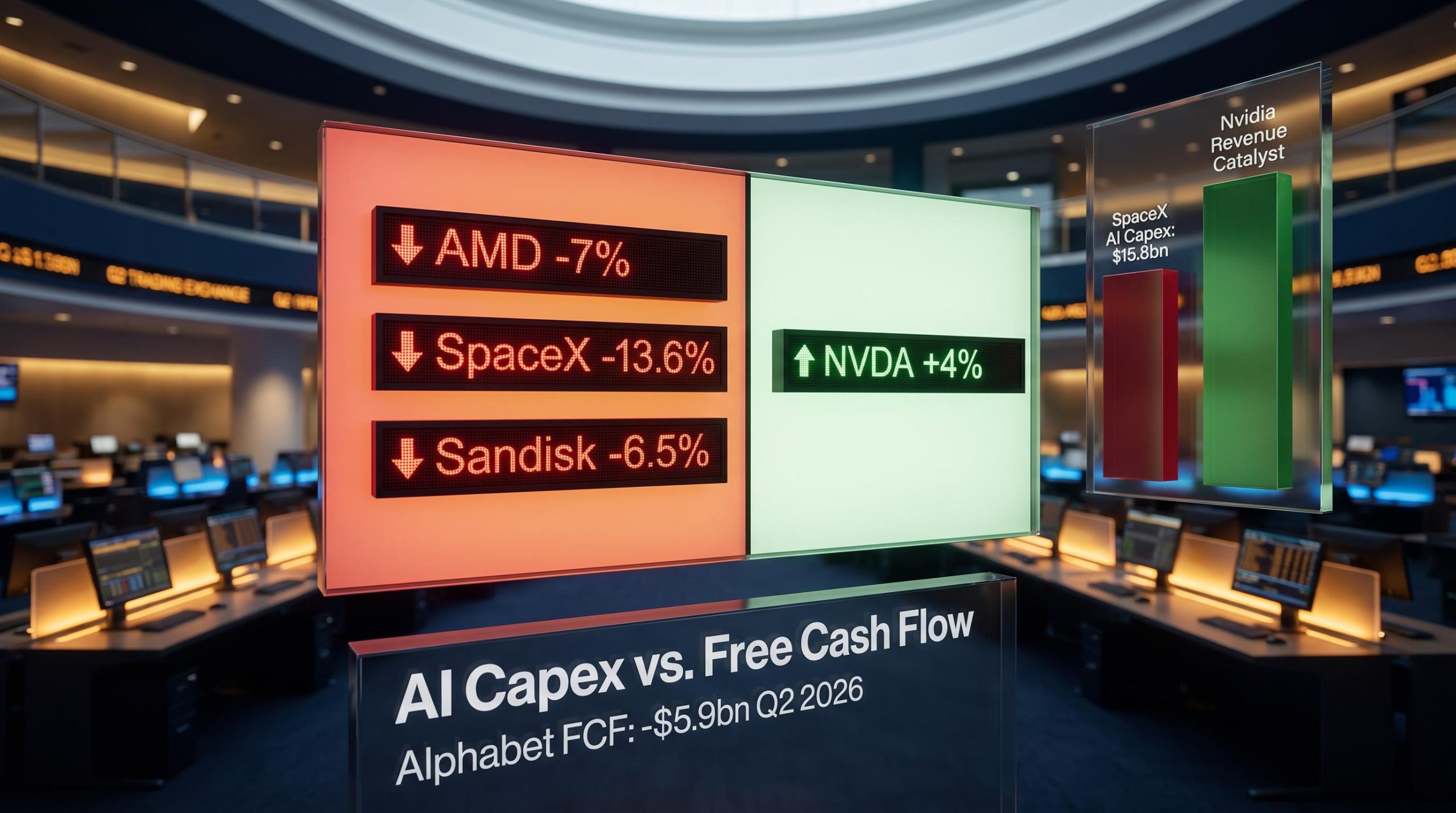
On 6 August 2026, AMD reported 50% revenue growth and record quarterly sales. SpaceX beat estimates by 13%. Sandisk grew revenue 372%. All three stocks fell.
The earnings-beat-yet-price-decline pattern is not a market anomaly or a temporary overreaction. It reflects a structural reassessment of how investors value AI capital expenditure. The companies being punished are not failing. They are spending heavily on AI infrastructure, and the market has decided it no longer knows when, or whether, that spending converts to free cash flow.
Here is how that reassessment works, why Nvidia is the one exception that proves the rule, and what the divergence tells you about which side of the AI stack is worth owning right now.
Why beating estimates is no longer enough
Three companies from different parts of the technology stack reported on the same session. All three posted record or near-record results. All three fell.
AMD delivered quarterly revenue of $11.54bn, up 50% year on year. Data centre revenue hit $6.72bn, a 107% jump. Q3 guidance of $13bn cleared analyst expectations. Shares dropped 7%.
SpaceX, reporting its first post-IPO quarter, posted revenue of $7.81bn, a 92% year-on-year surge that beat estimates by roughly 13%. Of its $18.4bn total quarterly capital expenditure, $15.8bn was directed toward AI infrastructure. Shares fell 13.6%. A $101bn lock-up expiry added technical selling pressure, but the capex figure was the catalyst that set the tone.
SpaceX allocated $15.8bn of its $18.4bn quarterly capex to AI infrastructure, a figure that exceeded analyst expectations and became the single largest factor in the stock’s 13.6% decline.
Sandisk posted revenue of $8.97bn (up 372% year on year), with adjusted EPS coming in 14% above consensus estimates, gross margins of 84.6%, and approved a $14bn buyback. Shares fell 6.5% in after-hours trading.
| Company | Quarterly Revenue | YoY Growth | Earnings vs. Estimates | Share Price Move (6 Aug) |
|---|---|---|---|---|
| AMD | $11.54bn | +50% | ~2% beat | -7% |
| SpaceX | $7.81bn | +92% | ~13% beat | -13.6% |
| Sandisk | $8.97bn | +372% | 14% EPS beat | -6.5% (after hours) |
When three companies across semiconductors, AI infrastructure, and storage all beat estimates and all fall on the same session, the market is not making a judgment about individual results. It is enforcing a new standard for what counts as a good quarter in the AI era: revenue growth alone no longer passes the test.
The expectations gap framework developed by Howard Marks and Aswath Damodaran offers a useful lens here: investment returns are driven by the difference between what a price already implies and what actually occurs, which is precisely why companies that beat headline estimates still fall when the capex trajectory embedded in their valuation was already more optimistic than the figure they reported.
When big ASX news breaks, our subscribers know first
What the market is actually pricing when it sells AI spenders
The surface observation is straightforward: companies with heavy AI capital expenditure commitments are being sold, even on strong results. The underlying logic runs deeper than headline scepticism.
What has shifted is investor tolerance for the gap between spending and cash generation. For two years, committing billions to AI infrastructure was treated as a signal of strategic vision. Now, investors are asking three specific questions before they decide whether a capex number is a positive or a negative:
- Is the spending contractual or speculative? Capex tied to firm, multi-year contracts (the kind that underpins Nvidia’s supply arrangements) gets treated more favourably than open-ended platform bets with uncertain demand.
- What is the free cash flow conversion timeline? Companies where capital expenditure structurally exceeds the revenue it generates need a credible, multi-year roadmap. Many are not providing one.
- Is the company building from a position of dominance, or challenging an entrenched competitor? AMD’s data centre revenue grew 107%, which in isolation looks exceptional. But AMD is investing heavily to dislodge Nvidia from a dominant position, and challengers face a tougher burden of proof on returns.
The clearest illustration of the new standard sits at Alphabet. The company raised its 2026 capex guidance to as much as $205bn and reported a quarterly free cash flow of negative $5.9bn in Q2, its first negative quarterly FCF since its IPO. Despite solid operating performance across its business, shares fell more than 7% on that disclosure.
Alphabet reported quarterly free cash flow of negative $5.9bn in Q2 2026, its first negative quarterly FCF since its IPO, despite strong operating results across its core business.
Alphabet is not alone. Amazon shares fell more than 8% and Microsoft shares dropped more than 11% on their own elevated AI and cloud infrastructure spending disclosures. For you as an investor evaluating any company with large AI capex commitments, these three questions now function as a pre-screening checklist before headline earnings numbers are even considered.
PIMCO estimates that AI capex vs monetisation dynamics have reached a critical inflection, with infrastructure spending now absorbing 93–94% of operating cash flow at major hyperscalers, up from 33–40% in 2022–2023, leaving virtually no slack for buybacks, dividends, or strategic optionality.
How the market learned to read AI spending differently
The current scepticism did not arrive overnight. It evolved through three distinct phases, each with a different investor mindset and a different threshold for what AI spending needed to demonstrate.
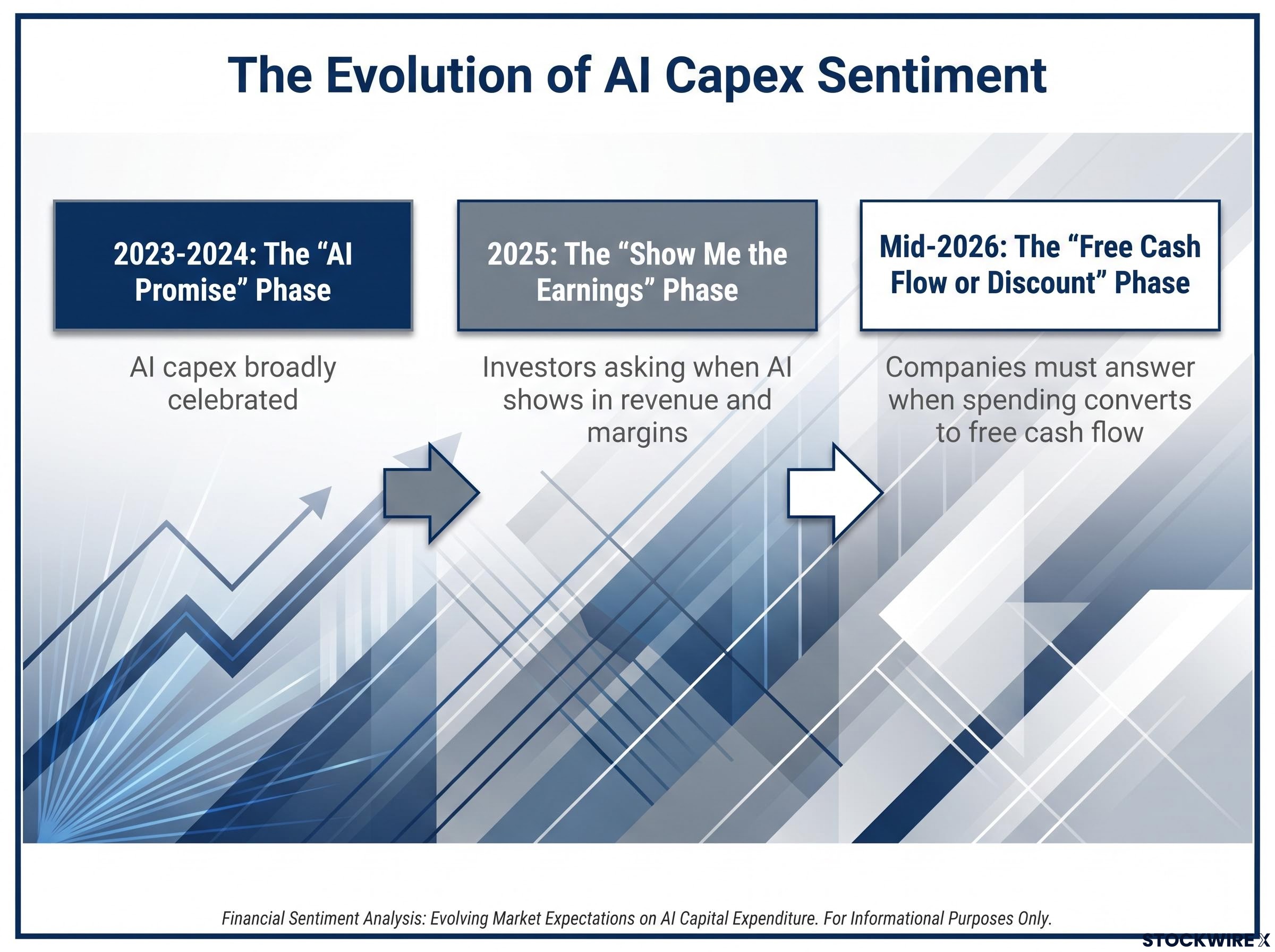
- 2023-2024: the “AI Promise” phase. AI capex was broadly celebrated. Valuations expanded on the assumption that infrastructure spending would inevitably produce huge future profits. The more a company spent, the more serious it looked.
- 2025: the “Show Me the Earnings” phase. Investors began asking when AI would show up in revenue and margins, but remained tolerant of elevated capex so long as top-line growth looked impressive. Growth bought time.
- Mid-2026: the “Free Cash Flow or Discount” phase. The current regime. The gap between AI ambition and demonstrable cash generation has widened to the point where the market no longer extends credit on faith. Companies must answer: when does this spending convert to sustainably strong free cash flow?
The evolution explains why the same level of AI capex that earned a company a valuation premium in 2023 now earns it a sell-off. The bar has risen with each phase, and analysts expect the growth rate of AI and cloud capex itself to slow considerably, raising the risk that companies will hold heavy fixed investments just as incremental spending decelerates.
When talent risk compounds the capex concern
On 6 August, Alphabet slid 4.0% following news that chief scientist Jeff Dean, along with three other long-standing AI leaders at the company, had left to co-found a new venture called Discovery Loop, in which Alphabet holds a position as an early backer.
The departure was structured, not an abrupt exit. But its timing, on a day already dominated by AI capex anxiety, compounded investor concern. One person does not change Alphabet’s trajectory. What the departure signals to investors is that talent concentration risk in AI, which they had been discounting, is real and can materialise quickly. When the most senior AI figures at an incumbent leave to start something new, the question shifts from “can this company deliver on its AI promises?” to “who, specifically, is going to deliver them?”
The Nvidia exception and what it reveals about the AI stack
On 6 August, Nvidia advanced more than 4%, marking its fifth straight session of gains and reaching its highest level in two months. On the same day that every major AI spender fell, Nvidia rose.
The logic is the structural inverse of the sell-off thesis. Nvidia sits on the supply side of the AI infrastructure stack. Every dollar of AI capex that companies like SpaceX, Alphabet, and AMD commit to spending flows toward suppliers of GPUs, networking equipment, and data centre hardware. For Nvidia, those billions are not an uncertain, long-dated bet on future applications. They are near-term, high-margin revenue with substantial pricing power.
Elon Musk stated that SpaceX would deploy infrastructure built exclusively on Nvidia hardware, and that the company expected to receive a meaningful portion of Nvidia’s 2027 GPU production.
That confirmation turned SpaceX’s $15.8bn in AI-allocated capex into a direct demand signal for Nvidia’s products. The same figure that sent SpaceX shares down 13.6% functioned as a revenue catalyst for Nvidia.
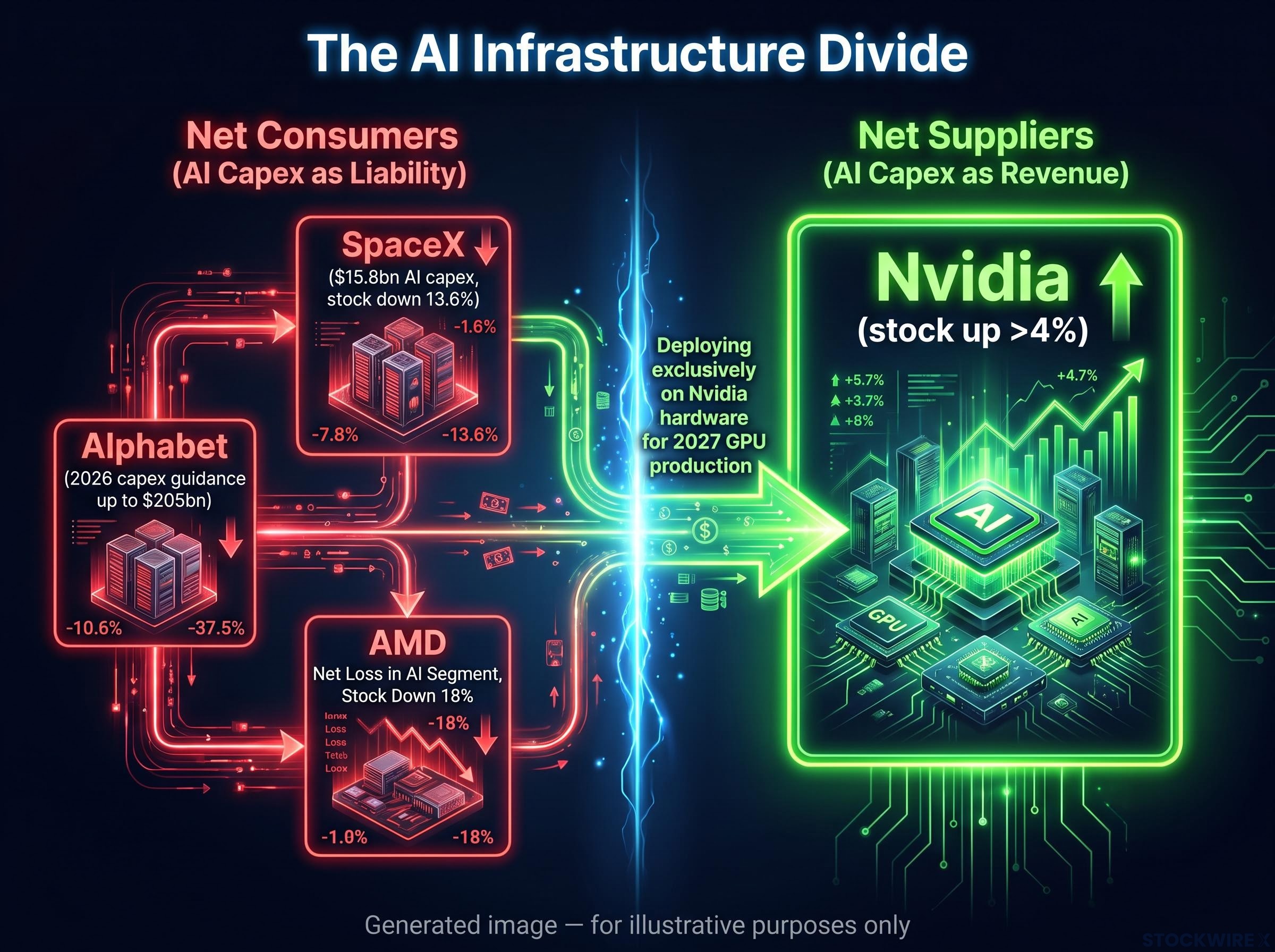
The divide is clean:
The same $700 billion AI capex wave funding Nvidia’s order book is simultaneously bankrolling custom silicon competition from Alphabet, Amazon, and Microsoft, a structural paradox that complicates any simple read of Nvidia’s current dominance as a durable, long-term moat.
- AI capex as liability (net consumers of infrastructure): SpaceX, Alphabet, AMD, which bear the cost and risk of building AI capability with uncertain free cash flow timelines.
- AI capex as revenue (net suppliers of infrastructure): Nvidia, which collects those spending dollars as high-margin revenue without needing to prove the downstream economics of AI applications.
For you as an investor deciding how to position within the AI theme, the consumer-supplier divide is the single most useful analytical frame. It determines whether AI capex appears as a liability on a company’s balance sheet or as a line item in its revenue pipeline.
The companies that escaped the AI capex penalty, and why
Not every company fell on 6 August. The session’s damage was concentrated, not broad-based.
Disney reported Q3 FY26 revenue of $25.25bn (up 7%), adjusted EPS of $2.06 (an 11% beat), and expanded its share repurchase programme to a minimum of $9bn. The market reaction was relatively stable. News Corp posted Q4 FY26 revenue of $2.34bn (up 11%), adjusted EPS of $0.35 (a 45.8% beat), and closed the full year with free cash flow of $811m, representing a 42% increase on the prior year. The reaction was positive.
| Company | Revenue Growth | EPS vs. Estimates | Share Price Reaction |
|---|---|---|---|
| Disney | +7% | +11% beat | Relatively stable |
| News Corp | +11% | +45.8% beat | Positive |
| Uber | +12% | Marginal miss | -5.3% |
The common thread between Disney and News Corp is not superior growth. It is cash flow visibility. Investors can build a reliable forward model for both businesses because neither is entangled in the AI infrastructure arms race. Their earnings convert to free cash flow on a timeline the market can see and price.
The sector performance data reinforces the pattern:
- Communication services: -2.39%
- Information technology: +0.02%
- Healthcare: +1.34%
- Materials: +1.54%
The session’s punishment was concentrated in communication services and AI-adjacent names. The market is effectively sorting companies into two buckets: businesses with modellable free cash flow, and businesses in the AI infrastructure arms race. Knowing which bucket a holding falls into matters more right now than any single quarter’s results.
AI infrastructure suppliers in niche power and optical networking segments, including companies like Bloom Energy and Lumentum, posted 90–130% revenue growth in the first half of 2026 by occupying the same supply-side position as Nvidia but in different stack layers, illustrating that the consumer-supplier divide extends well beyond the GPU market.
What changes from here, and what investors need to watch
The AI capex penalty is not going to resolve itself in a single quarter. Three variables will determine whether it persists, deepens, or begins to ease:
- The pace of FCF conversion at major AI spenders. If companies like Alphabet or SpaceX can demonstrate that AI revenue is beginning to cover its infrastructure cost, investor tolerance will return. Alphabet’s negative $5.9bn quarterly FCF is the current benchmark. The direction of that number over the next two quarters matters more than any revenue beat.
- Whether AI and cloud capex growth decelerates as analysts project. If the growth rate of new spending slows while existing fixed investments remain on balance sheets, companies face the worst outcome: peak cost and decelerating revenue growth simultaneously. AMD’s Q3 guidance of $13bn signals continued high investment, even in a quarter where the market penalised it for precisely that commitment.
- Whether challengers earn adequate returns. The competitive dynamics between companies like AMD and entrenched suppliers like Nvidia will determine whether challenger capex eventually pays off or becomes a sustained drag on shareholder value.
A new checklist for AI-era earnings
The old framework, where a revenue beat justified holding or adding, no longer applies. When reviewing any technology company’s earnings in this environment, four questions now come before the headline numbers:
- Is capex tied to contracted demand, or is it a speculative build?
- What is the projected free cash flow conversion timeline, and is management providing a credible one?
- Is the company a net supplier or a net consumer of AI infrastructure?
- Has the company disclosed talent departures or execution risks that could delay its AI roadmap?
The most important number in any AI-era earnings report is no longer revenue growth. It is the gap between capital expenditure and free cash flow, and how credibly management can explain when that gap closes. Investors who adjust their evaluation framework now, before the next cycle of AI capex disclosures, are better positioned to distinguish between AI exposure that compounds wealth and AI exposure that consumes it.
This article is for informational purposes only and should not be considered financial advice. Investors should conduct their own research and consult with financial professionals before making investment decisions. Financial projections and forward-looking statements referenced in this piece are subject to market conditions and various risk factors.