A stock climbs from $100 to $103, exactly as you predicted, and the call option you bought on it still loses money. That outcome surprises many people the first time it happens. In high volatility, trading options depends on more than picking the right direction.
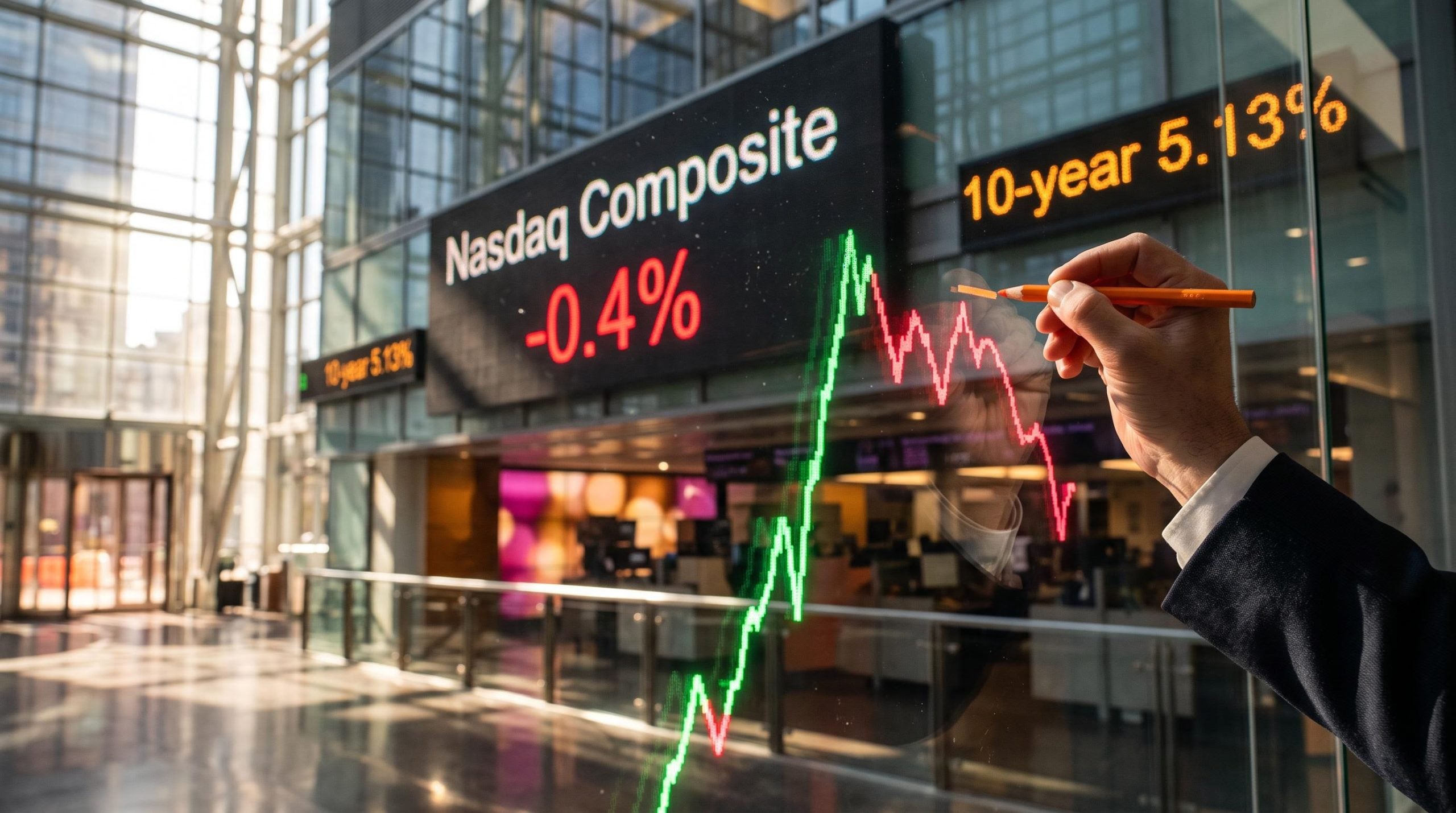
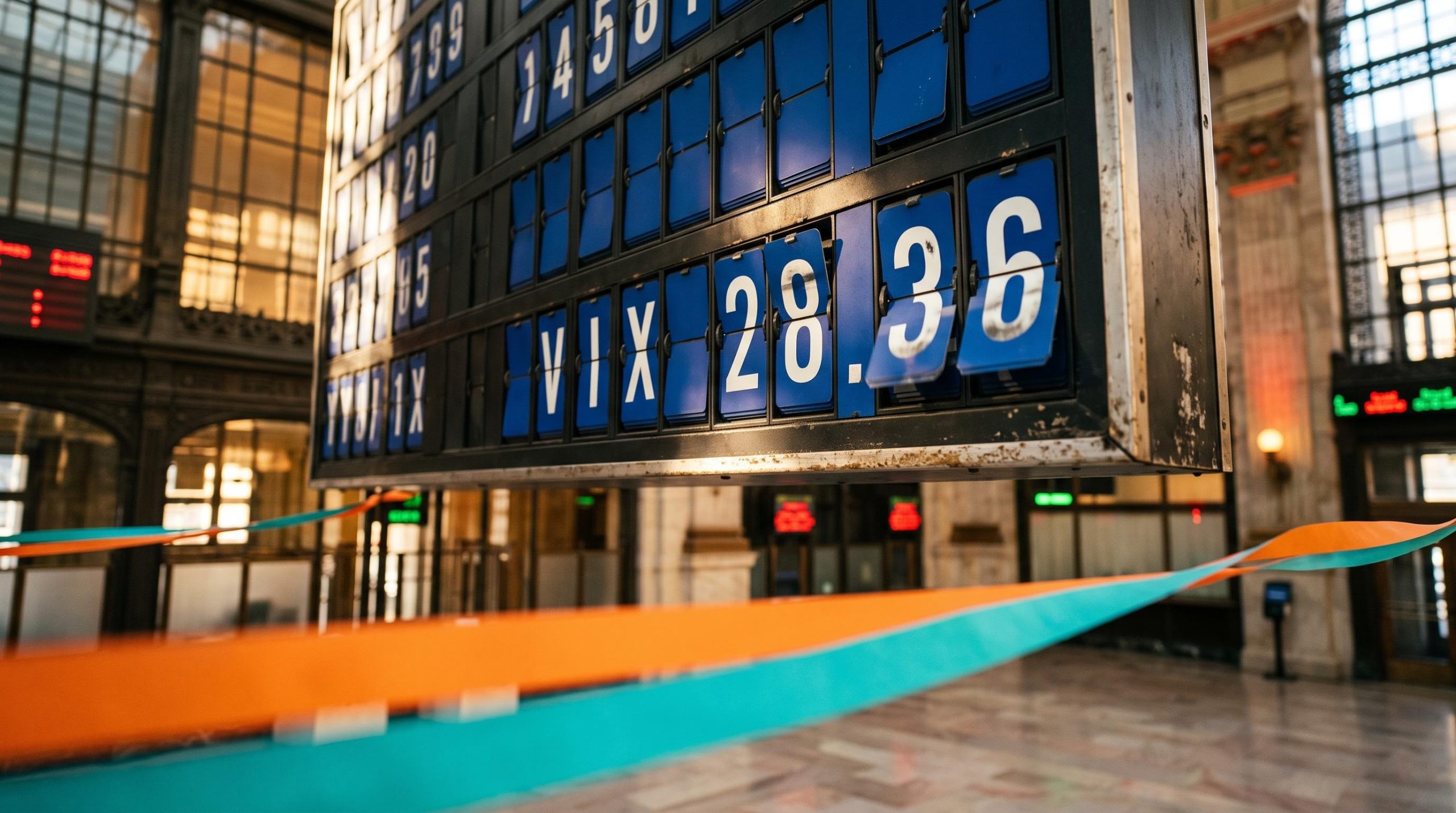
The timing makes this lesson urgent. The Cboe Volatility Index (VIX), a widely watched gauge of expected US stock market swings, jumped to 28.36 on 5 November 2026, its highest level in about eight months. Several market events lie ahead: Nvidia earnings, a shortened Thanksgiving session, the December Federal Reserve meeting, and fresh inflation data.
This guide covers three practical skills. You will learn how to cut the cost of expensive volatility with defined-risk structures, how to read stress directly from the quote screen, and how to judge whether new money or borrowed money belongs in the market right now.
Why can a long option lose money when you call the direction right?
Your intuition says a correct call should pay. It is a reasonable instinct, and it is incomplete.
An option premium is the price you pay for the contract. It reflects the underlying share price, implied volatility (the market’s estimate of how much the stock will move), the time left until expiry, interest rates and dividends, and the cost of executing the trade. Direction is only one of those inputs.
Because every Greek on your platform is derived from the volatility input at that strike, reading implied volatility on the chain before you click buy tells you how much uncertainty you are already paying for.
Implied-volatility crush
Implied volatility often rises before a known event such as earnings and then falls sharply once the news is out. The Options Industry Council (OIC) calls this a “volatility crush,” and it can wipe out the gain from a correct stock move. The table below shows an illustrative example. It is not a historical trade.
| Input | Before event | After event |
|---|---|---|
| Stock price | $100 | $103 |
| Call strike | $100 | $100 |
| Implied volatility | 60% | 35% |
| Option premium | $6.00 | $4.50 |
| Result | Correct bullish view | $1.50 loss per share, before costs |
The $3 rise added real value to your call. The collapse in implied volatility removed more.
Vega and theta in plain terms
Vega is the approximate change in an option’s price for each one-point change in implied volatility. If your call has a vega of $0.08 and implied volatility drops 10 points, you lose about $0.80 per share, or $80 on a standard 100-share contract.
Theta is the value an option loses as each day passes. Cboe and OIC educational material both note that theta speeds up as expiry approaches. That means you can be right on direction but wrong on speed, size or timing.
Todd Horowitz puts the mistake in everyday terms.
The overpaying-for-milk problem Horowitz compares chasing expensive puts to overpaying for milk: the purchase can still be a loss even when you needed exactly what you bought.
For context, the VIX has ranged from 13.38 to 35.30 over the past 52 weeks, and CNBC’s latest quote showed 19.92 on 9 November 2026. Readings move quickly, so check implied volatility before you buy any outright call or put. In these conditions, your entry price can matter as much as your direction.
When big ASX news breaks, our subscribers know first
How do defined-risk spreads and synthetic positions change the trade?
If expensive premium is the problem, one answer is to sell some premium back. Spreads let you do that, and they set your worst case before you place the trade.
Vertical spreads first
A bull call spread means buying one call and selling a higher-strike call with the same expiry. The call you sell offsets part of the cost of the call you buy, and your maximum loss is normally the net debit (the amount you paid upfront). A bear put spread applies the same logic to a bearish view by buying one put and selling a lower-strike put.
Cboe’s November 2026 volatility commentary states that vertical spreads reduce dollar risk, directional risk, theta and vega. The cost is a capped upside, because your profit stops at the short strike.
A long vertical spread illustrates the trade-off well: on a 100 stock with 60 days to expiry, a 100/110 call spread costs roughly half as much as a single call, with breakeven moving closer, in return for capped profit.
The three-leg synthetic
Horowitz separates two groups. Investors who hedge tend to use at-the-money options, while traders build synthetic positions with spreading techniques such as deep in-the-money spreads. His risk-defined synthetic long has three legs:
- Buy an at-the-money call for upside exposure.
- Sell an at-the-money put to help fund the call.
- Buy a lower-strike put to cap your downside below that strike.
A synthetic short reverses those legs. The protective put costs money, but it turns an open-ended position into one with a known floor.
| Structure | Benefit in high volatility | Main trade-off |
|---|---|---|
| Bull call spread | Short call offsets an expensive long call; loss capped at net debit | Upside capped at the short strike |
| Bear put spread | Cheaper bearish exposure; loss limited to the debit | Downside profit capped; short put can be assigned early |
| Risk-defined synthetic long | Lower-strike put caps downside on stock-like exposure | Protective put cost; three legs add friction |
| Collar | Protective put on owned shares, partly financed by a sold call | Upside capped above the call strike |
| Iron condor | Defined maximum loss; can benefit from time decay in a range | Complex payoff; slightly negative vega, so rising volatility hurts |
A collar suits you if you already own the shares. According to OIC, many iron condor and butterfly structures carry slightly negative vega, which means a further rise in volatility works against you.
What defined risk does not cover
Merrill’s options education notes that American-style options can be assigned at any time through expiry. Assignment means you must fulfil the contract you sold. Short legs can also bring broker-dependent margin requirements, and three legs mean three chances for a poor fill.
Spreads let you choose in advance how much you can lose and how much volatility you pay for. In exchange, you accept a capped payoff and more moving parts.
What do widening SPY bid-ask spreads tell you about market stress?
Structures address what you pay for volatility. The quote screen shows you a second cost, and it also works as a stress gauge.
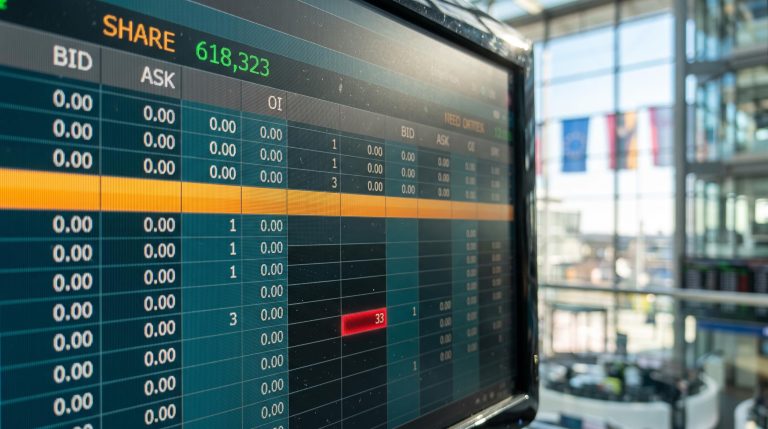
The bid-ask spread is the gap between the highest price a buyer will pay and the lowest price a seller will accept. You pay that gap when you buy and give it up when you sell. FINRA notes that wider spreads raise transaction costs and reduce returns.
The SPY spread claim Horowitz and the host reported that the at-the-money bid-ask spread on SPY, normally 1-3 cents, widened to about 15 cents over the prior two to three weeks.
No independently verifiable published report quantifies that exact SPY figure. Yahoo Finance’s Bloomberg-syndicated coverage, updated 12 November 2026, did report wider spreads in S&P 500 index options during the 5 November episode, when Reuters recorded the VIX jumping 11.75 points to 28.36. Saxo reported on 9 November that the volatility curve was inverted, which means near-term volatility was priced above longer-term volatility. Its reading of about 25.64 differs from CNBC’s 19.92, most likely because the quotes were taken at different times.
Why do market makers, the firms that continuously quote prices, widen spreads under pressure? There are six main reasons:
- Price uncertainty: the stock can move before they hedge.
- Volatility uncertainty: implied volatility can jump.
- Hedging difficulty: related markets can dry up together.
- Inventory risk: unwanted positions demand compensation.
- Adverse selection: better-informed traders take advantage of stale quotes.
- Thinner depth: fewer resting orders make each trade more price-sensitive.
A wide quote is both a warning light and an immediate cost. Before every trade:
- Check the bid-ask width against its normal level.
- Use limit orders, never market orders, on options.
- Size down when quotes are wide.
Why do leverage and new capital need extra caution in thin holiday markets?
Wide quotes become more dangerous when fewer people are trading. The holiday calendar ensures that will happen.
What a shortened session changes
Markets close on Thanksgiving, Thursday 26 November. On Friday 27 November, equities close at 1:00 p.m. ET and eligible NYSE options close at 1:15 p.m. ET. Fewer participants mean thinner depth, wider spreads, greater sensitivity to market orders and less time to fix a position before the bell.
In a market that thin, a small order imbalance can move prices further than usual. Horowitz warns that unusual moves like this can force leveraged traders out.
The leverage feedback loop
FINRA’s rules reference guide explains that when securities backing a loan fall, a broker may issue a margin call (a demand for more funds) and sell your assets to restore the required equity. The cycle runs like this:
- Prices fall.
- Collateral value declines.
- Margin calls go out.
- Positions are liquidated.
- Forced selling pushes prices lower.
- Volatility and spreads rise further.
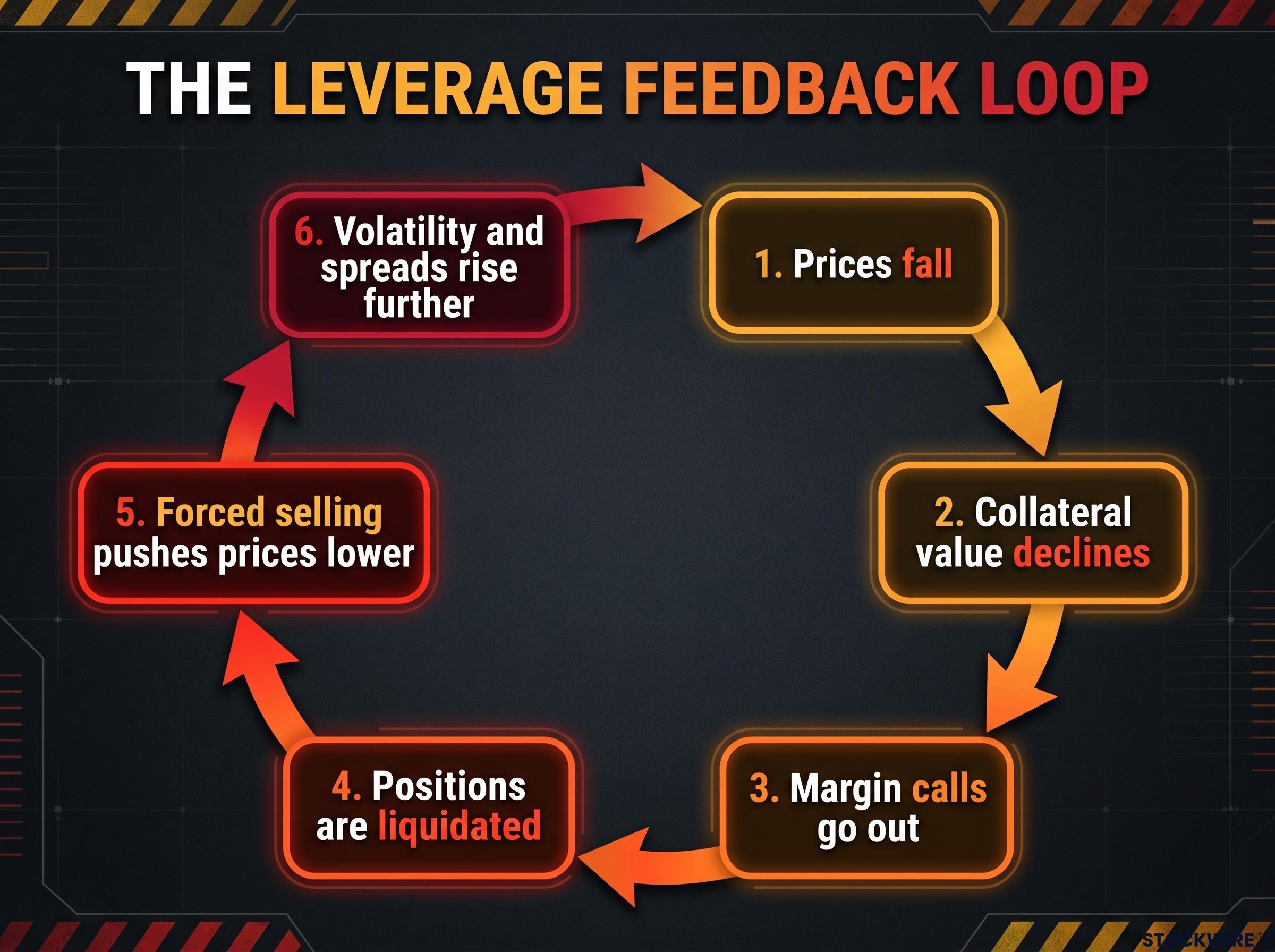
The diagram illustrates 6 steps in the leverage feedback loop, where falling prices trigger margin calls and forced selling.
Even a defined-risk debit spread can be too large for your account. Short spreads and synthetics also add assignment and margin obligations. No recent published source documents a specific Thanksgiving-week forced-liquidation episode, but the mechanism itself is well documented.
A short session is not automatically bearish. The risk is less about direction and more about being forced out at a bad price. Leverage you cannot carry through a sharp move is the real danger.
Options drawdowns tend to end trading accounts through forced exits rather than bad ideas, since rising volatility triggers broker margin calls at the same moment emotional pressure peaks and positions are hardest to close.
Your event calendar
Nvidia earnings are the nearest major event. The CPI and PPI inflation releases fall in December, not before Thanksgiving.
| Event | Date and time | Why it matters for options |
|---|---|---|
| Nvidia earnings | 17 November, 5:00 p.m. ET | Risk of implied-volatility crush after the release |
| Thanksgiving | 26 November, markets closed | Time decay continues while you cannot trade |
| Shortened session | 27 November, 1:00 p.m. ET equities, 1:15 p.m. ET options | Thin depth and wider quotes |
| FOMC meeting | 8-9 December, decision 9 December | Rate decision can shift volatility |
| CPI | 10 December, 8:30 a.m. ET | Inflation surprise risk |
| PPI | 15 December, 8:30 a.m. ET | Further inflation signal |
What basic cash-management rules should come before any options trade?
Every concept so far assumes the money at risk is money you can afford to lose. That assumption deserves a check before you choose any spread.
Horowitz’s rule Invest only money you do not need for bills or debt.
Work through these priorities in order:
- Keep a liquid emergency reserve sized to your income stability and essential expenses.
- Pay down high-interest revolving debt, especially credit cards.
- Set aside funds for near-term obligations.
- Invest only capital that can stay invested through a loss.
- Size each options position with a defined maximum loss.
- Avoid margin for any trade whose loss would eat into your reserves.
Horowitz cited credit-card interest of about 30%. Published averages are lower. The Federal Reserve’s G.19 report, released 6 November 2026, shows 21.19% APR across all accounts for September 2026 and 22.89% on accounts charged interest, while Bankrate puts the national average at 19.71% as of 4 November. The two sources differ because they use different methods and samples, and the 30% figure most likely reflects a higher-rate card.
Paying down debt at roughly 20% is a guaranteed return that few options trades can match on a risk-adjusted basis. The order of your priorities matters more than your choice of spread.
Caution has its own limits, though:
- Cash is not risk-free, because inflation erodes it and missing a rebound has a cost.
- Defined-risk trades are better than having no risk control at all.
- Staged entry can reduce timing risk, though it cannot remove losses.
- Horowitz still sees selected buying opportunities.
He applies that discipline to his own trades. Horowitz sold his gold position at a loss, says he would buy back in at a lower price, and remains positive on metals over the long term.
Putting volatility, structure and cash discipline together before the next event
Defined-risk structures do not remove risk. They make your maximum loss, your volatility exposure and the capital you commit visible before you trade, and they help you avoid overpaying for inflated premium.
Your next decision point is close. Check implied volatility and the bid-ask width before you enter, size positions so that a full loss leaves your reserves intact, and plan around the calendar that runs from 17 November to 15 December.
Approach each event with a known worst case and money you can afford to tie up.
This content is educational only and is not personalised financial advice. Options involve substantial risk and are not suitable for every investor.
This article is for informational purposes only and should not be considered financial advice. Investors should conduct their own research and consult with financial professionals before making investment decisions.