Citi moved to Overweight on European equities excluding the UK on 9 November 2026. If you went looking for a way to trade that call, you probably found a strange gap. The iShares MSCI Eurozone ETF (EZU) trades more than 600,000 shares a day, yet many of its option contracts show volume and open interest in the single digits.
That gap is the real story for a US investor. You might reach for options on VGK, EZU or FEZ to act on the upgrade, and then find chains with wide spreads, empty strikes and sometimes no buyers at all.
Citi’s reasoning is simple. Europe carries less technology exposure and should benefit more from lower oil prices, and the bank frames the move as a tactical rotation, not a rejection of AI. The tastylive hosts who first discussed the trade were also openly sceptical of bank calls in general.
This guide covers which instruments give you European exposure without the liquidity trap, how to test whether a European ETF options chain is tradable, and how a defined-risk call spread compares with a naked short put.
Why are European ETF options so hard to trade?
Heavy trading in a fund’s shares feels like proof that everything around it is liquid. It is not.
Shares versus options on EZU EZU traded 618,323 shares on 9 November 2026. Yet the Yahoo Finance chain on 2 November 2026 showed only 256 call and 33 put contracts of total open interest, with single-digit volume and open interest on many contracts.
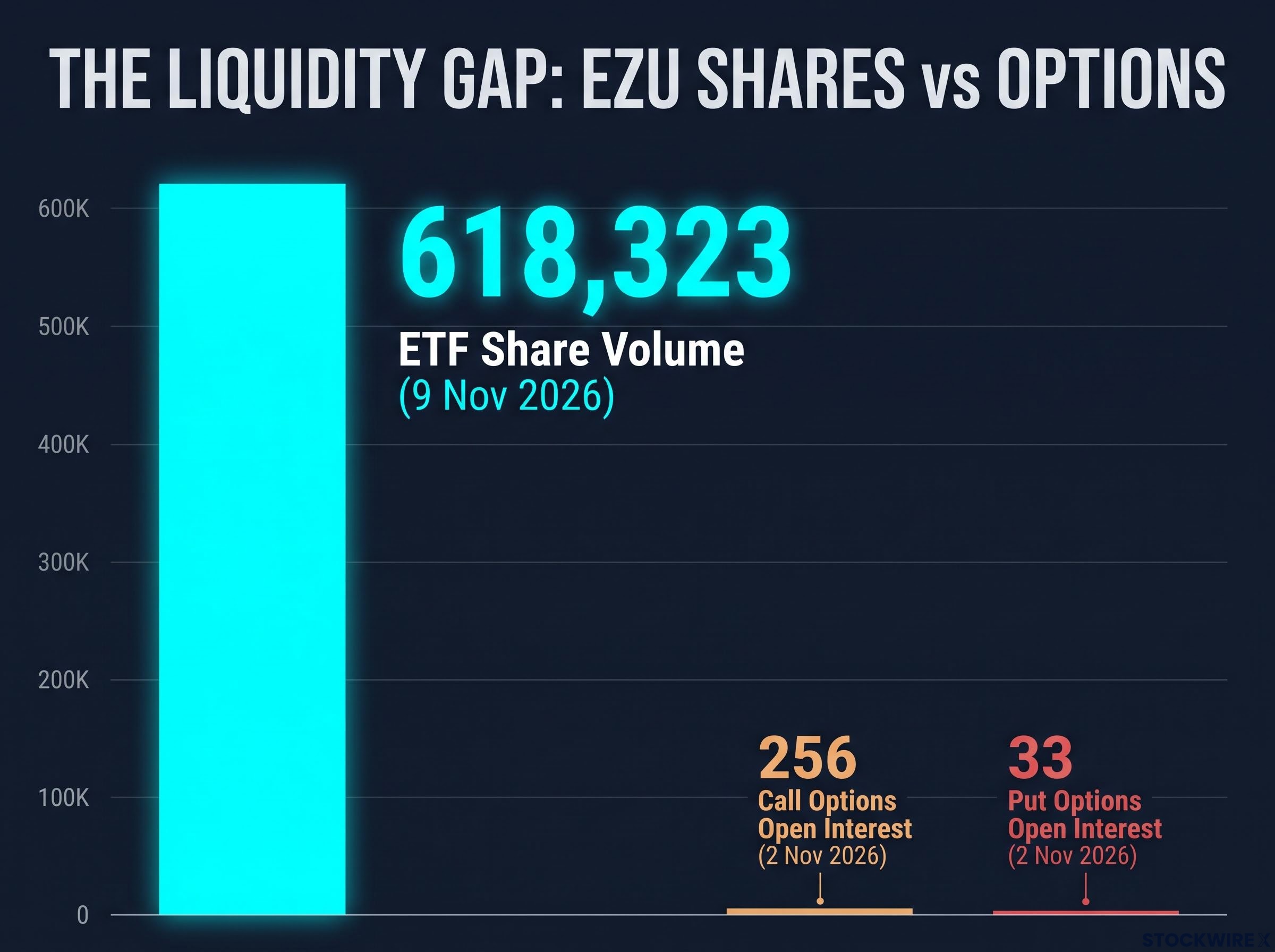
EZU traded 618,323 shares on 9 Nov 2026, but its options chain showed just 256 calls and 33 puts of open interest.
Open interest means the number of option contracts that are still open and have not been closed or exercised. Low open interest tells you few traders hold that contract, so few people are around to take the other side when you want out.
The gap is not unique to EZU. The tastylive hosts checked VGK, EUR, FEZ, EZU and EWU and found little volume, little open interest and often zero bids, which risks leaving you stuck in a trade you cannot close.
| ETF | Issuer | Assets | Share volume | Option activity |
|---|---|---|---|---|
| VGK | Vanguard | About $37.1B (31 Oct 2026) | About 2.58M average | Not found |
| EZU | BlackRock/iShares | $9.44B (9 Nov 2026) | 618,323 daily | 256 call, 33 put contracts of open interest shown (2 Nov 2026) |
| FEZ | State Street | Not found | Not found | Not found |
No verified options-activity data turned up for VGK or FEZ, so treat the live chain as your only reliable source. Why does the gap exist? It comes down to the market makers who quote these contracts:
- Thin strike-by-strike demand: share buyers spread across one ticker, while option interest splits across dozens of strikes and expiries, leaving many with almost no takers.
- Hard hedging: market makers must offset their risk, and a European basket trades across countries, currencies and time zones that barely overlap US hours.
- Defensive quoting: when hedging is costly, they widen the bid-ask spread (the gap between buying and selling prices) or post no bid at all.
- Vanishing liquidity: quotes can thin out exactly when volatility rises and you most want to exit.
Thin chains get worse under stress, because option liquidity during a selloff can disappear just as you need to exit, with dealers lifting offers far more than bids and leaving the midpoint price misleading.
Multi-leg trades suffer most. On a vertical spread, the slippage on each leg lands directly in the debit you pay or the credit you collect, so a poor chain taxes you twice.
A quick liquidity checklist before you trade
A busy share chart tells you nothing about whether you can exit an option at a fair price. Run these checks on the chain itself:
- Check open interest at the exact strikes you plan to use.
- Look for two-sided markets, with real bids as well as offers.
- Compare the bid-ask spread against the option’s price.
- Use limit orders, never market orders.
- Stay near-the-money in active expirations.
When big ASX news breaks, our subscribers know first
What can you trade instead of European ETF options?
The good news is that thin chains do not block you from acting on a Europe view. They just change the order in which you reach for tools. Here is a workable hierarchy drawn from the research:
- ETF shares first. VGK or EZU give broad exposure with no strike, spread or assignment problems.
- Liquid ADR or single-name options second. Shell (SHEL) is the example, ideally with defined-risk structures.
- Index futures third, such as Euro Stoxx 50 futures or options, where your broker offers them and they suit you.
- Thin country-ETF options last, and only when the specific chain shows genuine two-sided liquidity.
Buying VGK or EZU shares outright
The Vanguard FTSE Europe ETF (VGK) spreads your money across a wide set of companies. Its top holdings are:
- ASML: 4.47%
- HSBC: 2.19%
- Roche: 1.89%
- Shell: 1.79%
- Novartis: 1.72%
The top ten together make up about 19.20% of the fund. Schwab data as of 27 February 2026 shows financials at 25.8%, industrials at 19.3%, health care at 12.1% and information technology at only 9.1%, which matches the low-tech tilt Citi likes.
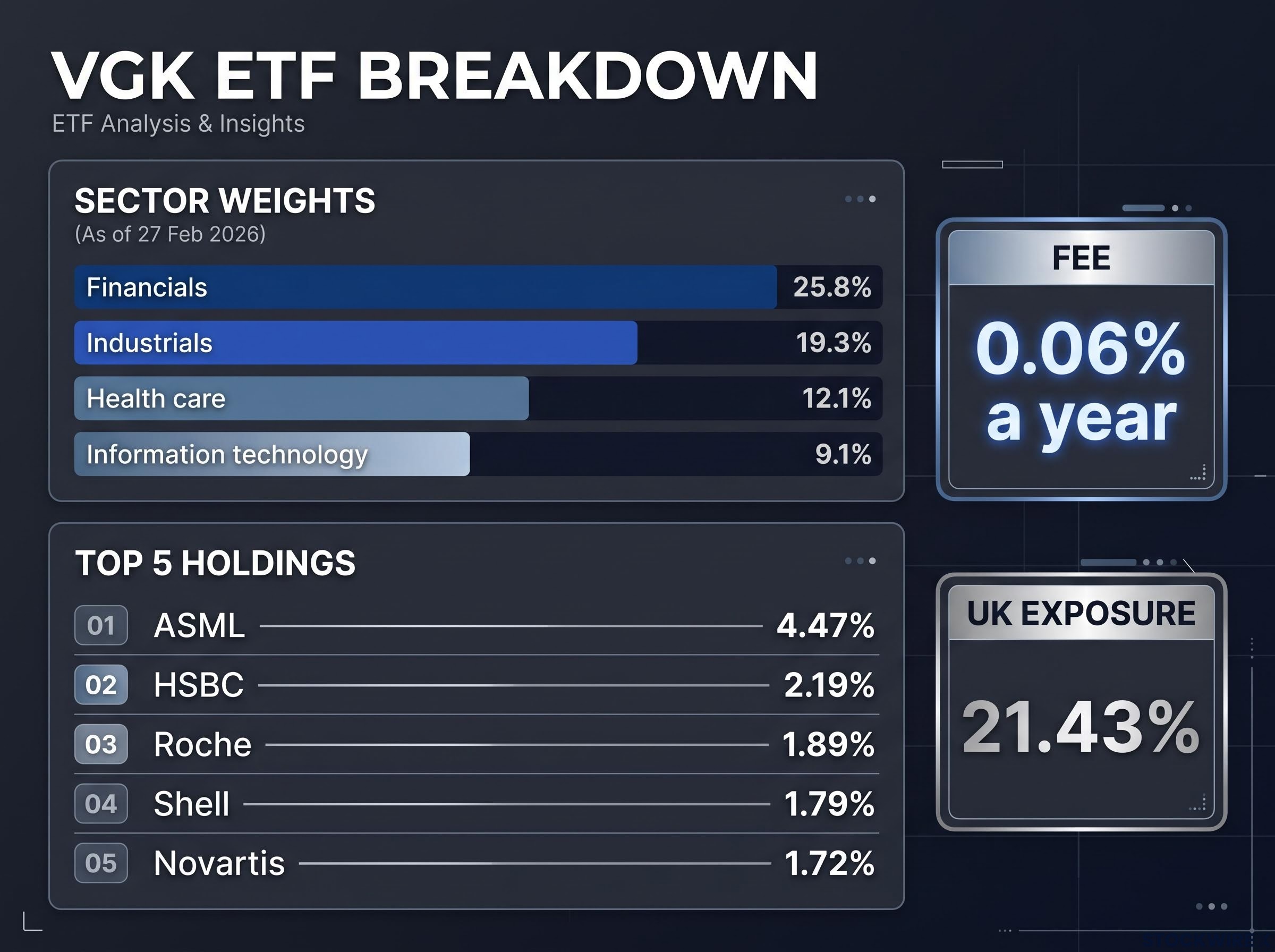
VGK features a low 0.06% fee and a defensive tilt led by Financials at 25.8%, alongside 21.43% UK exposure.
Cost differs sharply. VGK charges 0.06% a year against 0.50% for EZU.
One catch matters here. The UK makes up about 21.43% of VGK, even though Citi’s upgrade specifically excluded the UK, so VGK gives you a broader bet than the call itself. The tastylive hosts suggested small share lots, such as 20, 50 or 100 shares, rather than options.
The case for European diversification rests on more than a tactical call: the MSCI Europe Index trades at roughly a 31% discount to the S&P 500 on forward earnings, and your US holdings may already be concentrated in a handful of mega-cap technology names.
Using Shell as a liquid single-name proxy
If you want options, Shell offers a workable US-listed ADR chain. An ADR, or American Depositary Receipt, is a certificate traded in the US that represents shares of a foreign company.
As of 20 October 2026, SHEL showed about 201,161 contracts of open interest and two-week average daily options volume of 6,468. Even so, liquidity varies by strike: one call showed volume of 48 and open interest of 267, while another showed volume of 1, open interest of 17 and a zero bid.
Remember that Shell is one company, not Europe. You do not need options to act on a Europe view, and buying shares removes the strike, spread and assignment questions entirely.
How does a long call spread compare with a naked short put on Shell?
The tastylive hosts worked through a bullish Shell trade at about 38 days to expiration, when the stock had roughly 15,000 contracts of open interest on puts and a similar amount on calls. These figures come from that discussion and will differ at current prices.
The first option they weighed was selling a 92.5 put naked, meaning with no protective put underneath. That trade needed about $1,500 of capital.
The alternative was a long 95/97.5 call spread: buy the 95 call, sell the 97.5 call, same expiry. It showed a 66% probability of making half its maximum profit, a maximum profit of $117, maximum risk of about $128-133, and theta of about 28 cents a day. Theta is the amount an option position gains or loses each day from the passage of time.
The capital gap Naked short 92.5 put: about $1,500. Long 95/97.5 call spread: roughly $130 at risk.
| Feature | Long call spread | Naked short put |
|---|---|---|
| Structure | Buy lower-strike call, sell higher-strike call, same expiry | Sell a put with no lower-strike protection |
| Capital | Usually the net debit (about $128-133 here) | Substantial cash or margin (about $1,500 here) |
| Max loss | Defined, normally the debit | Strike minus premium, times 100, if the stock falls to zero |
| Max profit | Strike width minus debit ($117 here) | Premium received |
| Assignment | Short call can be assigned early | Short put can be assigned, leaving you long stock at the strike |
| Best use | Bullish view with a fixed maximum loss and capped upside | You genuinely want to own the stock at the strike and can fund it |
The numbers make the case on their own. Both trades express a bullish view, yet one ties up more than ten times the capital and carries a loss that can run far past the premium in a sharp fall.
If you want a bullish European position with a fixed maximum loss, the call spread fits. A naked short put only makes sense if you would truly take delivery of 100 shares per contract and can absorb a deep drawdown.
Assignment and account-type considerations
Assignment risk comes from the short leg. Assignment means the option buyer exercises the contract, obliging you to deliver or buy the shares.
The short call in a spread can be assigned early, especially when it is in the money with little time value left or around a dividend date. You are most exposed when only the short leg finishes in the money, which can leave you with an unwanted stock position.
Defined-risk spreads are generally available in smaller accounts and IRAs, where naked short options usually are not. Brokers may still require more than the debit, so check your own account rules.
What risks sit behind the Europe trade itself?
Choosing the right instrument solves the execution problem. It does nothing about whether the Europe thesis works.
Citi’s case rests on lower tech concentration, heavier weights in industrials, banks and defensive stocks, and the boost from cheaper oil. The bank kept its S&P 500 year-end target at 8,100 and held a positive 2027 outlook, but no European index target was reported. Several forces could cut the other way:
Futures markets are pricing elevated crude well into 2027, so oil prices macro risk remains a two-way threat and the lower-oil premise behind the Europe call is not guaranteed to hold.
- Currency: unhedged EUR, GBP and CHF exposure means a stronger dollar can shrink your US-dollar returns even if European shares rise.
- Valuation: a discount alone does not lift prices, and Europe can stay cheap for long stretches.
- Energy: lower oil helps importers but can weigh on Shell, the very proxy you might use.
- Political and fiscal shocks: elections, coalition breakdowns and trade disputes can flip sector leadership quickly.
- Earnings: weakness in one or two large sectors, such as banks or semiconductors, can drag on a broad Europe bet.
- ADR costs: depositary fees, foreign withholding taxes and varying tax treatment can trim your net return.
A view that has flipped before On 17 June 2024, the same Citi team cut Europe to Neutral on political risk. The current upgrade reverses that call, a reminder of how fast the stance can change.
No contemporaneous call from Goldman Sachs, Morgan Stanley or BlackRock surfaced in the research. That silence is not agreement. The tastylive hosts also questioned whether banks may be talking their own positions.
Treat a bank upgrade as one input to your decision, not a trade signal. Size any position for the currency and political swings that could move it against you.
Matching the instrument to your Europe view
The sequence is straightforward once you see the chains for what they are. Confirm liquidity on the actual strikes first. Default to VGK or EZU shares for broad exposure, and if you want options, use a liquid single name such as Shell with a defined-risk call spread rather than selling naked premium.
Before you act, verify current liquidity, margin requirements, tax treatment and account eligibility with your broker. The figures here reflect information available as of about 11 November 2026, and option chains can change within days.
Your next step is practical: pull up the live chains, check for two-sided markets, and watch for any further moves from Citi before you place a trade.
This article is for informational purposes only and should not be considered financial advice. Investors should conduct their own research and consult with financial professionals before making investment decisions.