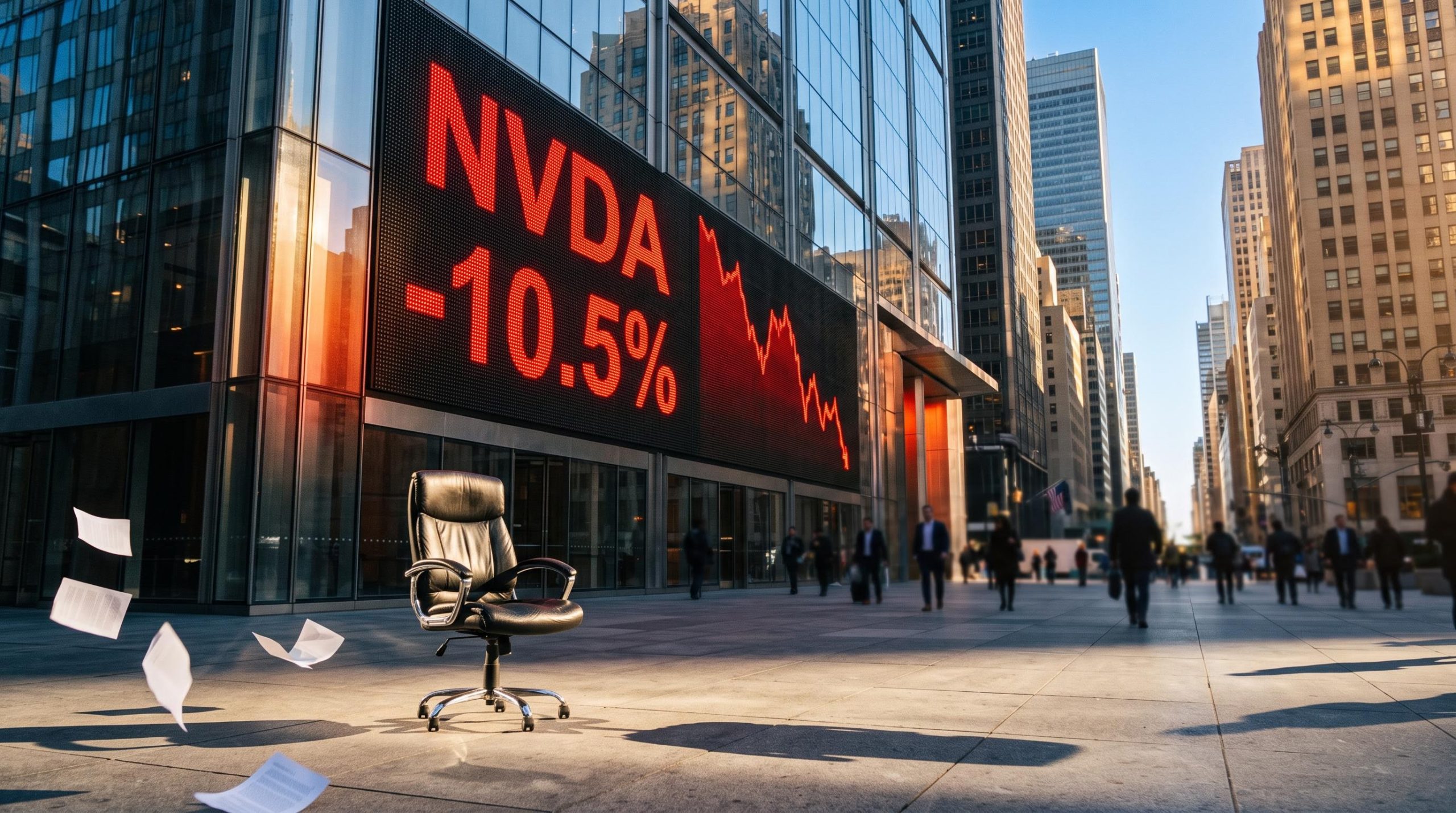
Nvidia shares fell sharply before the opening bell on Thursday after co-founder Jensen Huang resigned as chief executive and director, effective immediately. According to CNBC, Nvidia stock was down 10.5% in premarket trading as of 9:05 a.m. ET on 12 November 2026.
The exit follows a board investigation into Huang’s relationship with an executive at Megaspeed, a Singapore-based company that bought billions of dollars of Nvidia graphics processing units (GPUs). GPUs are the specialised chips that train and run artificial intelligence models.
The company at the centre of the AI trade is now facing a governance and succession shock at the same time.
Some of today’s reporting is confirmed and some is only alleged. Here is which parts are which, and the signals that are likely to matter more for the shares than this morning’s price.
What the premarket drop says about Nvidia stock and its market value
The move looks severe. The figures behind it are less settled than they first appear.
Reuters reported a 7.8% premarket decline earlier in the session. CNBC’s 10.5% reading at 9:05 a.m. came later, so it is the more recent intraday figure. Before that, the Economic Times and Reuters reported a fall of as much as about 10% in post-market trading, after reports that the board might remove Huang.
| Metric | Figure | Source | Timing |
|---|---|---|---|
| Premarket decline | 7.8% | Reuters | Earlier on 12 November |
| Premarket decline | 10.5% | CNBC | 9:05 a.m. ET, 12 November |
| Post-market decline | About 10% | Economic Times, Reuters | After the board-removal reports |
| Weekly value loss | More than $500B to nearly $600B | Reuters commentary; report citing Reuters | Week to 12 November |
The bigger marker Reuters said the decline put Nvidia’s market value on course to fall below $4 trillion for the first time since July 2025.
FXStreet put the share price near $155 and called it a 16-month low. Other sources reviewed did not confirm either figure. All the market value figures are intraday estimates, not a settled end-of-day valuation.
The selloff lands on a business whose 1,600% data centre revenue surge since 2023 has pushed Nvidia to roughly 80-85% of the discrete AI accelerator market, which is why a leadership shock moves the whole AI trade.
If you hold the shares, this is a headline-driven repricing of governance risk. The exact level matters less than whether it holds once the session closes.
When big ASX news breaks, our subscribers know first
Who runs Nvidia now: Kress, Jones and an open CEO search
The handover itself is confirmed. Nvidia announced three changes:
- Huang resigned as president, chief executive officer and member of the board.
- Colette Kress, chief financial officer (CFO) for roughly 13 years, became interim CEO and keeps the CFO role.
- Harvey C. Jones, a former Synopsys CEO and executive chairman who already sat on Nvidia’s board, became its first-ever chair.
Nvidia said the transition is not intended to interrupt its operations or product roadmap. The board is searching for a permanent CEO and will consider both internal and external candidates. The announcement did not name a search committee chair or its members.
Nvidia’s official announcement frames the handover as an orderly transition, with the board committing to weigh both internal and external candidates while the company keeps its product roadmap on schedule.
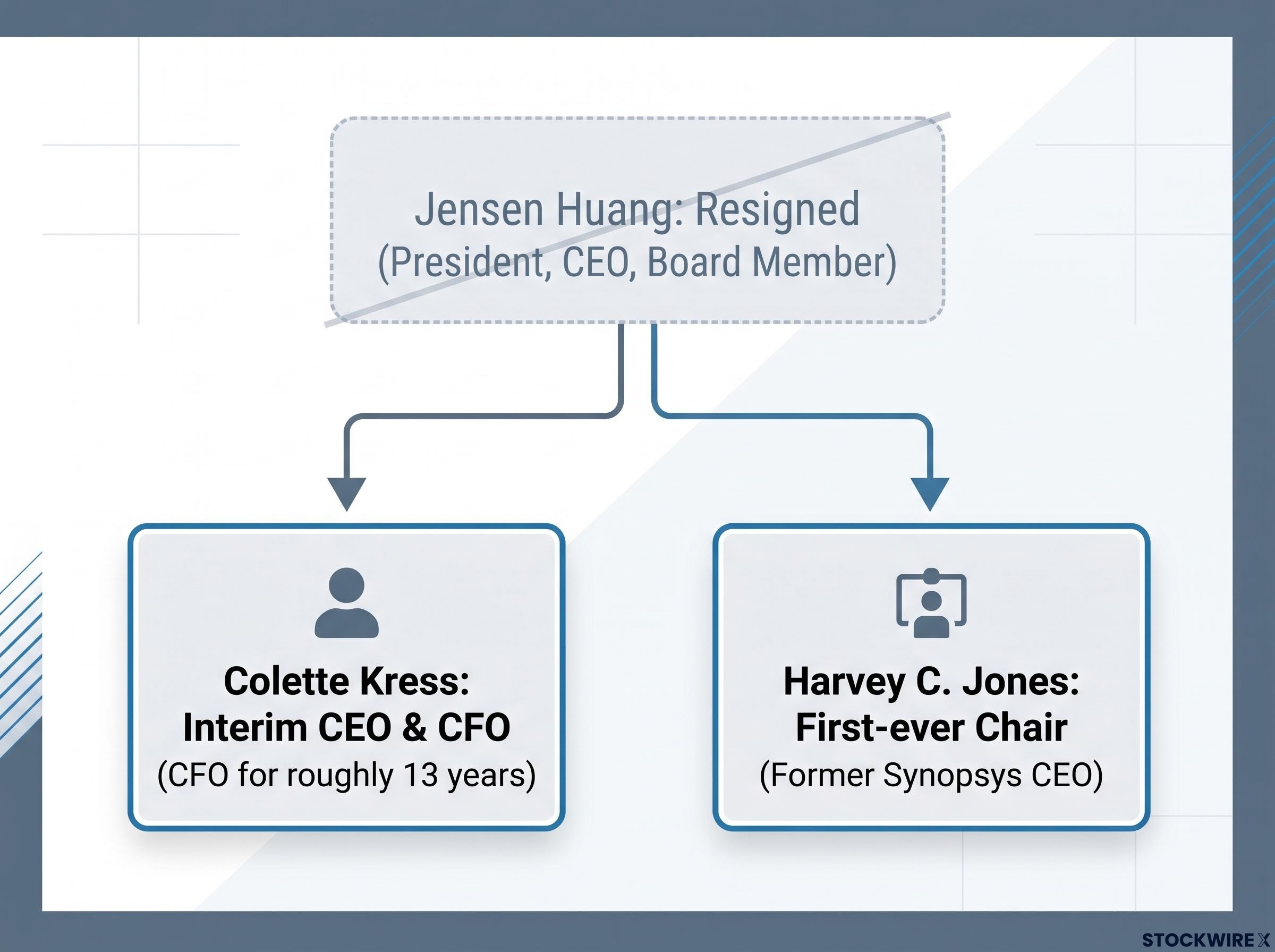
Following Jensen Huang’s resignation, Colette Kress takes over as interim CEO alongside her role as CFO for roughly 13 years.
“Obvious choice to steady the ship,” said Josh Gilbert of eToro, describing Kress.
Shawn Cole of executive search firm Cowen Partners said putting Kress in charge would stabilise the company during an investigation. Jason Schloetzer, a professor at Georgetown, was cited as seeing her as a plausible interim leader given Nvidia’s “key-man risk”. That is the danger of a company depending too heavily on one person.
According to Reuters, the harder question is who will lead Nvidia’s technology roadmap over the long term. A finance chief can steady a company, but Huang was also its chief product strategist.
The board has created a chair role for the first time and opened a search. That tells you it is separating oversight from the founder’s former combined influence. Watch who is named permanent CEO more closely than the interim title.
What the board is investigating and what the Megaspeed allegations claim
Each step of this story comes from a different source. Here is the sequence as reported:
- The New York Times reported on Huang’s relationship with Huang Le (also known as Alice Huang), a Megaspeed executive. The board then opened an investigation.
- The NYT reported that US officials believe she was working with Chinese intelligence. No public finding has been cited to support that claim.
- Megaspeed bought billions of dollars of Nvidia GPUs that the US prohibits selling to China. Some US officials allege Megaspeed resold the chips to Chinese companies.
- On Wednesday, it emerged that Huang had a separate relationship with an executive who reported directly to him. That relationship reportedly violated company bylaws.
A Reuters review of trade data found that Megaspeed’s Indonesian subsidiary imported H100 processors and related components between 2024 and 2026. A separate report, citing NYT trade data, said Megaspeed’s sister companies in Malaysia bought about $4.8 billion of Nvidia equipment, including roughly 136,000 GPUs, between June 2024 and February 2026. That figure has not been independently confirmed.
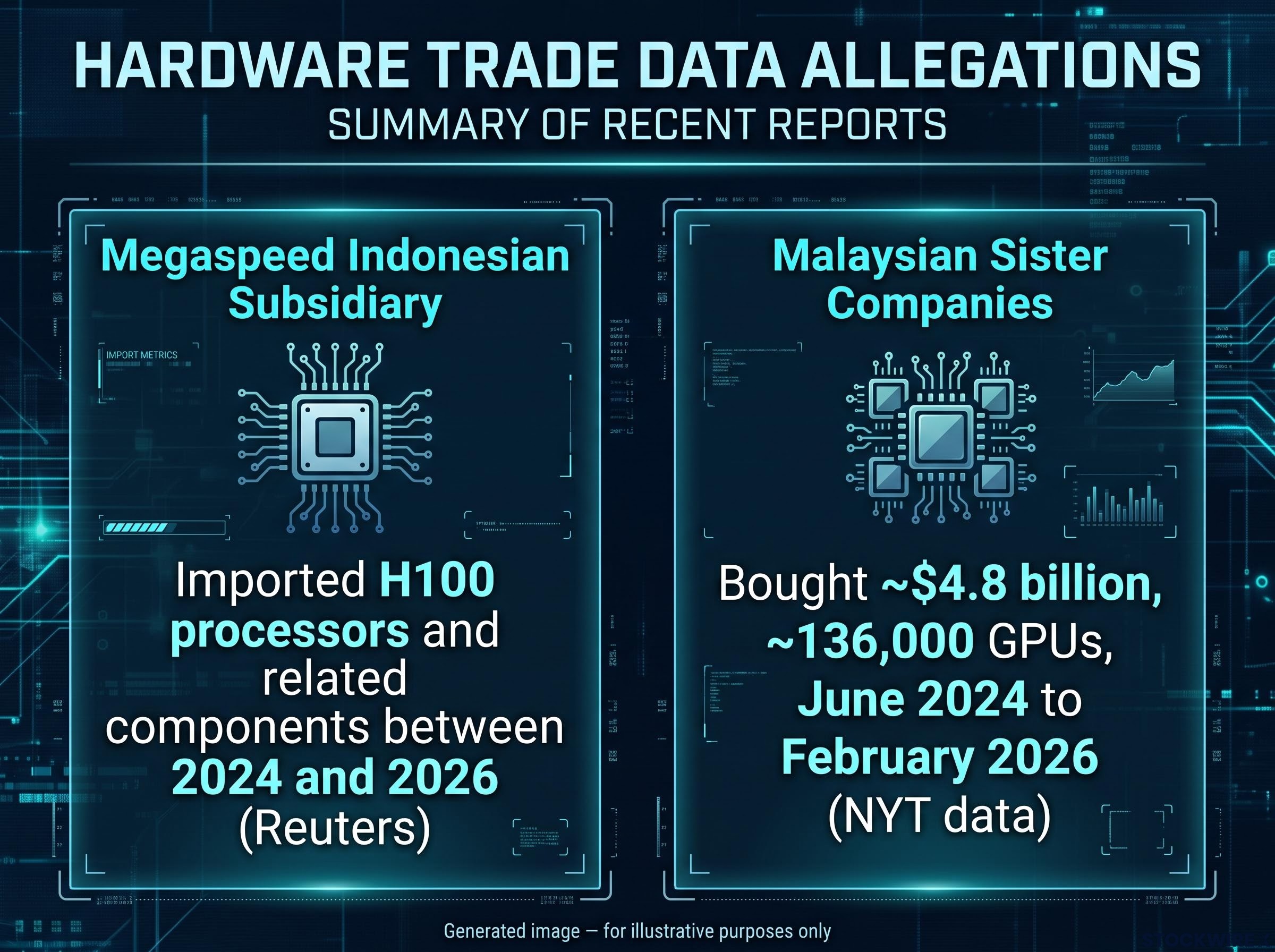
NYT data alleges Malaysian sister companies bought ~$4.8 billion in hardware, including ~136,000 GPUs, between June 2024 and February 2026.
The Bureau of Industry and Security (BIS), part of the Commerce Department, investigated Megaspeed before the Justice Department took the lead. A BIS spokesperson cited six chip-smuggling investigations that have produced criminal charges. Senator Michael Bennet has questioned the administration about the investigation, and House Foreign Affairs Committee Democrats have asked Commerce what due diligence it carried out on Megaspeed.
What is confirmed versus what is alleged
The resignation, the board investigation and Megaspeed’s GPU purchases are confirmed. The claims that the chips were diverted to China and that Huang Le had intelligence ties remain allegations, attributed to US officials through NYT reporting.
Megaspeed denies smuggling and says it will cooperate with US authorities. Nvidia says the allegations were investigated and debunked. Reuters stressed that import records alone do not prove a violation.
An inquiry is not a ruling. Treat the legal outcome as an open variable that could move the shares in either direction.
Why export controls turn this into a wider risk for Nvidia stock
The leadership story may settle within weeks. The regulatory question could run much longer.
Since 2022, the US has restricted exports of advanced chips to China, including the H100. BIS enforces these limits through the Export Administration Regulations, the federal rules that control which technology can be sold to which countries, users and purposes. A chip does not need to reach China to raise concern. A data centre in Southeast Asia can give Chinese firms remote access to its computing power.
The Commerce Department’s headquarters-based licensing standard, issued in May 2026, already requires licences for Chinese-headquartered buyers of advanced chips wherever they operate, which is the kind of third-country subsidiary route at issue in the Megaspeed allegations.
Nvidia reportedly placed Megaspeed on an internal restricted list and stopped new sales to it. The research points to several possible consequences, none of which has happened:
- Greater due diligence obligations for cloud partners and resellers.
- More scrutiny of who ultimately owns and uses the hardware.
- Possible limits on sales to regional data centres serving Chinese customers.
- Higher compliance costs and slower sales approvals.
- Congressional pressure to regulate remote access to computing power.
- More uncertain China-related revenue.
There are precedents. OpenAI‘s board reversed its removal of Sam Altman in 2023, and Uber‘s governance reset followed Travis Kalanick‘s resignation in 2017. Nvidia’s case differs because Huang was its co-founder and chief strategist.
Note that the selloff reflects governance and succession uncertainty, not any demonstrated weakening in demand for AI chips. For investors, the live risk is compliance cost creeping into China-related revenue, even if no finding is ever made against Nvidia.
What to watch next as the Nvidia stock reaction settles
Three signals should matter more than today’s price swing:
- Who becomes permanent CEO, and whether that person can lead the technology roadmap.
- Any formal export-control or criminal finding from the Justice Department’s inquiry.
- How the shares behave once the premarket move meets regular trading.
On the other side of the key-person concern, Nvidia has made continuity statements, has an experienced interim CEO and has a defined product roadmap.
Nvidia’s fiscal 2028 guidance of roughly 70% revenue growth, issued under Huang’s leadership, is the forecast the next permanent CEO will inherit and be measured against.
Three signals that will decide whether this is a shock or a shift
Huang has gone, Kress is running the company on an interim basis, Jones chairs the board and the search for a permanent CEO is under way. The biggest unresolved question is whether the Megaspeed allegations lead to a formal finding. Congressional follow-up could add pressure in the meantime.
The next major catalyst is the permanent CEO announcement. That choice will show whether the board sees Nvidia’s future in steady management or in another technology-led founder figure.
This article is for informational purposes only and should not be considered financial advice. Investors should conduct their own research and consult with financial professionals before making investment decisions.