Mary Daly wants you to hold two ideas at once. The San Francisco Federal Reserve President says there is “no doubt that AI is fuelling price pressures”, yet she also argues that the same technology could eventually help cool prices.
Her sharpest line pushes back on both the AI-as-villain and AI-as-saviour stories: “We have an inflation problem, but AI is not doing most of the driving.” For anyone tracking how the Fed views AI and inflation, that sentence reframes the debate.
Daly delivered the keynote at Stanford’s SIEPR Fall Policy Forum on 12 November 2026. On the same day, the US dollar index climbed to roughly a 19-month high near 103, and Treasury yields moved higher as traders added to bets on another rate hike.
The stakes are practical. If Fed rhetoric is a reliable rate signal, it shapes what you pay to hedge US dollar exposure, what bonds yield and how the market values AI-linked growth stocks.
Here is what Daly actually said, set apart from what markets are reading into it. It also shows how Fed mechanics connect her view to the dollar and to your portfolio.
Is AI driving inflation now, or only later? Daly’s two-stage argument
Start with the apparent contradiction. Daly says AI is adding to inflation and could add more from here. She also says productivity gains from AI may prove disinflationary, meaning they could slow the pace at which prices rise.
Both claims hold because they operate on different clocks.
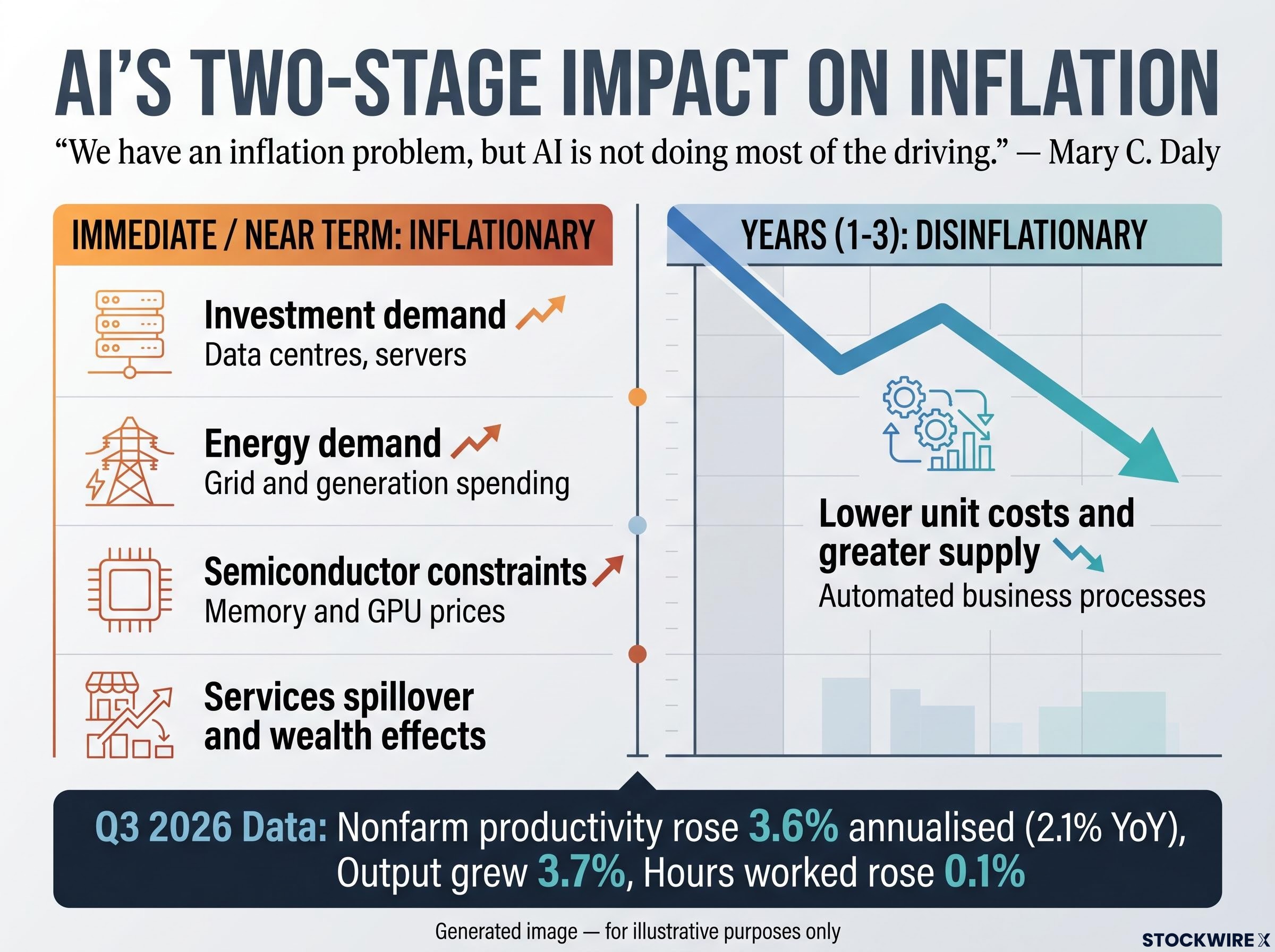
AI is adding to inflation now through demand, but productivity gains—which hit 3.6% annualised in Q3 2026—may prove disinflationary over the next 1-3 years.
“We have an inflation problem, but AI is not doing most of the driving.” Mary C. Daly, President, Federal Reserve Bank of San Francisco
The demand side of AI arrives first. Data centres, chips, power generation and grid connections absorb labour, materials and financing before any extra output appears. The supply side, where firms produce more with the same inputs, takes years to show up. Daly suggested the gains could emerge within roughly one to three years, but she stressed that their timing and scale remain uncertain.
| Channel | Type | Mechanism | Timing | Example |
|---|---|---|---|---|
| Investment demand | Inflationary | Build-out absorbs labour, materials and capital | Immediate | Data centres, servers |
| Energy demand | Inflationary | Higher electricity use lifts power costs | Immediate | Grid and generation spending |
| Semiconductor constraints | Inflationary | Chip demand raises input costs | Immediate | Memory and GPU prices |
| Services spillover and wealth effects | Inflationary | Costs passed to consumers; rising valuations support spending | Near term | Sticky service prices |
| Lower unit costs and greater supply | Disinflationary | More output per worker expands capacity | Years | Automated business processes |
Early evidence leans toward the supply story. The Bureau of Labor Statistics reported that nonfarm productivity rose 3.6% at an annualised rate in Q3 2026 and 2.1% year on year. Output grew 3.7% while hours worked rose just 0.1%.
Economists disagree on what that means for prices. Chicago Fed President Austan Goolsbee argues that an unexpected productivity surge should reduce inflation. IMF chief economist Silvana Tenreyro counters that if investment arrives before the productivity payoff, demand can run ahead of supply.
Some strategists argue near-term AI inflation is larger than the Fed assumes, pointing to electricity and semiconductor costs and warning that even optimistic productivity scenarios could lift the equilibrium real rate rather than lower it.
What this tells you is that the direction of AI’s effect matters less than its timing. The longer the investment phase outruns the productivity phase, the longer policy is likely to stay restrictive.
When big ASX news breaks, our subscribers know first
Why Daly backs a September hike and further tightening
Daly’s policy case does not rest on AI. It rests on where inflation is spreading.
Her concern is services, where price growth tends to stick once it rises. She also says she increasingly hears from firms that they plan to pass higher costs on to customers. Taken together, these points explain why she sees complacency as the larger danger.
“Inflation pressure is up, not down.” Mary C. Daly
Her argument rests on three pillars:
- Inflation is broadening. Price pressure has moved into services, and inflation shocks can compound.
- Firms are signalling pass-through. Companies say they intend to raise prices to cover their costs.
- The economy can absorb it. The labour market is stable, growth is positive and productivity is improving.
The data support her reading. October headline CPI rose 0.4% month on month and core CPI rose 0.3%, according to the BLS. Governor Michelle Bowman indicated on 10 November that 12-month core PCE inflation likely rose to 3.3%, although that is an estimate ahead of the official release, not a published figure. Unemployment sits at 4.1% and October payrolls grew by 165,000.
That is the backdrop to the September quarter-point hike, which passed 12-0 and took the federal funds range to 3.75%-4.00%. Daly says she is comfortable with that move and that her bias is that “further tightening will be needed.”
She also built in flexibility. In her view, the extent and timing of further hikes need not be decided now, and tighter financial conditions give the Fed more time. She played down the recent repricing of AI stocks, saying it does not reflect an unwinding of investor enthusiasm or a major threat to growth.
The read you should take from this is that at least one influential policymaker is tilted toward more tightening while services inflation persists. Hopes for rate cuts deserve scepticism.
How the Fed mandate, rate hikes and QT reach the dollar
To see why one speech can move currency markets, you need the mechanics.
The mandate and the committee
The Fed works under a dual mandate: price stability, defined as 2% inflation, and full employment. Its main tool is the federal funds rate, which is the rate banks charge each other for overnight loans.
Decisions are made by the Federal Open Market Committee (FOMC), which meets eight times a year. It has 12 voters: seven governors, the New York Fed president and four regional presidents who rotate on one-year terms.
Hikes, QE and QT
Rate changes are measured in basis points. A basis point is one-hundredth of a percentage point, so a 25 bp hike lifts rates by 0.25%. The US dollar index (DXY) measures the dollar against a basket of major currencies.
Here is how a hawkish signal travels to the dollar:
- A Fed official signals that higher rates are likely.
- Traders price in a higher expected path for US rates.
- Treasury yields rise, increasing returns on dollar assets.
- Foreign capital flows into US bills, deposits and bonds.
- The wider gap between US rates and rates elsewhere strengthens the dollar.
The balance sheet adds a second lever. Quantitative easing (QE) means the Fed buys bonds with newly created money. Quantitative tightening (QT) reverses that process by letting holdings run off.
Balance-sheet policy can also reverse its usual effect: QE tends to weigh on the dollar, yet in genuine crises safe-haven demand for dollar liquidity has overridden the yield effect, as in 2008-2009 and early 2020.
| Tool | What it does | Typical USD effect | Market effect |
|---|---|---|---|
| Rate hike | Raises the federal funds rate | Strengthens | Higher borrowing costs, pressure on growth stocks |
| QE | Fed buys bonds with new money | Weakens | Lower yields, more liquidity |
| QT | Fed lets bond holdings run off | Usually supports | Upward pressure on longer-term yields |
QT is currently proceeding within what the Fed calls an ample-reserves framework, which means the Fed keeps enough cash in the banking system to avoid funding strains.
The chain played out on 12 November. Reuters put the DXY at about 103, its highest level in roughly 19 months, and yields rose as traders added to December hike bets.
The implications reach well beyond currency markets. Higher rates tend to pressure long-duration tech stocks, raise financing costs for AI infrastructure and may support bank margins. If you hold US dollar assets, pay costs in foreign currency or own growth stocks, Fed talk alone can move your position before any vote is cast.
Where the Fed disagrees, and what could challenge the tightening case
Daly sounds confident. The committee as a whole is more divided.
In October, the FOMC held rates steady by a 10-2 vote, and its statement said it wanted more information on how the September hike was affecting the economy. That stance is more cautious than Daly’s tightening bias.
The hawkish dissent bloc has a longer history than October: in July, three members demanded an immediate 25 bp hike, and Waller’s stance as a swing vote has been central to whether that group can expand.
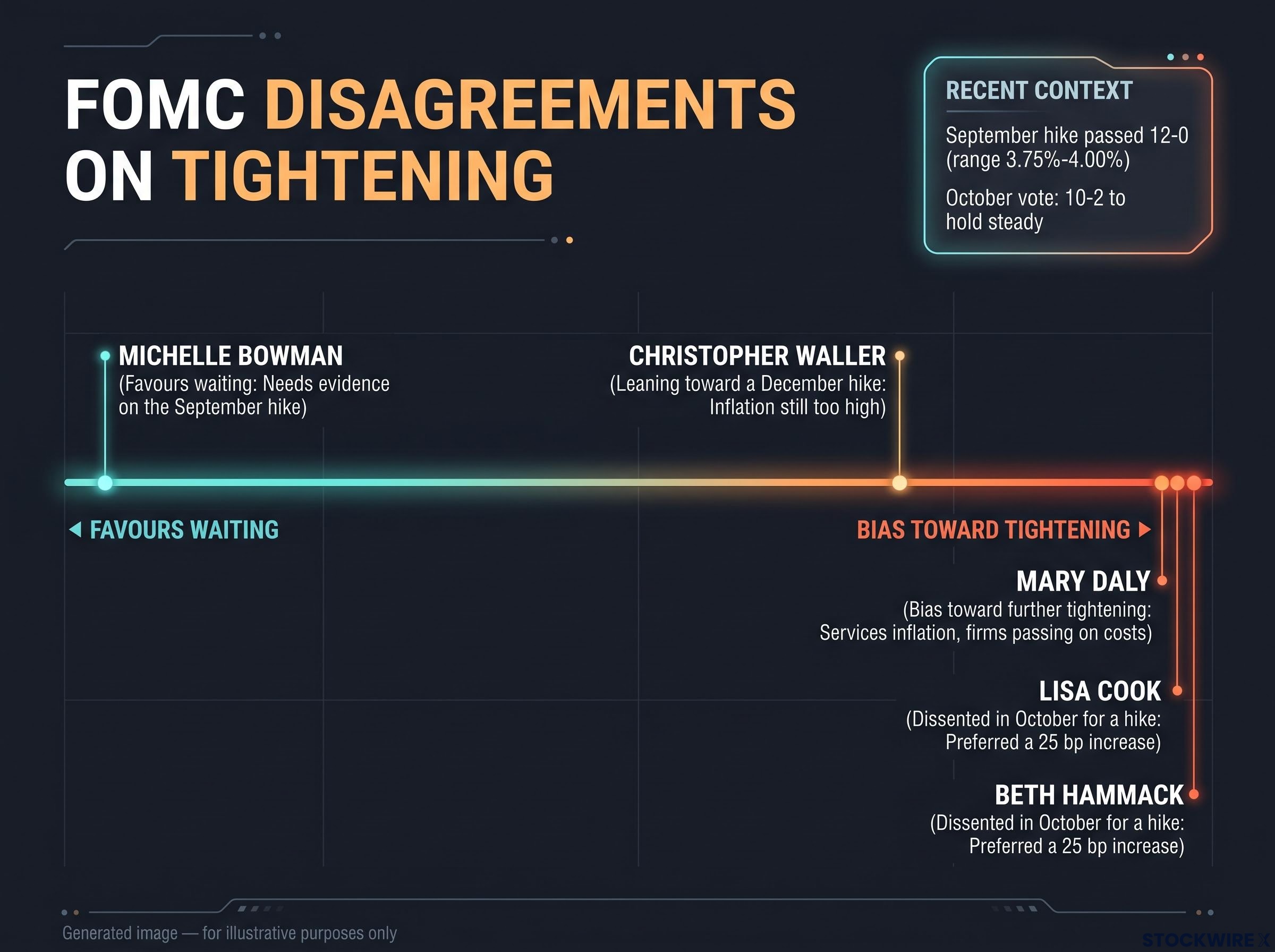
Following a 12-0 hike in September and a 10-2 hold in October, FOMC members reflect a spectrum of views on further rate increases.
| Official | Latest stance | Evidence cited |
|---|---|---|
| Mary Daly | Bias toward further tightening | Services inflation, firms passing on costs |
| Christopher Waller | Leaning toward a December hike | Inflation still too high |
| Michelle Bowman | Favours waiting | Needs evidence on the September hike |
| Lisa Cook | Dissented in October for a hike | Preferred a 25 bp increase |
| Beth Hammack | Dissented in October for a hike | Preferred a 25 bp increase |
History offers another reason for caution. A July 2026 St. Louis Fed analysis describes the late-1990s technology boom as a productivity-driven improvement in aggregate supply, with core inflation drifting lower through 1996-1997. The Reserve Bank of Australia (RBA) has drawn a similar comparison. In both cases, measured productivity gains appeared only after adoption spread across many firms.
The current boom is more capital-intensive than the 1990s, which could make the initial demand push larger and the eventual payoff less certain. Several risks could challenge the case for tightening:
- Over-tightening. Rate hikes work with a lag and could bite just as AI supply gains begin lowering inflation.
- AI repricing. The IMF estimates a major reversal in AI investment could cut US output by 1.8% by 2028.
- Measurement. Productivity data are noisy and may understate value when AI production happens offshore.
Goldman Sachs still expects a further hike in early 2027. These projections are speculative and subject to change as the data develop.
Treat December as a live possibility, not a settled outcome. One official’s speech is not committee consensus.
Three signals that will show whether Daly’s view prevails
Daly’s case comes down to sequence: AI is lifting demand now and may lift supply later, while broader services inflation justifies tighter policy today. Three signals will show whether that view wins out:
- Services inflation and core PCE. The official core PCE figure will confirm or revise Bowman’s 3.3% indication.
- Productivity data. Results that build on Q3’s 3.6% annualised gain would bring the one-to-three-year window closer.
- The December FOMC decision. A hike would validate Daly and Waller. A hold would point to the more cautious majority.
If tightening continues, the dollar’s 19-month high and firmer yields could persist, keeping pressure on AI-linked valuations. If it stalls, expect those moves to ease.
This article is for informational purposes only and should not be considered financial advice. Investors should conduct their own research and consult with financial professionals before making investment decisions.