Yarra Capital Management spent nine years as a private equity-backed independent. It has now agreed to be absorbed by a Canadian bank, and nobody outside the deal knows the price. The RBC Yarra Capital deal matters less as a single transaction than as a marker of where Australian active management is heading.
Royal Bank of Canada announced on 9 November 2026 that it will acquire 100% of the Melbourne-based manager, which oversees about $18 billion in funds. Completion still depends on regulatory approval and client consents.
The deal is signed, but it is not closed.
Here is what the announcement confirms, why mid-sized domestic managers keep ending up inside bigger groups, and which checks to run on any mandate that changes owner.
What RBC is buying, and what the announcement leaves out
The confirmed terms are simple. RBC Global Asset Management (RBC GAM) takes full ownership of Yarra, including its Australian fixed income, equity and alternatives capabilities and roughly 75 staff across Melbourne and Sydney.
Yarra’s path here took nearly a decade. It began in 2017 as a management buyout of Goldman Sachs Asset Management’s Australian arm, led by Dion Hershan and backed by US private equity firm TA Associates. In 2021 it absorbed Nikko Asset Management’s Australian operations, and Nikko (now Amova) received a 20% stake at the time. TA Associates and Amova both exit on completion, alongside selling management shareholders.
| Metric | Yarra | RBC GAM |
|---|---|---|
| Funds under management | About $18 billion (30 September 2026) | About C$834 billion |
| Staff | About 75, Melbourne and Sydney | About 1,600, Canada, US, Europe and Asia |
| Ownership status | Management, TA Associates and Amova; all selling | Acquirer, part of Royal Bank of Canada |
Yarra was reported at about $20 billion when the Nikko merger completed, so the business RBC is buying is somewhat smaller than it was then. RBC GAM chief executive Damon Williams called Yarra’s investment and distribution capabilities complementary. The strategic logic is a local vehicle for RBC’s offshore strategies, and the groundwork predates the deal: RBC BlueBay appointed Camilla Love as head of Australia and New Zealand on 14 April 2026.
On the search for a buyer Yarra executive chairman Dion Hershan said the agreement followed a lengthy, deliberate search for a partner, and pointed to cultural alignment with RBC.
What is confirmed, and what is not:
- Confirmed: 100% acquisition, Yarra’s capabilities and staff, the exits of TA Associates and Amova, and RBC’s statement that the deal should not significantly affect its CET1 ratio or run-rate earnings.
- Not disclosed: the price, current ownership splits, and retention terms for portfolio managers who are selling shareholders.
A reported 3-5% first-year earnings contribution circulating in coverage was not confirmed by RBC, so treat it as unverified.
Yarra’s own announcement frames the agreement as a decision to join RBC GAM, and it leaves the financial terms undisclosed, so any figure on price or ownership splits circulating before completion should be treated as unconfirmed.
The timetable conflict
RBC expects completion in Q1 2027. Yarra and TA Associates pointed to a close by the end of calendar 2026. The buyer’s timetable carries more weight, and the gap is a reminder that approvals are still pending. Until price, holdings and retention terms surface, your judgement on what this means for clients rests on what RBC and Yarra choose to disclose next.
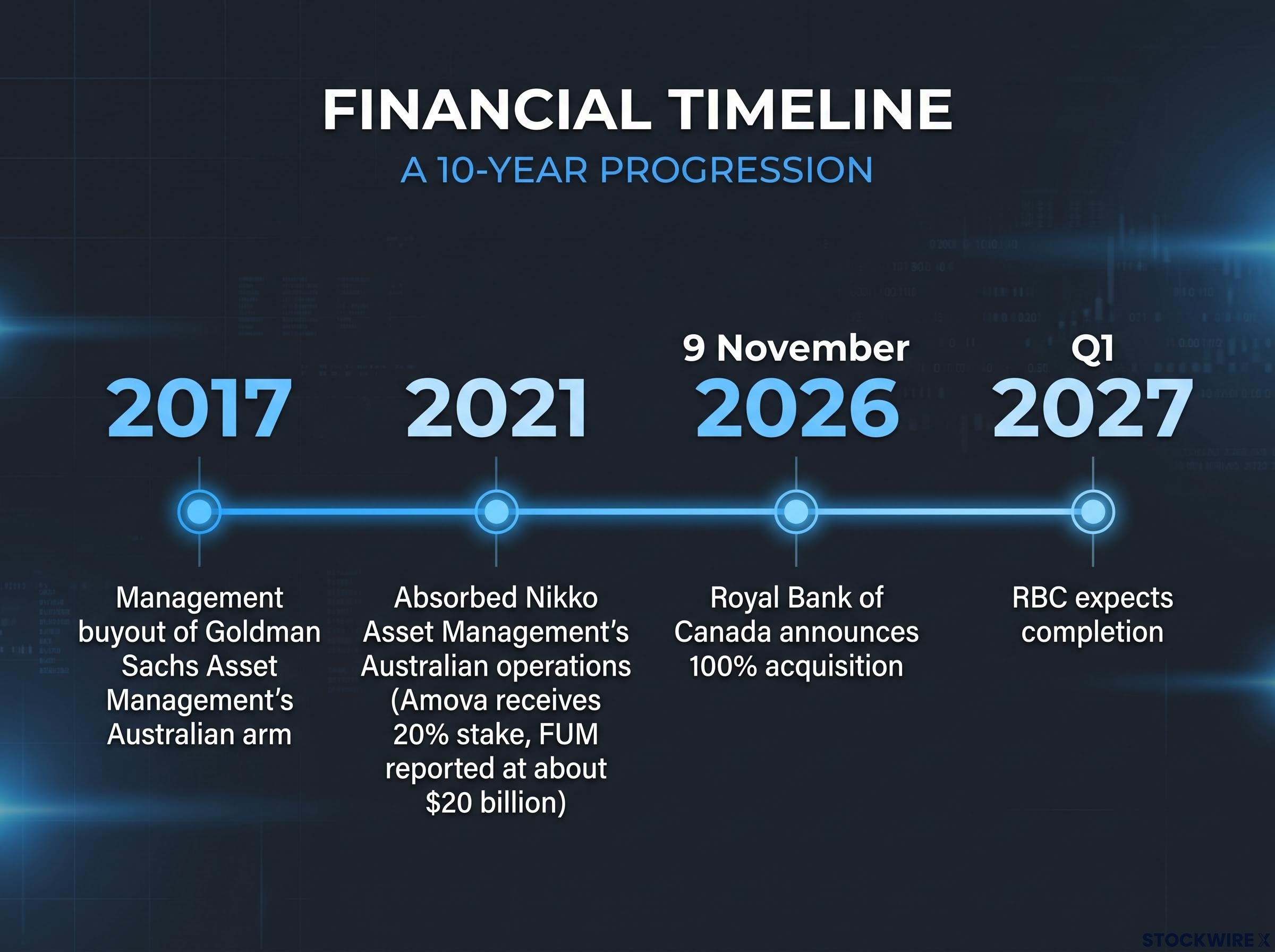
The timeline of Yarra’s evolution spans from a 2017 buyout to about $20 billion in FUM by 2021, leading up to a 100% acquisition expected in Q1 2027.
When big ASX news breaks, our subscribers know first
Why scale is squeezing Australian active managers
Yarra’s sale makes more sense once you see the forces pressing on every manager of its size. Five stand out:
- Super scale and in-housing. Mercer’s 2026 commentary noted fewer than 75 APRA-regulated funds remain after large mergers, and bigger funds manage more money internally, shrinking the pool open to external managers.
- Fee and performance pressure. APRA heatmaps, annual outcomes assessments and the Your Future, Your Super performance test (an annual benchmark that super products must pass or face consequences) push costs down and raise the bar on returns.
- Scale economics. Technology, compliance, sales and servicing costs are largely fixed, so a bigger owner can spread them across far more assets.
- Offshore allocation. Australian institutions are sending more money overseas, forcing local boutiques to build global reach or join a platform that already has it.
- Cyclical amplification. A weak run for one investment style can trigger withdrawals that make a fixed cost base unsustainable.
The first four are structural. The fifth is what turns slow pressure into a sudden decision.
Superannuation insourcing has moved internally managed assets from $227 billion in 2020 to $550 billion in 2025, and that shift sits behind the narrowing pool of external mandates available to mid-sized boutiques.
What Tyndall shows
Tyndall Asset Management, a value equities affiliate inside the Yarra group, announced on 1 December 2025 that it would close its large-cap research team in January 2026 and retire the brand. Tyndall cited a material change in its client base, which Money Management reported as the loss of a major super fund mandate. Yarra took over two Tyndall funds from 2 January 2026.
One reading of this, offered by the original reporting on the RBC deal, is that a single client decision can end a team, which helps explain why a domestic manager of Yarra’s size might want a larger parent. That is interpretation, not an established cause of the sale.
The aftermath also carries a warning. The AFR reported that seven former Tyndall employees are suing Yarra over an alleged terminated compensation and share-buyback arrangement.
For anyone allocating to mid-sized domestic managers, the lesson is practical: a fixed cost base paired with a concentrated client list is a vulnerability you can check for directly.
Where does the RBC Yarra Capital deal sit among other ownership changes?
Set alongside other recent transactions, the deal looks like part of a sequence.
| Transaction | Type | Status | Key terms |
|---|---|---|---|
| RBC and Yarra | Strategic sale | Announced; RBC expects Q1 2027 | 100% acquisition; price undisclosed |
| Janus Henderson | Take-private | Completed 30 June 2026 | US$52.00 cash per share; announced at about US$7.4 billion; delisted from NYSE |
| Challenger and Dai-ichi | Conditional proposal | Rejected 25 October 2026; board open to talks | $11.80 per share for the 79.5% not owned |
| Fidante and Channel Capital | Multi-affiliate merger | Expected late 1H 2027, subject to approvals | Fidante stays standalone; Challenger owns 45% |
| Amova exit from Yarra | Shareholder exit | Via the RBC deal | Historical 20% stake from 2021 |
Trian Fund Management, General Catalyst and Qatar Investment Authority took Janus Henderson private. TAL Dai-ichi Life Australia’s approach to Challenger remains unresolved, and the Fidante merger was disclosed to the ASX on 18 August 2026, with an ACCC milestone on 2 October 2026.
The pattern is real, but the deals are not interchangeable. One is complete, one was rejected, one is a partial-ownership merger and one is a full strategic sale. The author of the original analysis expects similar logic to draw other global firms to the remaining independents, though that remains an expectation.
There is also a fair counter-case:
- Ownership change does not automatically damage outcomes.
- A well-capitalised owner can strengthen succession planning, distribution and operational resilience.
- RBC and Yarra both describe cultural alignment, and RBC says it intends to retain Yarra’s talent.
No reliable dataset tracks post-acquisition flows and performance for foreign purchases of Australian boutiques. Read these deals as a direction of travel, not a rule, and judge each manager on its own ownership terms.
What allocators and advisers should check before a mandate changes hands
If you hold a Yarra fund, or any mandate with a pending owner change, the useful question is what to verify while terms are still emerging. RBC has said it intends to retain Yarra’s talent, and senior Yarra management intend to grow the business within RBC GAM. Retention terms for selling shareholders remain undisclosed, so the real question is what the manager will confirm.
Decide your threshold first The original analysis advises allocators to decide in advance how far an ownership change affects a mandate’s investment case.
Setting that line now lets you act on facts rather than headlines.
Contractual and people checks
- Change-of-control clauses: whether your mandate or platform agreement requires consent, permits termination or triggers a fee review.
- Retention terms: vesting and departure provisions for portfolio managers, analysts and distribution staff.
- Ratings reviews: Morningstar, Mercer, Willis Towers Watson, Rainmaker or JANA ratings are not automatically portable and may be reviewed.
- Succession depth: who runs the strategy if a founder or senior portfolio manager leaves.
- Equity ownership: whether management keeps meaningful skin in the game after the sale.
Process and governance checks
- Investment process continuity: portfolio construction, risk limits, benchmark, research budget and decision rights.
- Post-close flows: headline funds at signing are not the assets retained after completion.
- Scale benefits: whether savings reach clients or mainly lift the acquirer’s margin.
- Governance under a bank parent: investment committee authority, escalation and conflicts management.
- Operational resilience: technology, cybersecurity, valuation, custody and business continuity.
Some answers will not exist until completion. The first four checks are the ones to raise now.
Trustees facing a comparable ownership change at Schroders have been working through a documented out-of-cycle manager review, a template that allocators holding Yarra mandates can adapt once RBC’s retention and approval details emerge.
What the deal settles, and what the next announcements need to answer
The RBC Yarra Capital deal confirms the direction for Australian active managers: scale, global reach and larger parents. The details that decide client outcomes, including price, ownership splits, retention, approvals and timing, have not yet been published.
Over the coming months, watch whether completion lands within RBC’s Q1 2027 guidance, whether rating houses announce reviews, how Challenger’s board handles any renewed Dai-ichi approach and whether other independents attract offers.
Your next step is to run the contractual and people checks now and treat each new disclosure as a test against the threshold you have already set.
This article is for informational purposes only and should not be considered financial advice. Investors should conduct their own research and consult with financial professionals before making investment decisions.