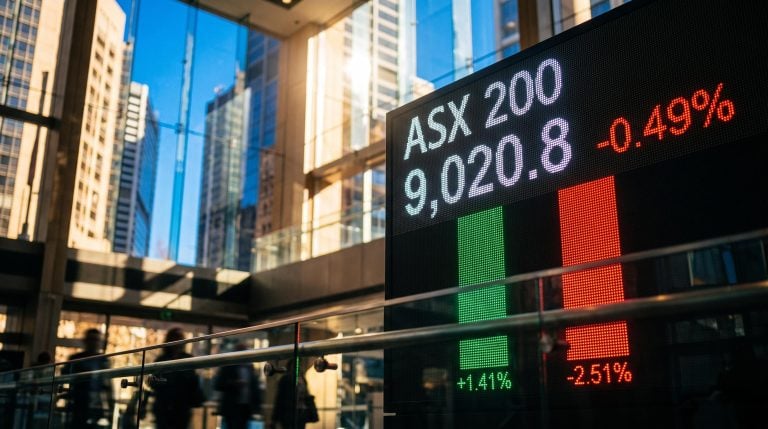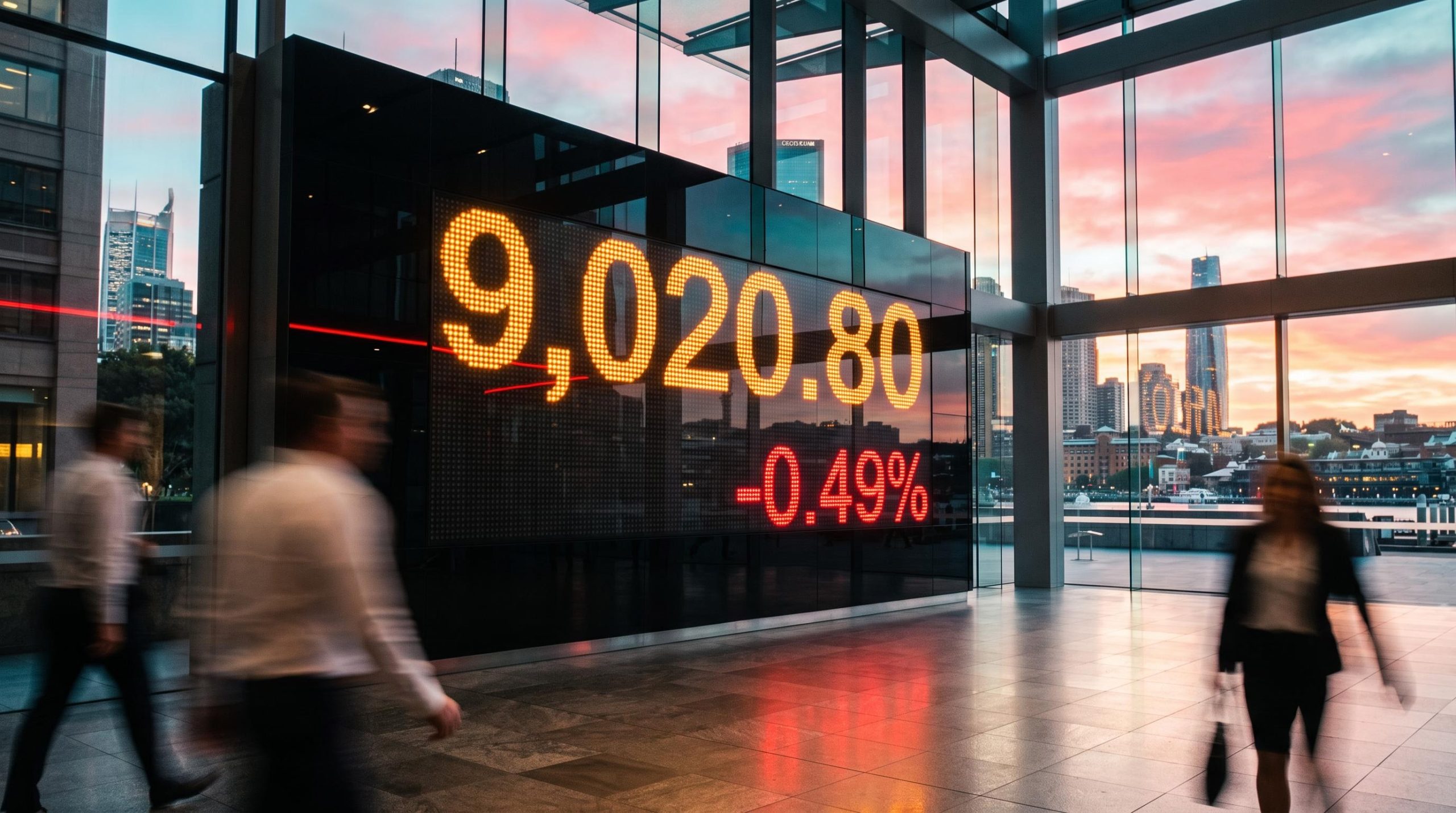
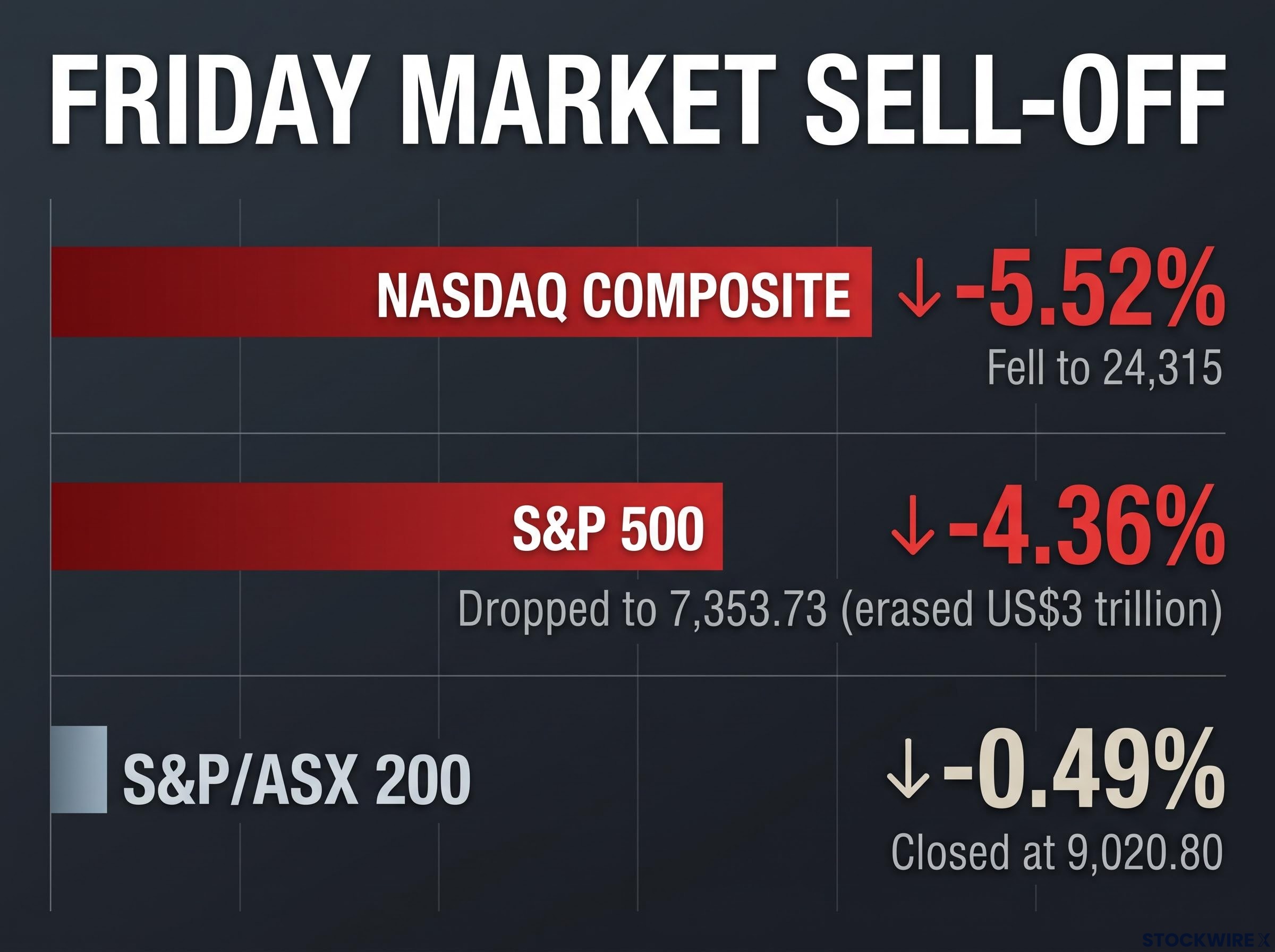
The S&P/ASX 200 dropped about 1.5% in the opening minutes on Friday, touching 8,923.30, then clawed back most of that ground to close at 9,020.80, down just 0.49%. The fall came after the Nasdaq Composite lost 5.52% overnight, its worst session in about 19 months.
The US sell-off followed fears that Democratic gains in the midterm elections could bring tighter regulation of artificial intelligence (AI) companies and slow the construction of data centres. Even after Friday’s dip, the Australian market finished the week about 1.25-1.3% higher.
Friday’s session shows how a US tech shock travels into Australian portfolios. It also shows why the local index absorbed the blow far better than Wall Street did.
Why did the ASX recover most of its early losses?
Wall Street’s shock arrives
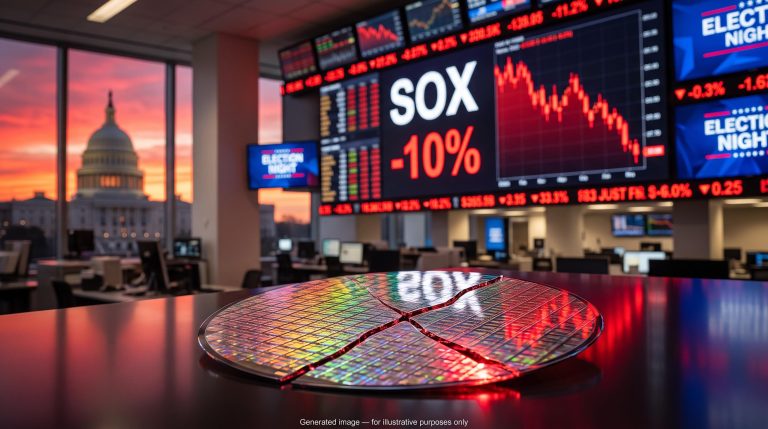
US shares swung from their best day since April 2025 to their worst in roughly 18-19 months, all within 24 hours. The Nasdaq fell 5.52% to 24,315, leaving it more than 10% below its record high. A fall of that size is known as a correction. The S&P 500 dropped 4.36% to 7,353.73, which erased roughly US$3 trillion in value in a single session.
Several Democratic candidates who won had campaigned against data-centre expansion because of its demands on electricity, water and local infrastructure. Semiconductor, server and power-equipment stocks led the losses. Reuters described the fall as a speed-up of a reassessment of AI valuations that was already under way, rather than a purely election-driven event.
Semiconductor weakness of this kind has precedent, as AI stock valuations were reset earlier in 2026 even where company guidance was unchanged, a sign that multiples rather than demand were driving the moves.
ASX 200 futures pointed to a weaker open, down about 0.4-0.5%.
Risk sentiment turns Westpac economist Ryan Wells said risk sentiment deteriorated as the post-midterm rally reversed and investors focused on the possibility that a Democrat-controlled Congress could constrain AI infrastructure.
What held the index up
The answer lies in what the ASX is made of. Financials, resources and defensive stocks carry far more weight in the local index than they do in the Nasdaq, so the US tech shock did not pass through one-for-one.
All four major banks rose. Investors also bought Telstra, the supermarkets and other consumer staples, which are businesses whose earnings depend less on the economic cycle. That buying offset losses in materials, which weighed most on the market, as well as in gold miners and tech. Thursday’s 2.61% rally to 9,065.10, the strongest session in about 18 months, also gave investors room to rotate between sectors rather than sell across the board.
| Measure | Friday move | Weekly context |
|---|---|---|
| S&P/ASX 200 | -0.49% to 9,020.80 | Up about 1.25-1.3%; a little over 4% across six weeks |
| All Ordinaries | Down about two-thirds of 1% | Small and midcaps lagged |
| Information technology | Among the weakest groups | Top sector, up about 10% |
| Energy | Slight decline | Down about 7% |
| Financials and staples | Outperformed | Seven sectors fell, four rose on Friday |
For you, the takeaway is that the local index is more insulated from US tech swings than the headlines suggest. That cushion only holds while banks and defensive stocks keep carrying the weight.
Which stocks moved most, and what drove them?
The index-level story was about structure. At the stock level, company-specific news mattered just as much as the US backdrop.
Results and updates
Nine Entertainment led the ASX 200, rising 10.96% to $0.81. Some reports put the gain closer to 11.5-11.64%, and it rose about 21% for the week. At its AGM, Nine said annual cost savings are expected to exceed $180 million, $20 million above its prior target. Management expects revenue and earnings to grow in FY27, with that growth weighted to the second half, helped by Stan and digital subscriptions at its publishing arm.
NAB rose about 2.6-2.7% after falling more than 5% on its full-year result, though it remains about 3.5% lower for the week.
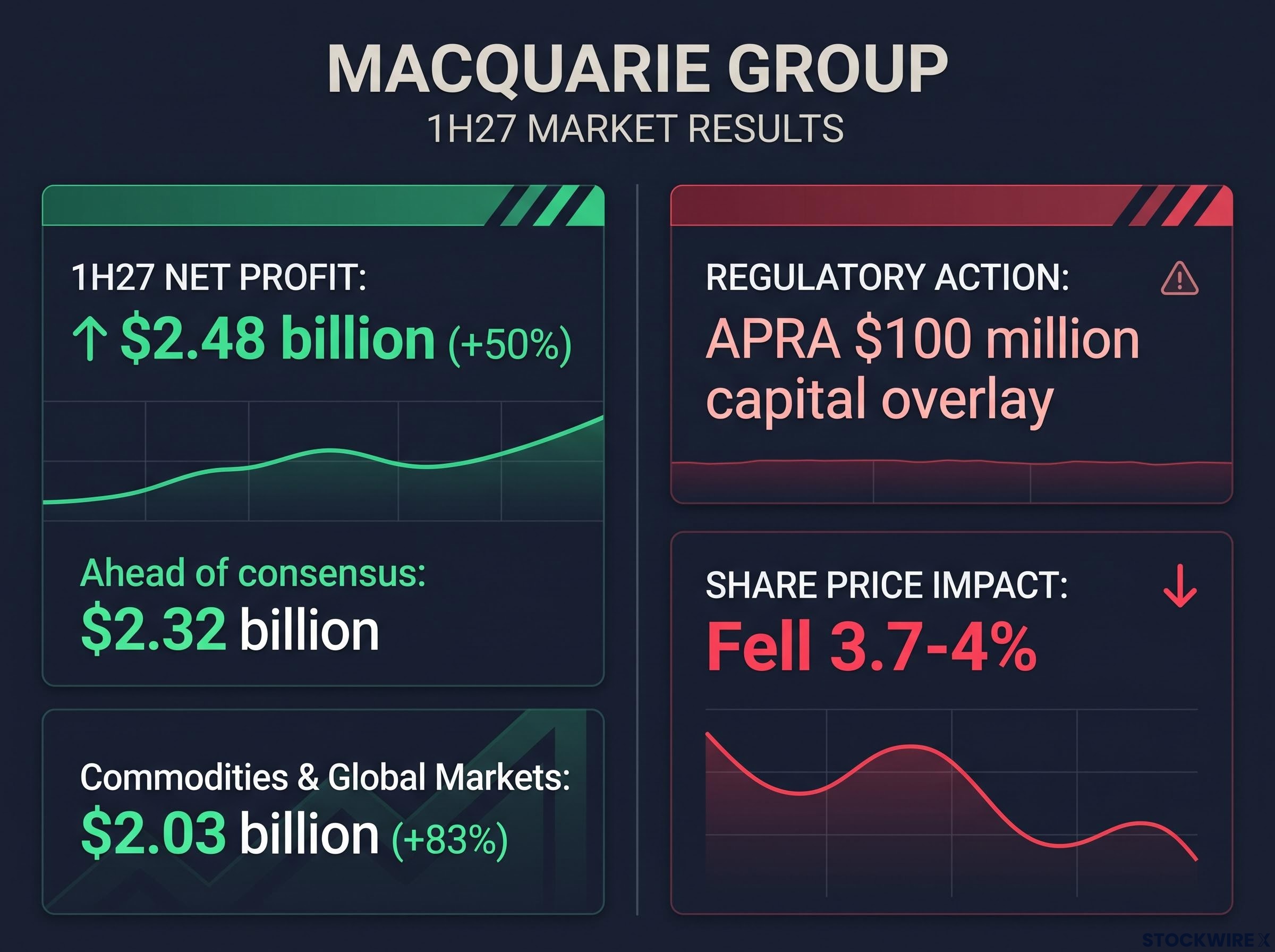
Macquarie Group fell roughly 3.7-4% after APRA imposed a $100 million capital overlay, an extra capital buffer set by the banking regulator. The fall came despite 1H27 net profit rising 50% to $2.48 billion, ahead of consensus of $2.32 billion. Its Commodities and Global Markets unit lifted its contribution 83% to $2.03 billion.
James Hardie dropped about 6%. Q2 FY27 net sales rose 24% to US$1.43 billion and adjusted EBITDA (earnings before interest, tax, depreciation and amortisation) climbed 44% to US$455 million. However, the company’s reaffirmed FY27 EBITDA guidance of US$1.45-1.53 billion has a midpoint below market expectations, and its third-quarter guidance came in softer.
Strong profits met with falling share prices tell you the market was pricing guidance and regulatory detail, not headline profit. Keep that in mind when you read the next reporting-season result.
Thematic buying and US-exposed selling
NextDC rose 3.86% to $10.23, adding to a jump of about 50% the day before and about 77% for the week. Because the global data-centre theme was under pressure, the gain points to company-specific buying rather than a broad tech recovery.
The sharp gap between NextDC and global tech sentiment also raises the question of Australian data centre oversupply risk, since a construction wave approaching $150 billion by 2030 could close the forecast supply gap faster than current estimates assume.
News Corp fell 9.40% to $43.02, and IperionX, a US titanium producer listed on the NASDAQ, slid 8.68% to $2.00. No separate company-specific catalyst was found for either stock. Both falls fit the sector-wide selling of US-exposed names.
| Stock | Friday move | Price | Main driver |
|---|---|---|---|
| Nine Entertainment | +10.96% | $0.81 | AGM update, cost savings |
| NextDC | +3.86% | $10.23 | Company-specific buying |
| NAB | +2.6-2.7% | Not reported | Rebound after result |
| Macquarie Group | -3.7-4% | Not reported | APRA capital overlay |
| James Hardie | -6% | Not reported | Guidance below expectations |
| News Corp | -9.40% | $43.02 | US-exposed selling |
| IperionX | -8.68% | $2.00 | US-exposed selling |
What does the weaker dollar mean, and what is on the calendar next?
The Australian dollar slipped to about 68.9 US cents, with reports ranging from 0.69 to 0.70. That is down about 2% for the week. A weaker dollar raises the Australian-dollar value of overseas earnings, which helps internationally exposed companies.
The timing matters, though. The dollar fell alongside the equity wobble, which signals that global risk appetite, not local conditions, is setting the tone for your portfolio right now.
Here are the events that could confirm or break the week’s recovery. The exact US and China dates are approximate.
- US non-farm payrolls (Friday night US time): a key input for Federal Reserve interest rate decisions.
- China CPI (around 9 November): an early read on demand from Australia’s largest trading partner.
- ANZ full-year result (Monday): a test of whether the banks can carry the index, given NAB’s swing from a heavy fall to a rebound.
- US CPI (around 10-11 November): further guidance on the Fed’s direction.
The local calendar is quiet next week. Australian October CPI and the Labour Force Survey are due later in November.
Whether the banks can carry the index may hinge on ANZ’s cost discipline, with its cost-to-income ratio already below 50% and just under half of its savings target banked at the last half-year.
What Friday’s session leaves investors watching
Friday’s session showed the ASX absorbing a severe US shock because of its weighting to banks, resources and defensive stocks. At the stock level, investors sorted companies on guidance and regulatory detail rather than headline numbers.
The next swing factors are clear: the direction of US futures, whether the bank bounce holds into ANZ’s result, and the coming US data releases. The durability of the rally remains untested. Part of the weekly gain may reflect rotation into banks and defensives rather than broad conviction.
This article is for informational purposes only and should not be considered financial advice. Investors should conduct their own research and consult with financial professionals before making investment decisions.