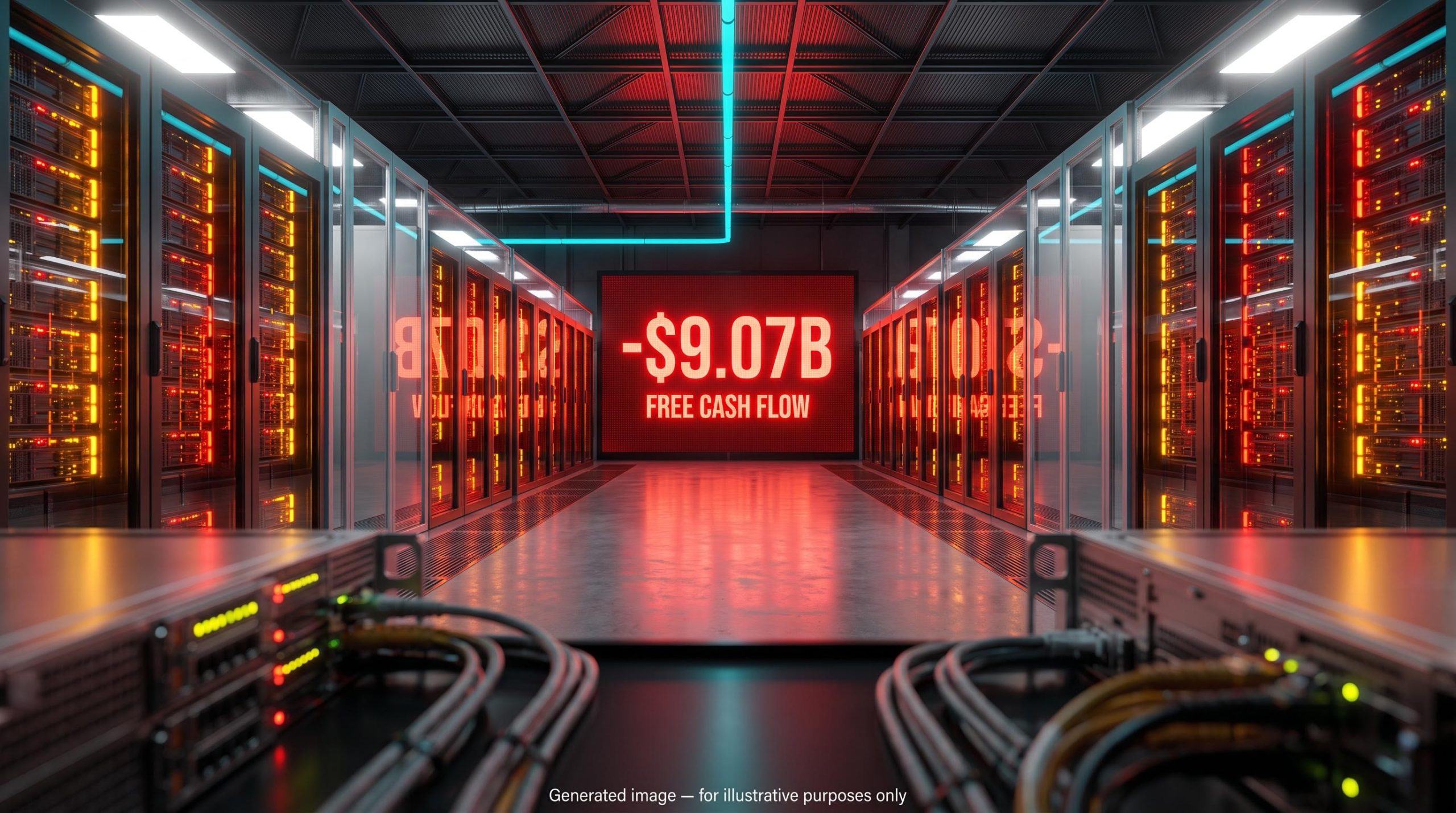
Alphabet shares fell about 10% in after-hours trading after the company posted adjusted earnings per share of $2.67 against the $3.02 analysts expected, and burned through $9.07 billion in free cash flow. The selloff came even though Google Cloud revenue more than doubled. The fastest-growing part of the business was not enough to carry the quarter.
Alphabet released its Q3 2026 earnings on 28 October 2026. Revenue of $127.58 billion missed the $128.22 billion consensus, and both Search and YouTube came in below forecasts.
The question for shareholders is whether this is a one-quarter stumble or a change in the investment case. This covers what the numbers show, how management explains them, and which metrics will tell you whether the damage is temporary.
Why did Alphabet burn $9 billion in cash in a single quarter?
Free cash flow was the sharpest number in the report. Free cash flow is the cash left after a company pays its running costs and its capital spending. Alphabet reported negative $9.07 billion, its second straight negative quarter.
The cash gap Reported free cash flow: negative $9.07 billion. CNBC’s consensus figure: positive $2.70 billion.
Sources differ on the expectation. LSEG and FactSet data put it closer to breakeven, while CNBC cited a positive $2.70 billion. Both agree the actual result was far worse.
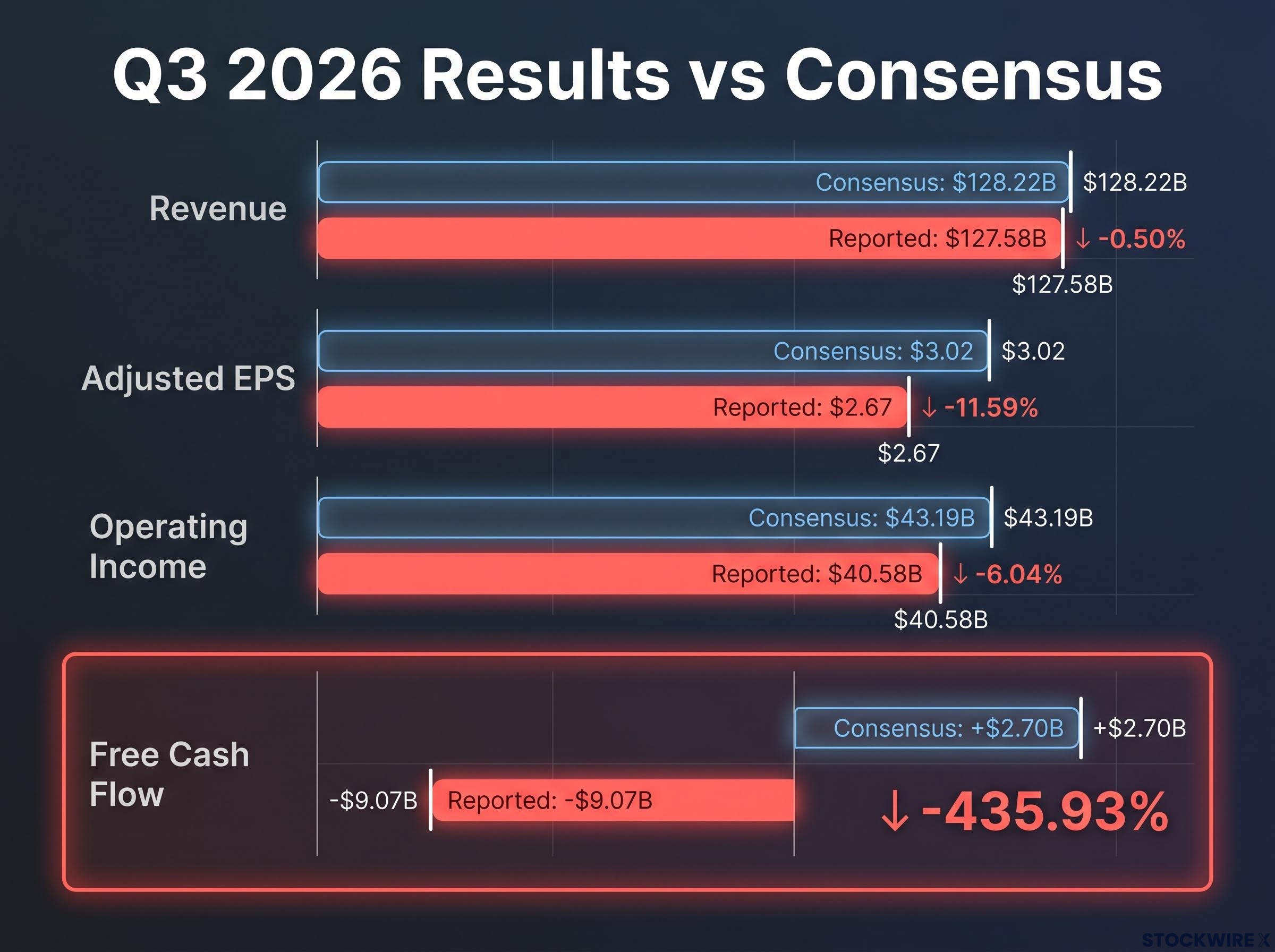
| Metric | Reported | Consensus | Result |
|---|---|---|---|
| Revenue | $127.58B | $128.22B | Miss |
| Adjusted EPS | $2.67 | $3.02 | Miss |
| Operating income | $40.58B | $43.19B | Miss |
| Free cash flow | -$9.07B | +$2.70B | Miss |
The cause is capital expenditure (capex), meaning spending on long-term physical assets. Q3 capex reached $51.36 billion across data centres, networking, servers and AI infrastructure, which was more than the business generated. CFO Anat Ashkenazi held the 2026 range at $195-$205 billion and said capex would “increase significantly” in 2027. Media coverage has suggested annual spending could pass $300 billion, though that is a reported expectation and not formal guidance.
Over the past 12 months, cumulative free cash flow remains in positive territory but has dropped to its weakest point in over ten years, with a move into negative territory looking probable. Shares were down roughly 10%-11% in premarket trading on 29 October.
Why Cloud can improve while cash flow worsens
The sequence explains the paradox. Alphabet builds data centres, buys tensor processing units (TPUs, Google’s own AI chips) and GPUs, and holds that inventory before any customer revenue is recognised. Cloud margins can climb while consolidated cash flow falls, and depreciation, the accounting cost of assets wearing out, arrives later.
For you, the cash burn signals that Alphabet is moving from funding AI out of its own cash flow towards a world where debt or equity may be needed. That reduces how much the balance sheet can absorb if returns lag.
Wall Street has been demanding concrete monetisation metrics within a one-year window, and the shift from funding AI out of cash flow to possibly needing external capital makes that pressure on Alphabet sharper.
When big ASX news breaks, our subscribers know first
Search grew 12%, so why did a record query surge fail to lift revenue?
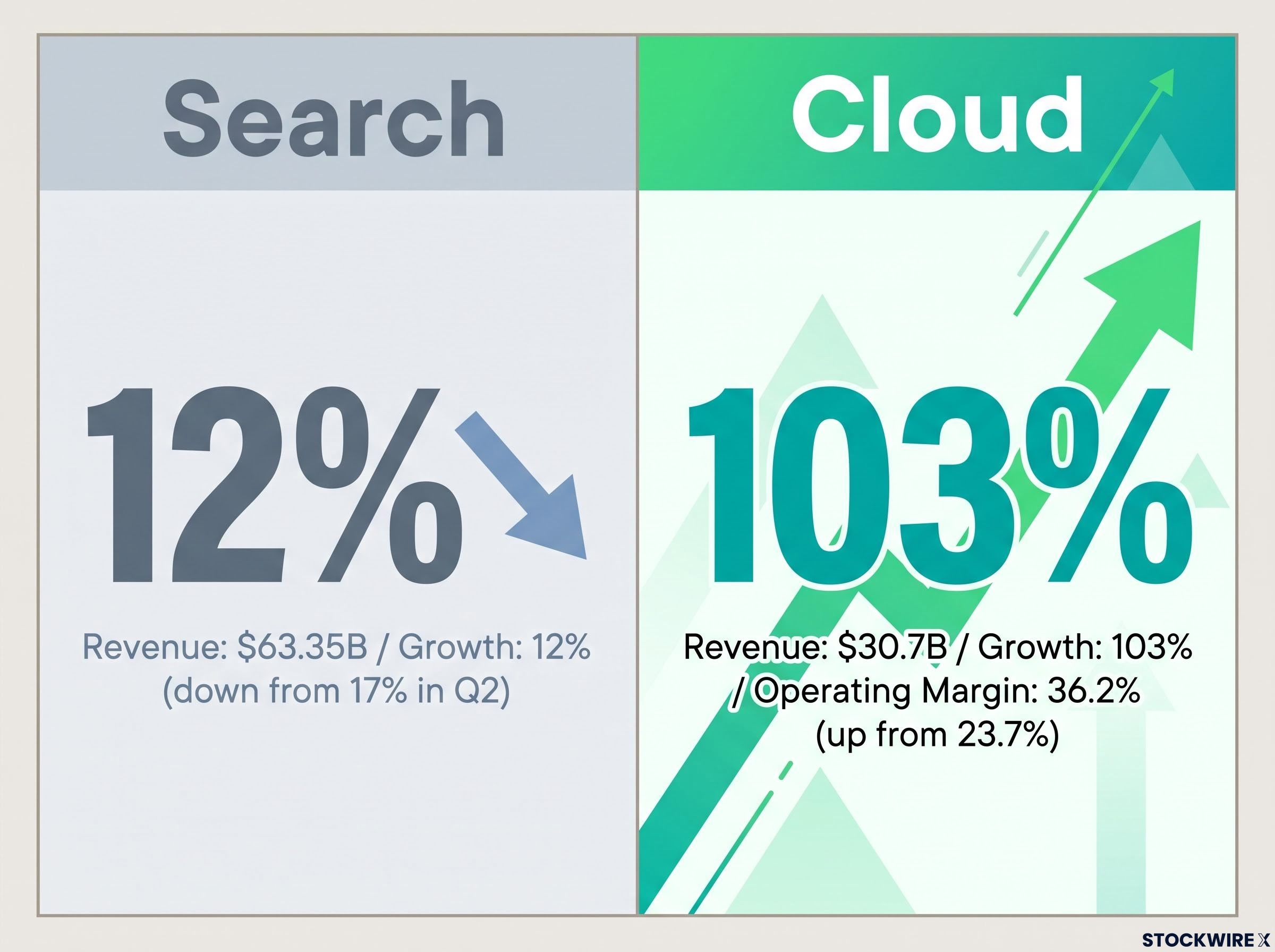
Management said Search recorded its highest year-over-year query growth in five years. Revenue still missed, coming in at $63.35 billion against $64.96 billion expected, and growth slowed to 12% from 17% in Q2.
Management’s explanation Chief Business Officer Philipp Schindler attributed the larger-than-expected slowdown to rapid growth in AI Mode usage, which earns less per query than conventional Search.
AI answers also cost more to serve because each one requires more inference compute, the processing power used to generate a response. Management described many AI Mode queries as incremental and upper-funnel, meaning early-stage research, and expects advertising to develop around them through three routes:
- AI Overviews can preserve engagement and add sponsored links.
- AI Mode creates longer sessions and new commercial queries but monetises lower at first.
- Agentic search, where AI completes tasks for users, could create high-value transactional ad inventory.
YouTube advertising slowed too, rising about 9% to $11.2 billion against roughly $11.4 billion expected. Search and YouTube ads together make up nearly 60% of revenue. Citizens analyst Andrew Boone downgraded the stock to Market Perform, citing challenged monetisation and execution risk in the move from AI Overviews to agentic products.
The lesson for you is that usage and revenue have decoupled for now. Query growth alone no longer signals health; revenue per query is the number to track.
Is Meta taking the budget?
Meta reported Q3 revenue of $64.60 billion, up 26%, with ad impressions up 10% and average price per ad up 14%. It also spent $34.91 billion on capex and posted free cash flow of negative $2.12 billion. The evidence does not establish Meta, or its Muse AI (live for under a month of the quarter), as the main cause of Alphabet’s slowdown.
Cloud more than doubled: how much of that is revenue you can count on?
Cloud was the bright spot, and a large one:
- Revenue of $30.7 billion, up 103%, against $28.7 billion expected
- Operating income of about $11.1 billion, up from about $3.6 billion
- Operating margin up from 23.7% to 36.2%
- Backlog of $561 billion
AI infrastructure, enterprise AI and TPU-system sales drove the growth. Backlog, contracted work not yet delivered, gives visibility, but it is not revenue, profit or cash. Management expects just over 55% to convert within 24 months, leaving timing, cancellation terms, customer concentration and margins as open questions.
The Cloud backlog has expanded sharply across 2026, from $460 billion in the first quarter to $561 billion now, which lifts revenue visibility but still leaves conversion timing and margins to be proven.
| Firm | Rating or action | Target and rationale |
|---|---|---|
| Morgan Stanley | Overweight | $375; TPU sales seen as upside |
| Goldman Sachs (Eric Sheridan) | Buy | Cut to $385 from $435; focus on Search, capex timing, backlog execution |
| DA Davidson | Target cut | $300; weaker Search, TPU hardware costs, capex |
Cloud is why the thesis is bent rather than broken. It also means your return now depends on that backlog converting at healthy margins, not on a Search recovery alone.
What should investors watch over the next few quarters?
The Q4 2026 call, where management has promised more 2027 capex detail, opens a “prove it” period. One commentator expects two to four more negative free cash flow quarters, so patience will be tested.
| Question | Bull case | Bear case |
|---|---|---|
| Structural Search slowdown? | Record queries; temporary monetisation gap | Users shifting to lower-earning conversational use |
| AI cannibalising Search? | Incremental queries expand the market | Erodes profits before ad formats mature |
| Is capex defensive? | Needed for model and Cloud leadership | Possible overbuilding amid uncertain demand |
| Is capex growth-generating? | Backlog and 103% Cloud growth back it | Only about 55% of backlog converts in 24 months |
Bernstein has also asked whether Alphabet accelerated Gemini deployment in response to softer financials. The main risks are valuation, rising depreciation, backlog quality, antitrust remedies and reduced financing flexibility. The metrics most worth tracking:
- Search growth stabilising
- Revenue per query, ad load and click-through in AI Mode and Overviews
- Cloud growth with margins held
- 2027 capex detail
- Operating cash flow and depreciation growth
- Return on invested capital (ROIC), the profit earned per dollar put into the business
History offers both outcomes: spending ahead of demand pays off if utilisation and pricing catch up, or leaves excess depreciation if monetisation lags. The next two or three prints, not this one, will decide whether this capex is a durable advantage or an expensive defence. This is analysis, not financial advice.
The bull case rests on contracted backlog across the hyperscalers, which one analysis puts above $2.3 trillion, shifting the debate from whether demand exists to whether capacity can be built fast enough to deliver it.
What the miss changes, and what it leaves intact
The cash and Search picture has weakened. Cloud’s surge and rising underlying operating income keep the core thesis alive, but the risk profile has shifted.
The question is no longer whether Alphabet can build AI capacity. It is whether Search monetisation and cash generation catch up with it.
The Q4 call and its 2027 capex detail are the next marker to watch.
This article is for informational purposes only and should not be considered financial advice. Investors should conduct their own research and consult with financial professionals before making investment decisions. Past performance does not guarantee future results. Financial projections are subject to market conditions and various risk factors.