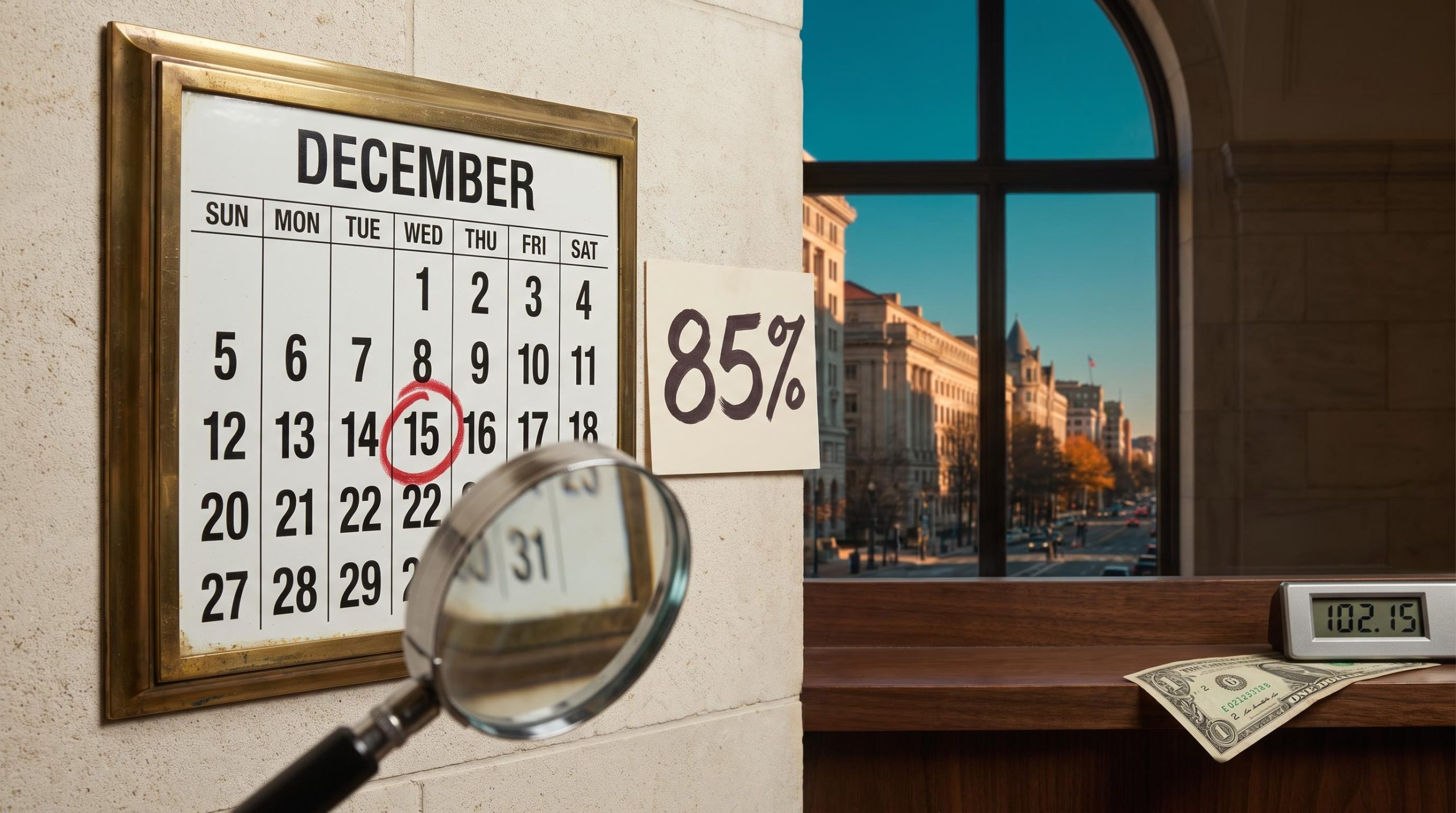
The Federal Reserve held rates, upgraded its view of the economy to a “strong pace” and drew two dissents calling for an immediate increase. The dollar barely moved. The dollar index (DXY) slipped to about 102.15, down roughly 0.2%, after a decision that would normally lift the currency. That gap is the clearest sign yet that the December Fed hike has already done its work on the dollar.
The reason is the pricing. Futures markets put the odds of a December increase at about 85% after the meeting, so the hike was largely paid for before it was announced. The live question is no longer whether the Fed moves in December. It is what the market believes happens after that.
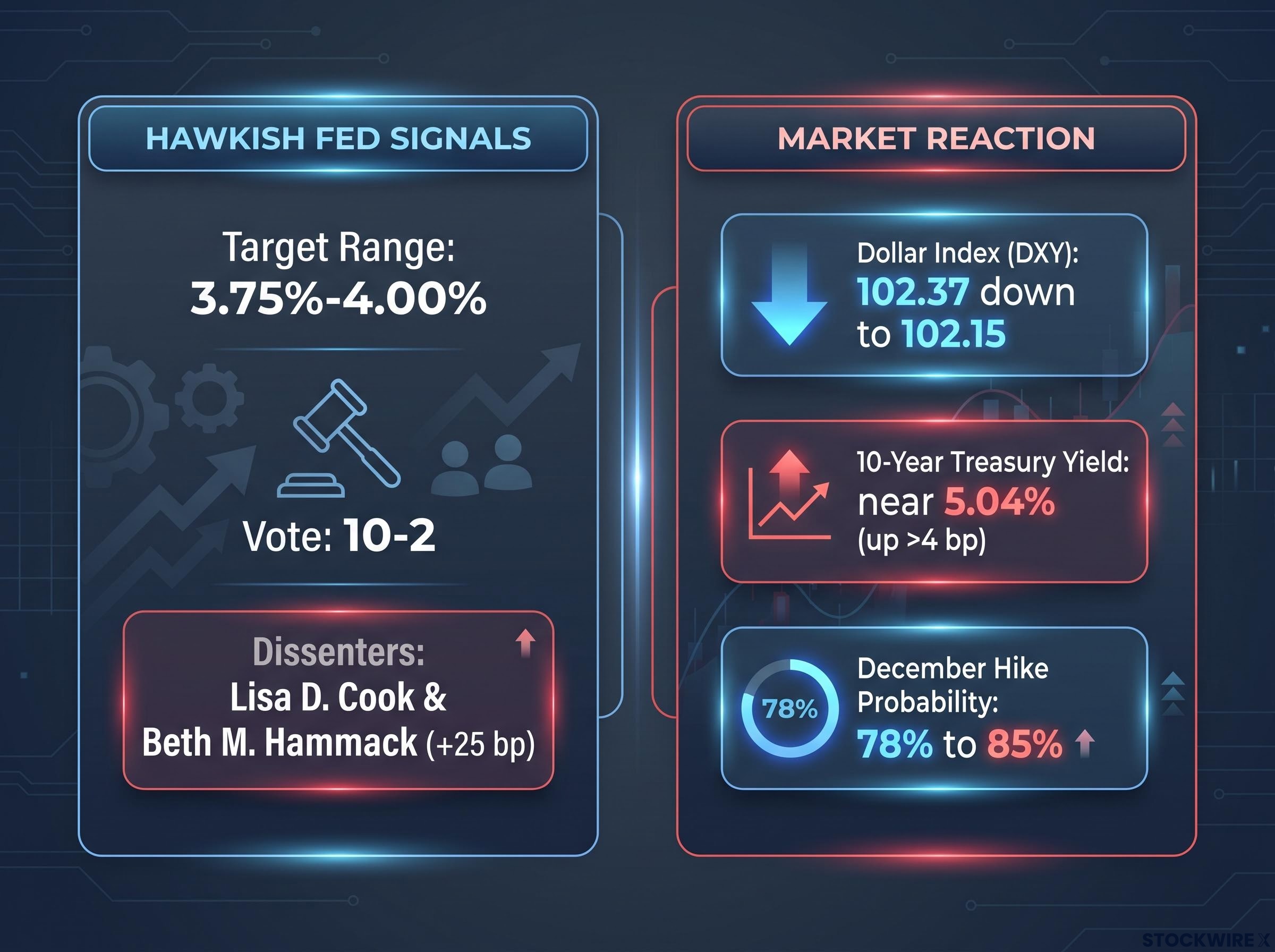
The Federal Open Market Committee (FOMC) kept its target range at 3.75%-4.00% on 28 October 2026 by a 10-2 vote. September personal consumption expenditures (PCE) inflation and the advance Q3 gross domestic product (GDP) estimate are due today at 8:30 a.m. ET.
Here is how to judge whether December marks the end of this hiking cycle or only the middle of it, and which data points would change that view.
Why did the dollar stall after a hawkish hold?
On paper, almost everything about the decision leaned hawkish. Governor Lisa D. Cook and Cleveland Fed President Beth M. Hammack both dissented in favour of a 25 basis point increase. A basis point is one hundredth of a percentage point. The statement also replaced September’s “solid pace” with “strong pace” and still called inflation “elevated.”
The FOMC statement confirms the 10-2 vote to hold the target range at 3.75%-4.00%, with Cook and Hammack preferring a quarter-point increase, which is why the hawkish language failed to lift a dollar that had already priced in December.
Bond markets responded as you might expect. The 10-year Treasury yield climbed to about 5.04%, up more than 4 bp, while the dollar softened.
| Market | Pre-meeting | Post-meeting |
|---|---|---|
| Dollar index (DXY) | 102.37 | 102.15 (down about 0.2%) |
| 10-year Treasury yield | Not available | Near 5.04% (up more than 4 bp) |
| 2-year Treasury yield | Not available | 4.722% |
| December hike probability | About 78% | About 85% |
Taken together, the readings point to several overlapping forces rather than a single cause:
- Already priced in. Commerzbank’s Michael Pfister called the meeting a non-event for the dollar.
- Yield-dollar divergence. DBS’s Philip Wee highlighted the unusual pairing of a weaker dollar index and higher Treasury yields.
- No forward guidance. Chair Kevin Warsh declined to commit to December, saying the Fed was not on a predetermined course.
- Term premium and consolidation. Term premium is the extra yield investors demand for holding longer-dated bonds. Part of the 10-year move may reflect that rather than Fed expectations. ING has also said in analyst commentary that the dollar was consolidating after rising about 4% through September and early October.
Warsh’s most hawkish line was a statement about conditions, not a commitment on timing:
Kevin Warsh, Federal Reserve Chair “While overall financial conditions are tighter, I’m unwilling and unable to call them tight.”
A flat dollar on hawkish news tells you the market had already bought the December hike. Further upside now needs a surprise about the path beyond December.
When big ASX news breaks, our subscribers know first
How does a December Fed hike work as a pricing anchor?
That 85% figure comes from the CME FedWatch tool, cited by CNBC, CNN and Reuters. It converts fed funds futures prices into the market’s implied odds of a given decision.
Fed rate hike odds have moved sharply across this cycle, swinging from near coin-flip readings in September to roughly 85% for December, which shows how quickly futures pricing can absorb new data and Fed communication.
What 85% does and does not tell you
- What it measures: The probability traders assign to a 25 bp December increase, based on where they are willing to bet money.
- What moves it: New data and Fed communication. CNN reported a rise from about 78% before the meeting to 85% after, and one Reuters-syndicated snapshot showed 87.4% against 78.3% the day before. The differences reflect intraday versus closing readings.
- What it ignores: The size and timing of moves after December, which is where the uncertainty now sits.
When an outcome is mostly priced, its arrival rarely moves a currency much. Pfister made the same point about this meeting:
Michael Pfister, Commerzbank The hold was expected and the dissents did not materially change December pricing, making the meeting a non-event for the dollar.
The sequence supports that reading. A September hike, an October hold and an expected December hike look like a planned pause, not an abandonment of tightening. A Reuters poll reportedly found 94 of 100 economists expected exactly that pattern, although that figure has not been independently confirmed.
For you, an 85% probability means December carries limited surprise value. The dollar is more exposed to the 15% scenario where the Fed does not move, and to shifts in the 2027 path.
DBS versus Commerzbank: where the 2027 debate really sits
The two banks whose views have shaped coverage of this meeting agree on December. Their disagreement starts once the calendar turns.
Wee at DBS argues that solid growth paired with softer underlying inflation leaves expectations for several 2027 hikes open to repricing lower. Pfister at Commerzbank sees solid growth and labour data supporting continued tightening, and points to the two dissenting votes as evidence of a meaningful hawkish faction.
| Source | December view | 2027 view | Key reasoning |
|---|---|---|---|
| DBS (Philip Wee) | Heavily priced | Multiple hikes vulnerable to repricing lower | Strong growth with softer underlying inflation |
| Commerzbank (Michael Pfister) | About 85% priced | Continued tightening supported | Solid growth and labour data; two hike votes |
| Goldman Sachs* | Hike expected | Further move possible, including March | Alternating meetings as a possible compromise |
| ING, MUFG, GSAM, Morningstar* | Hike expected | Limited tightening, prolonged pause or eventual cuts | Tighter financial conditions; inflation expected to ease |
*Based on secondary-source reports that have not been independently confirmed.
Most of the wider field leans towards fewer 2027 moves. Goldman Sachs Asset Management has reportedly said more hikes would need a material acceleration in prices, jobs or growth, while Morningstar has reportedly pencilled in cuts for the second half of 2027.
What the 2027 meeting format changes for dollar volatility
The FOMC will keep eight meetings a year, but from 2027 one will focus only on strategy, with no rate vote and no statement expected. CNBC reported this leaves six ordinary rate-setting meetings outside emergencies. Two effects follow:
- Fewer decision dates: Markets have fewer scheduled chances to price a policy change.
- Volatility redistributed, not eliminated: Pfister expects foreign exchange volatility to shift towards data releases.
The split tells you the real trade is the slope of the 2027 path. Your view on the dollar now depends on whether you believe growth is coming from productivity or from overheating demand.
PCE and Q3 GDP: the data that could set the dollar’s next move
Both releases land at 8:30 a.m. ET on 29 October 2026. At the time of writing, the results had not been published.
| Indicator | Consensus | Prior reference | What a miss could imply |
|---|---|---|---|
| Headline PCE | 3.6% YoY, 0.5% MoM | Not available | Hotter print may support hawks |
| Core PCE | 3.1% YoY, 0.3% MoM | Not available | Softer print may trim 2027 pricing |
| Advance Q3 GDP (annualised) | 3.2% (some estimates 3.0%-3.2%) | Q2: 2.2% | Composition matters more than the headline |
Core PCE strips out food and energy prices, so it gives a cleaner read on underlying inflation.
The August core PCE softening showed how one cooler print can buy time without changing direction, a useful benchmark for judging whether today’s September readings would genuinely alter the 2027 path.
Reading the results: three scenarios
A hotter PCE print would validate the dissenters and could lift both December and 2027 pricing. Softer core inflation would do the opposite. The middle case is strong GDP with cooling core inflation, which could trim 2027 expectations and cap dollar gains.
Composition is the detail to check. Growth led by productivity or investment is less inflationary than overheated consumption, and DBS has reportedly forecast faster GDP alongside slower consumption growth.
The main risks to any reading include:
- Data surprise: A large miss in either direction on core PCE.
- Growth composition: Consumption-heavy growth would strengthen the tightening case.
- Dissent dynamics: Two hawkish votes raise the risk of more hikes without guaranteeing them.
- Communication: Warsh’s refusal to pre-commit makes a deliberate pause harder to tell apart from uncertainty.
- Labour market: A later weakening in jobs could undercut the case for repeated hikes.
Market commentary has also cited energy-price pass-through and term premium as factors, though these are harder to pin down.
When the numbers print, check core PCE and the consumption component before the headline. They tell you whether the 2027 path is being repriced.
What the hold changes, and what it leaves open
December now looks like a planned step rather than a coin toss. The durable uncertainty is the 2027 path, and the new meeting format pushes more of that uncertainty onto data days.
DBS’s case for fewer 2027 hikes and Commerzbank’s case for continued tightening both remain credible until today’s releases are absorbed. Three things to watch from here:
- Core PCE: The cleanest test of underlying inflation.
- GDP composition: Investment-led strength versus consumption-led strength.
- Fed commentary: Any sign officials still refuse to call conditions “tight.”
All interpretations remain subject to incoming data as of 29 October 2026.
Past performance does not guarantee future results. Financial projections are subject to market conditions and various risk factors. These statements are speculative and subject to change based on market developments.
This article is for informational purposes only and should not be considered financial advice. Investors should conduct their own research and consult with financial professionals before making investment decisions.