The Banco Central de Chile announces its latest policy decision at 18:00 Chile time today, and economists broadly expect it to hold the rate at 4.50%. Interest rate swaps, however, are pricing about 50 basis points of hikes within 12 months. The outcome was not confirmed at the time of writing.
That gap is what matters for borrowers, savers and anyone holding pesos. The bank says it will set policy “meeting by meeting”, while the market is pricing a path toward 5.00%. Brown Brothers Harriman (BBH) strategist Elias Haddad calls that pricing too aggressive. Sources also disagree on the streak: FXStreet’s BBH coverage and Central Banking point to a sixth straight hold, while Bloomberg’s preview frames October as a potential seventh.
This piece covers three things: what the swaps curve is actually pricing, why BBH thinks it overreaches, and how copper and oil shape the peso’s exposure.
Why would a hold leave the market’s hike pricing exposed?
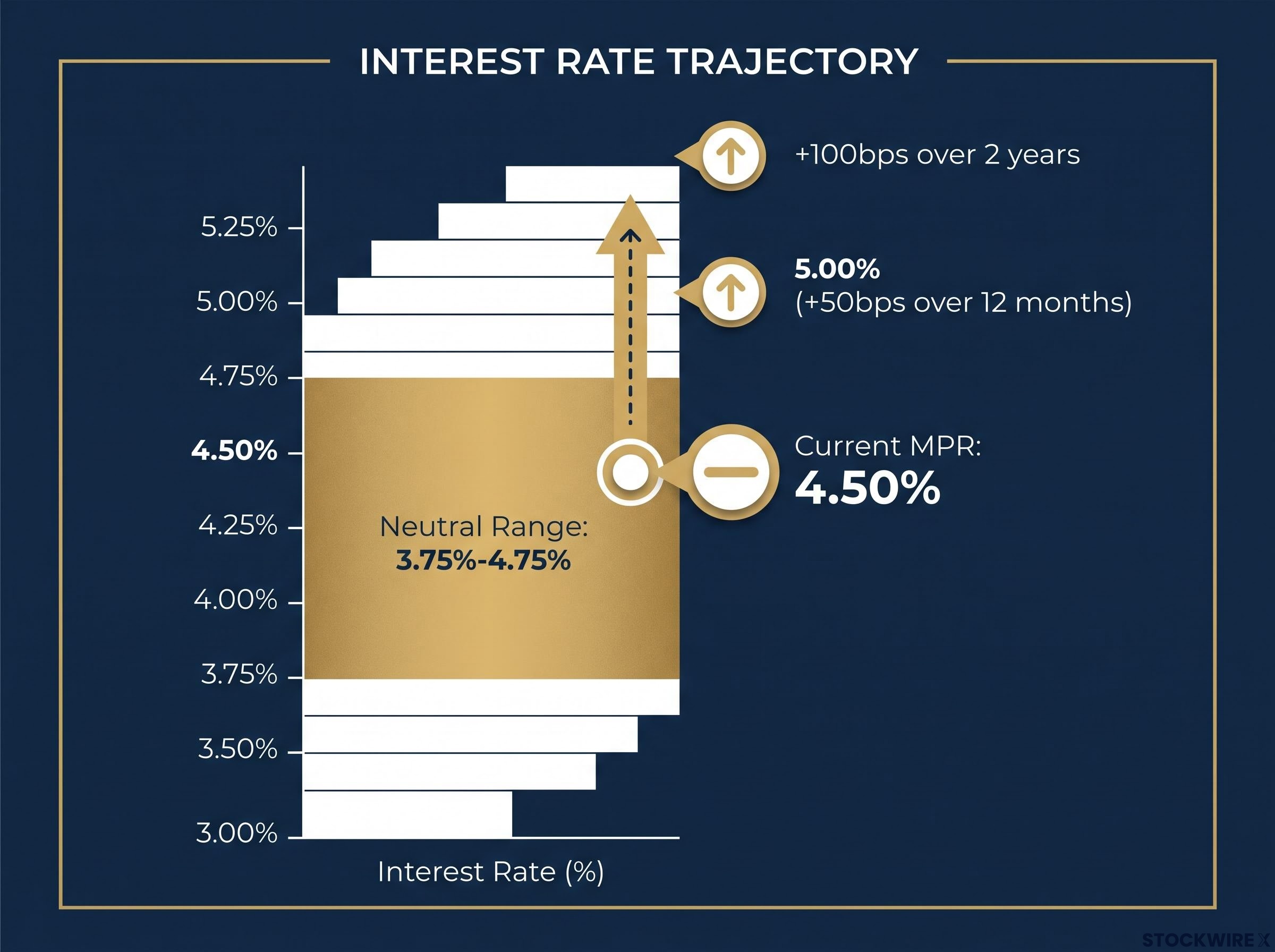
Everyone expects a hold. The curve does not expect the hold to last. Swaps price roughly 50bps of tightening over 12 months and about 100bps over two years.
In September 2026, the Board voted unanimously to keep the Monetary Policy Rate (MPR), the bank’s benchmark rate, at 4.50%. It also reaffirmed its target of bringing inflation to 3% within two years.
The bank’s September Monetary Policy Report projects headline inflation near 3% by the second quarter of 2027 and says the future path of the rate will keep being assessed meeting by meeting.
September statement: The bank said it would assess the future path of the rate “meeting by meeting”, with no automatic commitment to hikes or cuts.
BBH’s case rests on three points: weak activity, a policy rate near the top of the bank’s 3.75%-4.75% neutral range, and anchored inflation expectations. The neutral rate is the level that neither stimulates nor slows the economy. The bank’s own surveys of economists (EEE) and financial traders (EOF) both put two-year inflation expectations at 3%, which sits awkwardly with a tightening cycle.
| Indicator | Latest figure | Period | Policy signal |
|---|---|---|---|
| Imacec (monthly activity index) | -1.0% y/y; -0.7% m/m s.a. | August 2026 | Dovish |
| Non-mining Imacec | +1.4% y/y | August 2026 | Mixed |
| GDP | -0.2% q/q | Q2 2026 | Dovish |
| Headline IPC (consumer prices) | 4.1% y/y | September 2026 | Hawkish |
| Core inflation | 3.3% y/y | Latest | Near target |
What the hawks point to
Bloomberg’s preview on 27 October said markets were pricing a near-certain 25bp hike within six months. The April minutes, reported by Reuters on 7 May, showed some Board members saw grounds to contemplate a 25bp increase. August’s monthly IPC rise of 0.6% also came in stronger than expected.
What the doves point to
Q2 GDP shrank, and the September monetary policy report cut the 2026 growth forecast to 0.25%-0.75% from 1.0%-1.75%. At 4.50%, the MPR already sits close to the top of neutral.
If you hold peso loans or deposits, the weak activity data suggests the bank has less room to tighten than the curve implies, though not zero. Inflation at 4.1% keeps that door open.
How do you read swaps-implied rate expectations?
On a screen, the number looks simple: 50bps of hikes, a policy rate near 5.00%. A swap is a contract where two parties exchange fixed and floating interest payments, so its fixed rate reflects where traders think short-term rates are heading. That fixed rate is also carrying more than a forecast. It can include:
- Expected policy rates: traders’ view of the average MPR over the contract.
- Term premium: extra pay for holding rate risk over time, including fiscal and liquidity uncertainty.
- Inflation risk: compensation for energy, food or tariff shocks, even with expectations at 3%.
- Global rates: US Treasury yields and Federal Reserve expectations can lift Chilean swaps independently of the bank.
- Currency risk: a weaker peso can raise inflation and invite pricing of a tougher response.
- Liquidity and positioning: hedging demand or foreign flows can move thin local markets.
BBH’s view: Haddad argues the priced tightening path is too aggressive, with risk skewed toward a dovish repricing and a weaker peso.
That is one interpretation. The hawkish reading, documented by Bloomberg, says the curve is correctly flagging renewed inflation pressure. Historical meeting-day swap and peso moves are not available for this decision, so the table below shows mechanisms, not forecasts.
| Scenario | Statement tone | Likely swaps reaction | Likely CLP reaction |
|---|---|---|---|
| Plain hold | Meeting-by-meeting language | Some priced hikes removed | Weaker |
| Hawkish hold | Stresses inflation, currency or energy risks | Curve held or added to | Potential support from higher yields |
When you see a swaps-implied hike path, read it as a price for risk, not only a prediction. That is why a hold can still move rates and the peso sharply.
Chile is not alone in a split between hold expectations and market pricing: in Colombia, forecasters and markets disagree over whether a final hike is coming, with a record trade gap complicating the decision.
What does the copper/oil ratio mean for the peso?
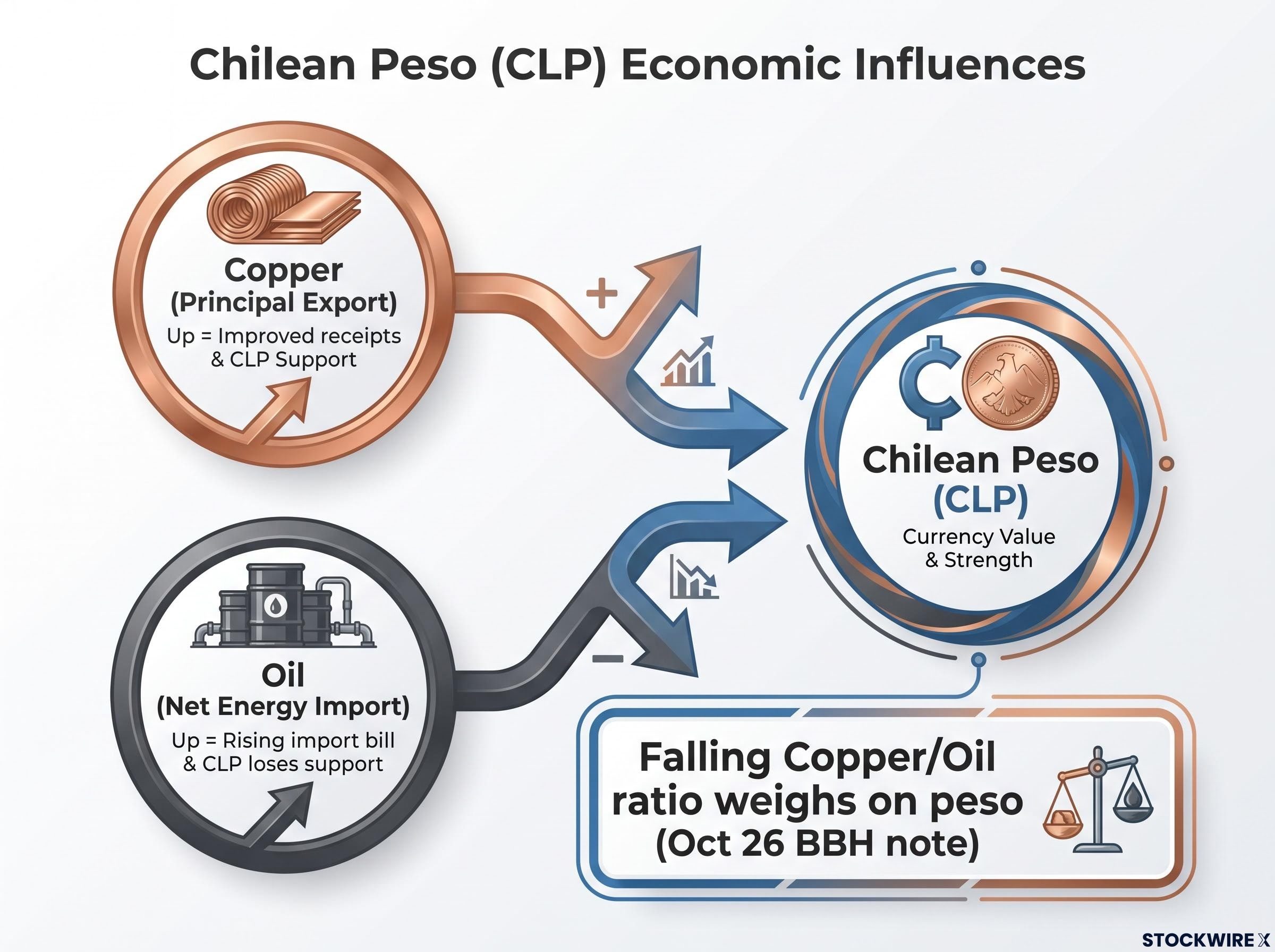
The statement’s wording is one driver of the peso, but trade flows are another. Copper is Chile’s principal export, and Chile is a net energy importer. Dividing the copper price by the oil price therefore gives a rough gauge of the terms of trade, meaning the value of what a country sells relative to what it buys.
- Copper up: export receipts and fiscal revenue improve, and the CLP generally finds support.
- Oil up: the import bill rises, domestic inflation pressure builds, and the CLP loses support.
On 26 October, BBH assessed that a falling ratio is weighing on the peso even with strong copper, because pricier energy offsets the gain. That marks a shift from Haddad’s 7 September note, which argued USD/CLP should be lower given the copper rally. Current spot levels for the peso, copper and oil are not included here.
Copper price drivers this year include US tariff front-running and a Chilean winter storm that cut production capacity, which helps explain why strong copper has not translated into a stronger peso.
If you earn in pesos but pay for imports or travel in dollars, a falling ratio tells you the currency’s usual copper cushion is thinner than the headline copper price suggests.
Where the dovish view could be wrong
- Copper upside: a fresh rally could lift the CLP.
- US-dollar strength: a broad dollar move can override local fundamentals.
- Inflation upside: IPC at 4.1% y/y could delay easing or prompt a hike.
- Tariffs and trade shocks: these could hit copper demand while raising imported inflation.
- Fiscal and political factors: slippage or election uncertainty could push rates higher.
- Mining weakness: the Imacec contraction shows high copper prices do not guarantee output.
The next scheduled catalyst after tonight is the 15 December 2026 decision.
What tonight’s decision changes, and what it does not
A hold at 4.50% is the expected outcome, and it was unconfirmed at the time of writing. The more telling signal will be the statement’s wording and whether the curve keeps its 50bps of priced hikes.
Watch how the bank describes inflation, currency and energy risks. Then track the next IPC and Imacec prints, the copper/oil ratio, and the 15 December meeting. Keep in mind that BBH’s dovish read is one perspective, set against a market and a Bloomberg preview that lean more hawkish.
This article is for informational purposes only and should not be considered financial advice. Investors should conduct their own research and consult with financial professionals before making investment decisions. Forward-looking statements are speculative and subject to change based on market developments.
If the statement leans on inflation risk tonight, the curve’s hike pricing is likely to hold through December. If it does not, expect that pricing to be tested.