
SAP has opened TechEd in Berlin by pushing its Joule AI agents beyond its own software. On 27 October 2026, the company said those agents should coordinate work across both SAP and non-SAP systems. It also said it plans to send one of its AI models to the International Space Station (ISS).
The bigger contest is over control. AI agents need data, business context and guardrails, and whoever supplies that layer is well placed to capture enterprise AI spending. SAP wants to be that supplier.
Here is how the pieces fit together, which claims are proven and which are only promised, and what to watch if you follow SAP or its rivals.
What did SAP actually launch for building and governing AI agents?
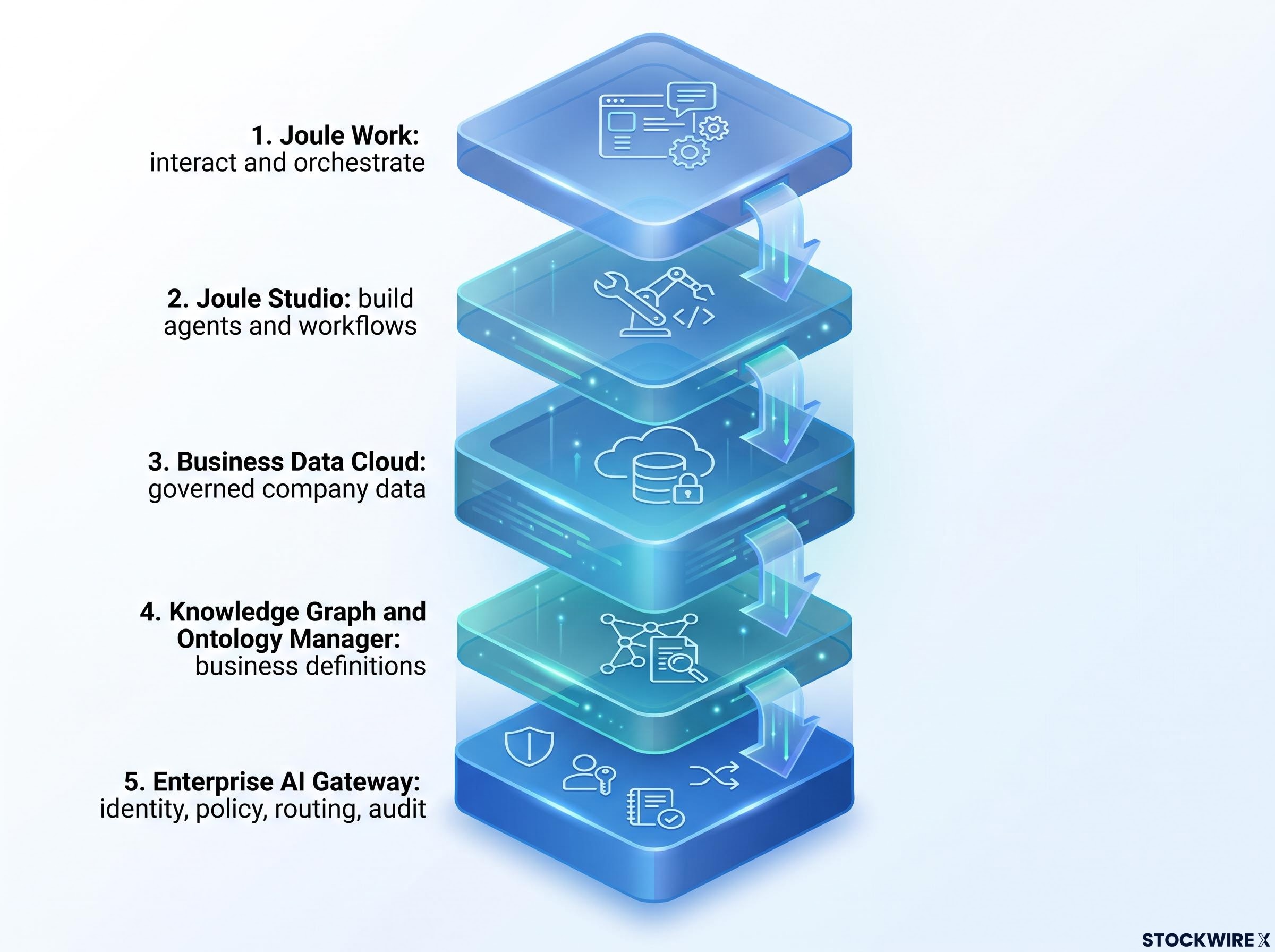
Think of it as a chain. Developers build an agent in Joule Studio, Joule Work runs it across business systems, and a new gateway decides what it may touch and records what it did. SAP describes five layers:
- Joule Work: where users interact and agents are orchestrated
- Joule Studio: where agents and workflows are built
- Business Data Cloud: governed company data
- Knowledge Graph and Ontology Manager: business definitions and how data relates
- Enterprise AI Gateway: identity, policy, routing, monitoring and audit
Building agents
Joule Studio offers no-code, low-code and pro-code options, with 70+ proprietary and open-source models. Early adopters can run n8n automation workflows inside it. Joule Work coordinates multi-step tasks using two open protocols: Agent2Agent (A2A), a standard that lets agents talk to each other, and Model Context Protocol (MCP), a standard for connecting AI models to tools and data.
Design-time tooling stays free within fair-use limits. Running custom agents on SAP’s managed runtime is free through December 2026, but only for select customers under a time-limited promotion.
Governing agents
The gateway handles authentication, policy enforcement, routing, monitoring, usage tracking and auditing across APIs, MCP, A2A and large language models. Third-party agents can call Joule agents through it. SAP positions Joule Assistant, SAP AI Agent Hub and a new AI Governance Assistant as supporting EU AI Act compliance.
SAP on customer data: The company says customer data remains customer-owned and is not shared with third parties to train or improve large language models.
New dashboards also track agent behaviour, model usage and spend. That tells you SAP expects agent sprawl and runaway costs to be the real buying concerns, so if you are evaluating agents, ask about governance and metering before features.
Cost dashboards matter because multi-step agents can consume far more tokens than a simple chat request, and cases of runaway AI spending have already shown how quickly uncapped access turns into bill shock.
When big ASX news breaks, our subscribers know first
How do Business Data Cloud and the new tabular models give agents something to reason over?
Fluent language is not enough. An agent approving an order must know how a customer, a delivery block and an approval limit relate. SAP’s answer is to ground agents in structured business data.
Data partnerships
The Knowledge Graph now draws on more SAP and non-SAP customer data, so staff can query their own information in plain language. The other additions share a theme: reach data where it sits rather than copying it.
| Component | What it does | Status |
|---|---|---|
| Ontology Manager | Maps relationships across SAP and third-party data | Announced |
| Dremio | Apache Iceberg and Polaris support; federated queries without moving data | Announced |
| SAP Databricks | Adds Lakeflow, Agent Bricks, Unity Gateway, Lakebase; links Joule with Genie | Expanded partnership |
| SAP Reltio | Unifies customer, supplier and product master records | Announced at SAP Connect |
| SAP-RPT-2.0 | Anomaly detection, embeddings, multi-table analysis | Announced |
| SAP-RPT-TS | Time-series forecasting, including demand planning in IBP | Announced |
| ISS deployment | Onboard telemetry analysis on HPE Spaceborne Computer-2 | Planned by early 2027 |
Tabular models and the ISS plan
A tabular model is AI trained on rows and columns, such as invoices or inventory records, rather than text. In SAP’s design, the language model chooses which tool to use, and the tabular model judges supplier risk or flags an abnormal order.
The space test puts SAP-RPT on HPE Spaceborne Computer-2 to triage anomalies, predict failures, rebuild missing sensor readings and score mission health. SAP links this to remote, disconnected work on Earth, a rationale not independently confirmed. Reporting found no accuracy, latency, energy or model-size figures, and no confirmation that crew will use it.
The signal is edge ambition. Until performance data appears, treat it as positioning, not proof of enterprise value.
What does the strategy mean for SAP investors and its enterprise software rivals?
SAP is bidding for the business-execution layer. Forrester reportedly reads Joule Work as the engagement layer for agents in finance, procurement and supply chain, though that analysis has not been independently confirmed.
| Vendor | Agent focus | Contrast with SAP |
|---|---|---|
| Salesforce | Agentforce across CRM, sales, service | Customer data strength; SAP claims deeper ERP grounding |
| Microsoft | Copilot across 365, Azure, Dynamics | Wider reach; SAP more specialised |
| Oracle | Agents in Fusion and Oracle Cloud | Closest suite rival for trusted ERP data |
| Workday | HR and finance workflows | Narrower in manufacturing and supply chain |
| ServiceNow | Cross-enterprise workflow, ITSM | SAP stronger where ERP transaction state matters |
This is a strategic comparison, not a benchmark. No independent 2026 study ranks these vendors on accuracy, cost or adoption.
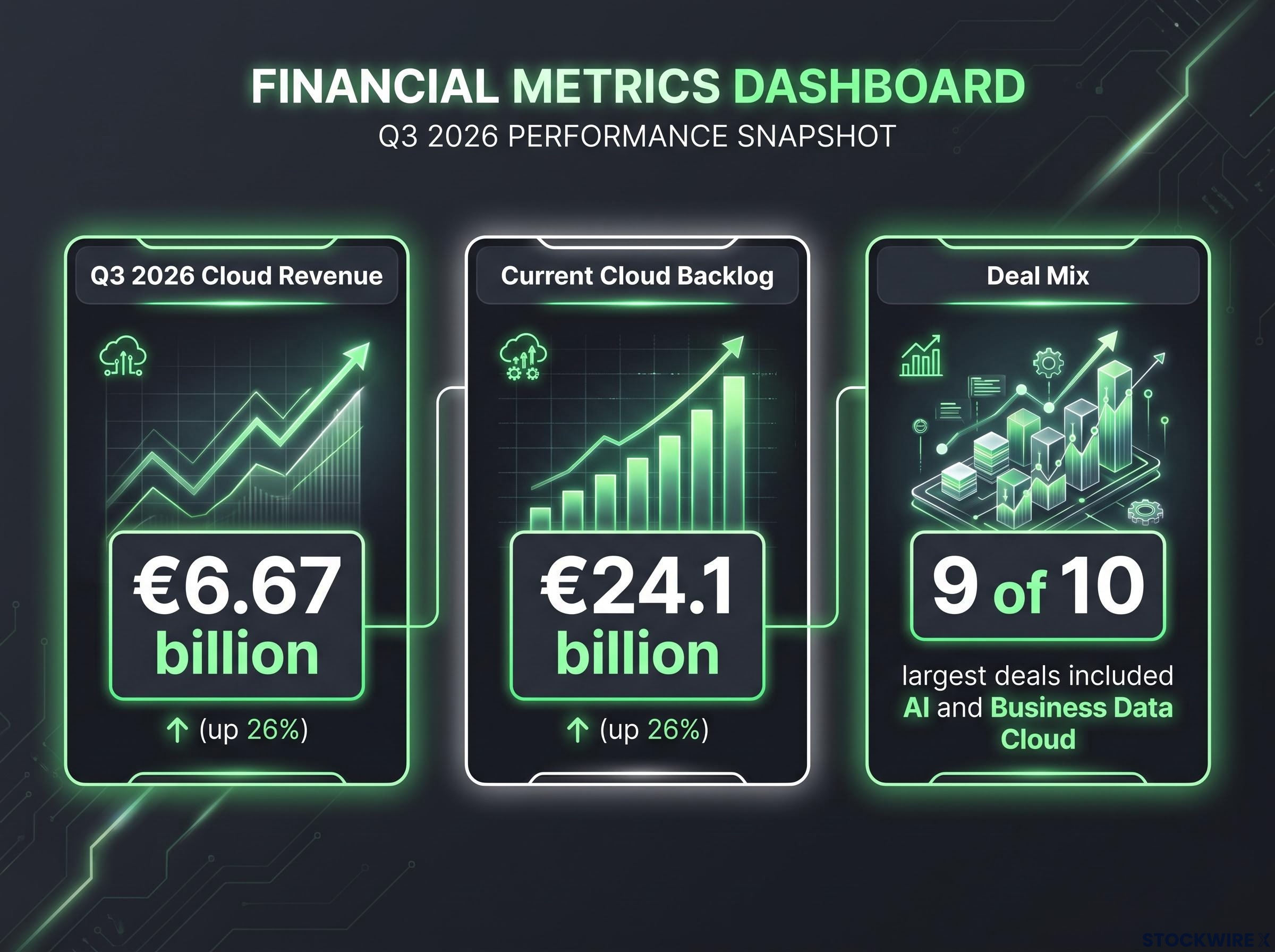
SAP’s Q3 2026 results, released this month, reportedly showed cloud revenue of €6.67 billion, up 26%, and current cloud backlog of €24.1 billion, up 26% at constant currencies. One outlet reported 28% backlog growth; the company figure is used here. Nine of the 10 largest deals reportedly included AI and Business Data Cloud components. None of these figures has been independently confirmed.
The deal mix is notable because BCG research found early adopters building on shared data foundations delivered 3.6x higher three-year shareholder returns than laggards, which is the advantage SAP is selling.
Analyst view: Holger Mueller of Constellation Research, quoted by SiliconANGLE, said the record results validated SAP’s AI and autonomous-agent strategy (not independently confirmed).
If you hold or track SAP, the deal mix suggests agents are already tied to large contracts. Read the strategy as credible, not proven. The advantage is strongest in SAP-heavy estates, and mixed environments need more mapping work. The “open” protocols still route traffic through SAP-controlled interfaces.
What are the unresolved risks behind the announcements?
SAP’s framing is confident. The evidence is thinner in four places:
- Governance: No independent production audits or EU AI Act assessments of the gateway or Joule Work have been found.
- Lock-in: Forrester reportedly cast SAP as a would-be AI gatekeeper that defines the protocol and meters traffic (unverified).
- Pricing: Free runtime and A2A interoperability end on 31 December 2026, and UpperEdge’s Michael Wesseler reportedly urged securing later pricing first (unverified).
- Sovereignty: No authoritative data-residency policy exists for the gateway, so prompts, telemetry and audit records may cross borders.
The ISS plan carries the same gap: no independent test results. For you as a buyer, that means getting post-2026 pricing and data-residency commitments in writing before any production rollout.
For readers weighing the gateway’s promises, our full explainer on external AI governance harnesses shows why compliance must sit outside the model itself.
What to watch after TechEd, and which claims still need proof
The stack hangs together: build, run, ground, govern. What it lacks is outside evidence. Three markers will show whether SAP’s agent bet is turning into revenue:
- Pricing once the December 2026 promotion ends
- First customer production results for Joule agents
- Any performance data from the planned early-2027 ISS deployment
Until then, weigh SAP’s agent strategy on contracts and audits, not keynotes.
This article is for informational purposes only and should not be considered financial advice. Investors should conduct their own research and consult with financial professionals before making investment decisions. Past performance does not guarantee future results. Forward-looking statements are speculative and subject to change based on market developments and company performance.