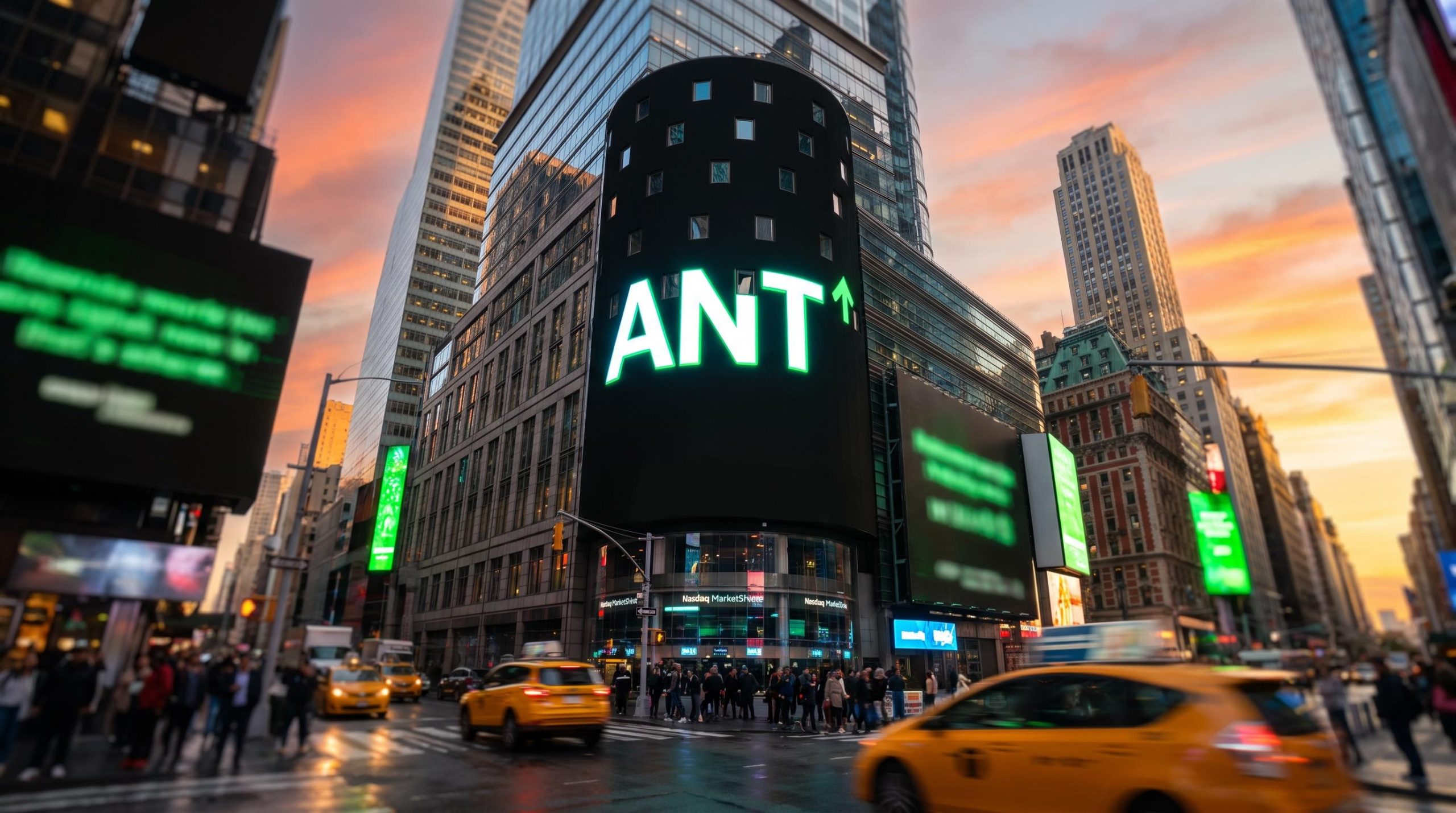
Anthropic has publicly filed to list on the Nasdaq under the ticker ANT, and the paperwork alone was enough to lift Wall Street and Asian chip stocks. On Monday, 26 October 2026, the S&P 500 rose 0.7% to 7,676.77 and the Nasdaq Composite gained 0.8% to 26,169.38 as investors weighed what could become a record Anthropic IPO.
The filing did not arrive alone. Meta set out plans to raise up to $95 billion in new equity, its largest raise ever. On the same day, Microsoft offered voluntary buyouts to as many as 60,000 employees.
Together, the three announcements show that the AI trade now turns on how the buildout gets paid for, not only on whether demand exists.
Here is what the market is pricing in, and which signals matter before a possible listing in mid-to-late November, potentially before Thanksgiving.
What does Anthropic’s filing actually show about the business?
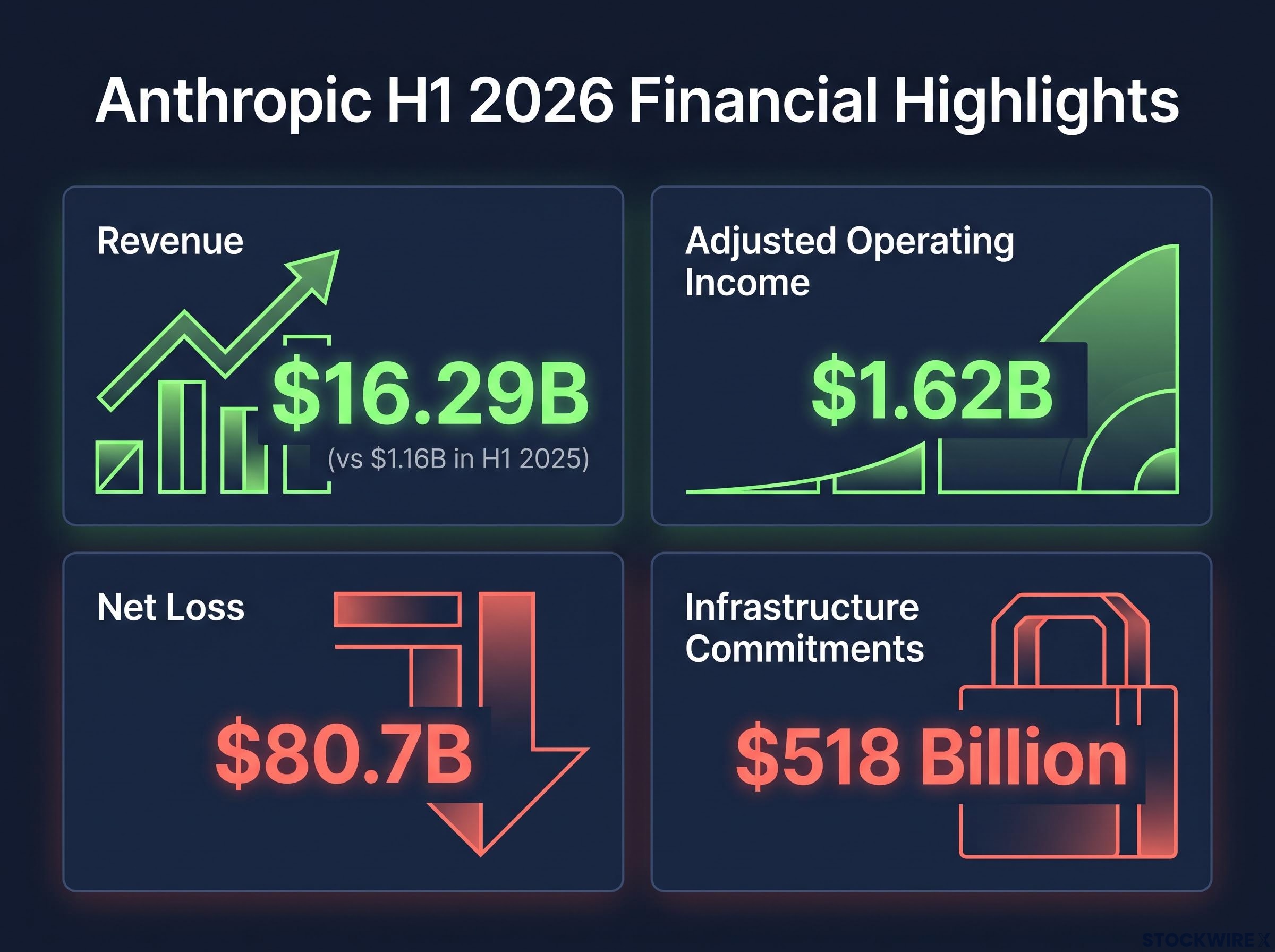
The number that grabs attention first is a $80.7 billion net loss for the first half of 2026. It looks alarming until you read the rest of the S-1, the registration document a company files with the Securities and Exchange Commission (SEC) before selling shares to the public.
Most of that loss comes from a non-operating accounting item tied to convertible bonds. These are bonds that can be swapped for shares, and their accounting value can swing with the company’s valuation. The operating loss was a much smaller $693 million. On an adjusted basis, which strips out certain non-cash and one-off items, Anthropic earned $1.62 billion.
| Metric | H1 2026 | Comparison |
|---|---|---|
| Revenue | $16.29B | $1.16B in H1 2025 |
| Consumption-based revenue | $13.1B | About 80% of total |
| Net loss | $80.7B | Largely convertible bond accounting |
| Operating loss | $693M | Not disclosed |
| Adjusted operating income | $1.62B | Adjusted loss of $1.85B a year earlier |
Second-quarter revenue grew 1,368% year on year, although the company warned that growth could decline and fluctuate. Goldman Sachs is lead-left on the deal, with Morgan Stanley also a lead underwriter, and the shares are slated for the Nasdaq Global Select Market.
A listing would make Anthropic the first public frontier AI laboratory, giving investors direct exposure that Nvidia, Microsoft and Google can only offer as indirect proxies.
Paul Meeks, Freedom Capital Markets Meeks said he was “pleasantly surprised” by the core financials, which came in stronger than the loss headline suggested.
The harder question is cash. The filing reportedly shows at least $518 billion of infrastructure commitments over a decade, about 80% of them noncancelable, meaning they must be paid regardless of usage. That gap tells you the debate is not about whether customers want the product. It is about whether future cash generation can keep pace with fixed bills.
What the filing leaves unsaid
The S-1 gives no share count, price range or proceeds, and the run-rate revenue line was left blank. The roughly $100 billion offering size is market speculation, not a company target. DW reported that an offering that large could top the reported $86 billion SpaceX IPO, but that remains unconfirmed.
Valuation talk among investors sits near $1.5 trillion, according to Reuters, down from almost $2 trillion. The private round in May raised $65 billion at $965 billion post-money.
When big ASX news breaks, our subscribers know first
Why are Meta and Microsoft turning to markets and headcount to fund AI?
Both companies face the same pressure: infrastructure costs are outrunning the cash their businesses generate. They have chosen different answers.
Meta reported negative free cash flow of $2.12 billion in Q3 2026, against positive $10.63 billion a year earlier. It was the company’s first negative quarter in more than a decade. Its raise is split into two parts:
- About $35 billion from underwritten common stock and mandatory-convertible preferred stock, which must convert into ordinary shares at a set point
- Up to $60 billion of non-voting Class C shares through an at-the-market programme, which sells stock gradually at prevailing prices, expected from Q1 2027
By one estimate, the full raise could dilute existing holders by about 6%, though that figure is unverified and depends on pricing.
Microsoft is working on the cost side instead. Its buyouts cover more than a quarter of its workforce in teams including AI experiences, Copilot, finance, HR, Xbox, and Windows + Devices, across the US, Canada, India and the UK. Reported expectations for its 2026 capital spending range from about $175 billion to $190 billion.
| Company | Move | Scale | Trade-off |
|---|---|---|---|
| Meta | Equity raise | Up to $95B | Dilution for shareholders |
| Microsoft | Voluntary buyouts | Up to about 60,000 staff | Lower operating spend, workforce disruption |
| Anthropic | IPO plus Blackstone junior debt | Yield above 10% on debt | Higher fixed financing costs |
Danske Bank strategists described big tech as leaning more on debt and equity markets than on internal cash flow. Axios’s report of Blackstone junior debt for Anthropic shows the same pattern reaching AI labs. If you own Meta or Microsoft, directly or through an index fund, you are helping fund the buildout through dilution or leaner operations. The return on that capital now matters more than the revenue story.
Credit markets are already ranking AI spenders by balance sheet strength, with Oracle bonds yielding about 7-8% against roughly 2.5-3.5% for Alphabet and Amazon, which gives context to the Blackstone debt yield above 10% for Anthropic.
How did markets react, and what are they pricing in?
The filing could have supported either a bullish or a bearish reading. Markets chose bullish.
| Market | Move | Date | Source |
|---|---|---|---|
| S&P 500 | +0.7% to 7,676.77 | 26 October | AP |
| Nasdaq Composite | +0.8% to 26,169.38 | 26 October | AP |
| Philadelphia Semiconductor Index | Up more than 2% | 26 October | Reuters |
| South Korean market | Up more than 4% | 27 October | Reuters |
| Samsung / SK Hynix | +4.8% / +7% (intraday) | 27 October | AP |
Danske Bank put the gain in global equities at 0.5%, and US futures were modestly higher overnight. The optimism came with conditions attached. Susannah Streeter of Wealth Club said enthusiasm for AI remains enormous, but investors are becoming more discerning.
Brad Bernstein, FTV Capital Bernstein sees Anthropic as an AI bellwether, warning that a poor public showing could create a “trickle-down effect” across the wider AI ecosystem.
Matt Kennedy of Renaissance Capital argued that a strong debut could revive the IPO market and give private AI companies a public valuation reference point. The rally tells you investors are paying for evidence of AI revenue. Your exposure to chip and AI-linked stocks now depends partly on how this one debut lands.
What could undercut the rally before a pre-Thanksgiving listing?
Momentum carried Monday. The weeks ahead will be decided by a handful of specific pressure points.
Near-term catalysts
Danske Bank pointed to the week of 16 November for a possible listing, subject to the roadshow and market conditions. Watch these in order:
- The S-1 amendment with a price range, which will show whether the $1.5 trillion talk holds
- Roadshow demand, including whether a large offering drains liquidity from other tech names
- Bond yields, since higher rates lift financing costs and cut the present value of distant profits
- Meta’s offering pricing, a read on appetite for AI-linked equity supply
Structural risks
Fortune highlighted concerns about circular financing, where chipmakers, cloud providers and AI labs invest in one another, potentially making demand look stronger than end customers justify. Concentration compounds that risk, because a slowdown at one hyperscaler, chip firm or lab could hit the others at once.
The scale gap is stark: $518 billion of commitments against $16.29 billion of first-half revenue. Reuters reported analysts expect AI valuations to correct if debt-market unease persists. Sceptics draw dot-com comparisons, though Anthropic already reports substantial revenue.
The price range, the first-day reaction and bond yields are the three signals that will tell you whether this rally is durable before you add AI exposure.
For investors weighing an order, our full explainer on judging the Anthropic IPO shows the revenue growth rate a $2 trillion entry price requires to earn 10% a year.
What the rally confirms, and what the listing will still have to prove
Monday’s moves endorsed AI demand, not current valuations. Anthropic’s filing and the Meta and Microsoft moves together show the buildout is increasingly funded by outside capital, through equity, debt and cost cuts.
The outcome that matters is whether public investors will fund the next stage at these multiples. The Anthropic IPO is that test. Watch the price range and first-day trading, and treat headline-driven AI swings with the discernment Streeter describes. Many figures here, including offering size and valuation, are reported rather than disclosed and may change.
This article is for informational purposes only and should not be considered financial advice. Investors should conduct their own research and consult with financial professionals before making investment decisions.