The Anthropic IPO finally has a prospectus behind it. On 26 October 2026, the maker of Claude filed to list on Nasdaq under the ticker ANT. Yet you cannot buy a single share today, and no retail allocation has been announced.
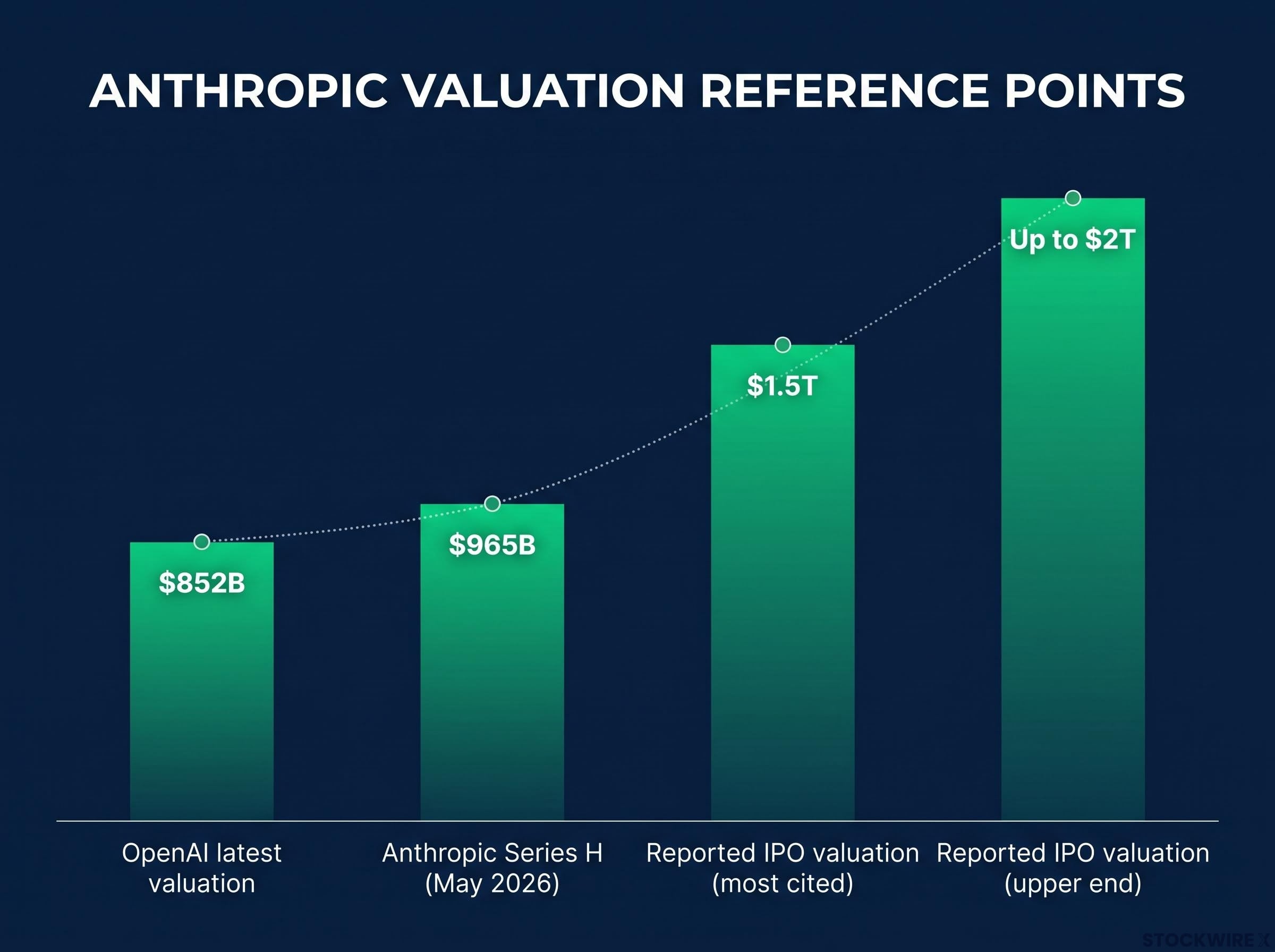
That gap between the headlines and your actual access matters. Reporting points to a possible debut before Thanksgiving. Reported valuations run from about $1.5 trillion to $2 trillion, against $965 billion in a private round in May.
Excitement like this tends to produce shortcuts: funds that claim a slice of Anthropic, private-share offers and “proxy” stocks. Some are legitimate. Others may not be what they appear.
This guide sorts the real routes from the shaky ones and shows you what the financials say about the risk you would be taking on.
What do we actually know about the Anthropic IPO so far?
Start with what is on paper. The prospectus, known as an S-1 (the registration document a company files with US regulators before selling shares to the public), settles some questions and leaves the biggest ones open.
Confirmed in the prospectus
- Venue: Nasdaq Global Select Market
- Proposed ticker: ANT
- Lead banks: Goldman Sachs and Morgan Stanley, supported by a syndicate of more than 20 firms, including JPMorgan, Citigroup, Barclays and UBS
- H1 2026 revenue: $16.3 billion, compared with roughly $4.6 billion for all of FY 2025
- Status: The stock cannot be bought yet
That revenue jump is the headline the bankers will lean on. Six months of 2026 brought in more than three times the full prior year.
Still unknown
The prospectus gives no exact date, no price range, no valuation and no retail allocation. Those are the numbers that decide what you would pay, and every one of them is still reporting rather than filing.
| Reference point | Valuation | Source status |
|---|---|---|
| Anthropic Series H (May 2026) | $965B post-money | Completed private round ($65B raised) |
| Reported IPO valuation (most cited) | $1.5T | Media reporting, not in prospectus |
| Reported IPO valuation (upper end) | Up to $2T | Morningstar reporting, not in prospectus |
| OpenAI latest valuation | $852B | After raising $122B |
At $1.5 trillion, the listing would price Anthropic about 55% above the round investors bought into five months ago. New buyers would be paying for growth that private investors have already captured. You should treat the listing price as the point where your risk starts, not as a bargain.
When big ASX news breaks, our subscribers know first
How can you buy Anthropic shares: at the IPO, on day one, or before?
Think of access as a ladder. The rungs at the top look most attractive and are hardest to reach.
- Retail IPO allocation, if one is created
- Open-market purchase once ANT starts trading
- Indirect exposure through funds or listed shareholders (covered in the next section)
Retail IPO allocation, if it materialises
In an IPO, the company and its banks decide who gets shares at the offer price. Institutional demand is usually heavy and the supply set aside at that price is small, so ordinary investors rarely get much.
If a retail channel opens, the process typically works in three steps. You submit a conditional indication of interest (a non-binding request for shares) through an eligible broker. You confirm once the price is set, and then you receive a partial allocation or none at all.
Key point: An indication of interest is a request, not a reservation. You may receive fewer shares than you asked for, or nothing.
No retail or directed-share programme had been announced as of today. The prospectus says underwriters may allocate shares to their online brokerage customers, and NerdWallet identifies **E*TRADE**, owned by Morgan Stanley, as the likeliest access point. For the SpaceX IPO in June, E*TRADE, Fidelity, Charles Schwab, Robinhood and SoFi all offered shares, but Anthropic has not said it will copy that model.
Buying ANT once it trades
This is the dependable route. Any broker that supports Nasdaq stocks will let you buy once trading opens, with no allocation lottery. The trade-off is opening-day volatility: popular listings often open well above the offer price, and you may pay that premium.
Pre-IPO shares for accredited investors
Accredited investors (people with $1 million in net worth, or income of $200,000 individually or $300,000 jointly, or certain financial licences) can buy private shares on platforms such as Forge Global and Hiive. Both say Anthropic shares are not available there, although OpenAI shares are. Anthropic says share sales require board approval and that unofficial third-party sales may be illegitimate.
Pre-IPO access is expanding through secondary platforms and listed vehicles, but it carries illiquidity, opaque valuations and dilution risk, so you should see unsolicited offers as a warning sign, not a shortcut.
Unless a retail allocation is announced, your realistic entry point is the open market on day one. Plan for price swings rather than counting on an IPO-price fill, and treat any unsolicited pre-IPO offer with suspicion.
Do funds and public stakeholders give you real Anthropic exposure?
If you cannot get in directly, the workaround is tempting: buy something that already owns Anthropic. The numbers show how much these routes dilute or complicate what you actually hold.
Funds claiming a stake
NerdWallet screened SEC EDGAR filings and fund websites, with data current as of 26 October 2026, for funds reporting at least 2.5% of assets in Anthropic.
| Fund | Ticker | Reported Anthropic share of assets |
|---|---|---|
| Destiny Tech100 | DXYZ | 14.40% |
| Tema Photonics & Optical ETF | LAZR | 10.47% |
| BlackRock Technology & Private Equity Term Trust | BTX | 8.61% |
| BlackRock Science & Technology Trust | BST | 7.25% |
| BlackRock Science & Technology Term Trust | BSTZ | 5.82% |
The top two carry a warning. DXYZ and LAZR hold special purpose vehicles (SPVs), which are separate entities set up to own an asset on behalf of investors, and Anthropic prohibits SPV investments. NerdWallet flagged this as suspicious, and an Anthropic spokesperson declined to comment or verify the funds’ legitimacy.
Even a verified holding brings structural risks:
- Premium risk: Commentary has reported DXYZ trading at roughly 200%-400% above the value of its holdings at times (unverified). If that premium shrinks, you can lose money even while Anthropic rises.
- NAV uncertainty: Net asset value (the estimated worth of a fund’s holdings per share) is hard to measure for private companies, and estimates can be revised.
- Fees and illiquidity: Management, incentive and transaction fees apply, and assets may not be redeemable at stated value.
Listed companies that own a piece
| Company | Role | Reported investment | Stake note |
|---|---|---|---|
| Alphabet | Hardware and cloud supplier | Stake worth over $120B | Above 12%; Bloomberg valued it at ~$124B as of 30 June 2026 |
| Amazon | Hardware and cloud supplier | At least $33B invested | S-1 reportedly caps stake at 12%; 15%-21% economic estimates unverified |
| Nvidia | Hardware supplier | $10B | Current percentage not found |
| Microsoft | Cloud supplier | $5B | Current percentage not found |
| AMD | Hardware supplier | $5B (late July 2026) | Current percentage not found |
These stakes sit inside far larger businesses, so a rise in Anthropic’s value moves the parent only slightly. For Nvidia and AMD, Anthropic matters more as a chip customer; for Alphabet and Amazon it is also a competitor to their own AI products. Reuters reportedly linked parent share gains during the filing coverage to broad AI sentiment rather than Anthropic itself.
The test is simple: how much Anthropic do you own per dollar? A double-digit fund weighting can leave you paying a premium for unverifiable assets, and a supplier stock is a diversified bet in which Anthropic is one small part.
Investors exploring fund routes can read our dedicated guide to indirect Anthropic exposure, which compares regulated vehicles and the dual equity-and-vendor stakes held by large-cap tech.
Should you worry about the losses, the valuation and the weak AI IPO record?
Anthropic lost $80.7 billion in the first half of 2026. That number looks alarming, and most of it is not what it seems.
Why the net loss looks so large
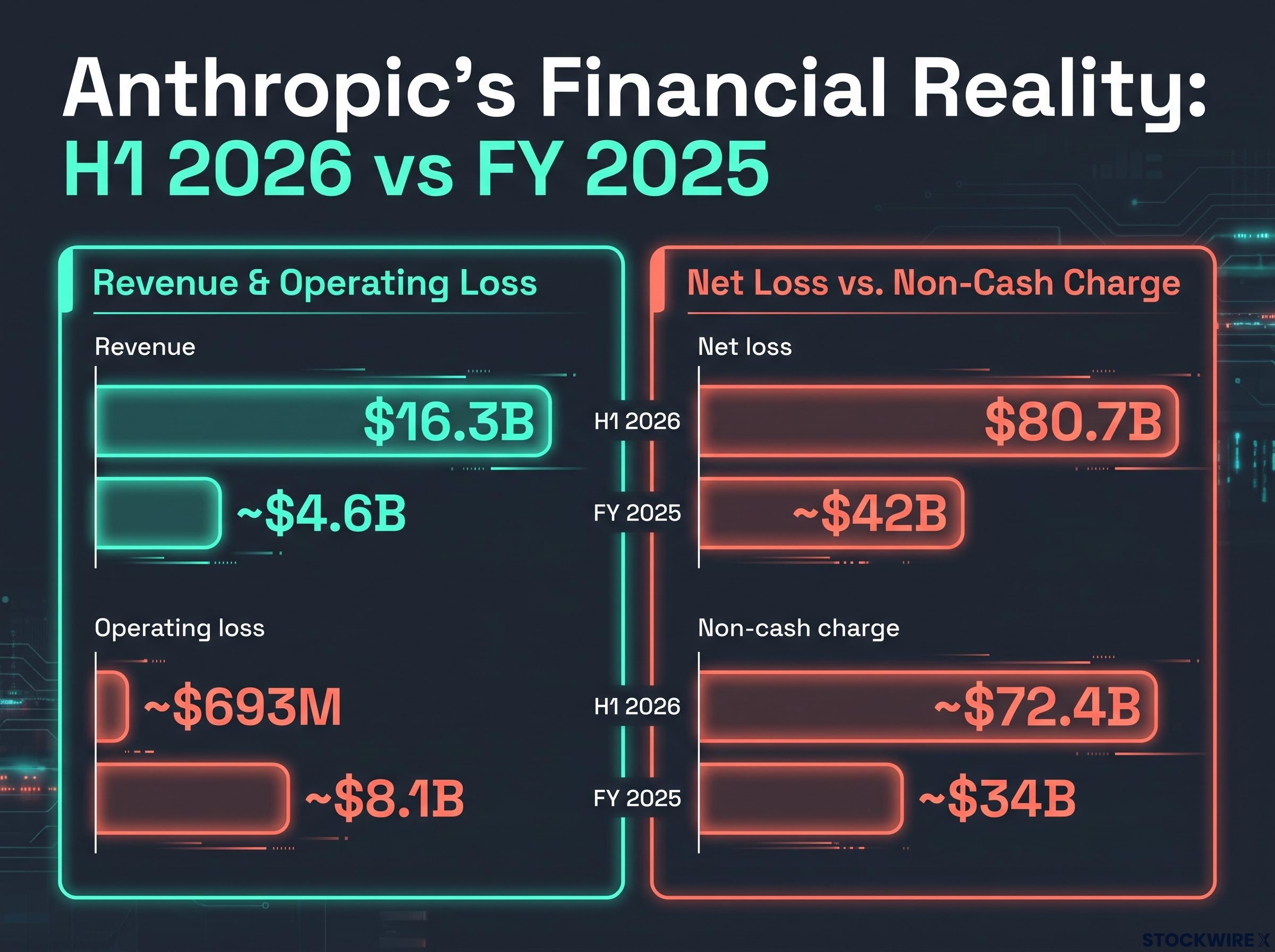
About $72.4 billion was a non-cash charge. Early investors hold convertible instruments that are recorded as liabilities, and as Anthropic’s valuation climbed, so did their estimated value. The increase is booked as a loss, but no comparable cash left the business.
| Metric | H1 2026 | FY 2025 |
|---|---|---|
| Revenue | $16.3B | ~$4.6B |
| Operating loss | ~$693M | ~$8.1B |
| Net loss | $80.7B | ~$42B |
| Non-cash charge | ~$72.4B | ~$34B |
The operating loss tells you more about the business: roughly $693 million, and Q2 revenue above $11.5 billion came with positive adjusted operating income. NerdWallet pushes back, arguing that combining investment and operating results shows more lost in H1 2026 than in all of 2025.
What still deserves caution
Strip out the accounting noise and real pressure points remain:
- Valuation: Morningstar and PitchBook reportedly calculated that $2 trillion equals nearly 31 times the July revenue run rate (unverified).
- Margins: One Morningstar-cited analysis estimated gross margin at about 44%, which would need to improve materially.
- Commitments: Heavy long-term compute deals span Amazon Trainium, Google TPUs, Nvidia and AMD, creating supplier dependence.
- Track record: Big AI IPOs have struggled recently.
NerdWallet’s warning: Recent large AI IPOs have performed poorly, and Anthropic investors should prepare for a similar outcome.
SpaceX is the reference point, though sources conflict. NerdWallet says it has often traded below its $135 IPO price since June; other reports cite a high near $225 and a $147.49 close on 23 October (unverified). Either way, early buyers near the peak have lost a large share of their money.
The headline loss overstates cash burn, but the valuation still assumes near-flawless execution. Size any position as if a SpaceX-style slump is plausible. Past performance does not guarantee future results, and projections are subject to market conditions and risk factors.
Choosing a route that fits your risk tolerance before ANT lists
Your best move right now is patience. Wait for the price range and final date, and watch whether E*TRADE or the other eligible brokers announce a retail allocation.
If none appears, open-market buying is your default, with a firm limit on how much you commit. Treat funds and supplier stocks as separate bets with their own risks, and check fund premiums before buying.
Above all, judge ANT by how it fits your whole portfolio. As NerdWallet suggests, a financial adviser can help you weigh that.
The AI valuation trap extends beyond direct buyers: passive index funds and retirement accounts could be forced to hold AI listings at prevailing prices, so check your total AI concentration before adding ANT.
This article is for informational purposes only and should not be considered financial advice. Investors should conduct their own research and consult with financial professionals before making investment decisions. Forward-looking statements are speculative and subject to change based on market developments and company performance.