You watched a headline IPO pop on its first day of trading. The excitement was real, the stock jumped, and buying in felt like joining the winners. Twelve months later, it was drifting sideways or lower, and everyone who mattered seemed to have already made their money somewhere you never saw.
That gap is not bad luck. It has a structural explanation, and once you see it, you cannot unsee it.
An initial public offering is a liquidity event built primarily for insiders, not for the public buyers who show up after most of the gains have already been captured. The stretch of time between a company’s earliest funding rounds and its listing date is where the bulk of wealth creation in high-growth companies happens. Historically, that window has been closed to nearly everyone in the retail crowd.
This breaks down exactly why the disadvantage exists, what it looks like in practice with real examples, and what you can actually do to position yourself closer to the value-creation window without taking reckless risks. Understanding pre-IPO versus post-IPO investing starts with a simple question you have probably never asked: who already made their money before you got the chance?
The party before the party: where wealth is actually created in a company’s lifecycle
A company does not go public on day one. It climbs a ladder of private funding rounds first, and each rung comes with a higher valuation because the risk has dropped a little further.
It starts at the seed stage, when the business is often little more than a team and an idea. Founders and angel investors put money in at the lowest possible price, absorbing the highest risk. If the company survives, they capture the highest multiple of anyone.
Then come the venture rounds. Series A, B, and C each mark a step-up in valuation as the company proves demand, scales revenue, and de-risks its model. By the pre-IPO secondary stage, sophisticated funds are buying shares from earlier holders at a price that already reflects most of the growth story.
Here is the sequence:
- Seed: Founders and angels. Highest risk, highest potential multiple.
- Series A: Early venture capital. Product proven, still fragile.
- Series B: Growth venture capital. Scaling revenue, risk falling.
- Series C: Late-stage venture and crossover funds. Near-maturity pricing.
- Pre-IPO secondary: Institutions and specialist platforms. Growth largely priced in.
- IPO: The public. Insiders exit, you enter.
- Post-IPO: Open market. Full public valuation, remaining uncertainty yours.
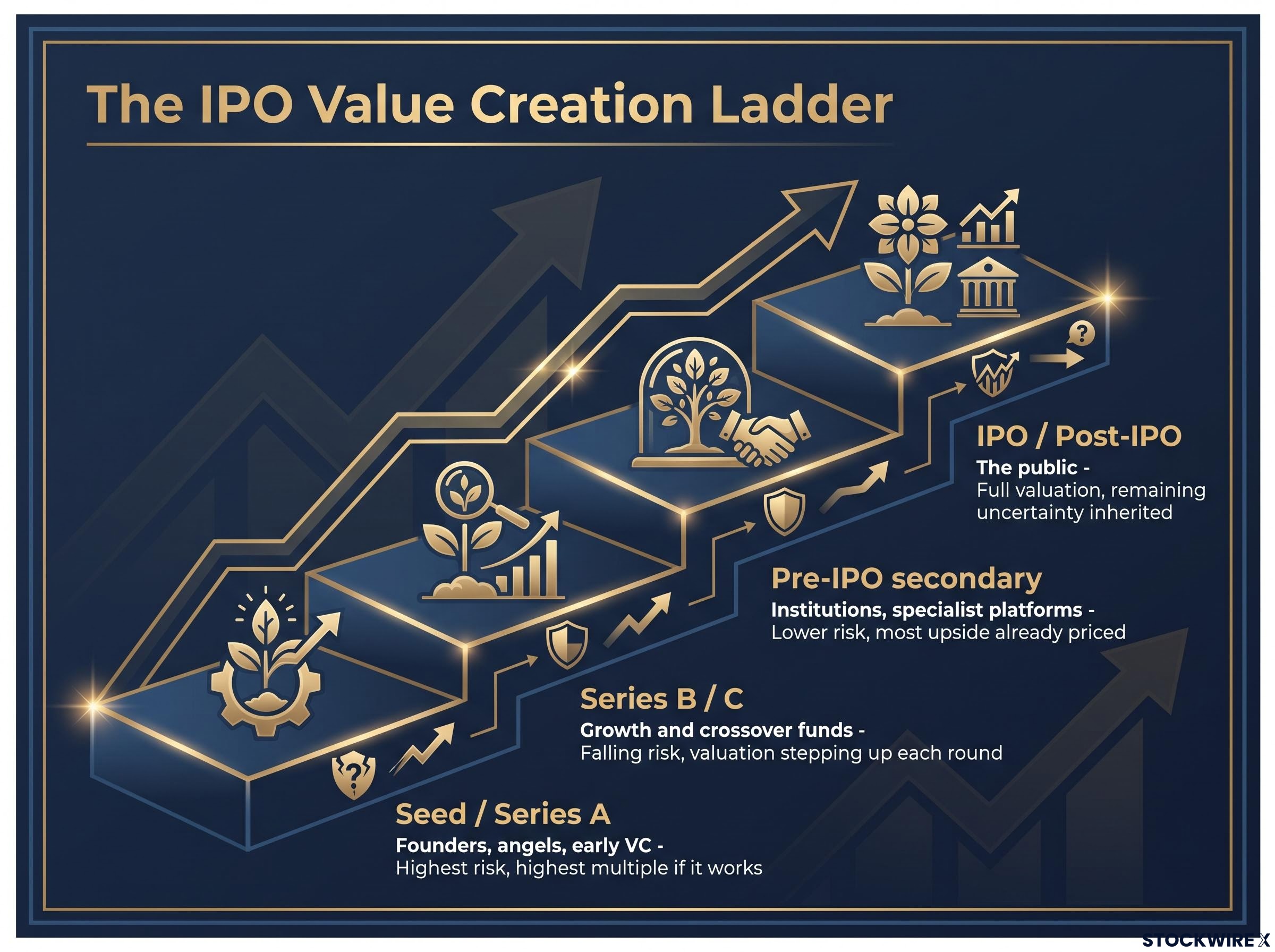
| Stage | Typical Investor | Risk / Return Profile |
|---|---|---|
| Seed / Series A | Founders, angels, early VC | Highest risk, highest multiple if it works |
| Series B / C | Growth and crossover funds | Falling risk, valuation stepping up each round |
| Pre-IPO secondary | Institutions, specialist platforms | Lower risk, most upside already priced |
| IPO / Post-IPO | The public | Full valuation, remaining uncertainty inherited |
The IPO is not a discovery event. It is a structured exit for the people who priced the risk years earlier and now want to sell.
Look at Facebook’s 2012 IPO. Early private backers including DST Global, Goldman Sachs, and Reid Hoffman captured enormous private-stage gains, while public buyers got a flat debut and months of volatility. Ron Baron’s early backing of Tesla and SpaceX, whose IPO completed in June 2026, tells the same story: the outsized returns came from private access. High-profile names like OpenAI and Anthropic remain private, meaning that value is still being created out of your reach.
Even the offer price itself is a discount. A study of Taiwan’s Emerging Stock Market found IPO offer prices set at an average of 67% of pre-market prices, producing initial returns of roughly 55%. By the time a company lists, you are not buying early access to a growth story. You are buying the expensive end of a story that already happened for someone else.
When big ASX news breaks, our subscribers know first
The burning match explained: why buying at the IPO already means buying late
The first-day pop feels like a gift. The stock lists, it jumps, and getting in on day one feels early. It is not.
Think of an IPO as a lit match passed hand to hand. Each holder takes on more heat and less remaining fuel. Insiders lit it years ago and have been passing it down the chain ever since. By the time it reaches you, most of the match has already burned.
The mechanics work against you structurally, not because of one bad decision. Institutional investors with sophisticated valuation models selectively bid on the highest-quality IPOs and receive preferential allocation at the offer price. Retail buyers end up over-represented in weaker issues or forced into the open market at inflated first-day prices.
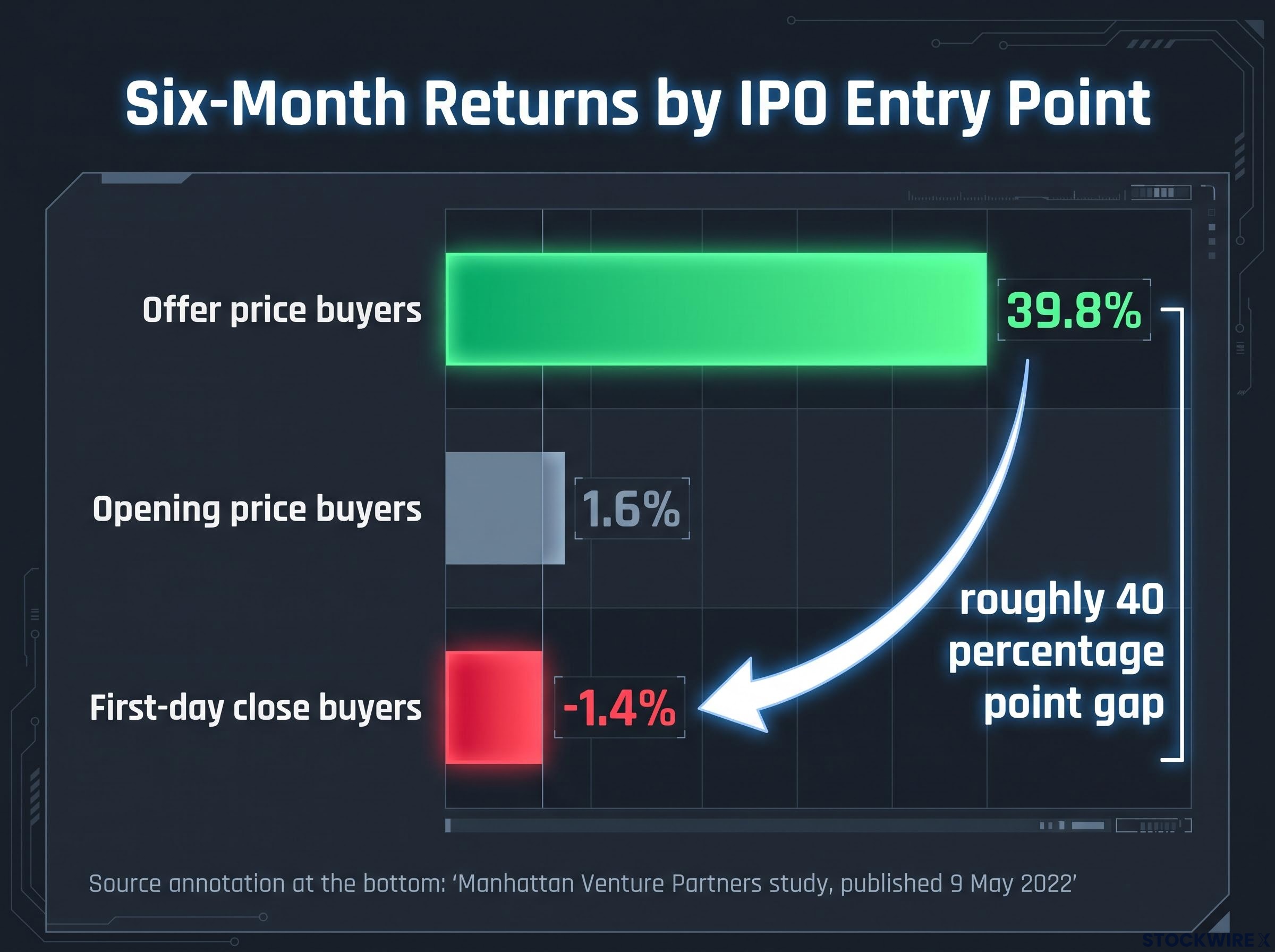
That entry price matters more than the company itself. A Manhattan Venture Partners study, published 9 May 2022, tracked returns by entry point over six months. The pattern is well-documented in academic literature even where the exact figures remain unverified.
IPO performance factors including valuation relative to peers, investor base composition, and the conservatism of initial guidance are largely locked in before the first trade executes, meaning business quality and deal construction quality are two separate variables that retail buyers routinely conflate.
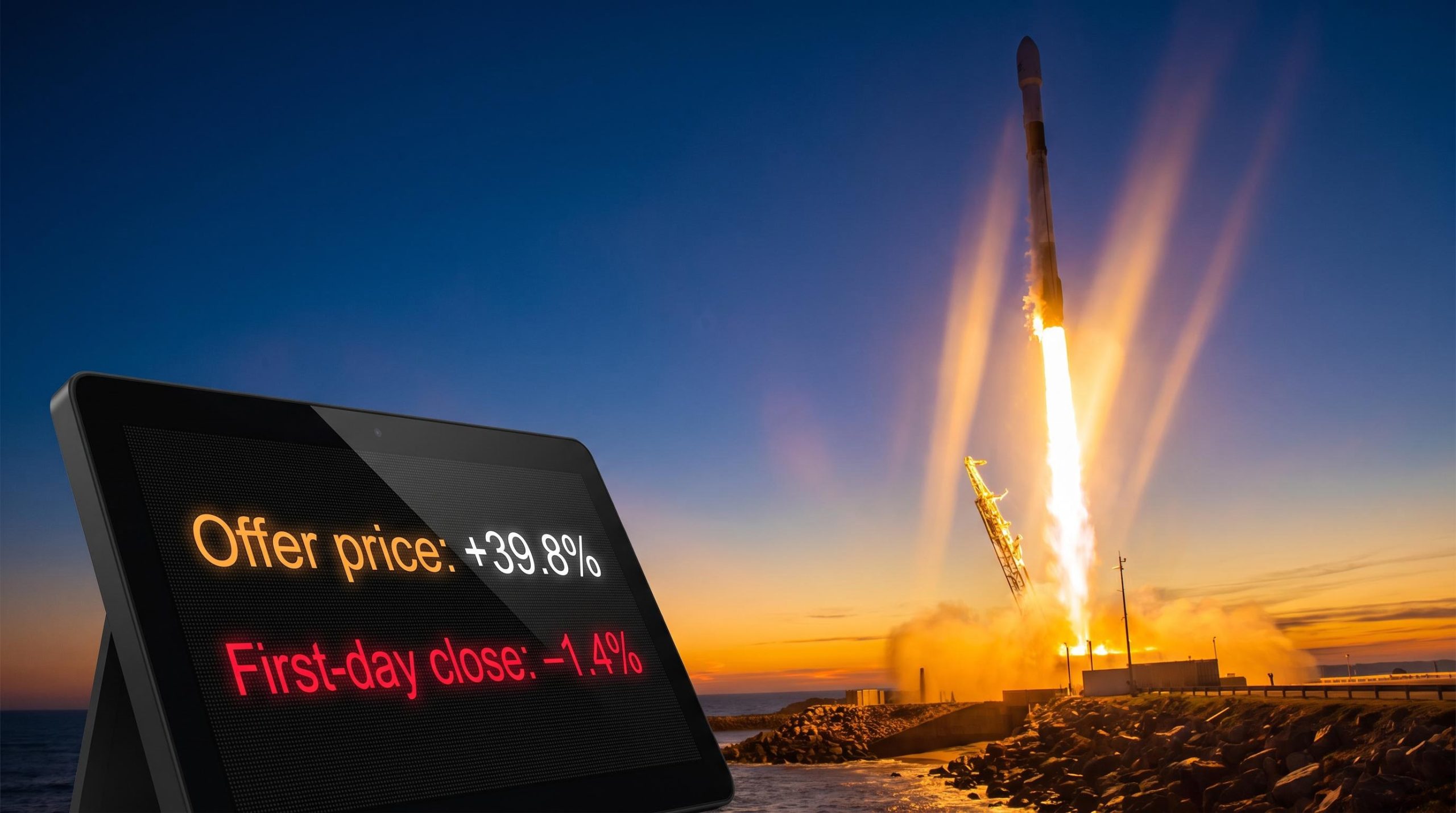
Six-month returns by entry point (illustrative, unverified figures) Offer price buyers: 39.8% Opening price buyers: 1.6% First-day close buyers: -1.4%
That roughly 40 percentage point gap between the offer price and the first-day close tells you something uncomfortable. The single biggest driver of your IPO outcome is not the quality of the business. It is the price at which you personally entered, and most retail buyers enter at the worst available price.
The broad numbers reinforce the trap. According to Jay Ritter’s data, US IPOs since 1980 have averaged roughly 19% first-day returns. Nasdaq reported the average 2024 pop at 15.3% in February 2025, and one 2026 review put the 2025 mean first-day return at 29.3% with a median of 13.7% (figures unverified). Big pops attract attention, and a 2025 SSRN paper found heavily marketed “retail IPOs” underperformed their peers by about 20 percentage points in the first year.
What happens when the lock-up expires
Lock-up periods, usually 90-180 days after listing, legally stop insiders from selling straight away. That restriction is temporary, and its expiry is a known date on every calendar.
Sophisticated investors price in the coming flood of insider shares before it arrives. A 2000-2020 study documented a cumulative abnormal return of approximately -0.94% in the five days before expiration, a signature of anticipatory selling.
If you chased the first-day pop, you are frequently still holding when that selling wave hits. The disappointment you may have felt was not a misjudgement of the business. It was the structural position you occupied in the queue.
Can retail investors actually access the pre-IPO stage, and at what cost?
The obvious question is whether you can get in earlier. The honest answer is sometimes, through legitimate channels, but every door comes with friction and real hazard.
Several routes genuinely exist:
Listed vehicles for private market access, such as ASX-traded structures that hold stakes in companies like Anthropic and OpenAI at the portfolio level while issuing publicly traded units, represent one structural attempt to solve the accreditation and liquidity constraints that otherwise keep retail investors outside the pre-IPO stage entirely.
- Secondary platforms (Forge Global, EquityZen): Buy shares from existing private holders. Mostly restricted to accredited investors.
- Regulation CF and Regulation A+ crowdfunding: Open to non-accredited investors, but often smaller or earlier-stage companies with thin disclosure.
- Fractional feeder funds (Moonfare and equivalents): Pooled access to private funds, with fees and minimums attached.
The direction of travel is toward wider access. Commentary from the World Economic Forum and KPMG through 2025 and 2026 points to regulatory momentum opening private market value creation to retail capital. This is a genuinely developing area, not marketing spin.
The hazards are equally real. Private shares are illiquid, with no guaranteed exit until a liquidity event that may never come. Valuations are opaque with no daily mark-to-market discipline, future funding rounds can dilute you, and the IPO can arrive as a down-round or not at all.
WeWork is your calibration point. Before its failed IPO, investors including SoftBank allocated capital at valuations exceeding US$48 per share, then watched that valuation collapse. Pre-IPO access is not a guaranteed upgrade. It is access to a different risk profile that can still destroy capital, and it demands the same disciplined scepticism as any speculative position.
Institutions share the caution. Stanford GSB in 2025 and Allianz in May 2026 warned that pushing retail money into private equity can magnify systemic risk given the complexity and illiquidity involved. Even the optimistic return data comes with caveats: Client Associates tracked 25 tech IPOs from May 2020 to June 2025 and reported average returns of 43% for pre-IPO investors, 36% for IPO-stage buyers, and 32% for post-listing buyers (figures unverified, directional only).
A practical fraud warning from the SEC Pre-IPO stock pitches arriving via cold calls or unsolicited emails, often using real company names like Facebook, Twitter, or Groupon, are a documented fraud category. If a pre-IPO offer reaches you unsolicited, treat it as almost certainly not legitimate.
What retail investors can actually do: adjacent strategies that capture some of the upside
You cannot fully replicate pre-IPO access without accreditation and a tolerance for binary outcomes. What you can do is participate in the same growth themes through routes that are open, liquid, and honest about their trade-offs.
Three categories are worth your attention:
- Small-cap speculation with conservative sizing. Capture early-stage upside in companies that have not yet reached large-cap status. The trade-off: most bets fail, so position size does the risk management, not stock picking alone.
- Royalty and BDC income structures. Access private company cash flows with income predictability instead of an IPO-or-bust outcome. The trade-off: you sacrifice explosive upside for yield.
- Adjacent sector infrastructure plays. Rather than buying a stretched-valuation AI startup, own the companies supplying what those startups need. The trade-off: correlated exposure, but indirect.
On the income side, Main Street Capital (MAIN), a Business Development Company that lends to and invests in private firms, offers a forward dividend yield in the mid-to-high 7% range as of mid-September 2026 (around 7.73% to 7.80% per StockAnalysis and DivvyDiary, figures unverified). Original sourcing put roughly 1% of its portfolio in default. That is private company exposure with a cash return, not a bet on a single listing.
Private credit stress accumulated quietly across 2025 and 2026, with public BDCs holding comparable assets trading at discounts of 17-26% to stated net asset values and over $7 billion in redemption requests going unfulfilled across the 12 largest non-traded BDCs in Q1 2026 alone, a context that matters when sizing any income-focused exposure to private company cash flows.
On the infrastructure side, the AI and electrification build-out is lifting physical commodities. Benchmark LME copper futures hit an all-time high of roughly US$14,533 per metric ton on 7 September 2026, a gain of about 16% year-to-date, driven by data centre and electrification demand. Uranium tells a parallel story, with TradeTech’s U₃O₈ spot indicator around US$90 per pound by mid-September 2026, supported by the nuclear energy thesis tied to data centre power needs.
Sizing speculative positions so a loss stays manageable
This is the single most actionable idea in the piece. A speculative allocation should be sized so that, if it went to zero, you would be uncomfortable but not damaged.
For most investors, that means 1%-3% of the portfolio per speculative position. Any one bet can fail completely without threatening your financial stability, while a winner still delivers a meaningful absolute gain.
The satellite position rule A speculative position should be able to generate a meaningful absolute gain if it works, but must not materially damage your portfolio if it fails.
The same discipline governs any pre-IPO crowdfunding stake. Illiquidity means you must size the position assuming it could be locked up for years with no way to exit. Because small-cap and pre-IPO investing carries both large potential gains and large potential losses, and because microcaps face scarce information, thin trading, and elevated fraud risk, position size is your primary tool, not your secondary one.
What the IPO structure tells you, and how to use that knowledge going forward
The central insight is simple once it lands. An IPO is a liquidity event for insiders, and holding that in mind reframes every IPO headline you will ever read.
The next time a listing dominates the financial press, the excitement should trigger a different set of questions. Who are the sellers? How long have they held, and what price did they pay? How much of the float stays locked up until the next expiry date? Those questions move you from excitement-driven to structure-aware, which is where better decisions come from.
Post-IPO return profiles are not uniformly inferior to pre-IPO access: evidence from Planet Labs, which delivered a tenfold gain entirely in public markets after its 2021 SPAC listing, and from modified staggered lock-up structures adopted by recent listings shows the relationship between entry stage and outcome is more complex than a simple insider-wins narrative suggests.
You do not need to be an accredited investor to participate meaningfully in AI, the energy transition, or private credit. Pre-IPO access is widening slowly, and the adjacent strategies here, sized speculation, income structures, and infrastructure plays, are genuine if partial alternatives. You now know where the value is created and where you sit in the queue. Use that.
This article is for informational purposes only and should not be considered financial advice. Investors should conduct their own research and consult with financial professionals before making investment decisions. Past performance does not guarantee future results, and financial projections are subject to market conditions and various risk factors.