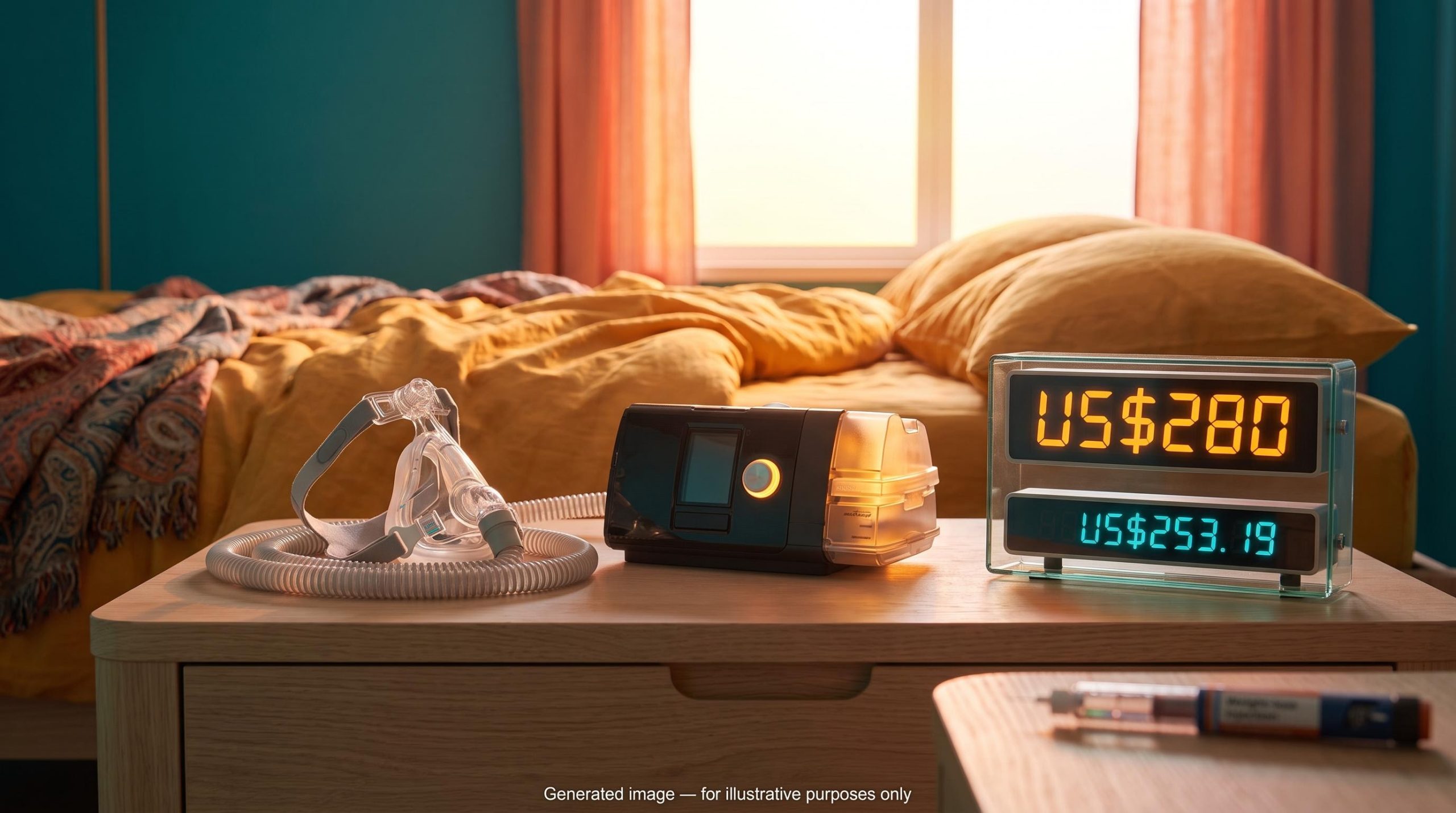
A fair value cut usually reads as a downgrade. Morningstar’s latest call on ResMed stock doesn’t fit that pattern: analyst Lochlan Halloway trimmed the fair value by about 7% to US$280, yet the firm still rates the shares undervalued against a US$253.19 close on 26 October 2026.
That gap between a lower target and a continued undervaluation call says more about the investment case than either number alone. Three forces are driving the debate. GLP-1 weight-loss drugs may shrink the pool of sleep apnoea patients, Philips could eventually return to the US device market, and US reimbursement rules keep a ceiling on what suppliers get paid.
Timing adds pressure. Fiscal Q1 2027 results are due on 29 October 2026, so the numbers below are a pre-earnings read rather than a verdict.
Use this as a test of what the current price already assumes about ResMed’s future, and of which risks could prove those assumptions too generous.
Why did Morningstar cut its fair value but still call the shares undervalued?
On the surface, the call looks contradictory. Morningstar lowered its value for narrow-moat ResMed to US$280, or about A$40 per ASX CDI. A CDI (CHESS Depositary Interest) is the instrument that lets Australian investors trade the US-listed shares on the ASX.
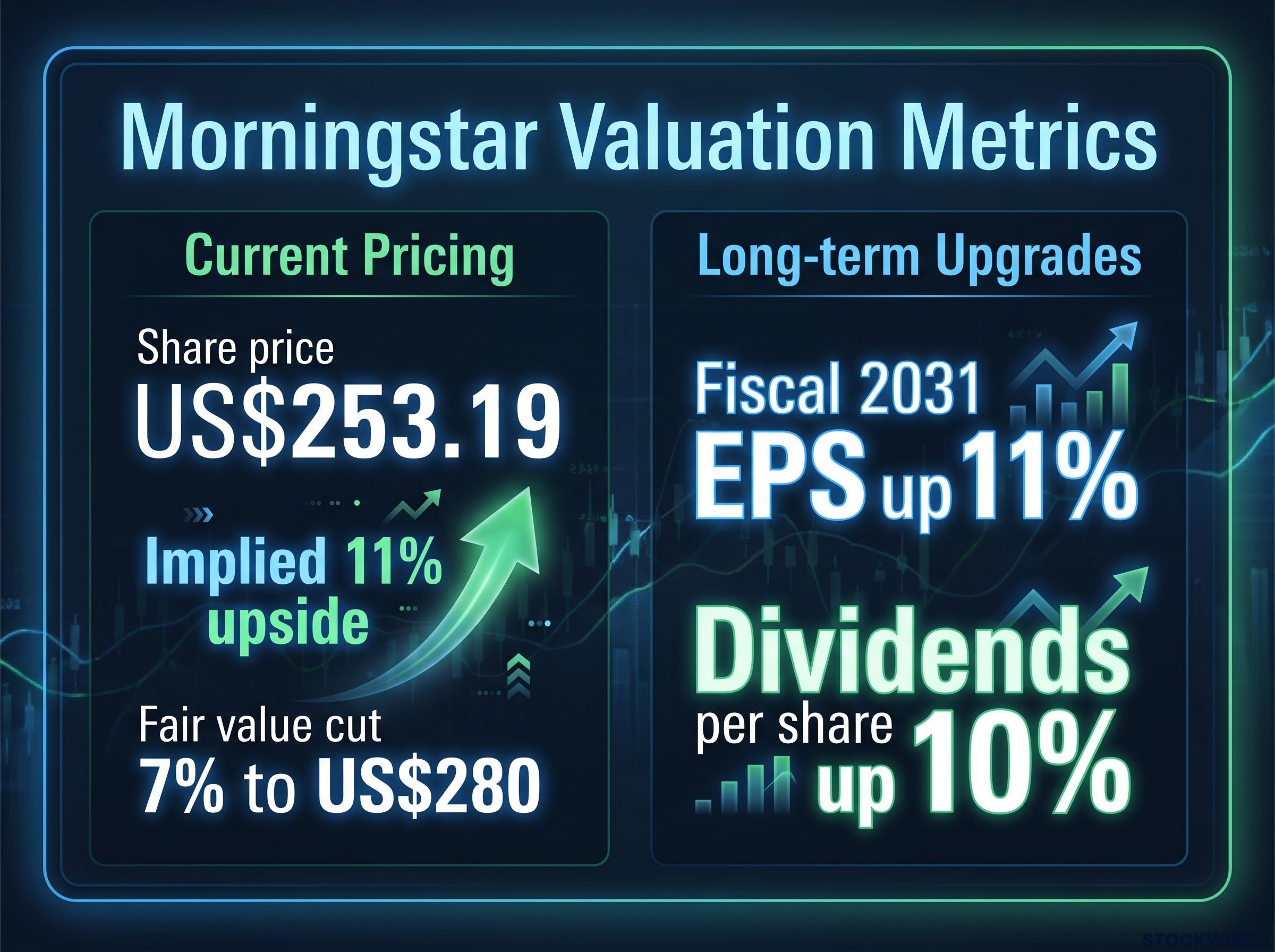
The tension in one line Fair value cut 7% to US$280, against a share price of US$253.19. That still implies about 11% upside.
The cut is smaller in substance than it looks. Morningstar trimmed revenue forecasts by up to 5%, mainly on slower device growth, but higher margins leave forecast operating profit roughly unchanged. Diagnosis rates should keep rising, only more slowly, because the easiest patients have already been found.
| Metric | Previous | Current | Direction |
|---|---|---|---|
| Revenue forecasts | Higher base | Cut by up to 5% | Lower |
| Earnings growth assumption | 7% a year to fiscal 2031 | About 5% a year beyond the five-year forecast | Lower |
| Operating profit | Prior forecast | Roughly unchanged | Flat |
| Fiscal 2031 EPS | Prior forecast | Up 11% | Higher |
| Dividends per share | Prior forecast | Up 10% | Higher |
Morningstar now expects revenue growth of about 7% a year over five years, well below the 16% annual earnings growth achieved over the decade to fiscal 2026. Buybacks of about US$1.4 billion a year to fiscal 2031 would cut the share count by one-sixth. The latest quarter, fiscal Q4 2026, delivered revenue of about US$1.46 billion, up about 9%, with a non-GAAP gross margin of 62.3%.
What this tells you is that the debate has moved from “will it grow” to “how fast”. Your per-share returns now lean more on margins and buybacks than on top-line acceleration.
When big ASX news breaks, our subscribers know first
What is the current ResMed stock price assuming?
Flip the usual question around. Instead of asking what could go right, ask what would have to go wrong for US$253 to be fair value.
Morningstar identifies two scenarios that would justify today’s price:
- Growth halves: revenue growth slows to about 3% a year over five years.
- Margins shrink: operating margin falls to about 32% from 36%, which would imply device price cuts above 10%.
The starting point matters. In FY2026, ResMed posted operating margins of 33.4% on a GAAP basis and 36.1% non-GAAP (a measure that strips out items such as amortisation and one-off costs). Gross margins were 61.1% GAAP and 62.4% non-GAAP.
Those margins were built on efficiency rather than price hikes. Selling, general and administrative costs fell from 27% of revenue in fiscal 2016 to under 20% in fiscal 2026, while R&D held at about 7%.
Part of the gap between a lower fair value and a still-undervalued rating reflects multiple compression, where the share price has fallen faster than earnings, leaving investors to judge how much of the GLP-1 fear is already priced in.
Why a 10% price cut looks unlikely
Morningstar argues that ResMed’s standing with physicians, plus the reputational damage from Philips’ recall, makes a double-digit price cut hard to force. Doctors who trust a brand keep prescribing it, and ResMed’s adherence tools strengthen that loyalty.
Growth is also expected to come mostly from volume, not price, so the business doesn’t need price increases to hit its numbers.
If you hold or are considering the shares, you are effectively betting that neither a growth collapse nor a double-digit price cut arrives. That is the specific bet to stress-test.
Are GLP-1 drugs a drag or a threat to CPAP demand?
The fear has real clinical evidence behind it. In the SURMOUNT-OSA trials, tirzepatide cut the apnoea-hypopnoea index (AHI, the number of breathing interruptions per hour of sleep) by 25.3 and 29.3 events per hour, against 5.3 and 5.5 for placebo. The FDA approved Zepbound for adults with obesity and moderate-to-severe obstructive sleep apnoea (OSA) on 20 December 2024.
If weight-loss drugs can treat the condition, fewer patients might need a CPAP (continuous positive airway pressure) machine. Morningstar resists that reading for three reasons. Age, sex and anatomy also drive sleep apnoea, so remission tends to be incomplete; most patients stop the drugs within a year; and diagnosis rates remain low.
The trials also involved selected patients, and many retained clinically meaningful OSA. ResMed’s own data, presented on 6 August 2026, push further. Across 2.593 million patients, GLP-1 users were more likely to start PAP therapy and showed higher one-year and three-year resupply rates.
The sequencing argument More than 40% of newly diagnosed OSA patients start PAP within 90 days, compared with fewer than 3% who start a GLP-1.
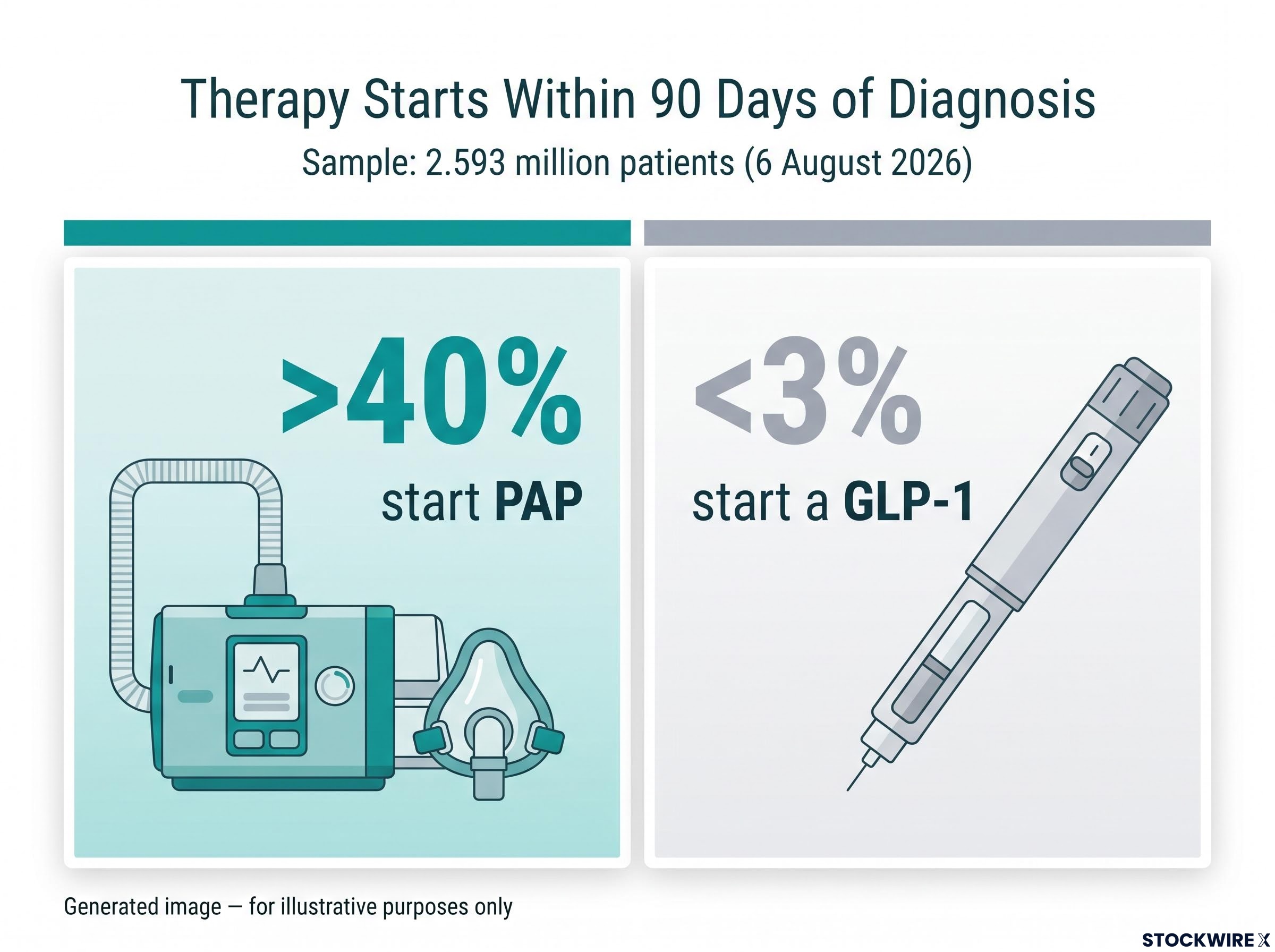
That sequencing means device revenue tends to arrive before any weight-loss remission. These figures are company-reported, though, and should be read that way.
| Interpretation | Reasoning |
|---|---|
| Manageable drag | Diagnosis feeds patients into PAP during drug treatment; company data show higher PAP starts and resupply among GLP-1 users. |
| Long-term volume headwind | Patients who sustain weight loss may stop PAP; SURMOUNT-OSA provides the biological case. |
| Incomplete remission | AHI improved, but only some participants reached remission or mild OSA. |
| Discontinuation uncertainty | No precise recent stopping rate for OSA patients is public, and long-duration persistence data are lacking. |
The evidence points to GLP-1s as a near-term neutral-to-positive for volumes and a possible long-term headwind. For your holding period, the question is how far out you are looking.
For readers weighing the regulatory side of the GLP-1 thesis, our deep-dive into tirzepatide approval for sleep apnoea explains how the Australian TGA decision shapes the displacement risk for ASX-listed ResMed holders.
How does diagnosis-led strategy support pricing power?
ResMed’s edge works as a chain, and each link makes the next more valuable:
- Diagnosis: a patient is identified as having sleep apnoea.
- Therapy start: a doctor prescribes PAP, usually choosing a trusted brand.
- Adherence: the patient keeps using the device.
- Reimbursement: insurers pay once continued use is shown.
- Resupply: masks and parts are replaced over years, creating recurring revenue.
The untapped pool
Headroom remains large. ResMed estimates fewer than 20% of US sufferers are diagnosed or treated. Treatment penetration sits at 15-20% in the US, 10-15% in Europe and under 5% in Asia, while emerging markets are essentially untapped.
Morningstar estimates about 22 million diagnosed US patients, roughly half on CPAP, and about 34 million undiagnosed. Diagnosis is hard because symptoms happen during sleep and often pass as snoring or tiredness. ResMed responds by training primary care doctors and through VirtuOx, its lower-cost home sleep testing business.
Why adherence is the revenue lever
Insurers typically pay only if the patient stays on therapy through a 90-day window, and CMS (the US Centers for Medicare & Medicaid Services) requires documented continued use for certain replacements. Published adherence estimates range from 50-80%, while ResMed reports up to 87% using its AirView monitoring and myAir app.
That physician loyalty is an economic asset. ResMed engages far more with US sleep physicians than Philips does, and referrals let revenue grow without matching sales costs. Acquisitions run under 3% of revenue in most years, so growth is largely organic.
For you as an investor, adherence is an underwatched metric. Every patient who drops out takes years of resupply revenue with them.
What are the bull and bear cases for ResMed stock?
The bull case
- Valuation: about 11% upside, with pessimism already priced in.
- Underdiagnosis: home testing and doctor training widen the funnel.
- Operating leverage: falling overhead costs could lift margins further.
- Pricing power: physician preference and adherence tools.
- Competitive window: widely reported, though not independently confirmed, gains from Philips’ US absence.
The bear case
- Philips return: aggressive pricing to win back share.
- GLP-1 efficacy: longer use or stronger drugs could remove more patients.
- Slowing diagnosis: remaining patients are harder to find.
- Adherence variability: dropouts end reimbursement and resupply.
- Reimbursement tightening: bidding or stricter resupply rules.
| Argument | Bull view | Bear view |
|---|---|---|
| Valuation | Price embeds growth halving or margin falling to about 32% | Lower growth assumptions could fall further |
| GLP-1s | Company data show higher PAP starts | Long-term persistence unknown |
| Diagnosis | About 34 million undiagnosed in the US | Easiest patients already found |
| Adherence | Up to 87% reported by ResMed | Published range of 50-80% |
| Competition | Philips still barred from new US device sales | Return could pressure prices |
Philips and reimbursement: the swing factors
Philips is barred from selling new US CPAP or BiPAP devices until it meets the requirements of its consent decree, a court-enforced agreement with regulators. It completed US recall remediation of sleep-therapy devices by 6 July 2026, has remediated 99% of actionable global registrations, and can already service devices and sell accessories and consumables. Morningstar expects a return in 2027, but that is a market expectation, not a company commitment.
The FDA consent decree update confirms that Philips Respironics faces restrictions on producing and selling new CPAP and BiPAP machines at several facilities until set requirements are met, which is why any US return depends on regulatory sign-off rather than company intent.
Reimbursement is more certain but slower moving. Under CMS competitive bidding, contract suppliers must accept Medicare’s single payment amount for CPAP devices and supplies, effectively capping prices. Replacement devices after five years need an in-person evaluation rather than a new sleep test, which helps keep resupply flowing.
The bear risks centre on timing and price, while the bull case rests on volume and durability. Your view depends on whether you expect pressure to land before the volume runway pays off.
Weighing the price against the risks before the next earnings print
On the available evidence, GLP-1s look like a growth-rate headwind rather than an existential threat, and the current price already embeds pessimistic assumptions about growth or margins.
Five signals are worth tracking:
- Fiscal Q1 2027 results on 29 October 2026
- Diagnosis trends
- Adherence and resupply data
- Any Philips consent-decree progress
- CMS competitive bidding developments
The decision comes down to one assumption. Buying at around US$253 means underwriting the view that ResMed avoids both a growth collapse and a double-digit price cut. If you doubt that, the discount may not be enough.
This article is for informational purposes only and should not be considered financial advice. Investors should conduct their own research and consult with financial professionals before making investment decisions. Past performance does not guarantee future results. Financial projections are subject to market conditions and various risk factors.