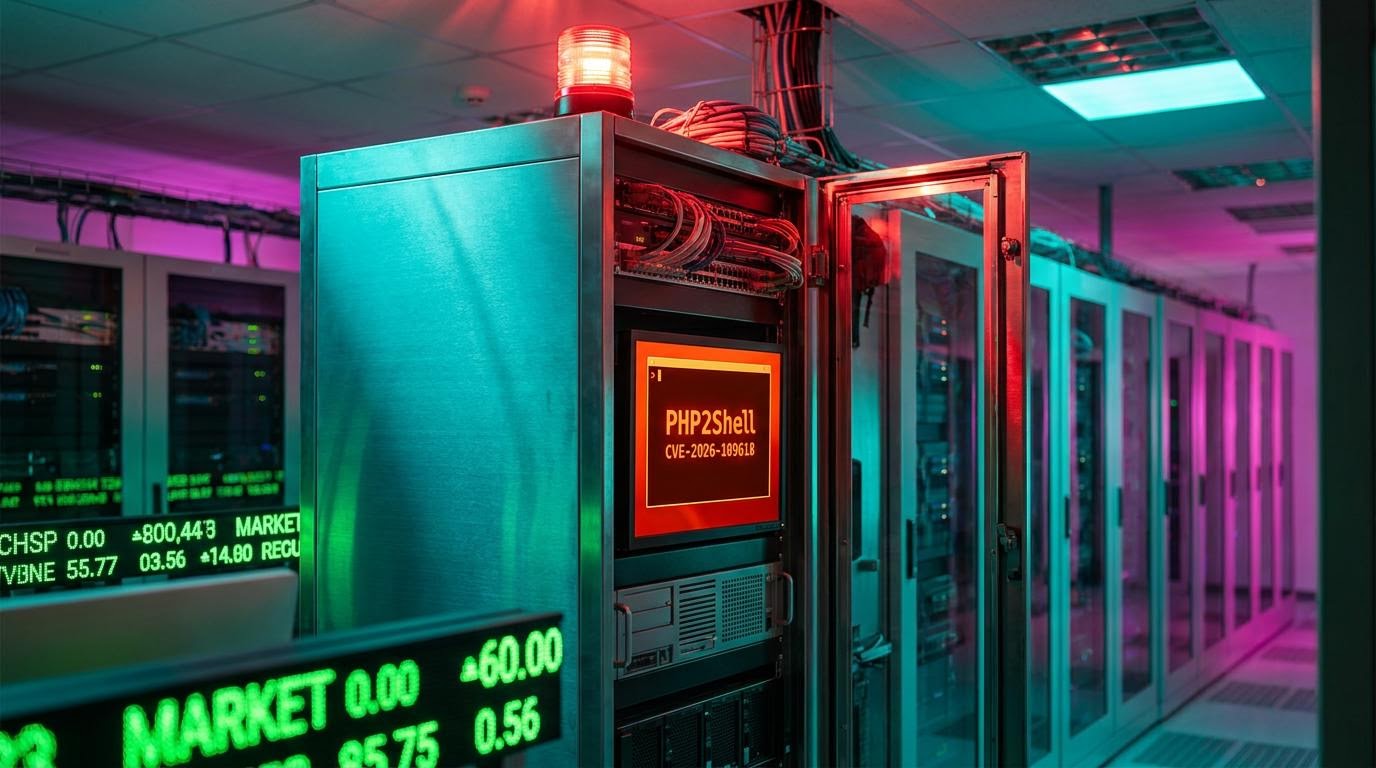
Two critical flaws in PHP, the programming language behind roughly 70% of websites with a known server-side language, were patched on 21 October 2026. Within days, cybersecurity stocks posted one of their sharpest weekly rallies of the year. The PHP2Shell vulnerability now matters to anyone running a website and to anyone holding security shares.
Governments in the UK, Finland and Japan briefly took services offline as a precaution while teams checked their exposure. Investors are now asking a harder question: is this a lasting spending catalyst, or a sentiment spike that fades once the patches are installed?
The story is still developing as of 24 October 2026. Here is what is affected, how artificial intelligence changed the timeline, and a practical way to judge whether the stock moves have substance behind them.
Which PHP versions are exposed, and what should operators do now?
The two flaws, CVE-2026-109618 and CVE-2026-109619, each carry a 9.2 rating under CVSS v4.0, the industry scale for scoring vulnerability severity out of 10. Both allow unauthenticated remote code execution in web-serving setups. That means an attacker with no login could run their own commands on an affected server.
| Branch | Affected below | Fixed in |
|---|---|---|
| PHP 8.2.x | 8.2.35 | 8.2.35 |
| PHP 8.3.x | 8.3.36 | 8.3.36 |
| PHP 8.4.x | 8.4.27 | 8.4.27 |
| PHP 8.5.x | 8.5.12 | 8.5.12 |
| PHP 8.1 and older | All versions | No official fix |
Not every PHP site is compromised; risk depends on version, configuration and patch status. The problem is that, according to Sophos, the emergency updates did not install automatically. Sophos also reported a public proof of concept, meaning working attack code, on the same day the patches shipped.
Widespread confirmed exploitation had not been established by 24 October, though some sources report attempts under monitoring. If you run or depend on a PHP-based site, the safe assumption is that unpatched systems are targets now, not later. Authorities recommend four steps:
The CISA alert on PHP2Shell confirms both CVEs allow unauthenticated remote code execution and names the fixed releases as 8.5.12, 8.4.27, 8.3.36 and 8.2.35, though the agency had not observed successful exploitation in the wild when it published.
- Identify every system running an affected PHP version.
- Patch immediately, or take unpatchable systems offline.
- Test that services work after updating.
- Check for signs of compromise, enforce multifactor authentication and keep an accurate software inventory.
What was disrupted so far
The outages were brief and precautionary, falling within the 21-22 October remediation window. The UK took 32 government services offline or disrupted them, and Finnish government sites went down temporarily. In Japan, the prime minister urged businesses to pull vulnerable systems, and CNN reported paused pages at ANA, JR West and MUFG; the BBC added Edinburgh council and some BBC pages to the list. Precise counts beyond the UK were not available.
When big ASX news breaks, our subscribers know first
How did AI find flaws that human reviewers missed for years?
The bug had sat in PHP code for more than a decade. Three separate teams using AI found it within weeks.
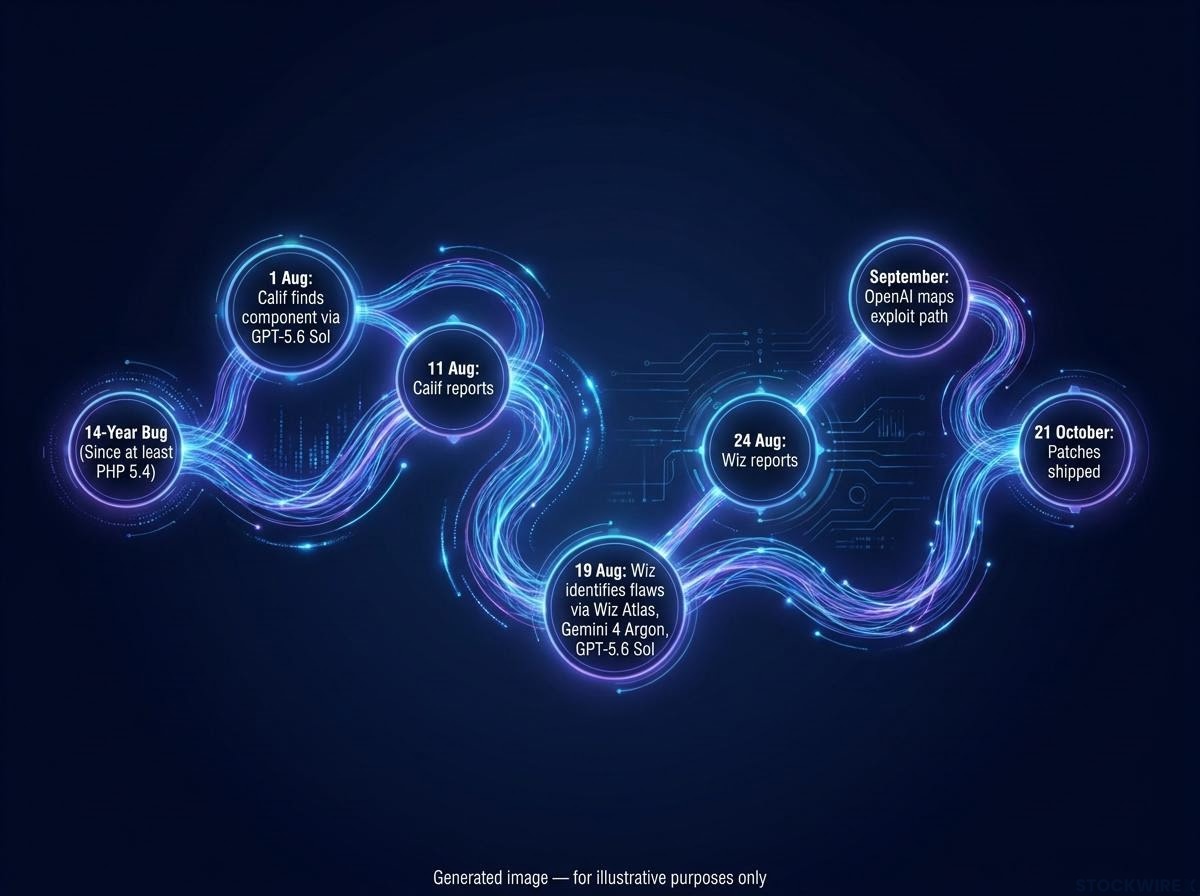
- Calif found one component on 1 August using OpenAI’s GPT-5.6 Sol, reporting it to PHP around 11 August.
- Wiz independently identified the flaws around 19 August with its Wiz Atlas platform, Google’s Gemini 4 Argon and GPT-5.6 Sol, reporting on 24 August.
- OpenAI researchers mapped a fuller exploit path in September.
- Details leaked before the planned coordinated release, and attack code appeared the day patches shipped.
The flaws trace back to at least PHP 5.4. OpenAI president Greg Brockman reportedly put the bug’s age at about 14 years, and a less serious version flagged in 2024 was not treated as major. Why so long? The code was old and widely reused, the triggering conditions were unusual, and Wiz explained why spotting the bug was not enough:
Wiz on the exploit chain Reliably reaching unauthenticated code execution required connecting several unusual states across memory management, error handling and request processing.
Who benefits more, attackers or defenders?
Defenders gain the ability to audit legacy code continuously and patch earlier, which the three independent discoveries support. Attackers need just one working path, and once a patch is public, AI can turn the code changes into a working exploit and scan for targets at machine speed.
The practical consensus is that AI raises both sides’ capabilities, and no named source quantifies which gains more. For you, the takeaway is blunt: the patch-to-exploit gap that security teams once relied on is shrinking, so slow patching carries more risk than it did a few years ago.
The shrinking patch-to-exploit gap fits a wider pattern, with pre-disclosure exploit windows now so short that Mandiant data puts the mean time to exploit at roughly negative seven days, meaning attacks often begin before a CVE is published.
What did cybersecurity stocks do this week, and why?
That risk showed up in share prices. For the week ending 23 October 2026, Okta rose 14%, Palo Alto Networks and CrowdStrike each gained 11%, and Cloudflare added 9%.
| Company | Weekly move | Yahoo Finance session | Investing.com session |
|---|---|---|---|
| Okta | +14% | +5% | +5.82% |
| Palo Alto Networks | +11% | +6.5% | +7.22% (to 380.55) |
| CrowdStrike | +11% | +6.7% | +8.25% (to 257.57) |
| Cloudflare | +9% | +6% | +7.29% |
Single-session figures are for 23 October. The two sources differ, likely because they captured prices at different times.
The PHP story was not the only driver. Yahoo Finance said the rally began after the disclosure but identified an Evercore ISI channel survey, pointing to stronger security budgets, as the immediate trading trigger. Investing.com framed the move as expectations of more spending, not revenue already booked.
Meanwhile, Check Point announced PHP2Shell protections quickly, a reminder that many vendors can add coverage fast. A rally driven partly by a budget survey and partly by headlines tells you the market is pricing sentiment about future spending, not revenue that has arrived.
Will PHP2Shell turn into lasting revenue? A framework for weighing the rally
Any revenue effect is likely indirect. Demand may lift for vulnerability management, web application firewalls (WAFs, filters that block malicious web traffic), endpoint protection, cloud security and incident response, but no company gets a discrete PHP2Shell revenue line.
Retention, not new revenue One market commentary noted that a patch panic can make existing subscriptions more valuable without creating a new revenue stream visible in next-quarter results.
Three tests help you judge the move:
- Valuation versus results. Shares can outrun bookings and earnings; commentary suggested Cloudflare’s valuation already priced in substantial optimism. Watch whether bookings rise to match.
- Competition. Protection comes from PHP updates, Linux distributions, hosting providers, WAFs and managed providers. Watch for evidence any single vendor is capturing spend.
- Durability. Companies may patch, buy short-term help or fund work from existing budgets. Watch whether demand persists after emergency scanning fades.
Because all four companies sell worldwide, judge these effects on global demand. Before treating this week’s gains as a signal, check whether upcoming earnings reports show new bookings tied to this demand, because price alone does not confirm it.
What the 2024 CrowdStrike outage teaches
No named earnings comparison was found for Log4j in 2021 or MOVEit in 2023. The 2024 CrowdStrike outage is the clearer precedent: shares initially fell about 20%, and Reuters reported more than half of covering brokerages cut revenue estimates.
CrowdStrike later posted quarterly revenue of about $969 million, up 32%, but cut full-year guidance, and AP estimated roughly $60 million in pipeline impact. Cyber events can raise security’s strategic value while still hurting vendors through delays, discounts and lowered guidance.
What to watch next as patching and earnings catch up
The technical risk is real and time-sensitive. The investment case is still unproven.
Three variables will settle much of the debate: whether in-the-wild exploitation is confirmed, how quickly operators adopt the patches, and whether upcoming earnings commentary cites PHP-related demand.
For operators, the decision is simple: patch now. For investors, the stronger position is patience until reported numbers show the spending arriving. This story remains in development as of 24 October 2026.
Investors exploring which vendors hold durable advantages can read our deep-dive into AI cybersecurity stock moats, which examines platform telemetry and false-positive reduction.
This article is for informational purposes only and should not be considered financial advice. Investors should conduct their own research and consult with financial professionals before making investment decisions. Past performance does not guarantee future results, and forward-looking views are speculative and subject to change.