SpaceX just beat its own revenue forecast by roughly $1.9B, reporting $14.58B against an expected $12.72B, and posted its first profitable quarter since listing. Yet SpaceX stock did not leap after the report. It crept higher. That slow climb is the signal most readers will miss, because a big beat that fails to spark an instant jump is information in its own right.
The timing makes it worth understanding now. Shares closed at $147.79 on 20 October 2026, then rose about 6.6% after hours, carving the first notable gap into SpaceX’s short trading history. Tesla reports after the close today, 21 October, and it has been rallying on speculation tied to SpaceX.
After reading this, you will be able to read a gap against expectations, judge whether a round-number level is acting as a magnet, and recognise when one Musk-linked stock is trading as a stand-in for another.
This is educational analysis of price behaviour, not a trade recommendation.
What a gap on the SpaceX stock chart actually tells you
Look at the screen first. Results arrived well above consensus, and according to the original market commentary, shares sat around $151 straight after the release before grinding into the low $160s. Research coverage puts the after-hours price near $157.59, up about 6.63%, with some timestamps closer to $163. The exact path depends on when you checked.
A price gap is a jump between one session’s closing price and the next traded price, caused by trading that happens while the regular market is shut. Nothing trades in the empty space, so the chart shows a hole.
Here is what drove the repricing:
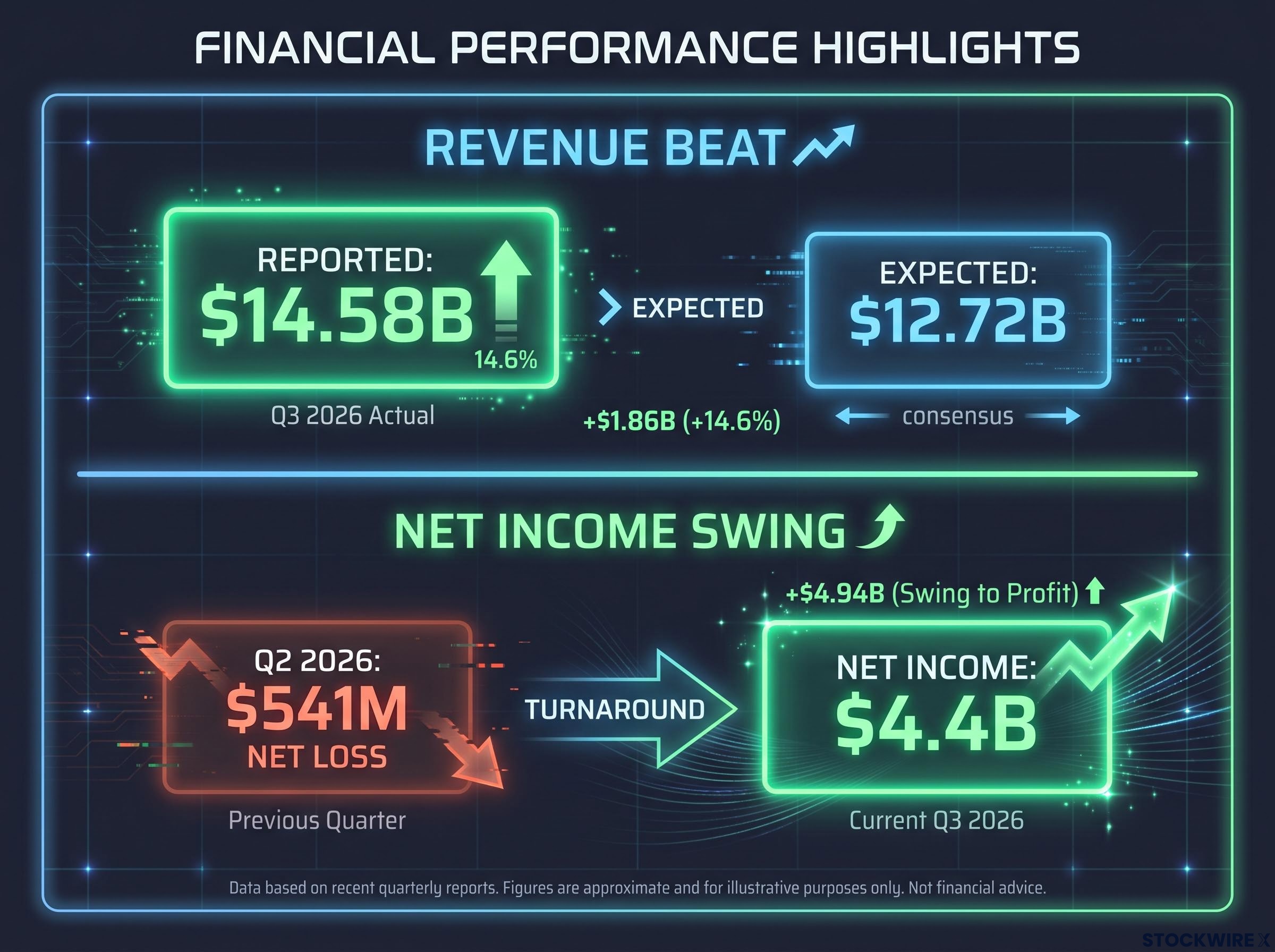
- Revenue: $14.58B reported vs $12.72B expected (CNBC)
- Adjusted earnings per share (EPS): $0.45 vs $0.13 expected
- Net income: $4.4B, against a $541M net loss on $7.81B of revenue in Q2 2026
Sources differ on per-share figures. AP and Zacks reported $0.35 per diluted share against a $0.10 consensus, while CNBC used the adjusted measure. The adjusted comparison is the cleaner gauge of surprise because it matches the basis analysts forecast on.
Why the quiet reaction matters Gaps usually signal surprise. Here, the surprise was how slowly the stock moved after a clear beat.
The early-October history explains some of that restraint. SpaceX jumped about 7% to roughly $159 on 2 October, after three launches in under 13 hours, hit $176.42 on 6 October, then slid back to the mid-$140s. A slow climb after a big beat tells you part of the good news may already have been in the price, so temper how much you read into the headline numbers.
Gaps are repricing, not predictions
A gap tells you the market changed its mind overnight. It does not tell you where the stock goes next. Read it alongside volume, the next few closing prices and the nearest support and resistance levels.
Some gaps mark lasting shifts in value. Others fill quickly, meaning the price drifts back into the hole. Neither outcome is mechanical, so treat the gap as your starting point.
Whether a hole in the chart closes depends heavily on context, and gap-filling analysis shows that small gaps in choppy markets fill far more often than large catalyst-driven gaps, which is why you should always ask what caused yours.
When big ASX news breaks, our subscribers know first
Why $150 keeps pulling SpaceX stock back: the anatomy of a price magnet
Support is a price where buyers have tended to step in and stop a fall. Resistance is a price where sellers have tended to appear and stall a rise. A magnet level is one the price keeps returning to because it combines both roles.
$150 did not become a magnet for one reason. It stacked several:
- IPO reference. SpaceX opened at $150 on 12 June 2026, according to TradingKey, which also flagged it as a zone where institutions may reassess valuation.
- Valuation. Yahoo Finance commentary cited roughly 200 times forward earnings, which leaves little room for disappointment.
- Lockup supply. FXStreet reported up to 1.3 billion shares could become sale-eligible two trading days after earnings; CNBC cited more than 1.6 billion across releases.
- Index flows. SpaceX entered the Nasdaq-100 on 7 July at roughly a 1% weight, with a further rebalance due in December.
- Options positioning. The $150 call strike drew particularly heavy interest before the report.
Notice what is missing from that list: a deteriorating business. The pressure comes from price, supply and positioning, not fundamentals. The IPO path shows how strong those forces can be. FXStreet traced a $135 offer price, a run above $225, a drop near $105, then a return to the mid-$140s.
Here is the map of levels analysts are watching:
| Level | What it represents |
|---|---|
| $172-$176 | Major resistance near the October high |
| $155-$160 | Next upside target after a move above $152 |
| $150-$152 | Repeated resistance and gap-recovery zone |
| $145-$147 | Immediate support near the pre-earnings price |
| $140-$143 | Near-term support and prior buying zone |
| $130 | Secondary downside target if $140 fails |
If you hold or watch the stock, treat $150-$152 as the zone where the market decides whether the gap is accepted or rejected, not as a prediction of where price must go.
How options and lockups add pressure
CNBC reported options traders pricing about a 6% post-earnings move, with 1.1 million contracts traded on Monday, 665,000 of them calls. Interest clustered at the $150, $170 and $190 call strikes. Heavy call buying can amplify a rally into expiry, then reverse once short-dated contracts lapse.
Lockups work differently. A lockup is a period after an IPO when insiders cannot sell. When it ends, new supply can cap rallies even on good news.
The SpaceX lockup schedule is staggered across roughly a dozen unlock events rather than one cliff, so supply can arrive in several waves that cap rallies well beyond the first release.
Why Tesla trades as a SpaceX proxy, and what the lower highs say
Start with an odd fact. Tesla rose more than 3% to $366.23 on 19 October with no company news of its own, according to Moomoo, amid renewed talk of a Tesla and SpaceX merger.
That is proxy trading: you express a view on one asset through a related, easier-to-access one. Both companies sit under Elon Musk, and some investors treat Tesla as a way to gain eventual SpaceX exposure. In an all-stock deal, a higher SpaceX valuation could lift the implied value for Tesla holders.
The mechanism The link rests on expectations and optionality, not an established financial connection.
No merger had been formally announced or filed as of today. Analysts are split:
- Barclays’ Dan Levy saw a combination as increasingly plausible, possibly before Tesla’s annual meeting.
- RBC’s Tom Narayan argued it would not be straightforward and could require a substantial premium for Tesla.
- Future Fund’s Gary Black warned arbitrageurs could short SpaceX and buy Tesla, eroding the premium in an all-stock deal.
Set that against Tesla’s own numbers:
| Metric | Expectation | Comparison | Source |
|---|---|---|---|
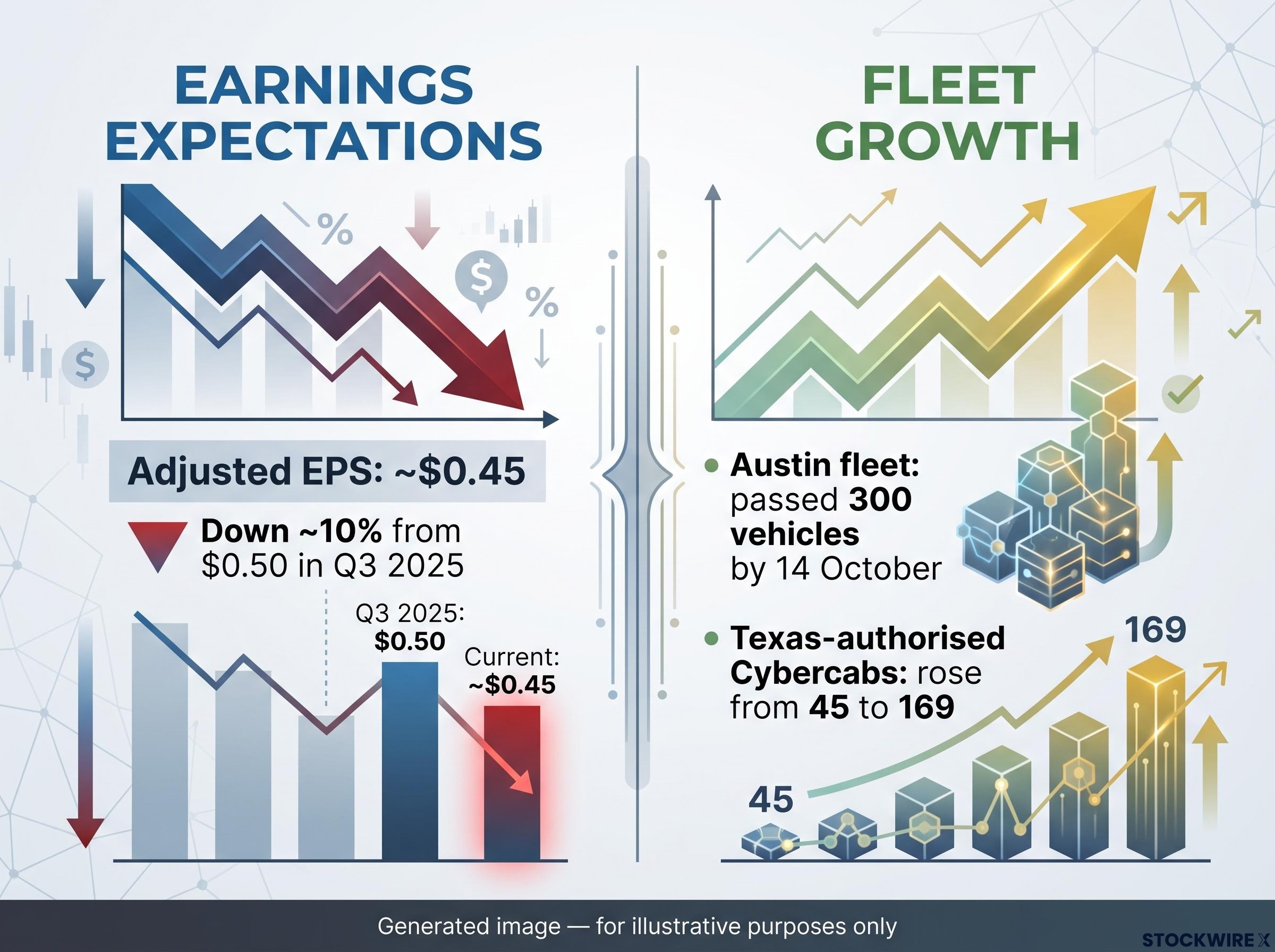
| Adjusted EPS | ~$0.45 | Down ~10% from $0.50 in Q3 2025 | Investors.com |
| Revenue | ~$27.9B | Down ~1% | Investors.com |
| Revenue (company-compiled) | $28.34B | Above $28.10B prior year | IndMoney |
The revenue figures conflict, but both sources agree on falling earnings. Meanwhile, Tesla sits below its 200-day moving average, the average closing price over the past 200 sessions, at about $387.58 on 19 October, roughly 5-6% above the share price. Market commentary pointed out that Tesla has made lower highs for months and was approaching another one near that average.
A rally driven by speculation rather than company news tells you the price carries a premium that earnings alone may not support. Ask yourself what happens to that premium if tonight’s report is merely in line.
For readers wanting the structural background, our full explainer on the Tesla SpaceX merger covers how the SpaceX listing made a stock-for-stock deal feasible.
Reading event-driven positioning: robotaxi, earnings and what could break the pattern
Traders often reduce positions before earnings because both a beat and an in-line result can disappoint once expectations have already moved. One commentator held a Tesla position and was weighing closing it before the report.
Robotaxi is the narrative variable for Tesla. Its Austin fleet passed 300 vehicles by 14 October, an eightfold rise in 30 days. Texas-authorised Cybercabs rose from 45 to 169, per CNBC. Musk said the fleet should double in December and service could reach eight to ten metro areas by year-end, while Morningstar reported Dallas as the next target. TradingKey noted the constraints: manufacturing scale, regulatory approvals, fleet utilisation and unit economics.
Watch these in order:
- Tesla’s earnings reaction and robotaxi commentary tonight
- Whether SpaceX holds or loses $150-$152 over the next closes
- Lockup eligibility two trading days after SpaceX’s report
- Any formal merger news
For SpaceX, the weighing looks like this:
- Risks: extreme valuation, lockup overhang, execution risk across Starship and AI, Musk concentration, options expiry reversals
- Counter-argument: the swing to $4.4B net income, with Starlink and AI growth that could support a higher valuation if sustained
For Tesla:
- Risks: a weak earnings setup, trading below the 200-day average, robotaxi uncertainty, an unconfirmed deal that could strip the proxy premium
- Counter-argument: rapid fleet scaling and the appeal of a combined Musk AI platform
Precedent cuts both ways. Tesla’s pre-earnings rallies have reversed before when reports failed to extend the story, and SpaceX’s own post-IPO swings show positioning can overwhelm fundamentals.
Scenarios, not predictions
If SpaceX moves above $152, analysts see room toward $155-$160. If it fails, 247WallSt and TradingKey flag $142.87, $140.66 or the $140-$143 zone.
A gap and a level describe probabilities, not guarantees. Decide in advance which outcomes would change your view, rather than reacting to the headline. Past performance does not guarantee future results, and these scenarios may shift with market developments.
What the gap changes, and what it leaves unresolved
The gap confirms a genuine repricing after a real beat. It does not settle whether that repricing holds; $150-$152 remains the test. Tesla’s premium, meanwhile, leans on a deal nobody has announced.
You now have three tools that work well beyond these two stocks: read a gap against what was already priced in, treat round numbers as magnets built from stacked reasons, and separate a stock’s own story from one it is borrowing.
Your next decision points are clear. Watch the closes around $150-$152, Tesla’s reaction after tonight’s report, and the lockup window opening later this week.
This article is for informational purposes only and should not be considered financial advice. Investors should conduct their own research and consult with financial professionals before making investment decisions.