A single Monday morning, 19 October 2026, delivered an 87.3% cash premium, a deal with no cash premium at all, a hunt for rival bidders that came back empty, and an approach that may never become a deal. All four were reported as takeover news. Only some of them put a firm price in front of you.
So which headline number tells you what you would actually receive? The answer depends on reading ASX takeover bids as legal instruments rather than as headlines.
FleetPartners, Malabar Resources, Reliance Worldwide (RWC) and Challenger now give you a working example of how control deals run in Australia. The word “bid” covers all four, yet their legal standing, consideration and certainty differ sharply. Pro Medicus, which signed a contract instead of a deal, shows what growth looks like without a buyer.
You will come away able to separate a binding scheme from a non-binding approach, question a premium before you trust it, and know which protections and conditions to check first.
Four deals, four different animals: what the 19 October cluster shows
At first glance, each of these looks like the same event. A buyer names a price, a board responds, and the shares move.
The detail tells a different story. Three of the deals sit inside signed, binding agreements. The fourth is a letter asking to open the books.
| Target and bidder | Consideration | Headline premium or value | Binding status | Expected timing |
|---|---|---|---|---|
| FleetPartners / SG Fleet (Pacific Equity Partners funds) | $5.30 cash | 87.3% to the $2.83 undisturbed close; about $1.13B equity value | Binding scheme deed | Vote February 2027; completion March 2027 |
| Malabar / New Hope | 0.5 New Hope shares per Malabar share | About $2.92 a share; about $1.8B equity value | Agreed scheme | Completion February-March 2027 |
| RWC / Brookfield | US$3.38 cash (about $4.75 at signing) | About US$2.9B | Binding deed; go-shop found no rival | Implementation late December 2026 |
| Challenger / TAL Dai-ichi Life Australia | $11.80 cash proposal | 19.8% to the $9.85 close | Non-binding, indicative | No timetable announced |
One caution on RWC: some sources convert the offer to about $4.87 rather than $4.75. The gap comes from the exchange rate each source used, not from a change in terms.
Challenger’s proposal covers the roughly 79.5% of the company Dai-ichi does not already own. It depends on due diligence and board support. Until a deed is signed, that $11.80 is where negotiation starts, not money you can count on.
Cash versus scrip: what each gives you and takes away
Cash, as offered for FleetPartners and RWC, gives you a defined exit. You know the number, and you give up any upside beyond it.
Scrip means payment in the buyer’s shares. Malabar holders would receive New Hope stock and end up owning about 21% of the enlarged group. There is no cash premium, so your value moves with New Hope’s share price, and you take on dilution risk as well.
When big ASX news breaks, our subscribers know first
How does a scheme of arrangement actually work?
If a buyer wants the whole company, why not just offer to buy everyone’s shares? Because some shareholders never reply, and a holdout minority can block full ownership.
A scheme of arrangement is a court-approved process, started by the target company, that transfers every share once the required approvals are met. A takeover bid, by contrast, is an offer the buyer makes directly to each shareholder, who decides individually whether to accept.
Schemes versus takeover bids
The difference in practice is binding force. Under a scheme, an approved vote and court sign-off bind every shareholder in the class, which is why buyers seeking 100%, such as SG Fleet and Brookfield, prefer this route. The process runs under the Corporations Act 2001 (Cth), with guidance from the Takeovers Panel and rules set by ASX and ASIC.
The two-part voting test A scheme needs more than 50% of shareholders present and voting (by headcount) and at least 75% of the votes cast, followed by court approval.
The sequence usually runs like this:
- Announcement and signing of the scheme implementation deed
- Release of the scheme booklet and the independent expert’s report
- Shareholder meeting and vote
- Court approval
- Implementation, when shares transfer and you are paid
An independent expert report is an outside assessment of whether the deal is in shareholders’ best interests. The law requires one when the bidder holds 30% or more of the target or the two companies share directors, though most boards commission one anyway. At both FleetPartners and RWC, board support depends on the expert’s conclusion.
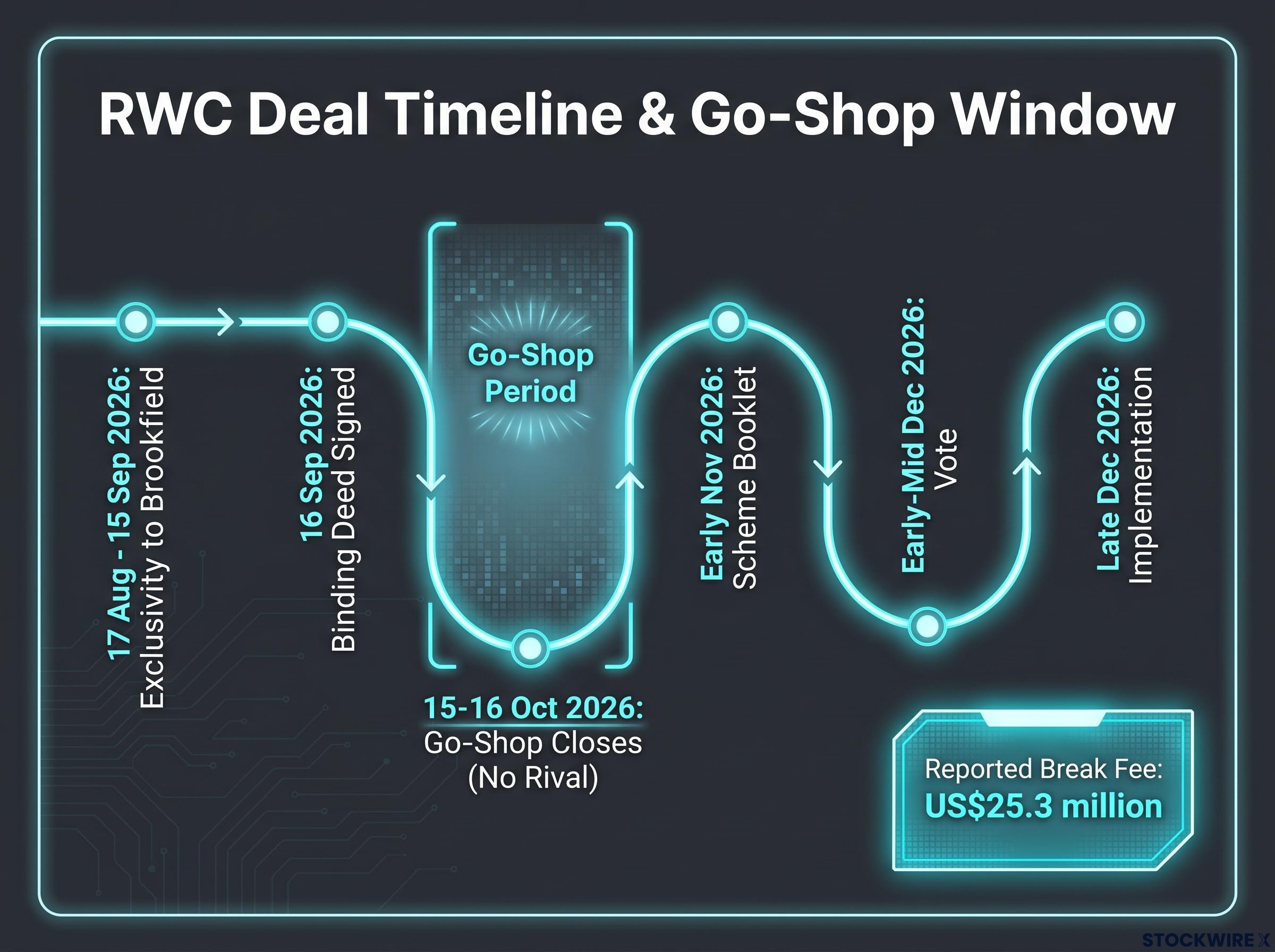
RWC shows how quickly this can move. The company has indicated a booklet in early November, a vote in early to mid-December, and implementation in late December 2026, although one secondary report points to Q1 2027.
Once both thresholds are cleared, court approval and implementation follow quickly, as the Qube scheme showed when Supreme Court sign-off made a $5.20 cash buyout legally effective and set a fixed settlement date for every shareholder on the register.
Here is the part that matters for you. Once both thresholds are cleared and the court signs off, your own vote no longer decides your outcome, so the booklet and expert report are worth reading before the meeting, not after.
What do no-shops, go-shops, matching rights and break fees mean for you?
Every signed deal carries tension. The bidder wants to protect the time and money it has spent, and the board has a duty to get the best price. The clauses below are where that tension is settled.
- No-shop: the target cannot go looking for rival offers.
- No-talk: the target also cannot engage with unsolicited bidders, usually with a carve-out allowing directors to meet their legal duties.
- Go-shop: the target may actively seek better offers for a set period after signing.
- Matching right: the original bidder can match any superior rival proposal.
- Break fee: a payment owed to the bidder if the deal fails for specified reasons.
RWC’s go-shop: a case study
RWC gave Brookfield exclusivity from 17 August to 15 September 2026, then signed a binding deed on 16 September. A go-shop period followed, which is uncommon in Australia.
That window closed around 15-16 October, depending on the source, with no rival offer. The board reaffirmed its support, can no longer solicit offers, and Brookfield keeps its matching right. Reports put the break fee at US$25.3 million, a figure not independently confirmed.
Two processes, two outcomes At RWC, the go-shop drew no competitor. At FleetPartners, an auction featuring SG Fleet, ORIX, Element Fleet and a Sumitomo-led consortium lifted the price to $5.30, 65 cents above the leading September non-binding proposals.
A quiet go-shop does not prove the price is fair. It shows only that nobody chose to pay more under those terms, so weigh the expert’s opinion alongside the premium.
Break fees and the 1% guide
The Takeovers Panel’s guideline puts break fees at generally about 1% of target equity value. Typical triggers include the board changing its recommendation, a competing deal completing, a condition within the target’s control failing, or a material breach.
Takeovers Panel Guidance Note 7 treats a break fee of up to 1% of the target’s equity value as generally acceptable, so you can use that figure as a quick test of whether a fee in a deal you hold looks reasonable.
The benchmark exists because large fees can make a rival bid uneconomic. Courts have also examined so-called “naked no vote” fees, payable simply because shareholders reject a scheme, with the Ausmincon case reportedly cited by Ashurst as an example, though this has not been independently confirmed.
Reading premiums, risks and the organic-growth counterpoint
An 87.3% premium grabs attention. Before it shapes your view, though, ask what it is measured against.
How to read a premium
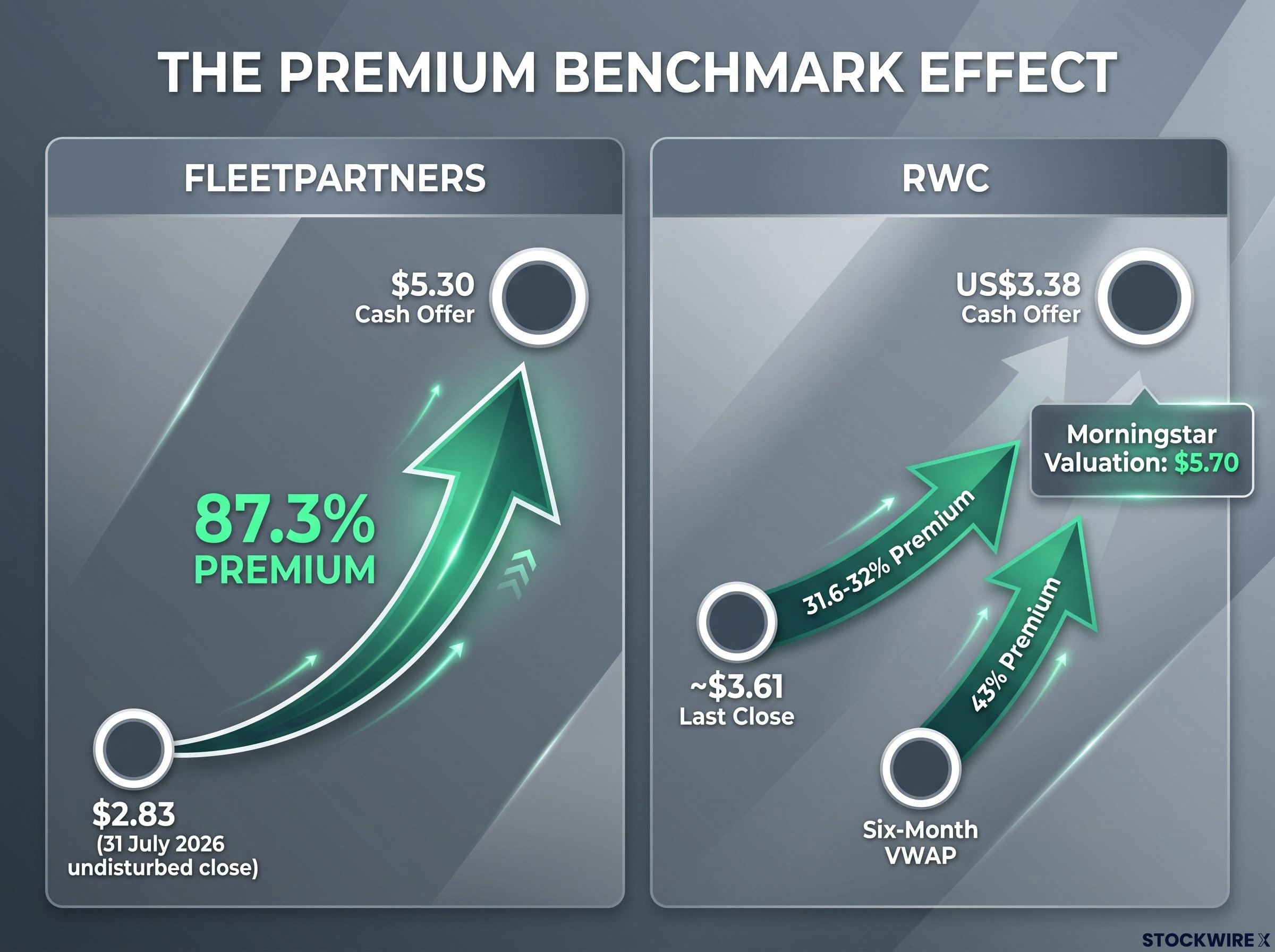
FleetPartners’ figure is calculated against the undisturbed close of 31 July 2026, before deal speculation lifted the shares. RWC’s offer is about 31.6-32% above the last close of about $3.61, yet about 43% above the six-month VWAP (volume-weighted average price, the average share price weighted by how many shares traded at each level).
Both RWC numbers are accurate, and that is the point: a premium only means something once you know its benchmark. Morningstar’s cited standalone valuation of $5.70, not independently confirmed, would make the offer look light despite the headline.
Dividends complicate things further. FleetPartners may pay an FY26 final dividend of up to $0.14 and a special dividend of up to $0.12, and these may reduce the $5.30, so do not treat the headline as payable on top of every distribution.
For readers wanting to see how premiums behave before a bid arrives, our full explainer on small-cap takeover premiums shows why typical ASX offers land 20% to 40% above pre-bid prices.
What can go wrong
- Non-binding risk: Challenger’s proposal needs due diligence, a binding agreement, regulatory approvals and board support.
- Dilution: Malabar holders depend on New Hope’s share price and the exchange ratio.
- Approvals: Malabar needs its shareholders, the court and Japanese competition approval, though no New Hope vote is required.
- Deal failure: a missed threshold or unmet condition can send shares back toward pre-bid levels.
- Tax: outcomes vary by cost base, residency, entity type and rollover eligibility, so professional advice is worth getting.
| Question to ask | Why it matters | Example from this cluster |
|---|---|---|
| Is it binding? | Sets how certain the outcome is | Challenger has no deed |
| Which price sets the premium? | Changes the percentage sharply | RWC: 32% or 43% |
| Was the price tested? | Competition can lift the offer | FleetPartners auction |
| What reduces the payout? | Dividends may come off the price | FleetPartners’ up to 26c |
Pro Medicus: growth without a deal
Pro Medicus will supply its cloud Visage 7 imaging platform to Billings Clinic-Logan Health, which runs 25 hospitals and over 1,000 beds. The contract is worth $24 million over seven years, about $3.4 million a year, with go-live targeted for Q1 2027. It is separate from the earlier $25 million BayCare contract.
In FY26 the company reported 28% revenue growth, about $407 million in new contract value and 16 go-lives. The questions here are about converting contracts into live deployments, implementation capacity and customer concentration, not premiums and approvals.
What to check before the next ASX takeover headline lands
Before you react to any deal, run through six questions. Is it binding or non-binding? Cash or scrip? Which benchmark does the premium use? What protections and conditions apply? What does the independent expert conclude? And how long are the timetable and approvals?
This cluster offers live milestones to practise on. RWC’s scheme booklet is due in early November, with a vote in December. Challenger’s board has yet to respond to Dai-ichi, while the FleetPartners and Malabar votes and completions fall in February-March 2027.
This article is for informational purposes only and should not be considered financial advice. Investors should conduct their own research and consult with financial professionals before making investment decisions. Past performance does not guarantee future results, and deal timetables and outcomes remain subject to approvals and market conditions.