Ten stocks, each starting at 10% of the index, sounds like the definition of balance. But a 10% jump in Palantir moves the Cboe Magnificent 10 Index exactly as much as a 10% jump in Microsoft, even though one company is a fraction of the other’s size. If you are looking at Cboe Magnificent 10 index options, that design choice shapes every number on your screen.
Cboe Global Markets launched the Magnificent 10 Index (MGTN) on 14 October 2025, and options on it began trading on 8 December 2025. Ten months later it is an established product, though it still trades thinly.
Misreading it can cost you. Confuse the index level with a share price, or assume an expiration settles at last night’s close, and your actual payoff can look nothing like the one you expected.
Here is a working model of how the index is built, how the contracts settle, and how to turn any quoted number into real dollars before you place an order.
What is the Cboe Magnificent 10 Index, and how is it built?
MGTN is not a basket you can own. It is a concentrated, equal-weighted, price-return index, which means it tracks only the share price movements of its members (not dividends) and gives each one the same starting influence. The index level is a reference number for the options, not a tradable share price, and it gives you no ownership of any company.
The list itself is fixed:
- Apple (AAPL)
- Microsoft (MSFT)
- Amazon (AMZN)
- Alphabet (GOOGL)
- Meta (META)
- Nvidia (NVDA)
- Tesla (TSLA)
- Broadcom (AVGO)
- Palantir (PLTR)
- AMD (AMD)
Members change only after a corporate action such as a merger, acquisition, delisting or bankruptcy. No substitution has been reported since launch, and Cboe’s product page, updated 2 October 2026, still shows the original ten.
Monthly resets and weight drift
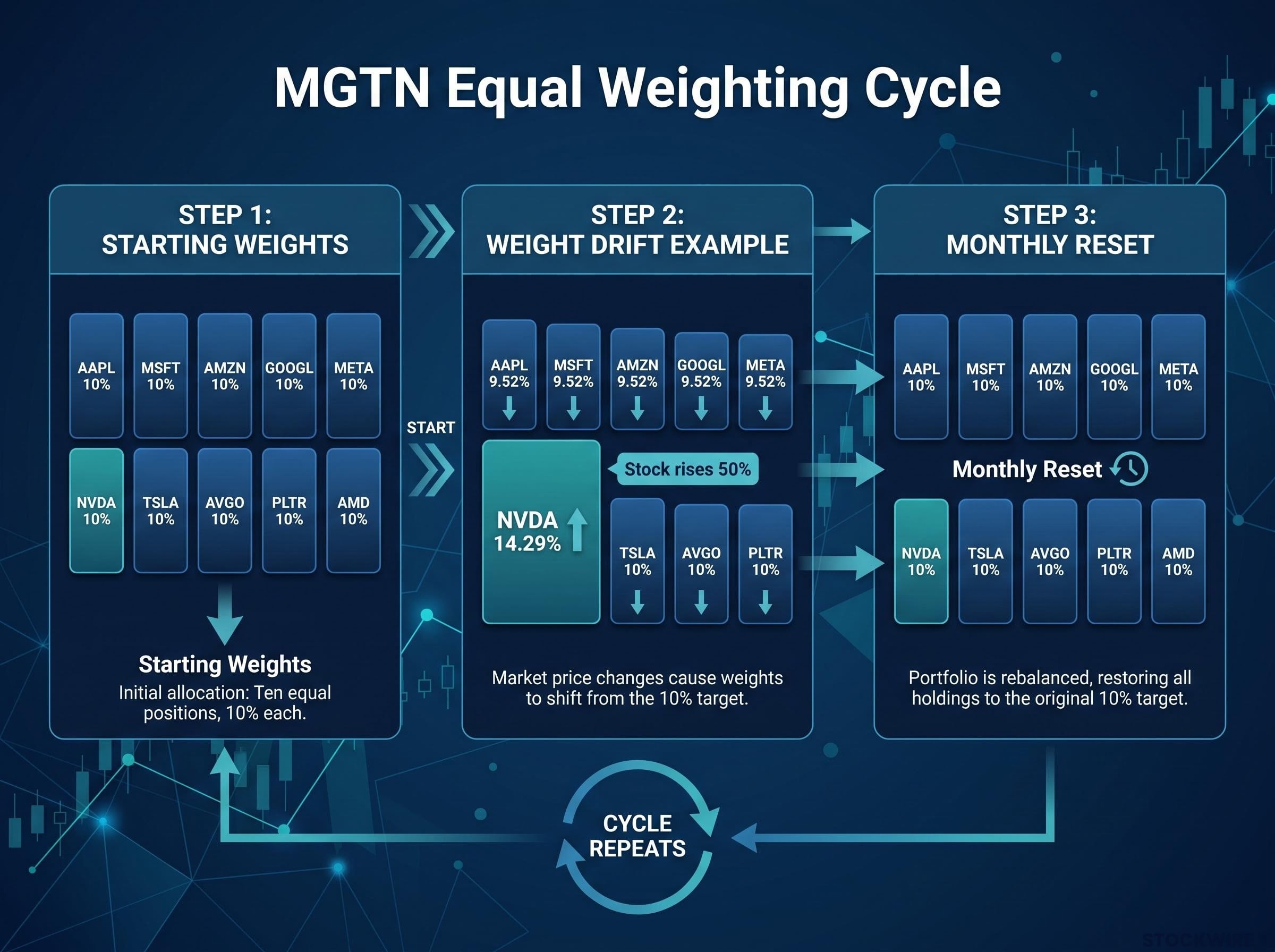
Each stock is reset to a 10% target at a monthly review, and Cboe checks weights daily. That is the key difference from market-cap-weighted products such as QQQ and MGK, where the biggest companies carry the most weight.
Between resets, though, weights drift. Suppose one stock rises 50% and the other nine stay flat. The basket is now worth 1.05 of its starting value, so the index is up 5%.
Weight drift in one step A stock that starts at 10% and rises 50% while the rest stay flat ends up at 14.29% of the index. The next monthly reset trims it back to about 10%.
Cboe announcements and methodology materials have also described ad hoc caps: a rebalance triggered if any single member exceeds 15%, or if the top five combined reach 57%. These thresholds do not appear on the current product page, so treat them as described rather than confirmed.
The Cboe Magnificent 10 methodology sets out how monthly reweighting and divisor adjustments work, so you can check for yourself how a stock that drifts above its 10% target is brought back into line at the next review.
A two-stock example of equal influence
Say Nvidia rises 20% and AMD falls 10%, with the other eight flat. Nvidia contributes 10% × 20%, or +2.0%. AMD contributes 10% × -10%, or -1.0%.
The index ends up roughly +1.0%. AMD’s move counted at full strength despite its smaller size.
The read you should take from this: MGTN behaves like ten roughly equal bets on closely linked growth themes. Equal weighting is a design feature, not a risk reducer, and it does not give you equal volatility or sector diversification.
When big ASX news breaks, our subscribers know first
How is the MGTN index level calculated and published?
The good news is that the level comes from live data. MGTN is calculated in real time from consolidated U.S. exchange prices, and it reflects price changes only.
When weights reset or a corporate action occurs, Cboe adjusts a divisor. A divisor is the number the combined component values are divided by to produce the index level, and changing it keeps scheduled adjustments from creating artificial jumps.
Timing matters too. Cboe publishes a real-time value every 15 seconds from 9:30 a.m. to 4:15 p.m. Eastern, and the end-of-day value after 4:20 p.m. Eastern.
That is why you should treat any quoted level as a snapshot. Sources and timestamps differ, and the gaps can be wide.
| Source | Reported level | Notional per contract | 1% move in dollars |
|---|---|---|---|
| Cboe Global Indices dashboard (16 October 2026) | 531.90 | About $53,190 | About $532 |
| Markets.com (third-party quote) | 565.62 | About $56,562 | About $566 |
Levels are illustrative snapshots as of mid-October 2026 and will change.
Notional value is the index level multiplied by $100. At 531.90, a 1% move is about 5.32 points, or roughly $532 per contract. Cboe’s own dashboard is the authoritative index source, so use it to sanity-check anything else you see.
Notional tells you how much market exposure one contract represents. It is very different from the premium you actually pay, which the next section turns into dollars.
What do the contract specifications actually mean?
Start with the reference card, then test each line against your wallet.
| Feature | Detail | What it means for you |
|---|---|---|
| Multiplier | $100 per index point | Every point of premium or payoff equals $100 |
| Settlement | Cash; difference between exercise price and final settlement value, times $100 | No shares change hands |
| Exercise style | European, exercise only at expiration | No early assignment if you sell options |
| Standard monthly expiry | A.M.-settled, third Friday of the month | Settlement uses expiration-day opening prices |
| PM-settled contracts | Trade as MGTNW | Check the chain for current expiration cycles |
Cboe confirmed European exercise on 10 September 2025, alongside a plan for weekly PM expirations that could be used as zero-days-to-expiration (0DTE) trades, meaning contracts bought and expiring the same day. Cboe’s initial specification and its current product page describe the MGTNW cycles differently, so verify what is listed on the chain before you trade.
Cash settlement and European exercise remove share delivery and early assignment. They do not remove the chance of losing your whole premium, shifts in implied volatility (the market’s priced-in expectation of future swings), gap risk or liquidity risk.
Implied volatility can swing an option’s quoted premium far more than most beginners expect, since the relationship between volatility and price is nonlinear and drives much of what you see on a thin chain.
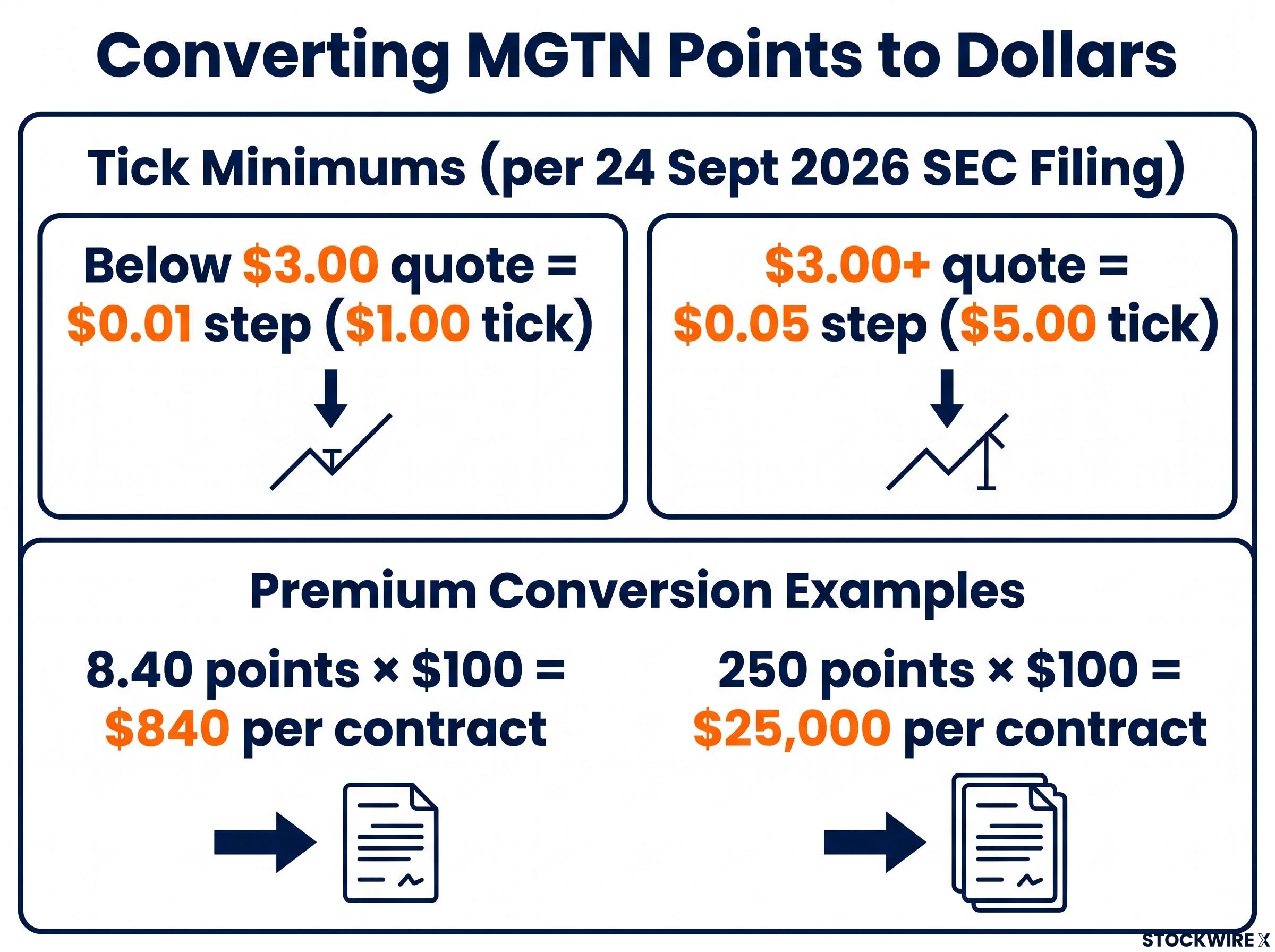
Then there are ticks, the smallest price steps a quote can move in. A Cboe SEC filing dated 24 September 2026 set them as follows:
| Option quote | Minimum increment | Dollar value per tick |
|---|---|---|
| Below $3.00 | $0.01 | $1.00 |
| $3.00 or higher | $0.05 | $5.00 |
Each tick is real money. Treat the gap between bid and ask as a direct cost, not a rounding detail.
Why does A.M. settlement matter, and what risks come with it?
You check the screen on Thursday evening and the index closed at a level that leaves your option comfortably in profit. On Friday morning, the contract settles somewhere else entirely.
That gap is built into the standard monthly contract.
How the Special Opening Quotation works
The final settlement value for monthly contracts is the Special Opening Quotation (SOQ). It is calculated from each member’s opening sale price on its primary listing exchange on expiration day.
Settlement in one line Monthly MGTN options settle to ten opening prices on expiration morning, not to the prior day’s closing index level.
Ten separate openings can land the settlement value well away from the prior close or the last quote you saw. PM-settled MGTNW contracts reference closing prices instead, keeping settlement tied to the final trading session.
If you hold an A.M.-settled contract into expiration, you carry exposure to any news released after the close and before the open. The last quote is not a guarantee of your payoff.
For readers holding monthly contracts into expiry, our dedicated guide to AM-settled expirations shows how opening auction dynamics can push final settlement through a short strike.
Risks that cash settlement does not remove
The structural conveniences leave plenty of risk in place:
- Overnight gap risk: an earnings surprise or regulatory action at one member can move the opening settlement sharply.
- Pin risk: when the index sits near your strike at expiry, uncertainty about the final value can make the payoff differ from what the screen implied.
- Gamma: Cboe’s SEC filing noted that shorter-dated MGTN options carry higher gamma, the rate at which an option’s sensitivity to the index changes, so their value can swing quickly.
- Thin liquidity: wider spreads and less reliable fills, especially in far-dated or out-of-the-money strikes.
- Correlation: in a tech selloff or rates shock, the ten names can fall together, and equal weights offer no shelter.
Compared with SPX options, MGTN shares the cash-settled, European structure but holds just ten stocks, so single-name gaps hit harder. Against NDX, also tech-heavy and cash-settled, the difference is weighting: NDX lets its largest constituents dominate, while MGTN does not.
Adoption is still modest. Cboe’s daily statistics for 17 October 2026 reportedly showed 34 contracts traded and open interest of 814, single-day figures you should check against Cboe’s current data. Cboe cited roughly 30% growth in average daily volume without disclosing the baseline, so that figure tells you direction rather than scale.
How do you read an MGTN options chain and convert points into dollars?
The numbers on a chain change every few seconds. The routine for reading them does not.
- Find the symbol. Search MGTN, or MGTNW for PM-settled contracts.
- Review expirations and confirm settlement. Check whether each date is A.M. or PM settled.
- Identify the strike, bid, ask and premium. Note how wide the spread is.
- Multiply the quote by $100. That gives you the dollar figure per contract.
- Confirm how final settlement is derived. For monthly contracts, it comes from expiration-day opening prices.
Worked premium conversions
A quote of 8.40 points is not $8.40. It is 8.40 × $100, or $840 per contract before commissions and fees.
| Quoted premium (points) | Multiplier | Dollar cost per contract | Cost for 3 contracts |
|---|---|---|---|
| 8.40 | $100 | $840 | $2,520 |
| 250 | $100 | $25,000 | $75,000 |
Because 8.40 sits above $3.00, it moves in $0.05 steps. One tick higher, to 8.45, adds $5 per contract, or $15 across three.
If you buy, you can lose the entire premium. Multiplying every quote by $100 before you click anything shows your true capital at risk, and that is the number that should drive your position size.
What to remember before trading these contracts
Four points carry most of the weight:
- Ten fixed names start at equal weights, but exposure drifts between monthly resets.
- Every point is worth $100.
- Monthly contracts settle to expiration-day opening prices, not the prior close.
- A five-step chain routine turns any quote into a dollar cost.
Cash settlement and European exercise simplify the mechanics, but they do not lower market risk. Thin trading also makes the spread a cost you pay on every entry and exit.
Before you trade, confirm the current expiration cycles, settlement terms and index methodology on Cboe’s official product page. Whether you use these options depends on your appetite for concentrated growth exposure and on what you can afford to lose.
This article is for informational purposes only and should not be considered financial advice. Investors should conduct their own research and consult with financial professionals before making investment decisions. Past performance does not guarantee future results.