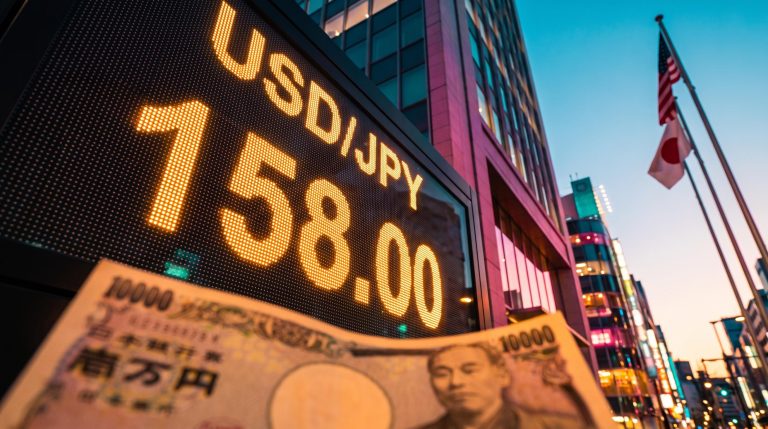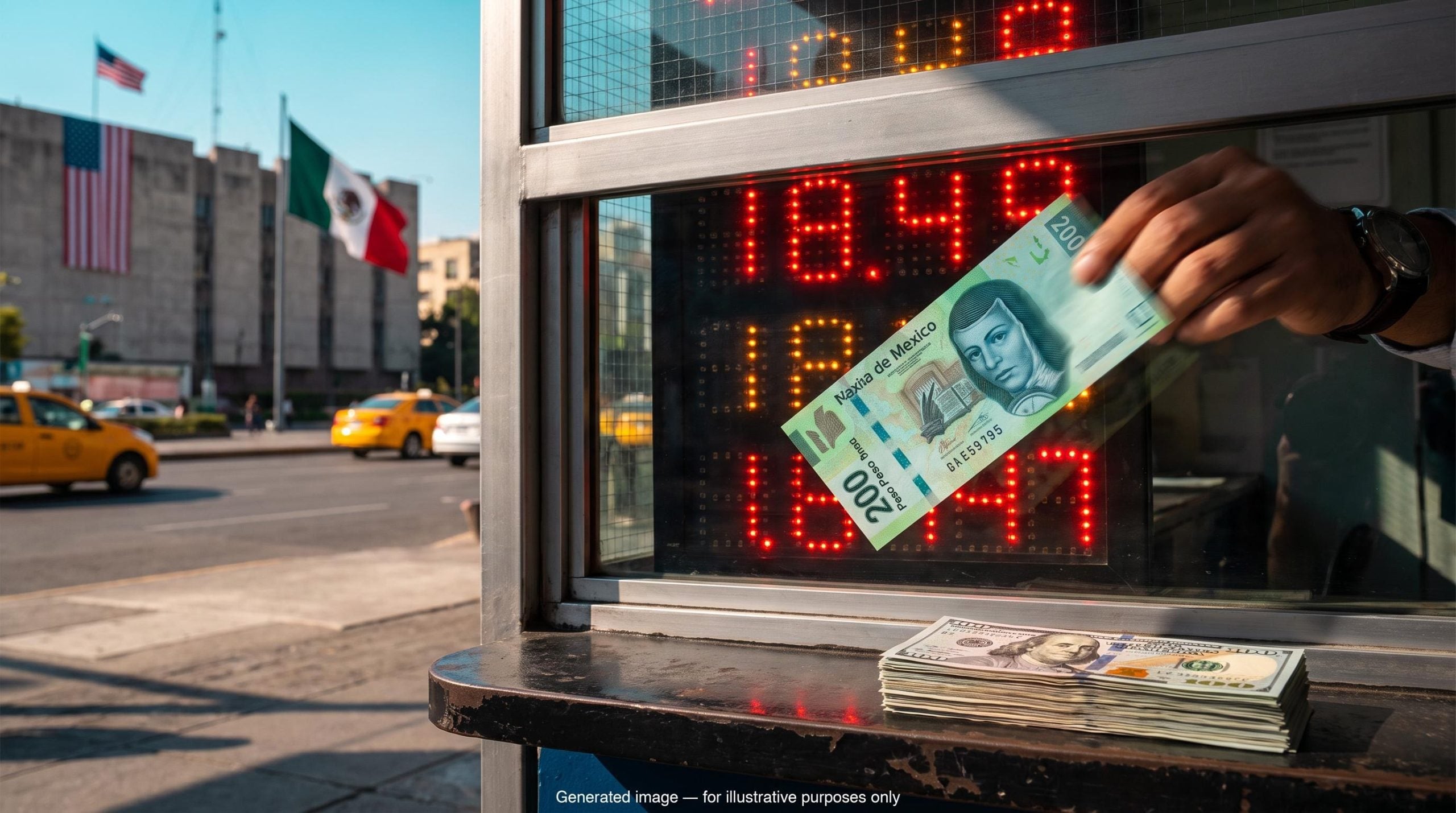
The Mexican peso slipped to around 18.49 per dollar on Friday, 16 October 2026, putting USD/MXN on course for a sixth straight weekly gain. The odd part is that the dollar itself was soft. The peso still lost ground against it.
Three forces are competing for the credit: stalled US-Mexico tariff talks, rising bets on a December rate hike by the US Federal Reserve, and a chart that looks stretched. Mexico had no major data releases on Friday, so US headlines set the tone.
The forces do not carry equal weight. One is headline risk that could reverse quickly. The other rests on rates. The chart then shows where the downside levels sit if either one turns.
Why did the peso fall on a soft dollar?
A weaker dollar should normally give the peso room to climb. On Friday it did not, and the reason was a specific report.
The Wall Street Journal reported on 15 October that talks on an interim trade deal had stalled over autos and metals. Reuters carried the story on 16 October, and El Economista and Anadolu Agency backed it up over the following two days. According to those reports, Commerce Secretary Howard Lutnick resisted any substantial cut to the tariffs at the centre of the talks.
| Issue | US position | Mexico’s position |
|---|---|---|
| Autos | Keep the 25% tariff | 15% or less, roughly the rate applied to Japanese and South Korean vehicles |
| Steel and aluminium | Keep the 50% tariffs | Seeking reductions |
| Derivative finished products | Lutnick opposed cuts | Seeking reductions |
Mexico’s side sounded more upbeat. Deputy Trade Minister Luis Rosendo Gutierrez told the Journal that talks were advancing. Traders paid more attention to Lutnick.
No new tariffs were announced. The peso fell because relief that traders had priced in now looks less likely. Mexican officials and executives had been hopeful about a deal, and some of that hope was built into the currency.
The USMCA tariff talks have been the main swing factor for the peso since September, when optimism over auto and steel relief helped push USD/MXN below 17.00 before the current reversal.
The pattern has a recent precedent. In February 2025, a postponed US tariff threat sent the peso into a rapid rebound. For you, this means part of the current move is positioning against a deal that has not happened yet. The same kind of headline could reverse it quickly if talks restart.
How much of this is the Fed?
Under the trade story sits a second layer that is less stable. US inflation data has pushed traders to price in more tightening by the Fed.
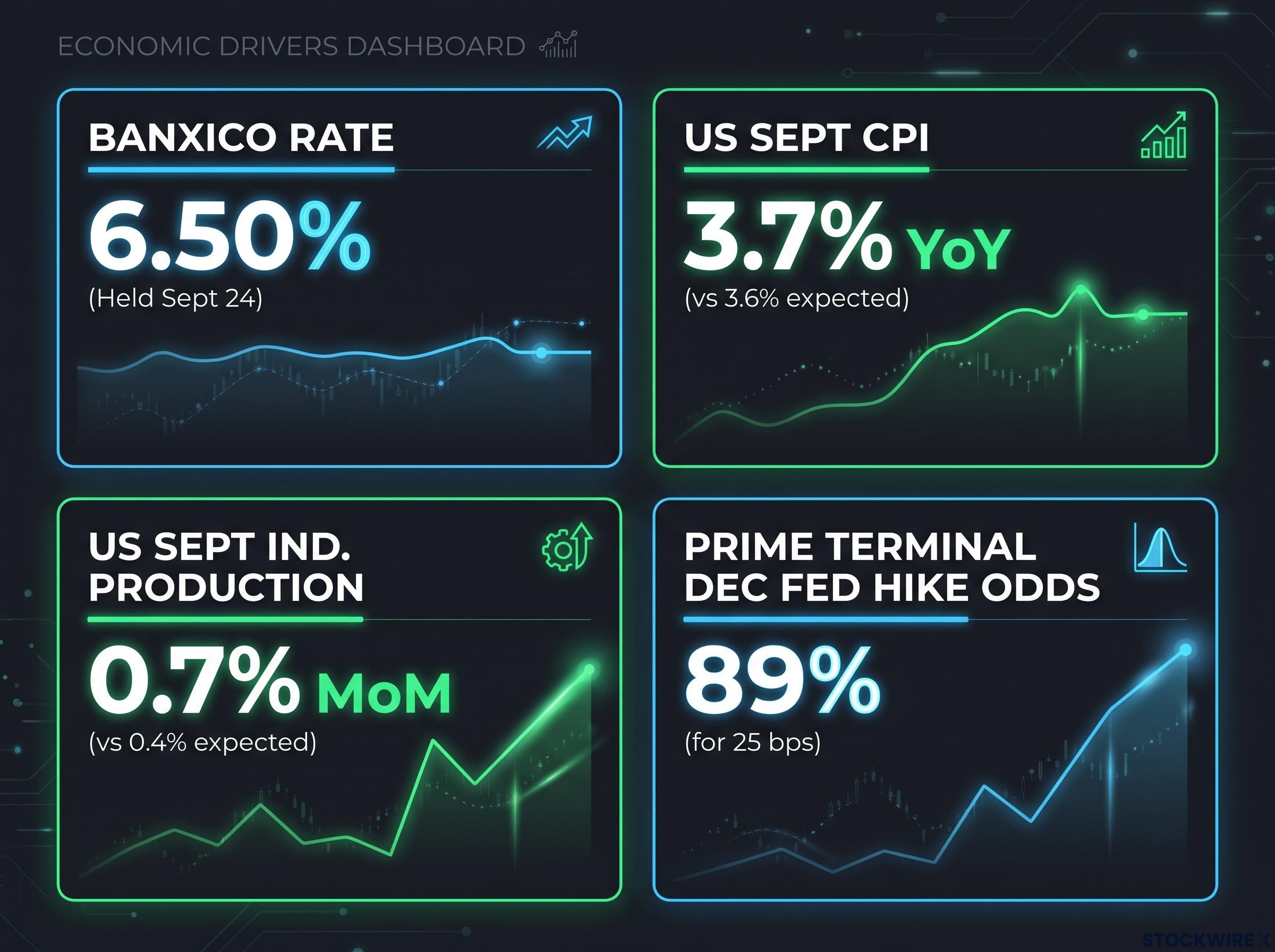
September consumer price inflation was reported at 3.7% year on year, against about 3.6% expected. The Seoul Economic Daily cited the Bureau of Labor Statistics for that figure, but it has not been independently confirmed. US industrial production for September also beat forecasts, rising 0.7% month on month against 0.4% expected.
Rates matter for the peso because of the carry trade. In a carry trade, investors borrow in a lower-yielding currency and buy higher-yielding assets. Banxico, Mexico’s central bank, holds its rate at 6.50%. If the Fed raises US rates while Banxico stays put, the extra return from holding peso assets shrinks, and so does their appeal.
Estimates of how likely a hike is vary widely by source and by time of day:
- October hike, Prime Terminal via FXStreet: 14%, down from above 50% after the inflation release
- October hike, CNBC: jumped to 53.7% from 22.1% just after the inflation data
- October hike, InvestingLive: later readings near 40%, then about 32%
- December hike, Prime Terminal: 89% for a 25 basis point move
- December hike, other reports: about 94%
The spread mostly comes down to different data providers and the timing of each reading. Fed Chair Kevin Warsh gave markets little guidance when he spoke at IMF meetings in Bangkok, according to InvestmentNews.
The inflation release triggered a sharp reshuffling of Fed hike bets on 15 October, with October odds swinging intraday before the market settled on December as the more likely date.
“I don’t prejudge meetings,” said Kevin Warsh, Chair of the Federal Reserve.
You should treat the December hike as the market’s working assumption and the October odds as noise. Whether this layer keeps weighing on USD/MXN depends on whether incoming data supports that assumption or undercuts it.
Why Banxico does not simply follow the Fed
Banxico held its rate unanimously on 24 September. BBVA Research has argued that Mexico can tolerate a narrower gap between US and Mexican rates, and that Banxico’s pause reflects domestic conditions rather than tracking the Fed. Scotiabank sees a November cut as possible but not its base case. A cut would reduce the carry support for the peso.
Is USD/MXN stretched, and where does the chart find support?
The rally is running hot. FXStreet’s AI-assisted technical reading shows a bullish bias on the daily chart. The price sits well above a cluster of moving averages, and a former trend-line ceiling has turned into support.
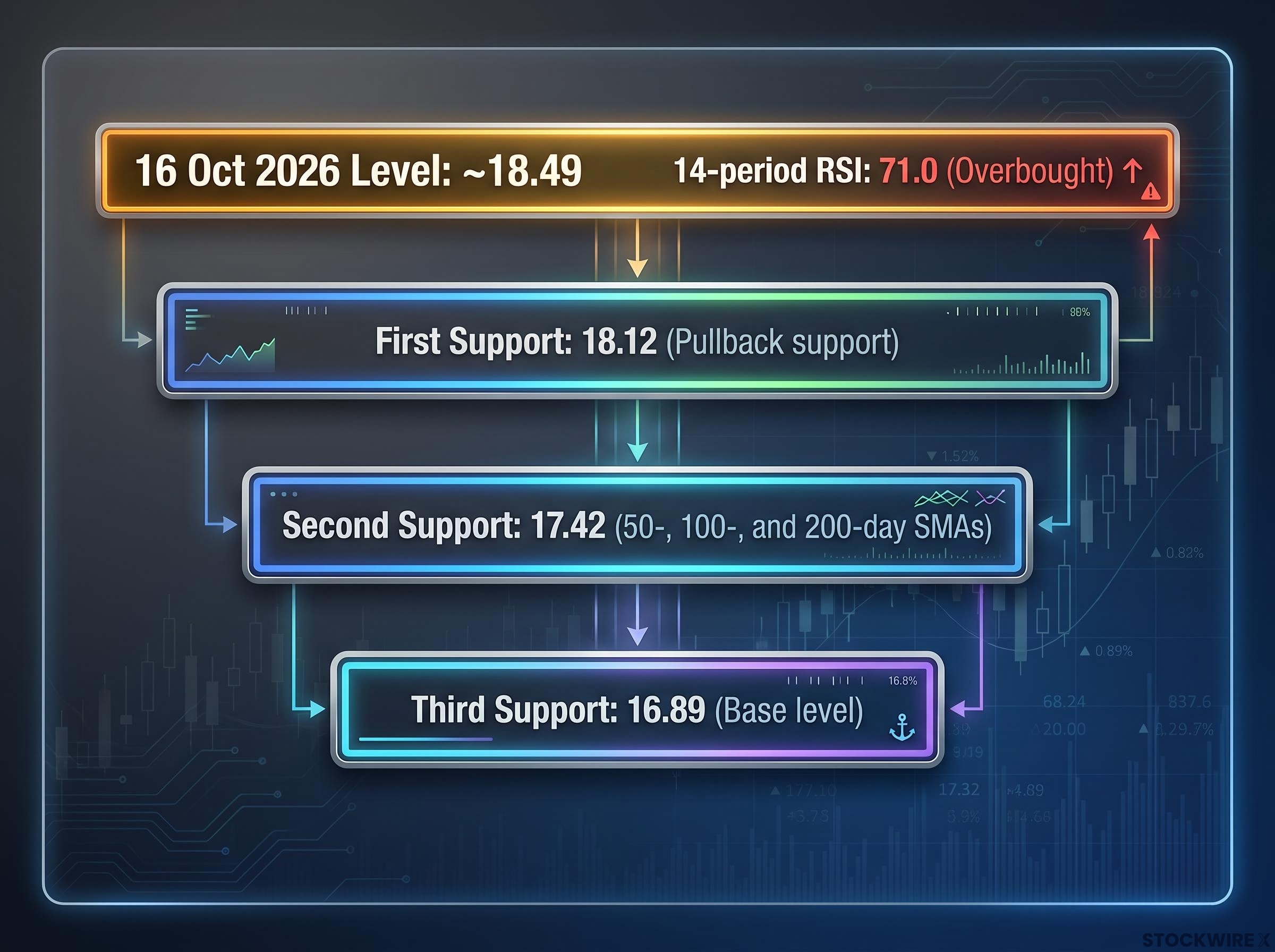
The 14-period Relative Strength Index (RSI) is about 71.0. The RSI is a momentum gauge that compares recent gains with recent losses, and a reading above 70 is usually treated as overbought. That raises the risk of a reversal if tariff news improves or US bond yields fall.
| Level | Approx. value | What it represents |
|---|---|---|
| First support | 18.12 | Pullback support |
| Second support | 17.42 | 50-, 100- and 200-day simple moving averages (17.4234) |
| Third support | 16.89 | Base level (16.8866) |
According to FXStreet, dips are likely to find buyers while the price stays above these levels. Banorte’s year-end forecast of about 17.30 suggests the bank sees the peso’s weakness as temporary rather than permanent.
An overbought reading tells you the trade is crowded, not that it is finished. Watch the 18.12 level and the tariff headlines together. If talks revive and that level breaks, the pullback has a clear path toward the averages.
Reading the peso’s next move: what is cyclical and what is structural
The pressure on the peso is mostly cyclical, coming from Fed repricing and tariff headlines. Remittances, trade integration under USMCA (the US-Mexico-Canada trade agreement) and nearshoring provide structural support. That support cushions a fast portfolio selloff but cannot stop one.
Rates and trade headlines are only two of the forces that drive the peso, and the structural supports of remittances and nearshoring operate on a much longer horizon than the weekly tariff news.
The drivers to watch:
- Banxico policy and any hint of a November cut
- Progress in the trade talks
- Global risk sentiment
- Oil, where the benefit to Mexico is limited by Pemex’s finances and by the greater weight of US manufacturing ties
- Remittance flows
A trade deal could spark a sharp rally, as the February and March 2025 episodes suggest. A level of 18.49 does not signal a structural collapse.
Next week brings Mexican retail sales, mid-month inflation, jobs data and the Economic Activity indicator. The US calendar is light: housing data, jobless claims and flash PMIs (early business survey readings). Two signals matter most: the tariff talks and the Fed odds.
This article is for informational purposes only and should not be considered financial advice. Investors should conduct their own research and consult with financial professionals before making investment decisions. Past performance does not guarantee future results. Forecasts and market-implied probabilities are speculative and subject to change based on market developments.