The Mexican peso is Latin America’s most actively traded currency, yet most people who watch it move cannot name the force behind the move. That gap between visibility and understanding is wider than you might expect. The peso is liquid, well-documented, and quoted on every major platform, but the combination of factors that drive it on any given day remains opaque even to investors who are comfortable reading equity charts and bond yields.
The practical stakes are immediate. Whether you are evaluating an investment with Mexico exposure, tracking the value of a remittance, assessing a nearshoring opportunity, or simply building your emerging-market literacy, the peso’s drivers determine the exchange rate that shows up in a real transaction. The currency sits at the intersection of domestic monetary policy, U.S. economic cycles, commodity markets, and global sentiment. Understanding even one of those layers changes how you read a currency move.
Here is the framework for each of the forces that actually move the peso, structured so you can read a rate decision, a remittance report, or an oil price swing and know immediately what it means for the currency, and which time horizon it belongs to.
Why the Mexican peso behaves differently from other currencies
Before you can interpret any individual peso move, you need to understand the currency’s character. The peso is not a typical emerging-market currency. It occupies a category of its own, defined by three features:
- Most liquid EM currency in Latin America. The peso commands a trading volume that far exceeds its regional peers, giving it a market depth that most other Latin American currencies cannot match.
- Risk-on asset. When investor appetite for yield is high, the peso typically gains ground, but it can sell off sharply when risk aversion takes hold and capital rotates toward safe-haven currencies such as the U.S. dollar.
- Emerging-market proxy. Professional FX frameworks frequently treat the peso as a proxy for broader EM risk sentiment, meaning it absorbs global shocks that have nothing to do with Mexico’s domestic economy.
That proxy status is what makes the peso both more transparent and more volatile than its fundamentals alone would suggest. When global conditions are benign and the dollar is weak, the peso can outperform beyond what local data justifies. When a banking scare or geopolitical escalation triggers broad EM selling, the peso sells off even if nothing material has changed inside Mexico.
What this means for you in practice: when you see the peso move sharply, your first question should not be “what happened in Mexico?” It should be “did something change inside Mexico, or did global sentiment shift?” The answer determines whether the move is a signal worth acting on or just noise you can safely ignore.
When big ASX news breaks, our subscribers know first
Banxico’s rate policy and its direct effect on peso valuation
The single most discussed driver of medium-term peso strength is the interest rate differential between Mexico and the United States. The mechanism is straightforward. When Mexican yields exceed U.S. yields, peso-denominated bonds and money-market instruments become attractive to global investors. To access that return, they must buy pesos first, creating direct currency demand.
This is the carry trade: borrowing in a low-yielding currency and investing in a high-yielding one, pocketing the difference. A carry trade (borrowing in a low-yielding currency to invest in a higher-yielding one) works only as long as the rate gap persists and the higher-yielding currency does not depreciate enough to wipe out the yield advantage. That is why every Banxico rate decision and every shift in Federal Reserve guidance is a direct input into peso valuation.
According to the Dallas Fed, peso appreciation has been driven by “high interest rate differentials relative to the U.S. and longer-run macroeconomic fundamentals.” The Peterson Institute for International Economics (PIIE) likewise highlights “a very large monetary policy interest rate spread vis-à-vis the federal funds rate” as a structural support for the currency.
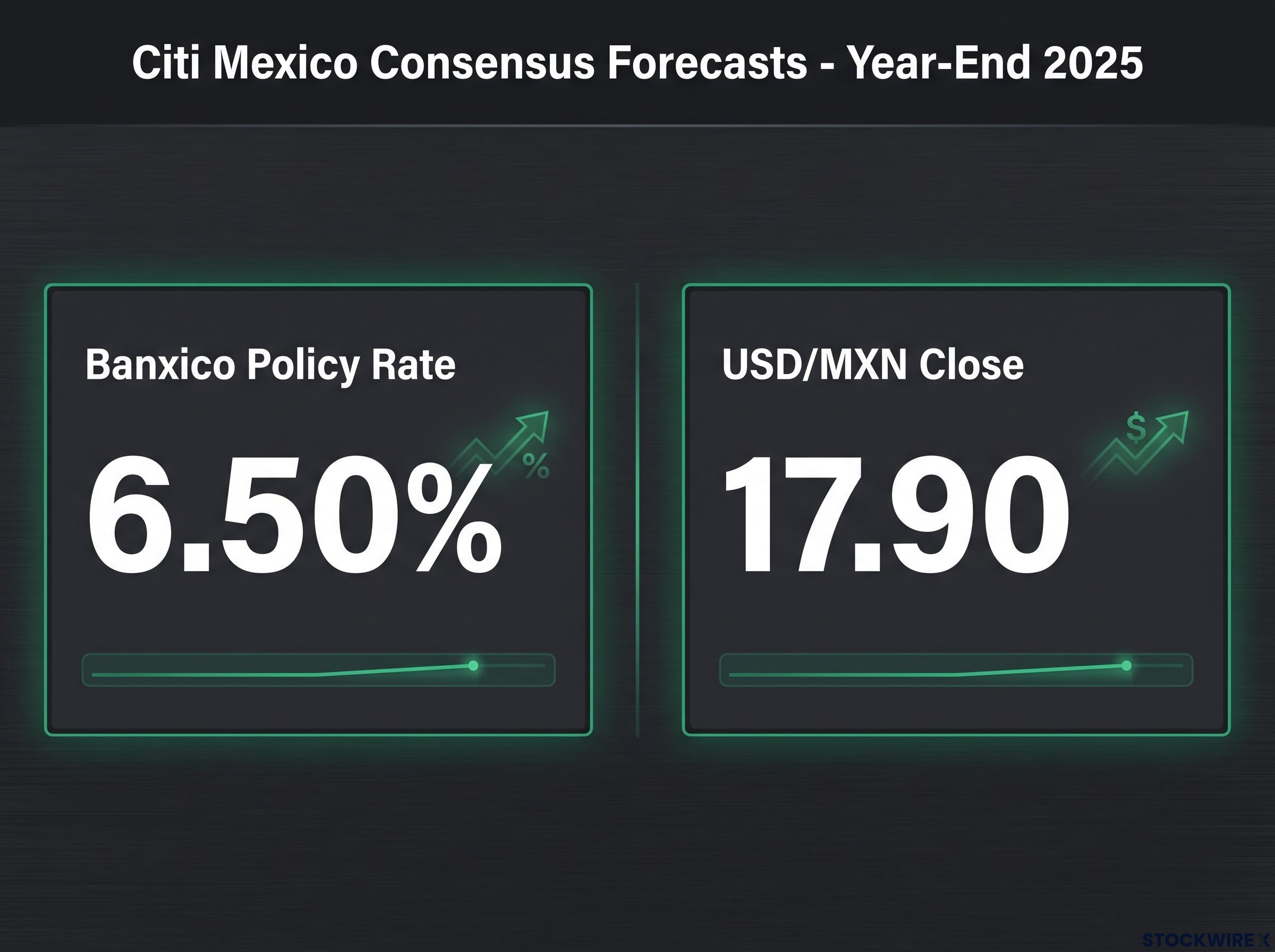
The vulnerability is equally clear. When the Fed hikes aggressively or Banxico cuts, the rate gap narrows and carry-driven peso support can fade quickly. In its most recent survey, Citi Mexico consensus forecasts pointed to a year-end 2025 Banxico policy rate of 6.50% alongside a USD/MXN close of 17.90, demonstrating how the rate gap feeds directly into analyst exchange rate projections.
The credibility premium: why Banxico’s reputation is a currency driver in its own right
The rate number alone does not tell the full story. Market confidence in the institution setting the rate matters just as much. Banxico’s reputation for proactive, orthodox monetary policy and perceived independence functions as a structural anchor for the peso. Even under external pressure, the market’s confidence in Banxico’s commitment to price stability limits the severity of peso depreciation.
This is why the peso has often outperformed other EM currencies under stress, despite sharing similar risk-on characteristics. If that perception of independence were to erode (through political interference in rate-setting, for example), the currency impact would extend well beyond whatever the rate itself happened to be. For you, a Banxico rate decision is not just a domestic policy event. It is a direct input into the rate gap that determines whether global capital stays in peso assets or rotates out.
Remittances: the structural inflow most FX models underweight
Remittances are often framed as a human interest story. For the peso, they are a hard FX mechanics story. Money sent home by Mexicans working abroad, primarily in the United States, arrives in dollars that must be converted into pesos. That conversion creates sustained, structural demand for the currency that is fundamentally different from portfolio capital.
The difference matters. Portfolio flows (foreign investors buying Mexican bonds or equities) are easily reversed. When sentiment sours, that capital leaves in a day. Remittances do not work that way:
- Stability: Remittance flows are steady and socially driven, tied to family obligations rather than yield calculations.
- Countercyclical quality: When Mexico’s domestic conditions deteriorate, families abroad often send more support, meaning the inflow strengthens precisely when other capital sources are under pressure.
- Reversibility: Remittances reverse not on market sentiment but on U.S. labour market weakness or U.S. immigration policy changes, both of which are external to Mexico’s control.
PIIE emphasises that strong remittances, combined with tight monetary policy, have been central to recent peso strength. FX market practitioners explicitly list remittances among the key determinants of MXN.
The World Bank remittance data for Mexico tracks personal remittance receipts in current U.S. dollars on a continuously updated basis, giving you a reliable benchmark for measuring how structurally significant these inflows have become relative to Mexico’s overall external account.
If you are assessing the peso’s medium-term stability, remittance data gives you a signal that is more durable than portfolio flow data. But it also means Mexico’s currency carries a meaningful dependence on conditions in the U.S. labour market and U.S. immigration policy that no domestic action can fully offset.
Oil revenues, nearshoring, and the FDI layer: how Mexico earns foreign currency beyond remittances
The peso is sometimes misread as a petrocurrency. Oil matters, but it is one of several external earning streams, and not the most structurally durable one.
When crude prices rise, Mexico’s fiscal position and FX earnings improve, typically supporting the peso. Prolonged declines strain public finances and weigh on the currency. Pemex’s balance sheet and debt position add a secondary channel: they feed into sovereign risk assessments independently of the oil price level, shaping how investors view Mexico’s overall credit profile.
But the structural story that has reshaped the peso’s medium- and long-term outlook is nearshoring. Mexico’s geographical proximity to the United States, its role within the United States-Mexico-Canada Agreement (USMCA), and its established industrial base make it a prime beneficiary of firms relocating production closer to North American markets. Foreign direct investment (FDI) linked to this relocation arrives in dollars that must be converted into pesos to pay wages, build plants, and fund local operations. That creates direct, sustained currency demand that compounds over time as export capacity expands.
Recent commentary explicitly cites nearshoring as a contributing factor to peso appreciation alongside rate differentials. The time horizons are different, though: oil is a medium-term cyclical driver; nearshoring is a long-duration structural story that shapes multi-year currency trajectories rather than daily moves.
U.S. trade policy shifts that redirect global supply chains also reshape the competitive environment for nearshoring destinations like Mexico, since tariff regimes and bilateral trade agreements simultaneously determine which countries attract FDI and which lose it to lower-cost or politically preferred alternatives.
If you are tracking the peso over a five-year horizon, weight nearshoring and FDI more heavily than oil price movements. FDI flows compound into export capacity and trade balance improvements that outlast any single commodity cycle.
| Income stream | Time horizon | Reversibility | Key risk factor | FX transmission |
|---|---|---|---|---|
| Oil revenues | Medium-term, cyclical | Moderate (tied to global crude prices) | Sustained price declines; Pemex debt | Fiscal revenues and external account improvement |
| Remittances | Structural, ongoing | Low (socially driven, not sentiment-driven) | U.S. labour market weakness; immigration policy | Dollar-to-peso conversion by recipients |
| Nearshoring FDI | Long-duration, structural | Very low (capital-intensive, sticky) | Trade policy disruption; USMCA renegotiation | Dollar conversion for wages, construction, operations |
The U.S. connection: why America’s economy is Mexico’s most important external variable
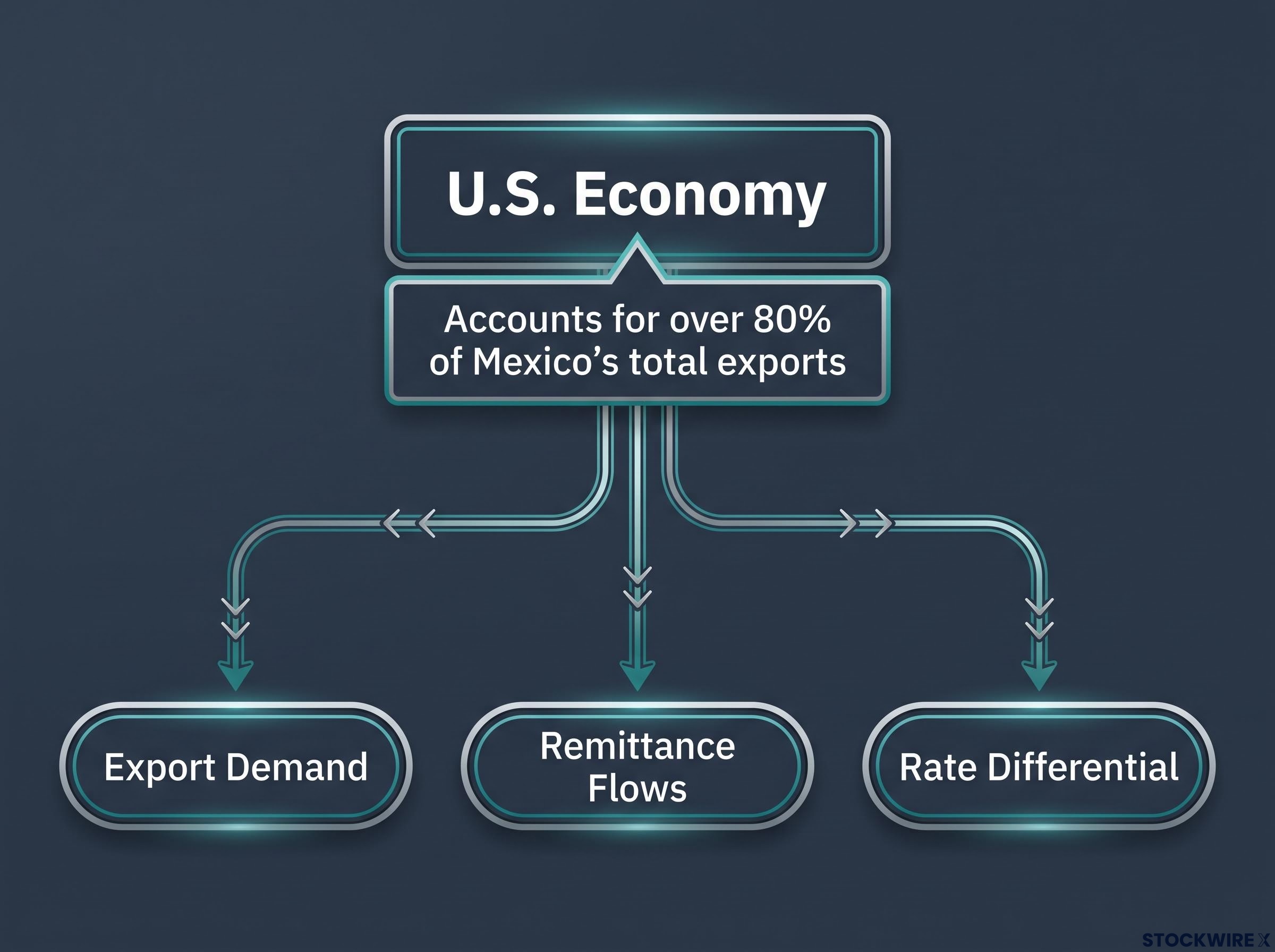
The United States accounts for over 80% of Mexico’s total exports. When that much of your trade goes to a single market, that market’s business cycle is effectively your business cycle, with a lag.
U.S. conditions ripple into Mexico “with unusual directness,” a characterisation strongly supported by trade data and policy analysis.
The scale of that integration means U.S. economic conditions simultaneously drive three distinct peso channels:
- Export demand. A strong U.S. economy boosts demand for Mexican goods, improving Mexico’s trade balance and supporting the peso.
- Remittance flows. U.S. growth supports employment for Mexicans working in the United States, reinforcing the remittance inflows that provide structural peso support.
- Rate differential. U.S. conditions shape Federal Reserve policy, which determines the Mexico-U.S. interest rate gap driving carry flows into or out of peso assets.
The directional risk is important. When the Fed tightens, it narrows the rate gap and strengthens the dollar simultaneously, creating a double headwind for the peso that domestic policy alone cannot offset. Conversely, softer U.S. rates and a weaker dollar have been explicitly linked to periods of peso appreciation.
Any serious peso analysis must treat U.S. GDP growth, U.S. employment data, and Fed guidance as first-order inputs, not background context. They feed three separate channels that all land on the currency at once, and no other bilateral relationship in emerging markets carries that kind of concentrated influence.
U.S. economic resilience signals matter to peso watchers because they shape both Federal Reserve rate expectations and U.S. employment levels, the two inputs that simultaneously determine carry trade attractiveness and the remittance inflow volumes that provide the peso with structural support.
Reading the peso across time horizons: what drives short-term noise versus long-term trend
Each of the drivers covered above operates on a different time horizon. That distinction matters, because the same peso move can mean entirely different things depending on which layer is causing it.
| Time horizon | Dominant drivers | Secondary factors | Key question to ask |
|---|---|---|---|
| Short-term (days to weeks) | Global risk sentiment, positioning, volatility events | Fed signals, geopolitical headlines | Is this a sentiment shift or a fundamental change? |
| Medium-term (months to quarters) | Interest rate differentials, inflation, U.S. conditions, oil prices | Banxico credibility, fiscal management | Has the rate gap or macro picture structurally changed? |
| Long-term (years) | Nearshoring and FDI, remittances, fiscal discipline, trade integration | Governance quality, political stability | Are the structural inflows strengthening or weakening? |
One practical factor that the table does not capture is investor positioning. When long-MXN trades are crowded (meaning a large number of investors are betting on peso appreciation), the currency becomes more vulnerable to sharp unwinds even when fundamentals are intact. The reversal comes from position mechanics, not from any change in the underlying story.
The interaction between positioning and fundamentals matters. The same external shock will have a larger or smaller peso impact depending on whether the currency is over- or undervalued relative to fundamentals and how crowded the prevailing trade is. Large international reserves give Banxico the capacity to signal stability during periods of external stress, functioning as a medium-term buffer. But reserves are a tool for managing disorderly moves, not a substitute for sound fundamentals.
When fundamentals and sentiment diverge: what the gap tells you
Sometimes the peso weakens despite strong domestic fundamentals: high real yields, healthy external metrics, and stable fiscal management. When that happens, the divergence is usually a positioning or sentiment story, not a fundamental one. Historically, these episodes have resolved in favour of fundamentals once global risk conditions normalise.
Banxico’s reserve buffer and institutional credibility are the mechanisms that allow that resolution to happen without a disorderly adjustment. Political risk is the wildcard: institutional deterioration or perceived threats to Banxico’s independence represent a long-term currency risk that can materialise suddenly, transforming a sentiment-driven dip into a fundamental repricing.
When you see the peso move sharply, the first question is not “what changed?” It is “what time horizon is driving this?” The answer tells you whether you are looking at noise or a signal that requires updating your view.
What the peso’s complexity reveals about emerging-market currencies more broadly
The peso is an unusually well-documented case study precisely because it is so liquid and so closely watched. That makes the framework you have just built, rate differentials, remittances, commodity exposure, FDI, bilateral trade integration, risk sentiment, and time-horizon sequencing, applicable well beyond Mexico. Most EM currencies are shaped by the same categories of force. The analytical skill is knowing which layer is active at any given moment.
Broader emerging market dynamics that have driven MSCI EM outperformance in 2026, including dollar weakness, improving corporate earnings cycles, and supply-chain diversification into Mexico specifically, form the structural backdrop against which peso-specific carry and FDI flows should be read.
No single factor explains the peso, and the same is true of most emerging-market currencies. The value of the framework is that it scales. You can now read a Banxico decision, a remittance data release, an oil price move, or a Fed guidance shift and place it in the correct layer. You can apply similar logic to other EM currencies using Mexico as your reference point.
As nearshoring deepens, remittances remain structural, and Banxico’s credibility holds, the medium- and long-term architecture for the peso is more clearly articulated than for most EM peers, even as short-term volatility persists. The peso does not promise simplicity. It rewards the reader who understands which question to ask first.
This article is for informational purposes only and should not be considered financial advice. Investors should conduct their own research and consult with financial professionals before making investment decisions.
—