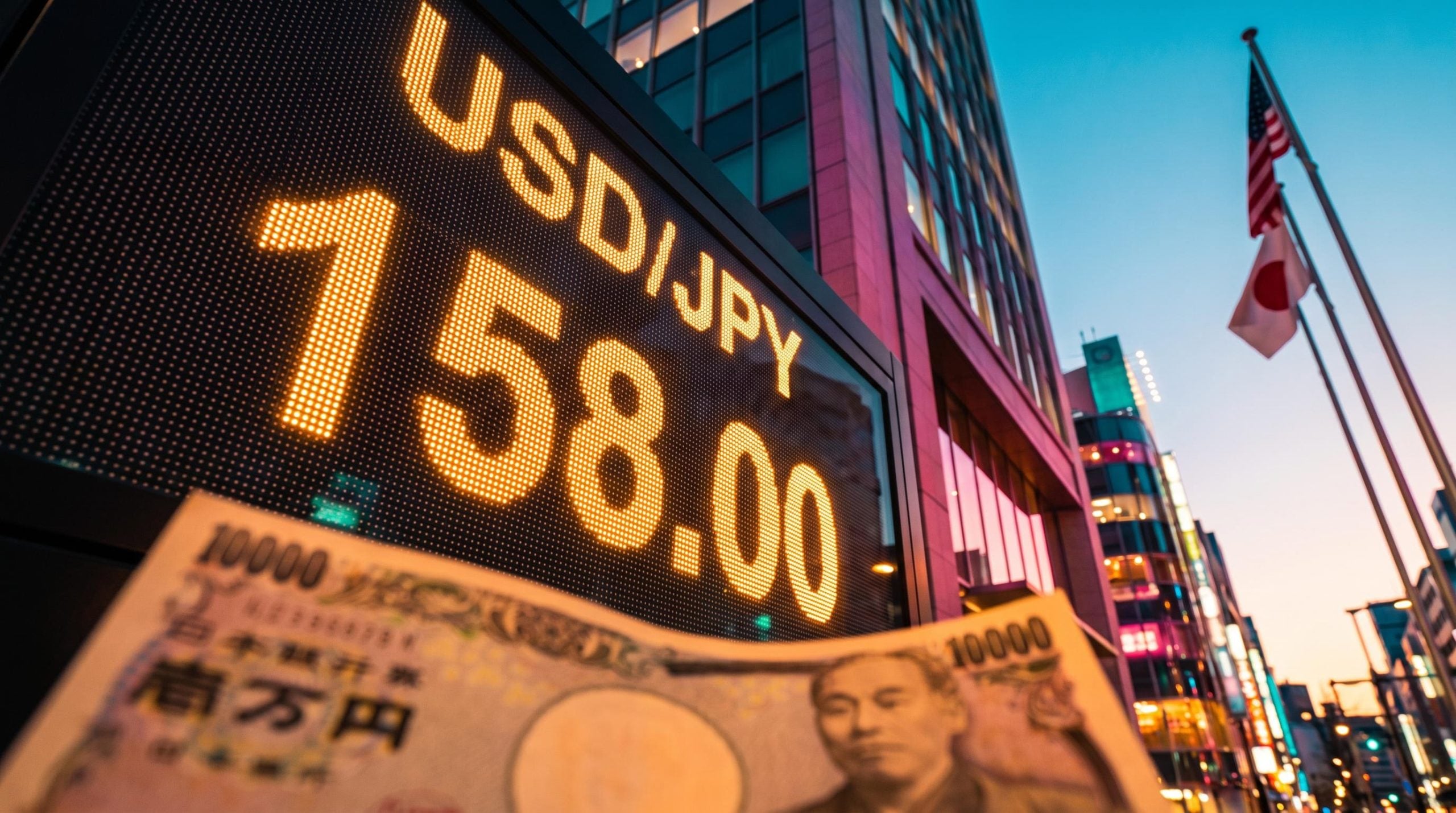
A senior US Treasury official has said publicly that Japan’s currency and monetary policy “must change” because deflation is over. The yen barely flinched, and USD/JPY sat near 158.00 the morning after, keeping the near-term outlook for the pair firmly in focus.
Erin Browne, US Treasury Undersecretary for International Affairs, made the comments to Reuters reporters in Bangkok during the IMF/World Bank Annual Meetings. The interview took place on 15 October and was published on 16 October.
Remarks like these would normally pass as routine diplomatic language. They are harder to dismiss this year. On 31 July 2026, Washington and Tokyo reportedly carried out the first coordinated US-Japan intervention to support the yen since 1998.
Here is a plain reading of what Washington is asking for, what it is not asking for, and the forces that will decide whether the dollar-yen rate actually moves.
What did Browne actually say, and what is she asking Japan to do?
Browne’s central line linked the yen directly to Japan’s changed inflation picture.
Erin Browne, US Treasury Undersecretary for International Affairs “Japan no longer faces the deflationary environment that existed for more than a decade, and the level of its currency and monetary policy must change accordingly.”
She paired that with a message of partnership. US and Japanese officials, she said, had worked closely at all levels to support stable, well-functioning markets and would keep doing so.
Then came the warning. Sharp, disorderly currency moves, Browne said, can force investors to unwind positions, spread volatility across markets and potentially raise financing costs “in both the United States, and really globally.”
Read together, the three remarks sound firmer than they are. Reuters called the comments an unusually direct US signal, yet LSEG cautioned they are not necessarily a demand for a specific yen target. The wording points to a preference, not an ultimatum.
Deputy Governor Himino’s willingness to act without complete information lowers the threshold for BOJ normalisation, which is consistent with the gradual adjustment Washington appears to be endorsing.
What the remarks signal:
- US support for a stronger yen than today’s levels
- Backing for continued Bank of Japan (BOJ) normalisation, meaning a gradual return to more typical interest rates
- Joint US-Japan management of disorderly market moves
What they do not signal:
- A demand for an immediate BOJ rate hike
- A named exchange-rate level that either government will defend
Browne also argued the IMF should be more forceful in flagging global imbalances and more balanced on upside risks to growth, side points that did not change her core message on Japan.
For you, the takeaway is restraint. The wording describes gradual adjustment and coordinated market management, so pricing it as a countdown to a BOJ move or a defended level would be reading more into it than Washington said.
When big ASX news breaks, our subscribers know first
Where does USD/JPY stand, and why is the yen still weak?
The market’s verdict was a shrug. USD/JPY traded near 158.00 on 16 October, up 0.01% on the day, after touching a recent high of 158.75 on 12 October.
| Item | Level or detail | Source |
|---|---|---|
| USD/JPY | About 158.00 (16 October) | FXStreet |
| Recent high | 158.75 (12 October) | UOB via FXStreet |
| Recent range | About 157.83-158.75 | UOB |
| BOJ policy rate | 1.25%, a 31-year high | Reuters |
| Latest BOJ move | 25 bp hike in September, reportedly by a 7-2 vote | InvestingLive |
| US-Japan rate gap | Roughly 250-275 bp | LSEG |
A basis point (bp) is one hundredth of a percentage point. Even after the BOJ’s September hike, US rates still sit well above Japan’s, and that gap is only the first layer of the yen’s problem:
- Rate gap: dollar assets still pay considerably more than yen assets.
- Negative real yields: after inflation, Japanese returns stay unattractive.
- Overseas investment: Japanese investors keep holding foreign securities and bring little money home.
- Fiscal concerns: worries about Japan’s public finances weigh on confidence in yen assets.
- Energy imports: buying fuel abroad creates steady demand for foreign currency.
- Carry trades: investors borrow cheaply in yen to buy higher-yielding assets, selling yen in the process.
Analysts split on the main driver
LSEG and UBP treat the rate gap as dominant, with UBP arguing the carry advantage persists. J.P. Morgan Asset Management points to speculative positioning, limited repatriation and fiscal worries. Capital Economics noted yield gaps had moved slightly in the yen’s favour over the past year, which suggests rates alone cannot explain the weakness. Fitch adds that further BOJ hikes would likely be needed for lasting appreciation.
Because these causes are structural and stacked on top of each other, you should expect official commentary to move the pair far less than a shift in yields or capital flows would.
Can talk and intervention move the yen, or only fundamentals?
Tokyo’s warnings carry more weight now than they did a year ago. The 31 July joint operation gave them teeth, and Finance Minister Satsuki Katayama leaned on that yesterday.
The 31 July operation was a rare coordinated US-Japan intervention, with Washington selling euros to buy yen rather than dollars, a design choice that kept Treasury market supply out of the equation.
Satsuki Katayama, Japan’s Finance Minister, 15 October “The US is here with us right now, and we will act without hesitation if necessary.”
The US Treasury’s latest currency report, updated on 26 August, kept Japan on its Monitoring List, a watch list of economies whose currency practices Washington tracks closely. That report found Japan did not intervene during its review period, but the period ended before the July operation, so the finding does not cover it.
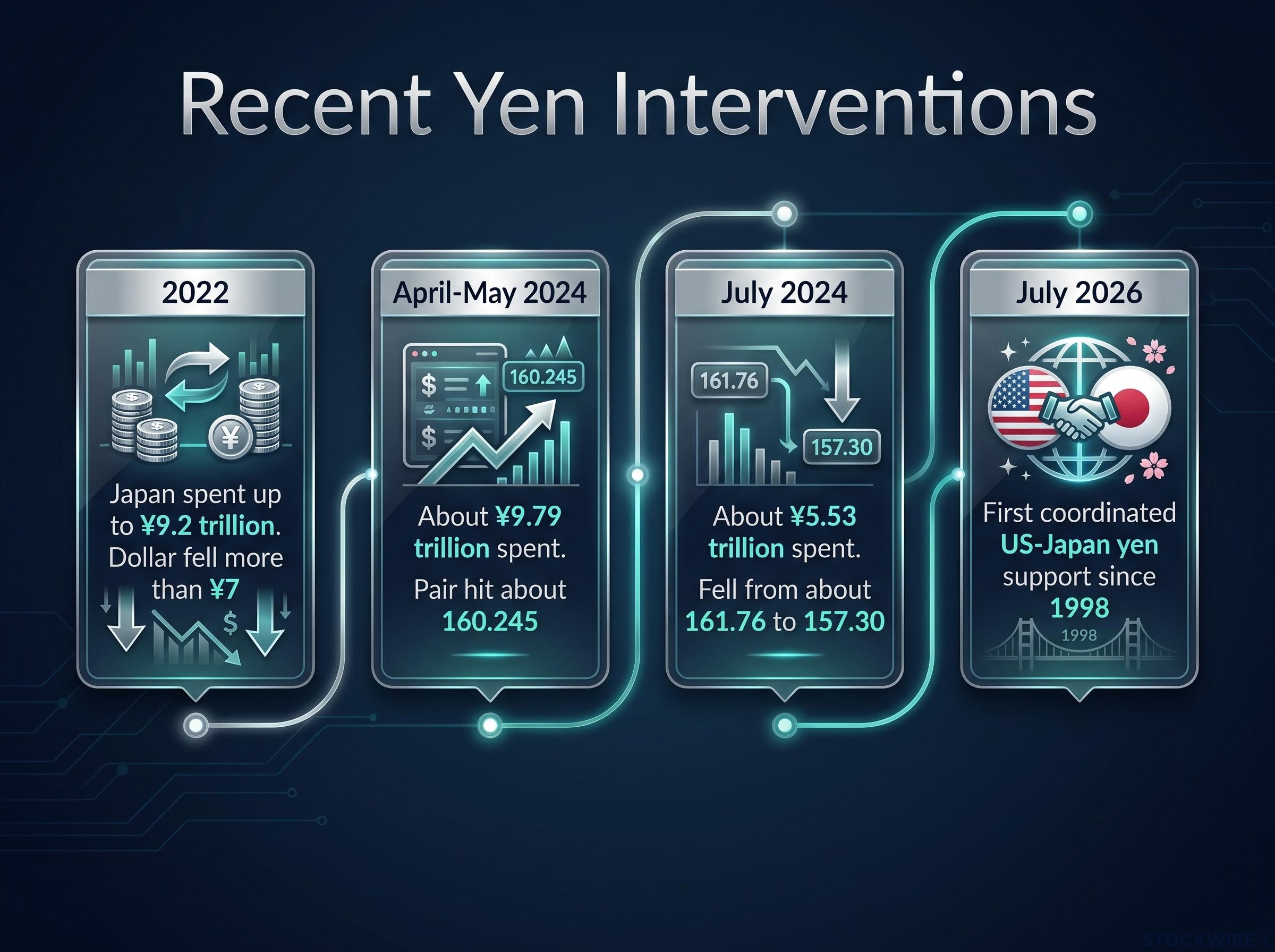
History shows how intervention tends to play out.
| Episode | Circumstances | USD/JPY reaction |
|---|---|---|
| 2022 | Japan spent up to ¥9.2 trillion amid aggressive Fed tightening | Dollar fell more than ¥7 at one point on 21-24 October; gains faded |
| April-May 2024 | About ¥9.79 trillion after the pair hit about 160.245 | Sharp yen rally; broader slide not reversed |
| July 2024 | About ¥5.53 trillion on 11-12 July | Fell from about 161.76 to 157.30 |
| July 2026 | First coordinated US-Japan yen support since 1998 | Immediate reaction not found in available reporting |
Each operation bought a fast rally. None closed the yield gap behind the yen’s weakness.
The limits remain. Japanese authorities say they target excessive volatility, not a level, and no exchange-rate target has been agreed. Any sense that Washington is dictating BOJ policy risks political friction over central bank independence. Browne herself flagged a further danger: a sudden yen surge can force leveraged carry positions to unwind, spreading stress into equities and credit.
History tells you intervention can hand traders a sharp tactical move but rarely a durable trend. Treat any spike lower in the pair as an event to assess, not proof of a new direction.
What should you watch next for USD/JPY?
The nearest real test arrives in two weeks, and it comes from Tokyo rather than Washington.
- BOJ meeting, 29-30 October 2026: with the policy rate at 1.25%, any signal of further tightening would hit the rate gap directly.
- Federal Reserve direction: UBP argues the yen stays vulnerable unless the BOJ tightens further or the Fed cuts.
- Intervention triggers: the 158.75 recent high and the 160 area that preceded 2024 action are reference points, not official targets.
- Positioning and risk appetite: a sharp carry-trade unwind could move the pair faster than policy.
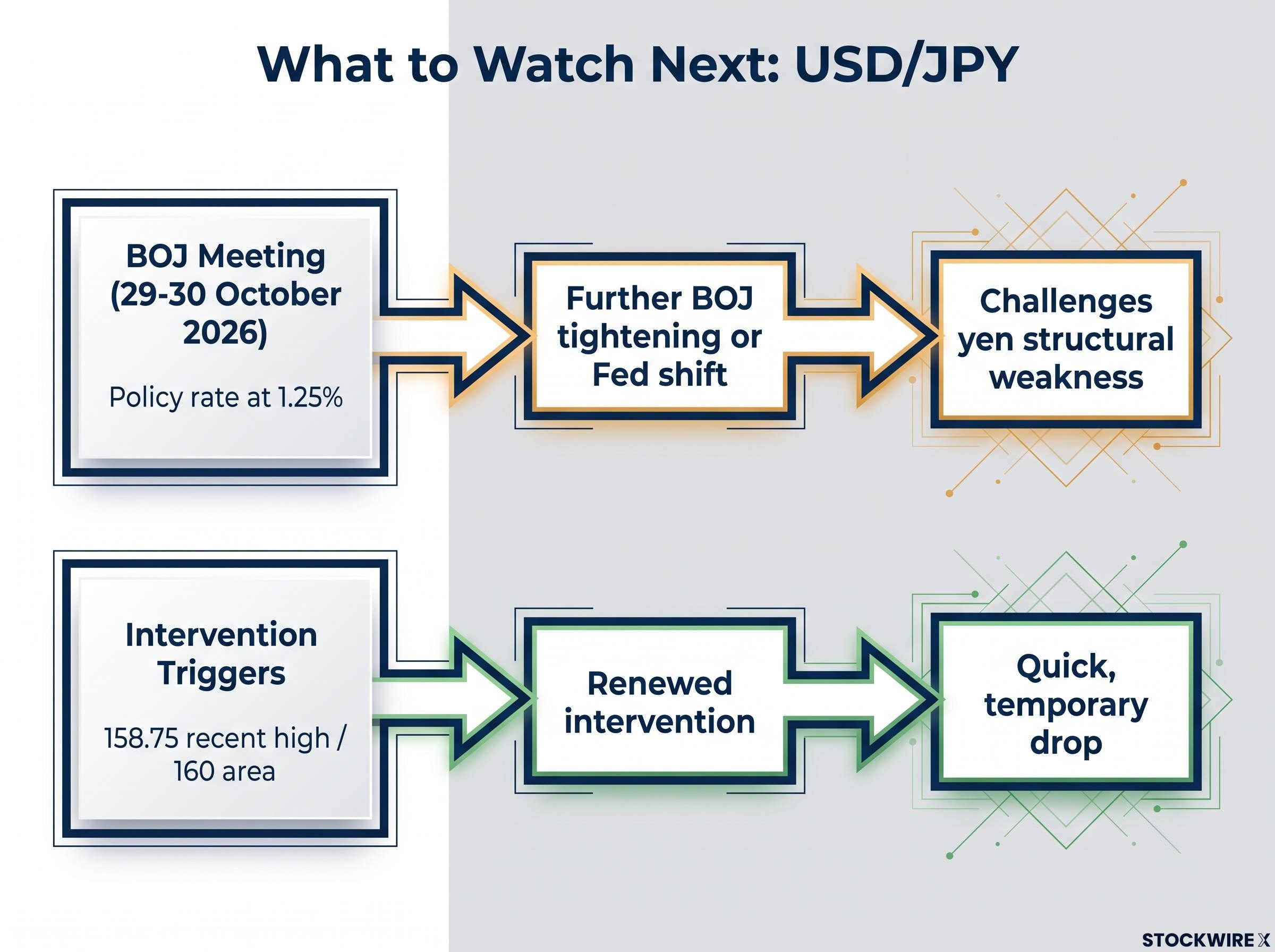
Scenarios for the pair
Further BOJ tightening or a Fed shift would challenge the yen’s structural weakness. Renewed intervention would likely deliver a quick but possibly temporary drop. Absent any of these, the pair may simply keep drifting near current levels.
Policy error cuts both ways. The IMF’s 13 October outlook expects gradual hikes toward neutral, while Fitch suggests faster tightening may be needed to support the yen. Moving too slowly risks entrenching inflation; moving too fast could damage fragile domestic demand.
The BOJ decision, not US commentary, is the next event capable of changing the pair’s direction.
Markets treated the September hike to 1.25% as priced in, so forward guidance on the pace of further tightening now carries more weight for the yen than the rate step itself.
Past performance does not guarantee future results. Forecasts and scenarios are speculative and subject to change based on market developments and policy decisions.
What Browne’s message changes, and what it does not
Browne’s remarks confirm that Washington backs a stronger yen and continued BOJ normalisation, and that both governments stand ready to act together against disorderly moves. That raises the credibility of any future intervention.
What it does not change is the machinery underneath: the rate gap, negative real yields and the steady flow of Japanese money abroad. Those will set the pair’s path, alongside BOJ and Fed decisions and how traders are positioned.
For you, the practical stance is caution. Treat rhetoric-driven or intervention-driven moves as short-term events until the fundamentals themselves shift.
This article is for informational purposes only and should not be considered financial advice. Investors should conduct their own research and consult with financial professionals before making investment decisions.