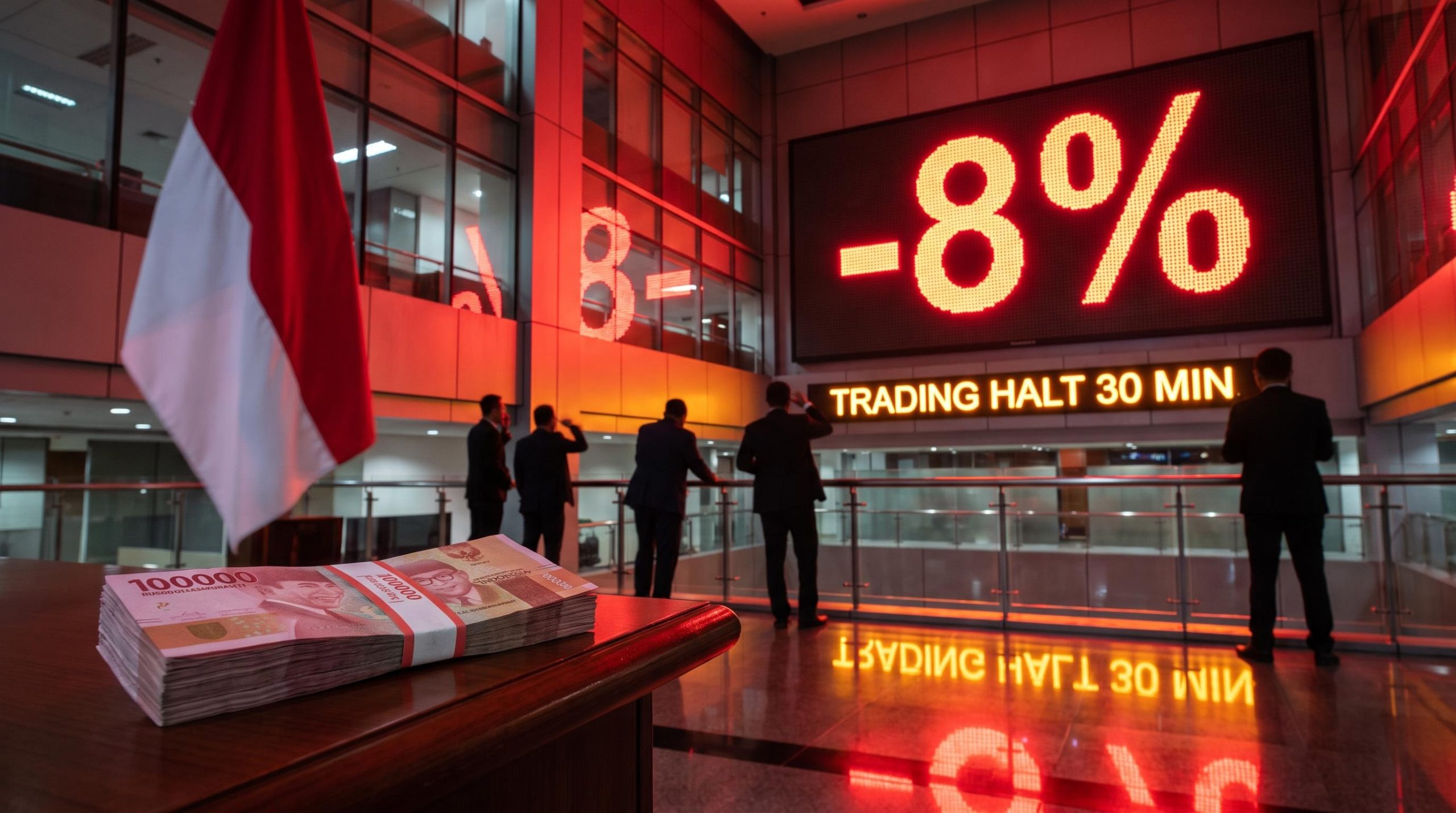
MSCI has proposed moving Indonesia to standalone status, a tier below frontier markets. The reclassification would strip Indonesian stocks out of its emerging- and frontier-market index families entirely. Jakarta equities fell as much as 8% at the open, triggering a 30-minute trading halt, while USD/IDR held near 17,900-17,950.
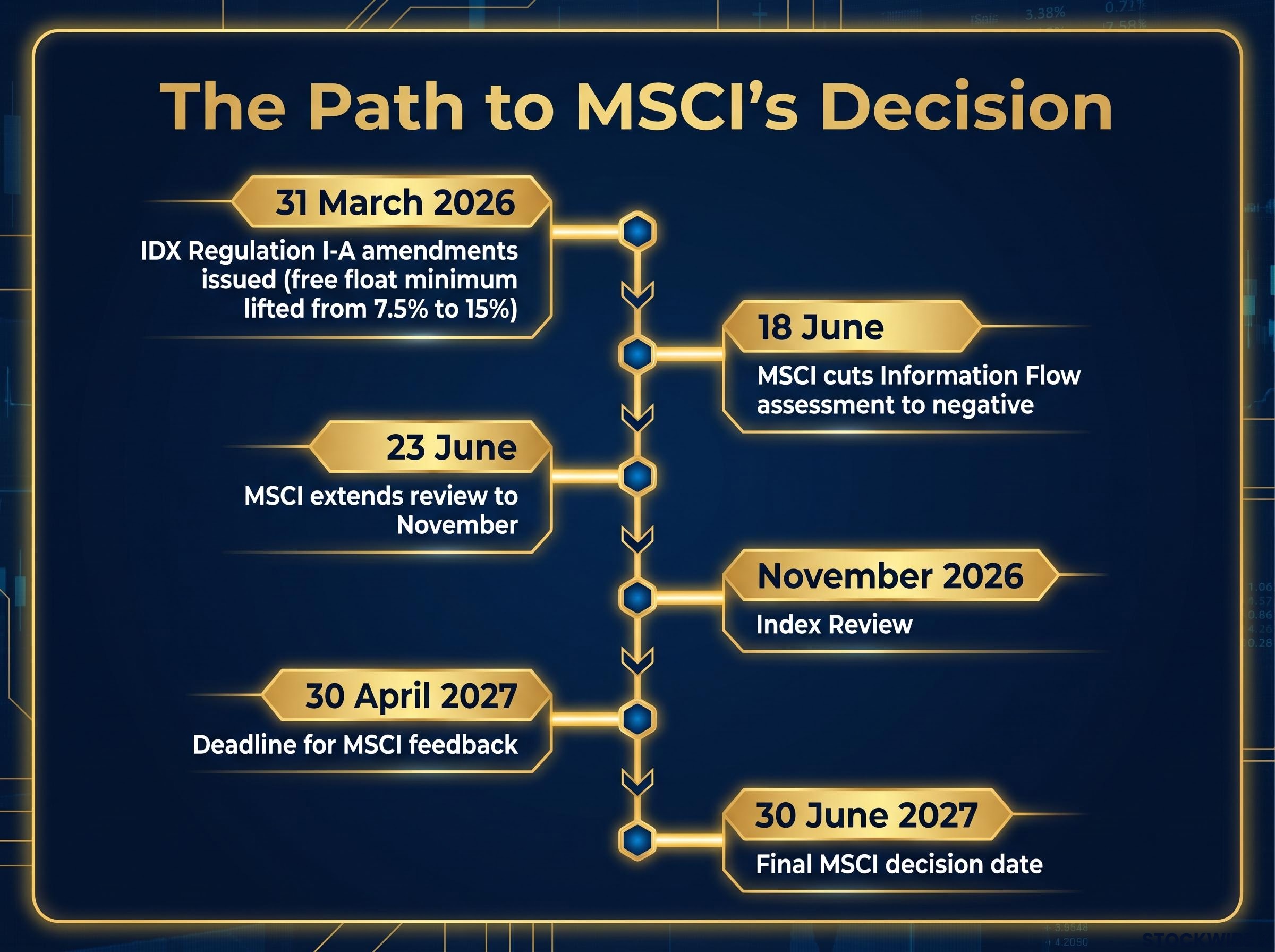
This is a proposal, not a ruling. MSCI is taking feedback until 30 April 2027 and has said it will decide on or before 30 June 2027.
The market is pricing two risks. One is forced selling by funds that track MSCI benchmarks. The other is a lasting retreat by foreign investors from one of Asia’s largest emerging markets.
This piece explains why the equity shock has so far barely dented the rupiah, what Bank Indonesia can and cannot do about it, and which signals will show whether the damage becomes permanent.
Equities have cratered, so why has the rupiah moved so little?
The equity reaction was brutal. After the 8% opening plunge and the trading halt, other reporting put the decline at about 10%, taking the market to a six-year low. Reuters described Indonesia as the world’s worst-performing stock market this year.
The currency told a calmer story. Quoted levels vary slightly by source and timestamp, but they cluster in a narrow band.
| Date | Rupiah per US dollar | Source |
|---|---|---|
| 22 September 2026 | Rp17,855 (down 0.78% from end-August) | Bank Indonesia |
| 15 October 2026 | Rp17,950 (morning) | Tempo |
| 15 October 2026 | Rp17,953 (open) | Radio Republik Indonesia |
| Latest close | Rp17,925 (from Rp17,900) | J Trust Bank |
| 16 October 2026 | 17,900-17,950 (Asian hours) | Market report |
Tempo, citing central-bank data, put fourth-quarter depreciation at just 0.17% as of 15 October. The original market report argued that further USD/IDR upside looks limited because the US dollar itself is weakening.
The calm may not last.
The bigger risk may be the currency Investors cited by Reuters warned that currency pressure, rather than the immediate equity selling, could prove the larger threat if outflows build and force more Bank Indonesia intervention.
The currency channel only switches on when foreign holders sell their shares and convert the proceeds into dollars. A quiet rupiah today tells you that conversion has not happened at scale yet. It does not tell you the currency is safe.
Foreign portfolio inflows supported the rupiah through a record current account deficit earlier this year, and the same capital can leave faster than it arrived, which is why equity selling is the channel that could reverse that support.
When big ASX news breaks, our subscribers know first
What MSCI is actually worried about
The trigger sounds technical: free float. Free float is the share of a company’s stock available for the public to buy and sell, as opposed to shares locked up with insiders.
MSCI’s concern is not the headline percentage. It is whether the reported free float reflects shares that genuinely trade independently. The problem comes down to three linked mechanisms:
- Opaque beneficial ownership. If related parties or coordinated investors are hidden, MSCI cannot tell how much stock is truly investable.
- Concentrated holdings. A stock can look widely held on paper while its real tradeable float is far smaller.
- Suspected coordinated trading. This distorts prices and creates misleading signals about liquidity.
MSCI cited ongoing opacity in shareholding structures, limited ownership visibility, impaired price formation and insufficient evidence that reforms had improved governance. It said a frontier downgrade would not adequately reflect the severity of these problems.
That matters because index weights depend on float. If the float figures are unreliable, funds that must replicate an index cannot know whether they are buying what they think they are buying.
Standalone status would put Indonesia alongside Argentina, Nigeria, Ukraine, Zimbabwe and Lebanon, according to Business Times. Indonesia would be the first Asia-Pacific market in that group.
Why the escalation was not a surprise
On 18 June, MSCI cut Indonesia’s Information Flow assessment to negative. On 23 June, it extended its review to November, tying its concerns to the Information Flow and Market Infrastructure pillars of its market accessibility assessment. The consultation arrived ahead of the November 2026 Index Review. Even so, Reuters reported that MSCI’s Richard Mackintosh viewed the move as unusually severe given Indonesia’s transparency and free-float measures.
This is a question of trust in the market’s basic plumbing. That is far harder to fix with a policy announcement than a liquidity or valuation problem.
What Bank Indonesia and the exchange can do, and what they cannot
The central bank is well equipped to defend the currency. Bank Indonesia has pledged active intervention through:
- Intensified offshore non-deliverable forwards (NDFs), which are currency contracts settled in dollars without the rupiah changing hands
- Spot currency transactions
- Domestic NDFs
- Secondary-market purchases of government bonds, known as SBN
- Money-market rate and liquidity management
The central bank also has room to act. It held the BI-Rate at 5.75% on 22-23 September, with the Deposit Facility at 4.75% and the Lending Facility at 6.50%. Reserves stood at US$146.3 billion at end-September, enough to cover 5.3 months of imports, little changed from US$146.5 billion a month earlier.
Bank Indonesia’s graduated FX hedging discounts, reaching 30% on 12-month DNDF contracts, show how the central bank is leaning on targeted tools rather than another rate hike to keep the rupiah orderly.
Indonesian regulators have moved too. Ownership disclosure now covers holders above 1%, rather than only above 5%. Investor classification is more granular, and High Shareholding Concentration reporting flags concentrated stakes. Amendments to IDX Regulation I-A issued on 31 March 2026 lift the minimum free float from 7.5% to 15%, phased in gradually.
The Indonesia Stock Exchange (IDX) plans direct talks with MSCI and stresses that this is a consultation, not a final decision.
| Tool or reform | What it can address / what it cannot |
|---|---|
| Currency intervention (NDFs, spot) | Can smooth disorderly rupiah moves / cannot prove who owns shares, and prolonged outflows could drain reserves |
| Bond purchases and liquidity tools | Can support market liquidity / cannot restore confidence in price formation |
| Rate hike | Could support the rupiah / could weigh on growth and raise financing costs |
| Disclosure and free-float reforms | Directly target MSCI’s concerns / need time to produce verifiable evidence |
Strong reserves buy the rupiah time, but they do not answer MSCI’s questions. Your read on Indonesian equities should depend on the regulators, not the central bank.
How big could the outflows be, and is this a one-off shock or a lasting shift?
Three estimates put the potential damage in the billions, though each rests on different assumptions.
| Source | Estimate | Key assumption |
|---|---|---|
| Samuel Sekuritas | Rp105-132 trillion (about US$5.8-7.3B) | Standalone status implemented |
| Goldman Sachs | About US$7.8B | MSCI proceeds; Goldman previously saw this as unlikely and cut Indonesia to underweight |
| Henry Wibowo, Alphagate Capital | Up to another US$5B | Further foreign selling |
The mechanism is straightforward. Passive funds, which automatically mirror an index, could be forced to sell once Indonesia leaves MSCI benchmarks. Market analyst Nafan Aji Gusta said active managers and funds using other benchmarks would not have to exit, but wider bid-ask spreads would weigh on the rupiah. Gary Tan of Allspring Global Investments said index-linked investors could cut exposure.
Passive fund flow mechanics are valuation-blind: when an index drops a market, tracking funds must sell every constituent regardless of fundamentals, which is why index exclusion can push prices well beyond what earnings would justify.
The case for a temporary shock
There is still a long runway. Indonesia has until 30 April 2027, and MSCI until 30 June 2027, for reforms to show results. Some of the selling looks anticipatory, and active managers are not forced to sell.
The case for a structural downgrade
Reuters commentary framed the risk as a loss of confidence in market institutions. That could mean shrinking institutional participation, thinner liquidity, a higher risk premium and rupiah spillover. FTSE Russell kept Indonesia as a secondary emerging market on 6 October and has not placed it on a watch list. However, it postponed a February review over difficulty identifying free-floating shares.
The headline outflow figure matters less than whether foreign participation shrinks for good. Only a permanent retreat would keep pressure on the rupiah and on equity financing costs.
What to watch between now and the June 2027 decision
The rupiah has held while equities have not, and Bank Indonesia can smooth currency swings without resolving MSCI’s governance concerns. The outcome turns on whether reforms are judged credible. Four markers will tell you which way this is heading:
- Progress in the IDX’s direct engagement with MSCI
- Evidence from the 1% disclosures and the free-float phase-in
- Any change in FTSE Russell’s stance
- USD/IDR behaviour if foreign outflows accelerate
If those markers improve, the sell-off looks technical. If they stall, it looks structural.
This article is for informational purposes only and should not be considered financial advice. Investors should conduct their own research and consult with financial professionals before making investment decisions. Outflow estimates and forward-looking statements are speculative and subject to change based on market developments.