The rupee has just had one of its best weeks in months, rallying about 1.5% to trade near ₹95.2 per US dollar. Over the same days, the cost of protecting yourself against a rupee fall jumped, with one-year onshore forward premiums reaching about 4.5%, the highest in more than four years. Both moves trace back to the same source: the Reserve Bank of India’s (RBI) new FX curbs.
If you read the stronger rupee as a sign that India’s currency market just got cheaper or easier to use, you are reading it backwards.
The RBI announced and refined its measures between roughly 10 and 16 October 2026, and the picture is still developing. If you pay, receive or hedge rupees, whether as an importer, a foreign investor holding Indian assets or a currency trader, your costs have already changed.
Here is how to see which rupee exposures got more expensive to protect, why the spot rate and the derivatives market moved in opposite directions, and which signals will tell you whether the relief lasts.
What did the RBI actually change, and who does it hit?
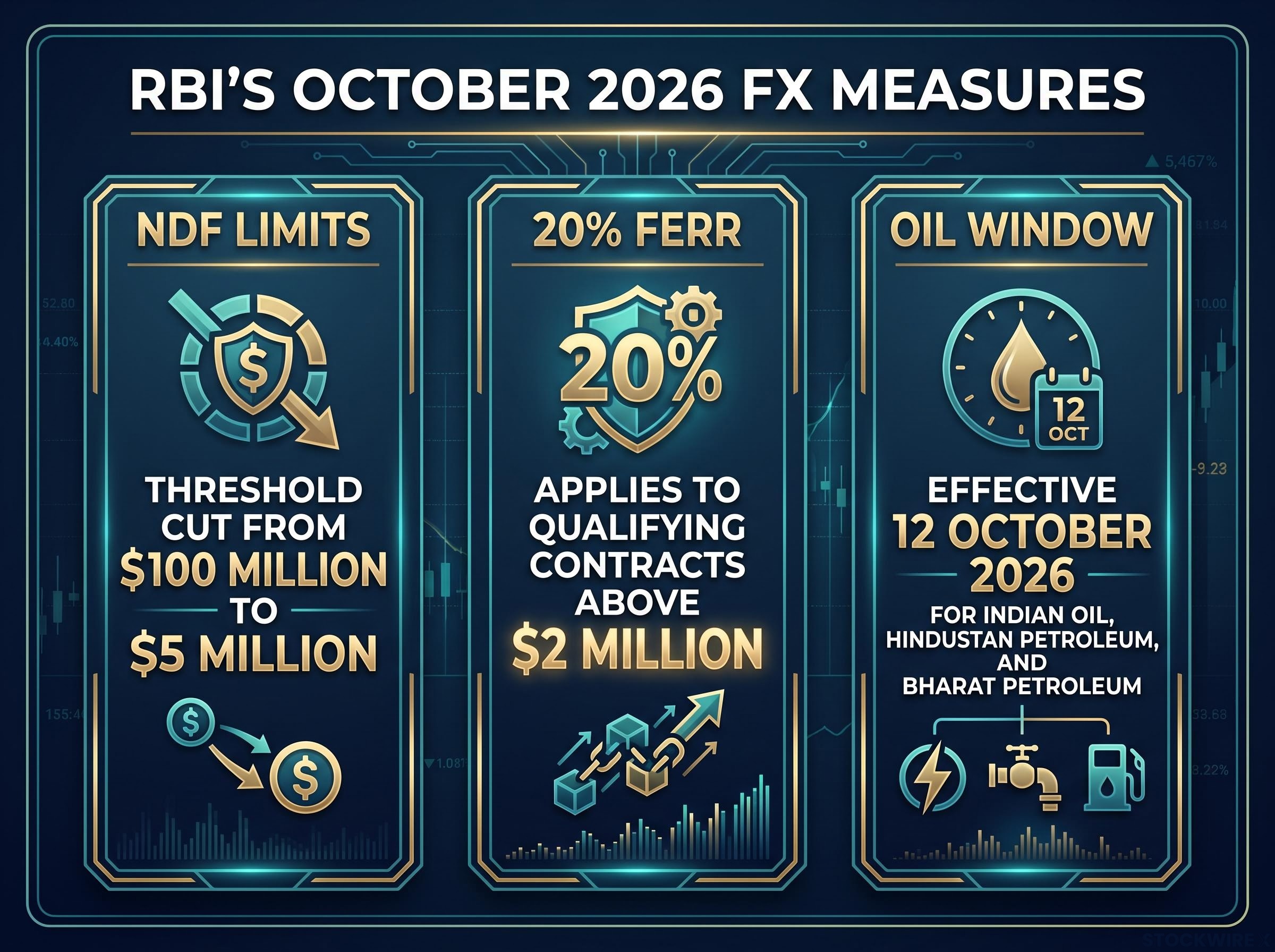
The package has three parts. One limits offshore betting, one makes certain hedges more expensive, and one takes India’s biggest dollar buyers out of the open market.
A non-deliverable forward (NDF) is a contract traded outside India that bets on the future rupee rate and settles in cash, usually dollars, without any rupees changing hands. The Foreign Exchange Risk Reserve (FERR) is a new cash deposit banks must park with the RBI against certain rupee derivative contracts.
| Measure | What the rule says | Who it mainly affects |
|---|---|---|
| NDF and derivative access limits | Non-resident NDF access restricted to genuine hedging; no rebooking of cancelled rupee-linked contracts; threshold for some trades without an underlying exposure cut from $100 million to $5 million | Offshore speculators and non-resident traders |
| 20% FERR | Banks hold cash with the RBI equal to 20% of the rupee notional on qualifying contracts above $2 million, until one day after the contract ends; banks must block attempts to split trades below the threshold | Customers buying dollars against rupees to hedge a current-account exposure, such as importers |
| Oil-company dollar window | From 12 October 2026, the RBI meets the full daily dollar needs of Indian Oil, Hindustan Petroleum and Bharat Petroleum through designated banks, until further notice | State-owned oil marketing companies and the spot market they used to buy from |
RBI Governor Sanjay Malhotra has rejected the label of capital controls. He says the rules target derivative-market behaviour and hedging flows, not the general movement of money in and out of India.
The detail that matters most is the asymmetry. FERR applies when a user buys foreign currency against rupees to hedge a current-account exposure, not when they sell it. An importer locking in future dollar payments pays more, while an exporter selling dollars forward sits outside the reserve.
So before reading on, place yourself. Do you buy dollars, sell them, or trade offshore? Your answer decides which of these rules touches you.
What the October 15-16 clarification narrowed
Early reporting left banks unsure whether the 20% reserve covered dealer-to-dealer trades. The clarification of 15-16 October confirmed it applies to contracts between a bank and its customer, excluding ordinary interbank trades and certain transactions tied to coupons on external commercial borrowings (foreign-currency loans raised by Indian companies).
That makes the rule narrower than first feared. If you are a qualifying customer, though, your trades remain costlier.
When big ASX news breaks, our subscribers know first
Forwards, NDFs and hedging costs: the basics behind the headlines
Imagine you run a company that must pay a US supplier $10 million in three months. You do not know where the rupee will be by then, and a sharp fall could wipe out your margin.
A forward contract solves this. It is an agreement with a bank to exchange currencies at a fixed rate on a future date, so you know your rupee bill today. An NDF works the same way but is traded offshore and settled in cash on the difference between the agreed rate and the actual rate.
The forward rate is usually higher than today’s spot rate. That gap, expressed as an annual percentage, is the forward premium, and it is effectively what you pay for certainty.
The normal baseline for that premium is the interest-rate differential: the gap between Indian and US interest rates. Because rupee deposits earn more than dollar deposits, the forward price adjusts to cancel out that advantage. Before the measures, a one-year hedge typically cost about 3%.
Anything well above the rate differential is extra cost, and right now there is a lot of it.
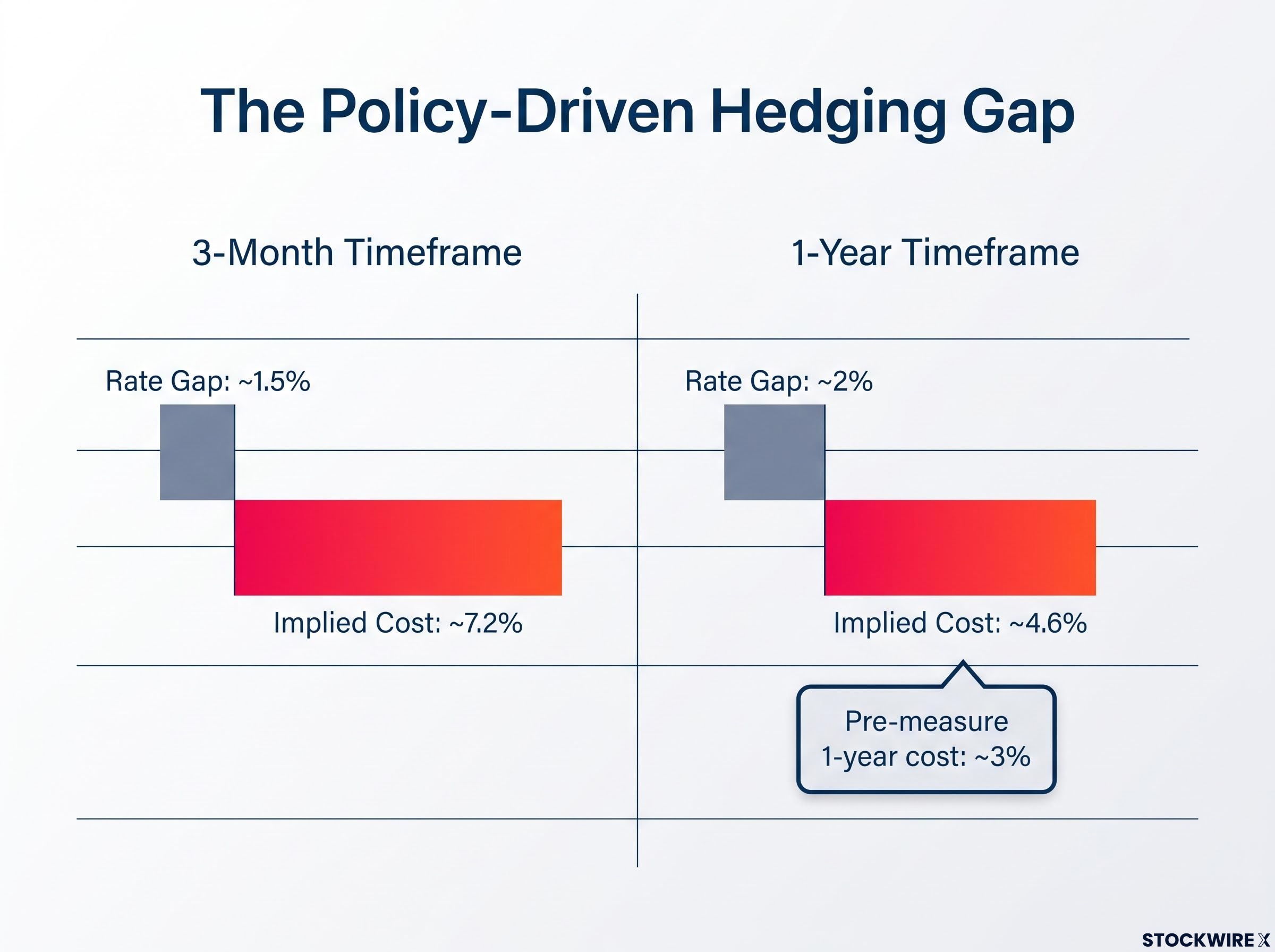
The gap to watch Three-month implied hedging cost: about 7.2%. Cost implied by the India-US interest-rate gap: about 1.5%. The difference is the policy-driven part of your hedging bill.
How a 20% reserve turns into a higher quote
FERR forces a bank to lock up cash that it would otherwise lend or invest. That idle cash has an opportunity cost, the return given up by not using it, and dealers pass it to you.
Here is how it works, using the illustrative $10 million payment above and reported market levels:
- You ask your bank for a forward to buy $10 million against rupees for a current-account payment.
- The contract exceeds the $2 million threshold, so FERR applies.
- The bank parks cash equal to 20% of the contract’s rupee value with the RBI until one day after the contract ends.
- The bank prices the lost return on that cash, plus extra caution, into its quote.
- You pay a premium well above the rate differential, such as the reported three-month cost near 7.2% against about 1.5%, or a one-year cost near 4.6% against roughly 2%.
When you see any forward quote, check it against the rate differential first. The gap tells you how much of your price comes from the policy rather than from the market’s normal arithmetic.
Why the rupee rose while hedging got more expensive
The paradox resolves once you follow the pressure as it moves from one part of the market to another. Nothing disappeared; it was relocated.
- Oil demand left the spot market. With the RBI supplying the state oil companies directly, a large and predictable source of daily dollar buying vanished from the open market.
- Speculative positions were forced out. The NDF limits and rebooking ban made it hard to roll or recreate bets against the rupee, so those positions unwound and the rupee rallied.
- Eligible hedges got pricier. FERR added a cash cost that dealers passed on through wider premiums, wider spreads or both.
- Dealers pulled back. Facing a new cost and uncertainty over which trades qualified, market makers quoted smaller sizes and wider gaps between buying and selling prices.
- Forward demand was compressed, not removed. Some importers delayed hedging, which reduced dollar demand today but left them exposed to a later rupee fall.
The spot numbers vary slightly by source and date, but they describe a rupee holding in a narrow band near 95. MUFG put spot at 95.28 after the measures on 13 October, then about 95.20 on 14 October, with a rally of about 1.5% over two days. The Economic Times reported about 95.05 on 15 October.
The derivatives market told a different story.
| Tenor or market | Reported level | Source/date |
|---|---|---|
| One-year onshore premium | About 4.5%, highest in over four years; some quotes up to 10% | Market reporting, 15 October |
| One-year implied hedging cost | About 4.6%, up more than 90 bp in the week | Reuters via MarketScreener, 15 October |
| Six-month onshore premium | About 6% | Market reporting, mid-October |
| One-month onshore premium | Quotes up to 8% | Market reporting, mid-October |
| One-month NDF | Fell as much as 2.7% to 94.17 before paring | Early Asian trade, 12 October |
A basis point (bp) is one hundredth of a percentage point. Kotak estimates corporate hedging costs could rise by roughly 1-1.6 percentage points, while IDFC FIRST Bank puts the increase at about 1.5 points. Reuters also reported that USD/INR forward quotes were briefly pulled amid confusion over whether interbank trades were covered.
MUFG’s Michael Wan argues the measures supported the spot rupee but pushed the stress into derivatives, curbing speculative dollar demand while leaving derivatives costlier and less liquid.
Nomura calls the package a “second line” of rupee defence. The read for you is simple: the stronger headline rate reflects less dollar demand from specific sources, not a cheaper market, so do not treat it as your cost of doing business.
The stronger spot rate reflects less dollar demand from specific sources, and your USD/INR outlook still depends on inflation, the Fed and whether the rupee can hold below the 96.00 level once the policy effect fades.
Where the pressure goes next: offshore
Offshore forward premiums fell sharply across all tenors between 12 and 13 October as bets against the rupee reversed. Other coverage pointed to wider offshore NDF spreads and a temporary offshore discount to onshore forwards.
That pattern suggests positions were displaced rather than eliminated. If you trade offshore, expect thinner pricing and keep an eye on the gap between the two markets.
What this means for importers, investors and traders, and what could go wrong
Your exposure decides whether this package is a cost, a risk or a short-lived opportunity.
Winners, losers and the in-between
| Group | Effect | Why |
|---|---|---|
| Importers | Pay more to hedge or stay unhedged | FERR targets dollar buyers; premiums are well above the rate gap |
| Exporters | Mixed | A stronger rupee cuts the rupee value of receipts, but selling dollars sits outside FERR |
| Foreign investors | Costlier protection on Indian assets | Wider spreads and thinner depth |
| Currency traders | Restricted onshore and offshore | NDF limits, rebooking ban and cautious dealers |
If you import, you now choose between a higher hedging bill and open exposure to a later rupee fall. If you export, the stronger spot rate trims your rupee income, although you avoid the reserve cost.
If you hold Indian equities or bonds as a foreign investor, protecting those positions now costs more, which could deter some marginal inflows. If you trade the currency, both the onshore and offshore doors have narrowed.
Why the relief may not last
SBI Research says the rupee could still test about ₹94.50 per dollar after the initial relief, and Business Standard commentators and IDFC FIRST doubt the measures alone can reverse the broader weakening trend. IDFC FIRST’s Gaura Sen Gupta expects USD/INR and premiums to fall near term, with the medium-term direction resting on global conditions and India’s balance of payments.
- Temporary rally: global dollar strength and India’s external position remain decisive.
- Offshore migration: trading may shift to offshore NDFs, visible as wider spreads or a lasting onshore/offshore gap.
- Reserve drain: the oil window draws directly on RBI reserves, which could deplete them if kept in place for long.
- Administrative confusion: the pulled quotes show that uncertainty over scope can hurt liquidity almost as much as the reserve’s cash cost.
India has seen this before. During the 2013 taper tantrum, the RBI tightened derivative limits to curb speculation, and spot improved quickly while the underlying external vulnerability stayed in place. Treat the current spot gain with the same caution.
A reserve drain is a real concern because the oil window draws on the same buffer, and the usable cushion is smaller than the record headline reserves figure suggests once forward and swap obligations are counted.
These assessments are forward-looking and subject to change as market conditions evolve.
What the curbs change, and what they leave unresolved
The package manages spot dollar demand. It does not fix India’s external pressures, and it buys time at the price of costlier, thinner hedging.
Three variables will show whether the trade-off holds:
- Onshore forward premiums and spreads compared with the interest-rate differential baseline
- The gap between onshore and offshore pricing
- Any change to the oil window or further RBI scope clarifications
This remains a developing situation as of mid-October 2026, and reported figures vary by source and date. Your next decision should rest on where your own exposure sits and on whether the hedging premium you are quoted still runs far above the rate gap.
For readers wanting the wider backdrop, our deep-dive into the three forces driving the rupee toward 97 explains how yield spreads, inflation and crude oil shape the currency’s structural pressure.
This article is for informational purposes only and should not be considered financial advice. Investors should conduct their own research and consult with financial professionals before making investment decisions. Past performance does not guarantee future results. Financial projections are subject to market conditions and various risk factors.