
European Central Bank (ECB) Governing Council member Álvaro Santos Pereira said on Thursday that euro-area inflation is “not spreading”, but warned that central banks would be “forced to act” if it starts to. The remark was a conditional threat, not a policy signal. It arrives as bond yields climb and gas prices sit at three-year highs.
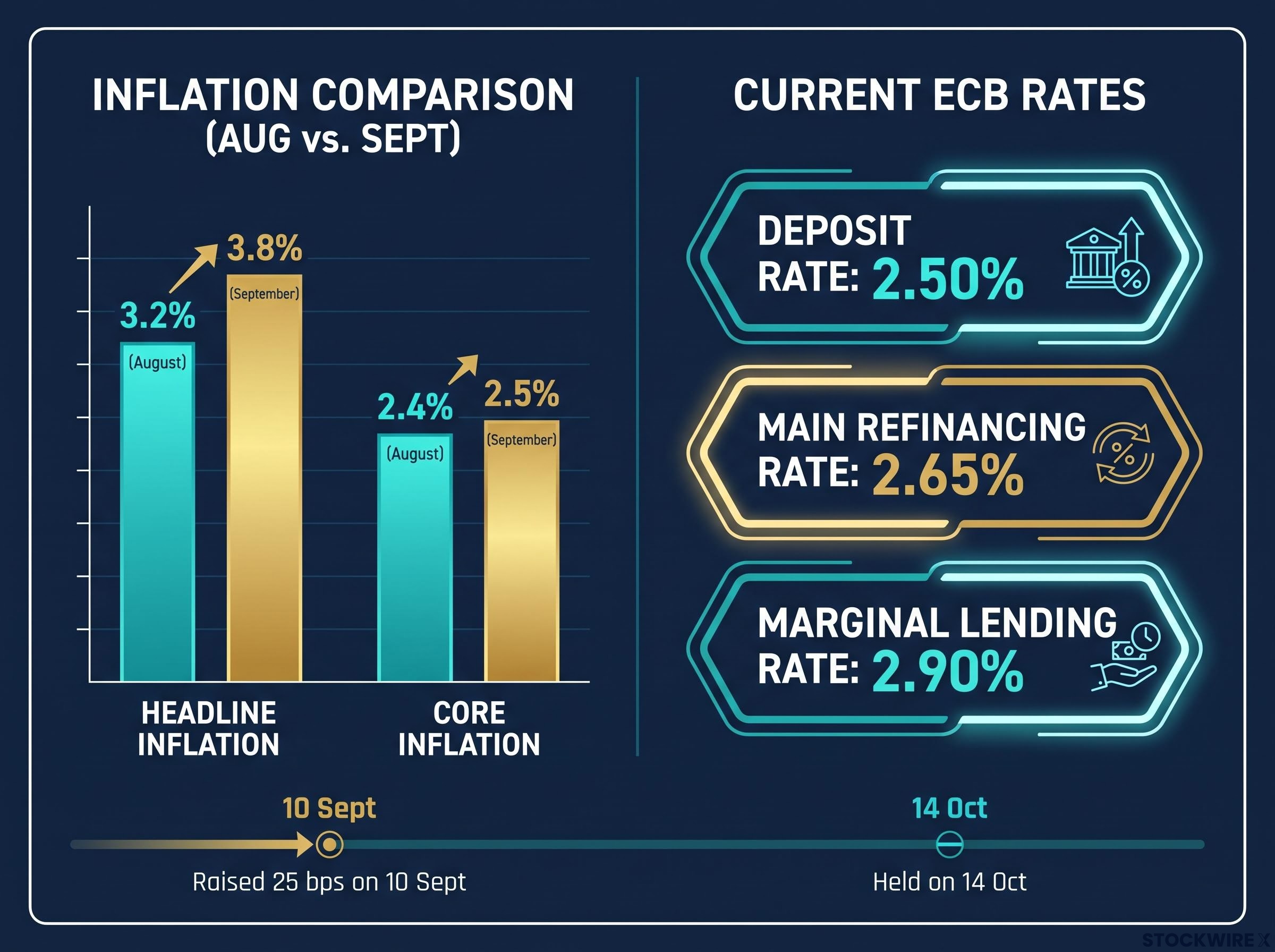
The numbers behind the warning are uncomfortable. Eurostat’s September flash estimate put headline inflation at 3.8%, with core inflation at 2.5%. The ECB raised rates by 25 basis points on 10 September, then held them on 14 October.
Across the Atlantic, a hotter-than-expected US inflation print on Wednesday pushed the dollar higher and complicated the picture for euro traders.
Here is how to read central bank commentary alongside moves in the euro, bond yields and gas prices, and which data actually decides the ECB’s next step.
What Pereira’s “not broadening” line tells you about the ECB’s next move
The trigger matters more than the reassurance. Pereira, who is also Governor of the Banco de Portugal, set a clear condition: if inflation broadens, the ECB moves.
“If inflation starts broadening, central banks will be forced to act.”
Broadening means an energy shock spreading into services prices, wage settlements and inflation expectations. A concentrated energy shock lifts headline inflation for a while and then fades, so a central bank can look through it. A broad one feeds on itself through higher wage demands and firms rebuilding margins.
Pereira has held this line for weeks. Reuters reported on 29 September that he saw inflation spreading less widely than in past episodes, while flagging gas as a concern. On Thursday he added that growth has been stronger than expected and could stay that way.
The data supports both sides. Headline inflation jumped from 3.2% in August to 3.8% in September, and core edged up from 2.4% to 2.5%. That is movement, but not yet the wide spread Pereira describes.
The 1.3 point gap between headline and core shows that oil supply shocks are still mostly first-round effects, with wage and core data deciding whether they become a lasting policy problem.
After the September hike, the deposit rate sits at 2.50%, the main refinancing rate at 2.65% and the marginal lending rate at 2.90%. ECB staff project core inflation of 2.5% in 2026, 2.6% in 2027 and 2.3% in 2028, which suggests underlying pressure stays above target once the energy effect fades.
| View | Reasoning | Counter-argument |
|---|---|---|
| Hold | Inflation has not spread widely; core and services remain contained | A winter gas spike could feed wages and services, forcing a sharper response later |
| Hike | Headline 3.8%, core 2.5% and gas near €87/MWh keep inflation above target | Higher rates could weaken growth if the shock is supply-driven |
| Cut later | If gas falls and storage holds, tight policy could needlessly hurt demand | Cutting with headline at 3.8% and core rising risks ECB credibility |
| Data-dependent | The October hold kept the 2% commitment while projections absorb uncertainty | A sudden energy shock or growth rebound could make gradualism inadequate |
The gap between a hold and a hike is narrow. For you, the speech is a statement about thresholds, so the next core and services print matters far more than the words themselves.
Are fiscal worries really behind rising bond yields?
Pereira offered his own explanation for higher borrowing costs: rising yields are “more related to fiscal issues.” That is one reading, and it is far from settled. BNP Paribas reported the German 10-year yield near 3.5% in October, and at least five forces could be pushing it there:
- Fiscal concerns: deficits and heavier government borrowing, Pereira’s preferred explanation.
- Policy repricing: the September hike forced markets to rethink how long rates stay high.
- Energy-linked inflation risk: expensive gas lifts expected headline inflation.
- Term premium: the extra return investors demand for holding long-dated debt through uncertainty.
- Supply and geopolitical risk: weak LNG deliveries and Middle East disruption add risk to long bonds.
Each one has a claim. None has a monopoly.
Because the reason behind a yield move matters more than its direction, how bond yields move after auctions, inflation data and policy repricing is the starting point for separating fiscal stress from rate expectations.
How the US CPI backdrop complicates the read
The Bureau of Labor Statistics reported on Wednesday that US headline inflation rose to 3.7% year on year against a 3.6% consensus. Core came in at 2.6% versus 2.5% expected, with a monthly gain of 0.3% against 0.2%.
The dollar climbed to its highest level since April 2025 after the release. One report noted the bond market has priced in Federal Reserve hikes into 2027 since late June. Yet gold recovered to about US$4,150 as US yields fell, a sign that rate moves were mixed rather than one-directional.
The shared risk on both sides of the Atlantic is the same: an energy shock reaching core inflation. If fiscal pressure is the main driver in Europe, higher yields say little about ECB tightening intentions. Treat each yield move as a question about its cause, not as an automatic rate call.
Gas, storage and the euro: what the market did with it
Pereira named the winter risk plainly: “If we have a winter like last year, then we have a problem with natural gas prices.” The storage figures give that warning weight.
| Item | Level | Comparison |
|---|---|---|
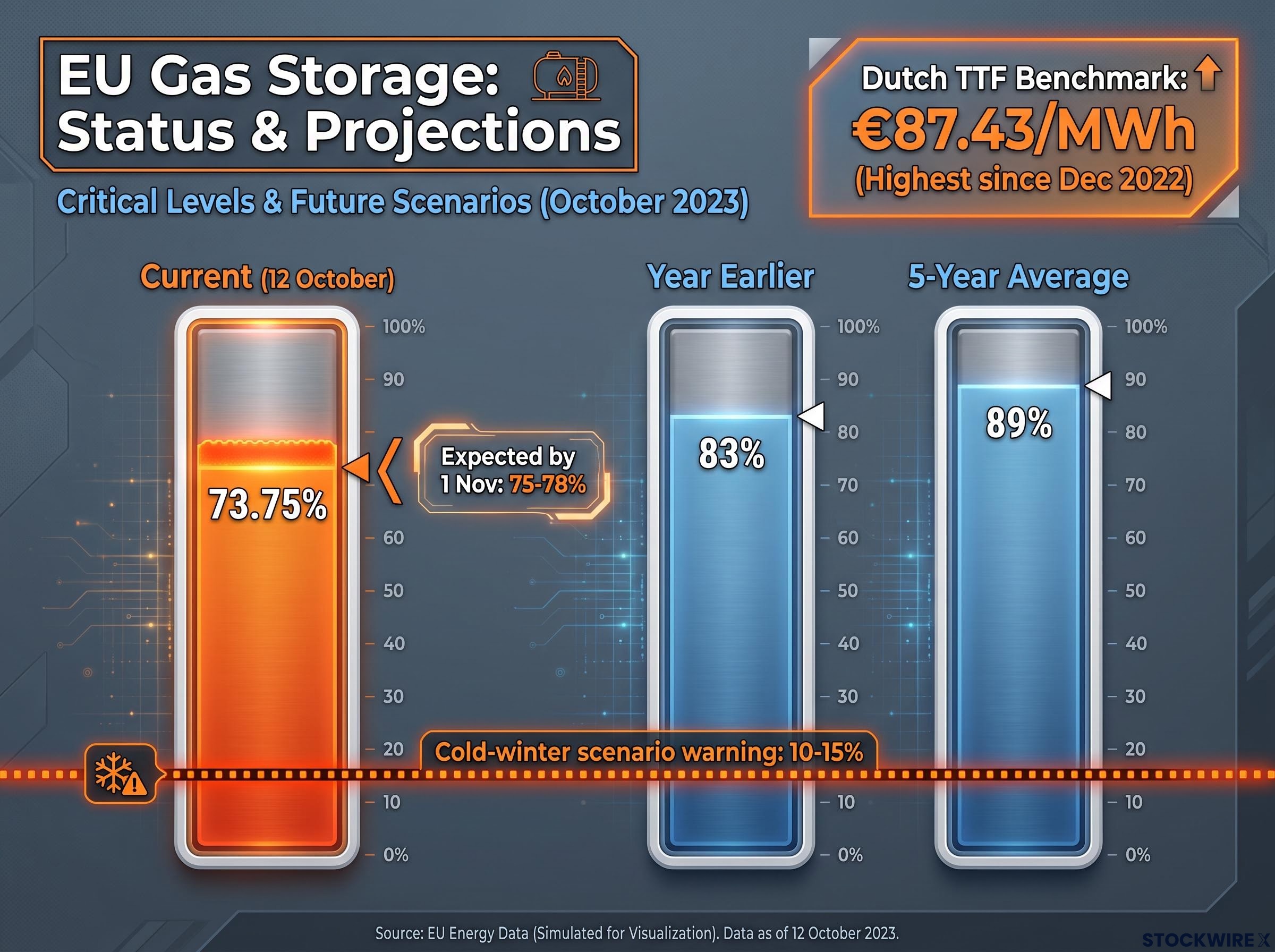
| Dutch TTF gas benchmark (14 October) | €87.43/MWh intraday | Highest since December 2022 |
| EU gas storage (12 October) | 73.75% full | 83% a year earlier; 89% five-year average |
| Expected storage by 1 November | 75-78% | Analyst estimates cited by Reuters |
| Cold-winter scenario | 10-15% by end of winter | ABN Amro warning |
The 2022-23 precedent explains why policymakers are watching closely. Then, a gas supply shock flowed into electricity, food and transport costs, inflation surged far above target and the ECB hiked rapidly. Today storage sits well below normal and prices are at late-2022 levels, but core inflation has not yet followed.
Damage at Qatar’s Ras Laffan LNG complex, with repairs expected to take years, makes the structural gas squeeze in Europe a different problem from the oil premium, and one less likely to fade on diplomacy alone.
The euro largely shrugged. The original report saw no clear reaction to Pereira’s comments, while EUR/USD rose 0.53% to 1.1211 as traders weighed US inflation against ECB commentary. Against other currencies on Thursday, the euro moved:
- +0.45% against the US dollar
- +0.80% against the Australian dollar
- +0.14% against the British pound
- -0.15% against the Swiss franc
The muted response suggests the market sees the gas risk as unpriced rather than dismissed. For you, storage levels and core data are the real catalysts, not the speech alone.
What to watch before the ECB’s next move
Three threads remain open. Broadening is the trigger, the yield story is contested and gas storage is the live risk.
Track these three variables:
- Core and services inflation in the next Eurostat release
- EU storage progress toward the 1 November estimates
- Whether yield rises follow fiscal headlines or shifts in rate expectations
If core holds steady and storage fills on schedule, Pereira’s reassurance stands. If either slips, his conditional warning becomes the operating rule.
For readers wanting a repeatable framework for the next Eurostat release, our dedicated guide to reading eurozone inflation data shows how to separate an energy-driven headline spike from a structural reset.
This article is for informational purposes only and should not be considered financial advice. Investors should conduct their own research and consult with financial professionals before making investment decisions. Past performance does not guarantee future results. Financial projections are subject to market conditions and various risk factors.