
The Federal Reserve’s latest snapshot of the US economy holds a pairing that rarely sits comfortably together. Employment across the country was largely flat, yet three of the 12 Federal Reserve districts reported price growth in the report’s strongest terms, and eight more called it moderate.
That is the tension inside the Fed Beige Book released today, 14 October 2026. It landed the same day as a hotter September consumer price index (CPI) reading. CPI is the government’s main monthly measure of how fast consumer prices are rising.
The Beige Book does not set interest rates. It is a collection of stories from businesses, not a statistical model. But it arrives two weeks before the Federal Open Market Committee (FOMC) meets on 27-28 October, and markets are already debating whether another rate hike is on the table.
After reading this, you will know how to read the Beige Book’s careful language, what it can and cannot tell you about rates, and how Fed signals travel through to the US dollar.
What the October 14 Beige Book actually said
On the surface, the report reads soft. Economic activity grew at a slight-to-moderate pace in most districts, based on information collected on or before 5 October 2026. Consumer spending and some business sectors did the heavy lifting, but growth was patchy rather than broad.
Hiring told a quieter story still. Most districts saw little or no net change in overall employment, as businesses held back on adding staff amid caution and uncertainty. Some districts did report shortages in specialised roles, which tells you the slowdown is not simply a lack of available work.
Then came the prices.
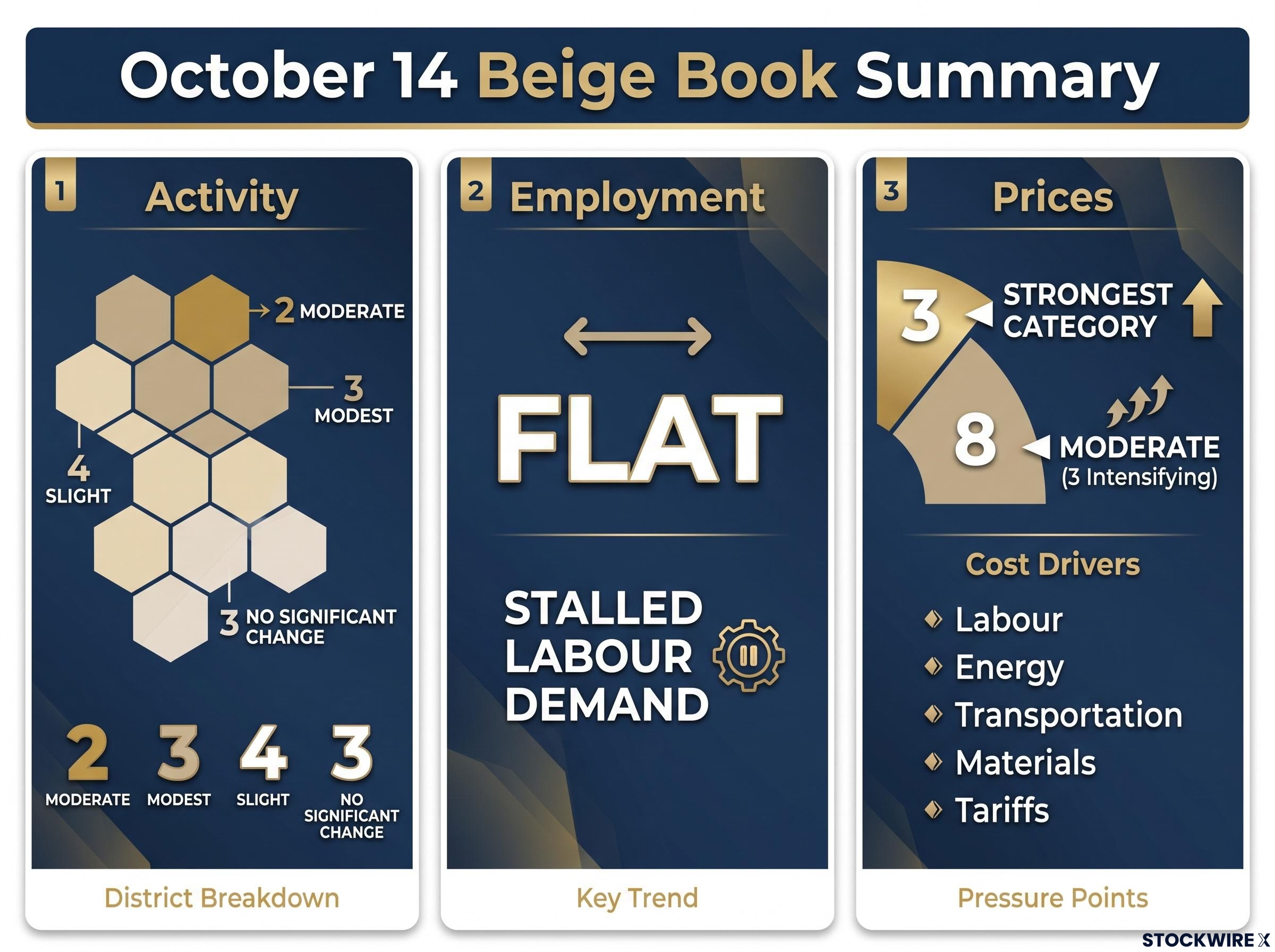
Price pressure stayed firm across nearly the entire map. Three districts described price growth in the report’s strongest category and eight called it moderate, with three of those eight flagging intensifying input price pressures.
The Federal Reserve Beige Book summary lays out each district’s account of activity, hiring and prices, so you can check for yourself how the strongest price language compares with the softer employment picture.
| Category | What districts reported | Signal |
|---|---|---|
| Activity | 2 moderate, 3 modest, 4 slight, 3 no significant change | Uneven, mostly slow growth |
| Employment | Generally flat; hiring limited by caution, shortages in specialised roles in some districts | Stalled labour demand |
| Prices | 3 strongest category, 8 moderate; 3 of the 8 saw intensifying input costs | Firm, broad price pressure |
What matters most is where that pressure came from. Firms were not raising prices because customers were queuing up. The recurring cost drivers were:
- Labour
- Energy
- Transportation
- Materials
- Tariffs
Contacts generally expected the expansion to continue but stayed wary of demand, costs and policy uncertainty. The report itself offers no numerical forecast and no policy recommendation.
For you, the takeaway is that this edition makes no clean case for rate cuts or for hikes. Treat it as a complicating input that muddies the picture, not a verdict that settles it.
When big ASX news breaks, our subscribers know first
What is the Beige Book, and how does the FOMC use it?
You probably met this report as a headline about “slight” growth or “flat” hiring. Those words are chosen with care, and knowing who chooses them helps you judge how much weight they deserve.
Who writes it and who reads it
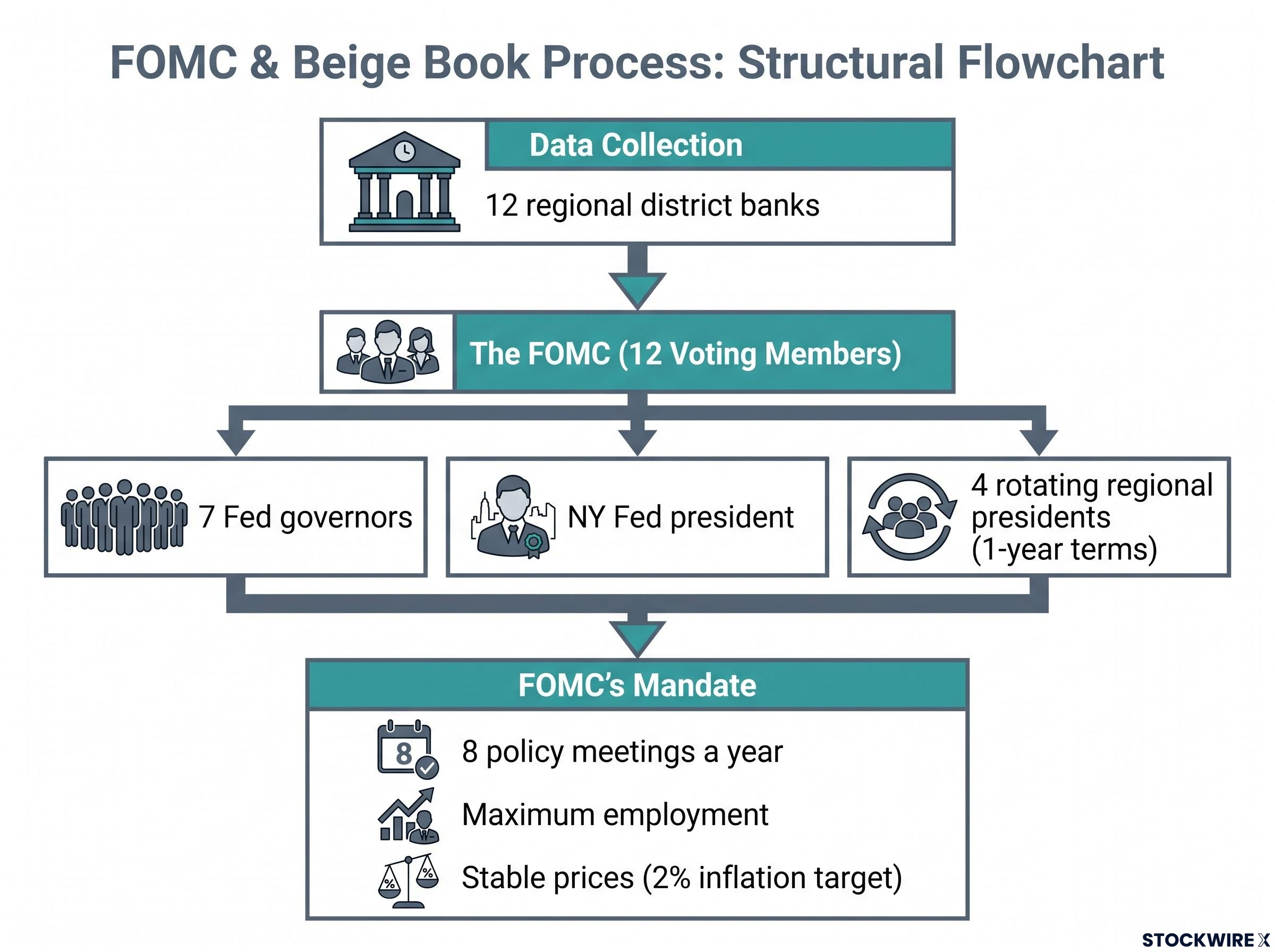
The Beige Book is compiled by the Fed’s 12 regional district banks. Each bank gathers anecdotes from business contacts, economists and market experts in its area, then summarises conditions in plain language.
It is published ahead of each of the FOMC’s eight policy meetings a year. The FOMC is the group that sets US interest rates. It has twelve voting members: the seven Fed governors, the president of the New York Fed and four other regional presidents serving rotating one-year terms.
The committee works under a dual mandate, meaning two legal goals: stable prices and maximum employment. Its inflation target is 2%. The Beige Book gives members a ground-level read on both goals before the hard numbers fully arrive.
The dual mandate shapes how you should weigh every anecdote in the report, because the committee judges each one against two tests at once: whether it points to price pressure or to labour market slack, and how far each sits from the 2% target.
What it cannot tell you
The report’s strength, its human texture, is also its weakness. Keep these limits in mind:
- It is qualitative and anecdotal, not a statistical estimate.
- Its contacts may over-represent certain sectors or regions, a problem known as sampling bias.
- It cannot measure inflation, payrolls or GDP with the precision of official data.
- It is released before some official figures, so it signals direction rather than confirming it.
- It does not mechanically determine FOMC decisions.
Policymakers weigh it alongside CPI, the personal consumption expenditures (PCE) price index, payrolls, unemployment, financial conditions and inflation expectations. PCE is the Fed’s preferred inflation gauge.
The smart way to use the Beige Book, then, is as a test. Ask whether its stories confirm or challenge what CPI and payrolls are telling you, rather than reading it as a rate forecast on its own.
Why can hiring stall while prices stay firm?
Normally, a cooling jobs market eases price pressure, because fewer workers bidding for pay means less cost for firms to pass on. So why did this report show the opposite?
The answer is that several forces are working at once. Some are cyclical, meaning they rise and fall with the business cycle. Some come from the supply side, meaning costs rise regardless of demand. Others are structural, meaning they reflect longer-term shifts in the economy.
| Mechanism | How it works | Type |
|---|---|---|
| Uncertainty | Firms delay hiring and investment while still passing on costs | Cyclical |
| Tariffs and imported inputs | Higher import costs lift prices without adding jobs | Supply-side, potentially persistent |
| Energy, transport, materials | Non-labour costs climb even as demand stays subdued | Supply-side |
| Labour supply constraints | Slow workforce growth and specialised shortages push wages up | Structural |
| Productivity and automation | Output met through technology and capital rather than new staff | Structural |
| Weak labour demand | Reluctance to hire while demand is uncertain | Cyclical |
The most defensible reading is a mix of cyclical caution and structural supply constraints. That is not a wage-price spiral, where rising pay and rising prices chase each other upward.
Two ways to read the same report
The same facts support two competing stories:
- Soft landing: Employment cools without a sharp jump in unemployment, which official data puts at 4.2%. Activity still expands in most districts, and productivity and investment help support output while inflation eventually eases.
- Stagflation risk: Growth is uneven, hiring is flat, prices are firm in several districts and tariff costs are flowing through. Restrictive policy could cut jobs without quickly fixing supply-driven inflation.
Stagflation means weak growth combined with high inflation. This report is not proof of it.
The deciding question is whether price pressure spreads into wages, services and inflation expectations, or stays contained in input costs. If firms are simply passing on tariffs and fuel, rates may not need to rise much further. If workers start bidding up pay broadly, rates are more likely to stay high, so watch for broadening rather than headline inflation alone.
How do Fed signals and tools move the US dollar?
The link between a Fed report and the currency runs through expectations. Here is the chain the research lays out:
- Stronger activity or firmer prices in the Beige Book can lift expected policy rates or reduce expected cuts.
- Higher expected rates raise Treasury yields and the relative return on dollar assets.
- That supports the dollar against currencies of less restrictive central banks.
- Weak activity, falling employment or easing prices raise cut expectations and weigh on the dollar.
- Quantitative tightening can reinforce tightening; slower or halted runoff does the opposite.
Interest rates are the main lever, but the Fed’s balance sheet matters too. Quantitative easing (QE) means the Fed creates money to buy high-grade bonds, a crisis tool used heavily in 2008. Quantitative tightening (QT) reverses it by halting purchases and not reinvesting maturing bonds.
| Tool | Action | Typical dollar effect |
|---|---|---|
| Rate hike | Raises the policy rate when inflation is above target | Tends to strengthen |
| Rate cut | Lowers the rate when inflation is low or unemployment high | May weaken |
| QE | Creates money to buy bonds | Usually weakens |
| QT | Halts purchases, lets bonds mature without reinvestment | Usually supports |
No new QT announcement was found around today’s report, so the rate channel is doing the work right now.
Sustained dollar moves depend less on the headline rate than on real yield differentials, which is why a hike that fails to outpace inflation expectations can leave the currency little changed.
What happened on October 14
The policy backdrop was already hawkish, meaning tilted towards tighter policy. Research reports the FOMC raised its target range to 3.75%-4.00% on 16 September, and minutes released on 7 October showed most participants saw another increase as possibly appropriate.
Dollar move on 14 October Reuters reported the US Dollar Index (DXY) rose 0.68% to 102.86, its highest since April 2025, after the hotter September CPI. The index traded around 102.87-102.90.
Before the CPI release, Reuters reported traders assigned about 77% probability to no October change; the hot reading revived hike talk. Fed Governor Christopher Waller has said inflation expectations remain well anchored.
Be clear about the driver. Commentary tying today’s dollar move specifically to the Beige Book was limited; CPI did the heavy lifting. A Beige Book moves the currency only when it shifts expected policy, so ask whether it confirms or contradicts CPI and Fed guidance before expecting a reaction.
What the Beige Book changes, and what it leaves to October 27-28
This edition shows a labour market that has gone quiet and prices that refuse to soften. That combination strengthens the case for keeping policy restrictive rather than cutting, but it leaves the final call to harder data.
Before the meeting, watch three things:
- Signs that price pressure is spreading into wages and services
- Measures of inflation expectations
- The next round of labour market data
When the dollar moves around the meeting, ask what changed the expected path of rates. If the answer is fresh inflation or jobs data, the move has substance; if it is anecdote alone, treat it with more caution.
Before the 27-28 October meeting, the FOMC vote split will be as informative as the rate decision itself, since dissents show how close the committee is to changing its stance.
Past performance does not guarantee future results. Financial projections are subject to market conditions and various risk factors.
This article is for informational purposes only and should not be considered financial advice. Investors should conduct their own research and consult with financial professionals before making investment decisions.