On 14 October 2026, the Monetary Authority of Singapore (MAS) left its currency policy band untouched. Going in, 17 of 20 economists in a Bloomberg survey had expected a steeper slope, and all 10 analysts polled by Reuters had expected tightening. The miss challenges a familiar assumption about MAS monetary policy: that a central bank in a year of inflation watch has to keep tightening until prices give way.
The catch is that MAS does not set an interest rate. It steers the Singapore dollar, so a “hold” can still leave the currency climbing.
That distinction matters if you trade the Singapore dollar or hold Singapore assets. Treat this decision as a dovish turn and you may position for weakness that the policy framework is still built to prevent.
Here is why MAS paused, what its forecasts say about 2027, and which signals will decide whether the pause holds.
Why did MAS skip a third tightening when everyone expected one?
The scale of the consensus miss is the story. Bloomberg’s survey found only three economists expecting no change, and Reuters found none.
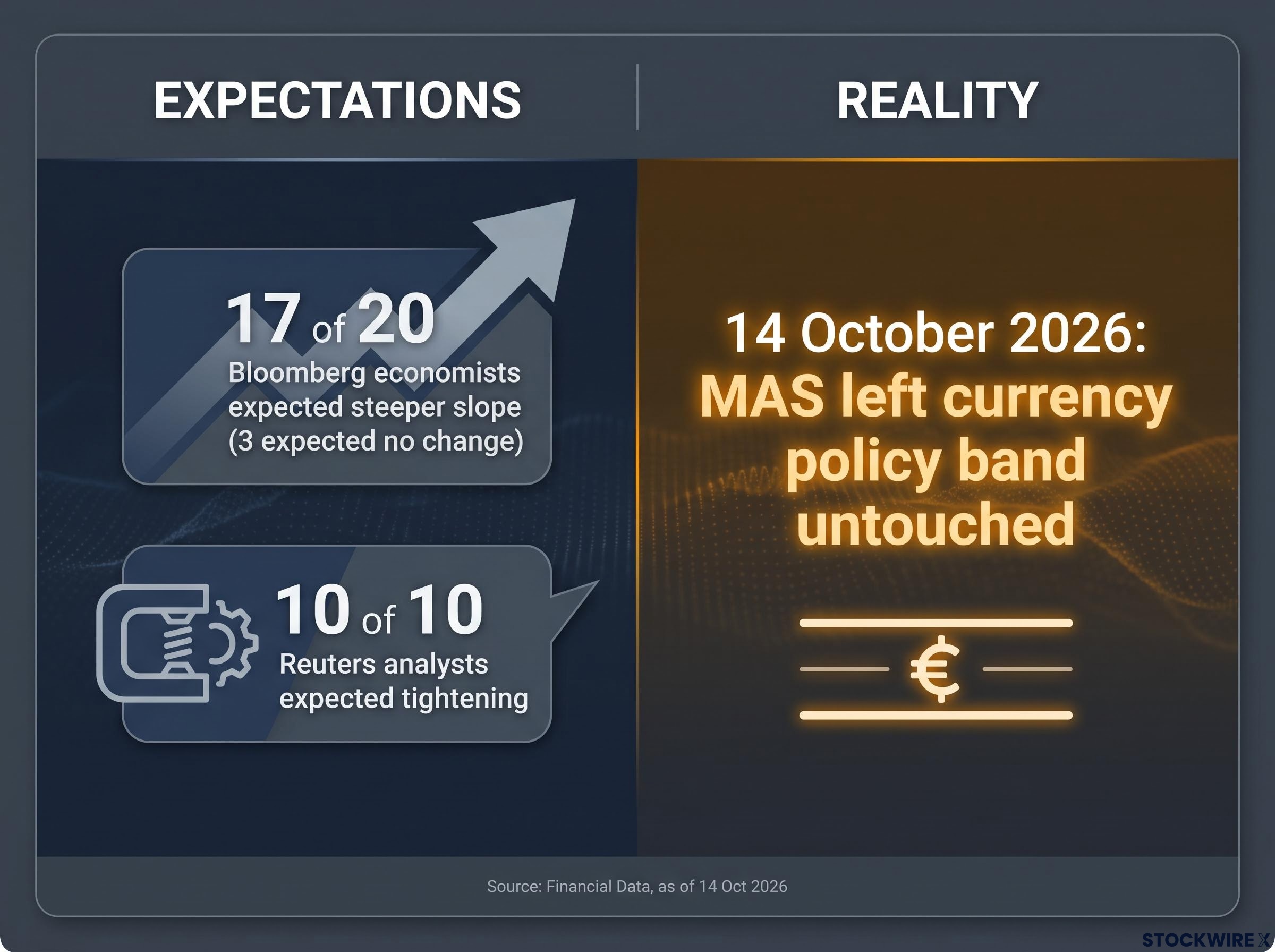
MAS kept the slope, width and centre of the band unchanged. That came after a tightening in April and a “very slight” slope increase in July, both still working their way through the economy. Its reasoning was that the existing appreciating band, plus the delayed effects of those two moves, was enough.
MAS guidance, 14 October 2026 “The current appreciating policy band will allow the S$NEER to continue to strengthen and lean against the anticipated near-term rise in imported inflation, ensuring the gradual easing of inflationary pressures in 2027.”
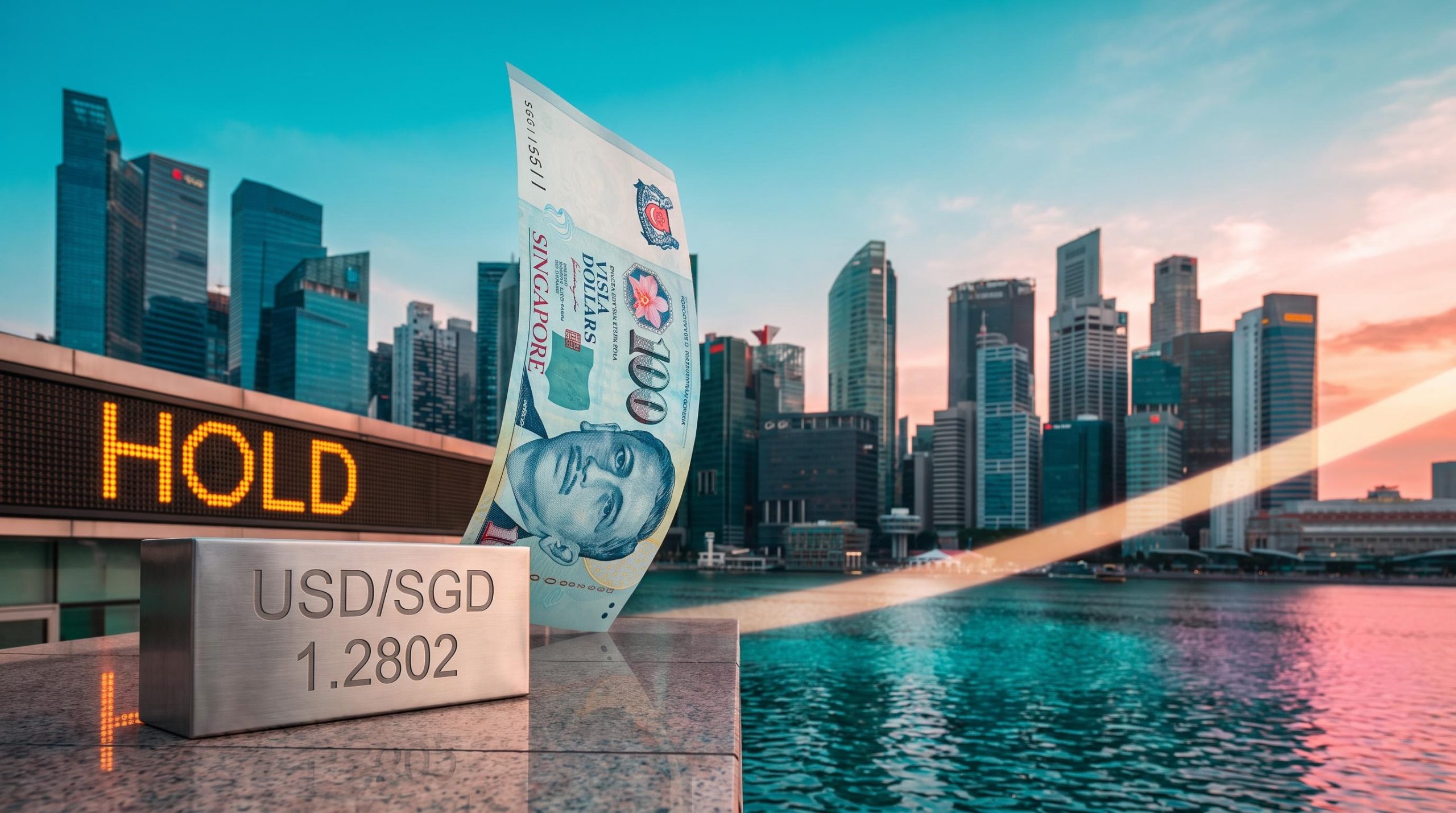
MAS added that it was “well-placed to respond effectively to any risk to medium-term price stability.” Since July, the Singapore dollar’s trade-weighted value has strengthened modestly within the upper half of the band. USD/SGD held steady at 1.2802 after the announcement.
The bank commentary arrived at the same explanation from different directions.
| Institution | Interpretation | View on next move |
|---|---|---|
| OCBC (Selena Ling) | More confidence that core inflation is stabilising; earlier moves still working | Hold expected through at least January 2027 |
| DBS (Chua Han Teng) | A pause after two proactive moves | Further tightening still possible |
| ANZ (Khoon Goh) | Policy likely already slightly restrictive; July’s smaller step signalled caution | Could tighten again in 2027 if risks materialise |
| MUFG (Michael Wan) | Existing band should offset the near-term rise in imported inflation | Likely on hold unless conditions shift |
The surprise tells you the market had priced in a tightening bias that MAS did not share. Read the hold as a reset of expectations, not a policy reversal. The bar for the next move is now higher.
When big ASX news breaks, our subscribers know first
How the S$NEER framework works, and why a “hold” still means appreciation
How can a central bank stand still and keep tightening at the same time? The answer lies in what MAS actually controls.
Most central banks move a short-term interest rate. MAS manages the Singapore dollar against an undisclosed, trade-weighted basket of currencies. The S$NEER (Singapore dollar nominal effective exchange rate) is the currency’s value measured against that basket, and MAS lets it move within a policy band that drifts along a set path.
Because MAS steers policy through exchange rates, not interest rates, a hold on the band can still deliver continued appreciation, which is why the slope matters more than the headline label.
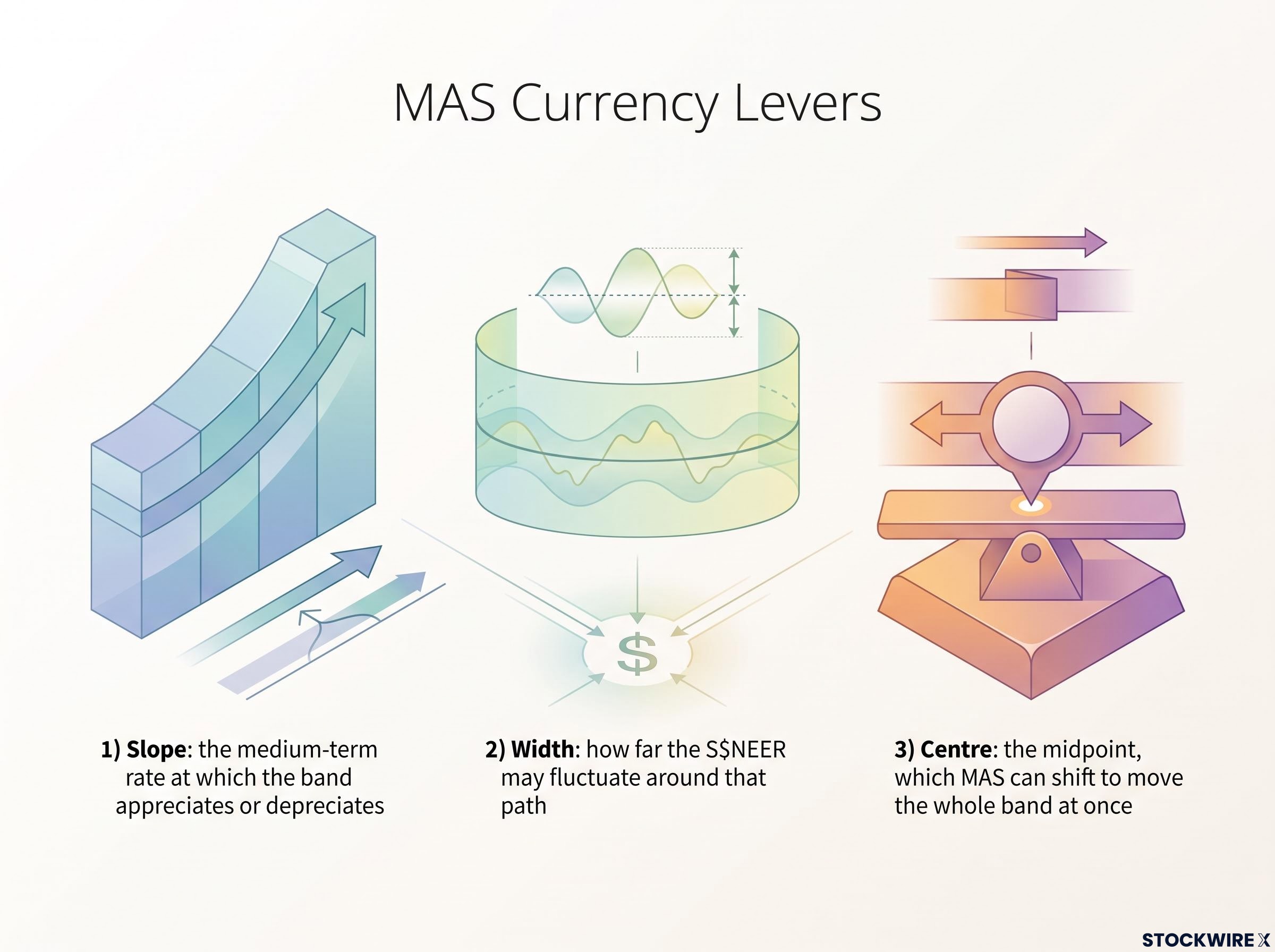
The three levers MAS can adjust
- Slope: the medium-term rate at which the band appreciates or depreciates.
- Width: how far the S$NEER may fluctuate around that path.
- Centre: the midpoint, which MAS can shift to move the whole band at once.
A stronger currency affects prices through two routes:
- Imported inflation: appreciation lowers the local price of goods and services bought from overseas.
- Derived demand: a stronger currency softens foreign demand for Singapore’s output, which eases pressure on domestic capacity and price-setting.
The design suits a small, open economy that imports much of what it consumes and uses in production. When foreign energy or food costs rise, appreciation absorbs part of the increase.
Where the framework falls short
Appreciation cannot erase a global energy or commodity shock; it only softens the local impact. It is weaker against inflation from domestic rents, wages and services, and a stronger currency costs exporters competitiveness. Policy also works with a lag, so aggressive tightening can hit activity after imported inflation has peaked.
Two limits stand out for investors. The band is undisclosed, so you cannot see its centre, width or remaining room. And if the US dollar strengthens broadly, keeping the basket rate rising can require a large move in USD/SGD.
The IMF’s account of the framework names the same two channels. It also implies that pass-through is partial and slow. Because the band still slopes upward, read an unchanged slope as continued restraint, not easing.
What do MAS’s inflation forecasts say about 2027?
The case for pausing starts with recent prices. Core inflation rose to 2.1% year-on-year in July-August, from 1.5% in the second quarter. That was a real uptick.
MAS still narrowed its 2026 core range to the lower end. It then published 2027 ranges for the first time.
| Indicator | October 2026 forecast | Previous forecast |
|---|---|---|
| 2026 MAS core inflation | 1.5-2.0% | 1.5-2.5% |
| 2026 headline inflation | Around 2.0% | 1.5-2.5% |
| 2027 MAS core inflation | 1.5-2.5% | No previous forecast |
| 2027 headline inflation | 1.5-2.5% | No previous forecast |
MAS expects core inflation to stay slightly elevated through the first half of 2027, then ease more clearly from the middle of the year. It cited three drivers:
- Supply-driven imported inflation slowing.
- Domestic costs staying muted, with services unit labour cost growth held back by productivity gains.
- The positive output gap (economic demand running above sustainable capacity) shrinking as the AI cycle moderates.
The restrained services costs may also reflect a softer labour market and more retrenchments in services. That is a less comfortable reason for inflation to cool.
The AI cycle behind the positive output gap is visible in trade data, where record NODX growth driven by electronics exports shows how strong external demand has been pressing on capacity.
Banks followed MAS lower. DBS cut its 2026 core forecast to 1.8% from 2.0% and headline to 2.0% from 2.2%, and trimmed 2027 to 1.8% from 2.0%. OCBC kept 2.0% headline and 1.8% core.
There was no new GDP forecast, despite Q3 growth of 5.4% year-on-year. The Ministry of Trade and Industry (MTI) releases official forecasts in November.
The case for a third tightening rested on a risk MAS no longer treats as its base case. The mid-2027 easing is the test of the whole call, so that is the point to watch.
What could change the outlook, and what it means for currency watchers
The base case is orderly: earlier moves bite, inflation fades from mid-2027 and MAS waits. It rests on assumptions that could crack.
The sequence shows how quickly MAS has moved this year. April 2026 brought the first tightening in more than three years, July a very slight slope increase, and October a hold. A pause after front-loaded tightening can be reversed just as fast.
Risks that could reopen the tightening debate
- AI-cycle slowdown: a sharp drop in investment, exports and hiring would weaken the case for tightening, though it could threaten growth.
- Persistent AI strength: a positive output gap keeps wage and services pressure alive, reviving the tightening case. DBS’s Chua tied the next move partly to this.
- Energy or tariff shocks: imported inflation could outrun forecasts, and the band may not fully offset it.
- Labour-market softness: rising retrenchments argue against tightening, while strong employment could keep core inflation sticky.
- Rapid appreciation: a fast-rising currency squeezes exporters and could push MAS towards caution.
Ling’s hold call is conditional on the output gap narrowing and core inflation easing. ANZ sees room for MAS to tighten again in 2027 if inflation risks materialise.
Before the October meeting, UOB had already expected MAS to hold its S$NEER settings through 2026 and into early 2027, with energy prices and food risks as the main threats to that baseline.
Currency implications
MAS kept its appreciation bias, which makes this decision less dovish than a flat or falling slope would have been. If traders unwind positions built for a steeper slope, the Singapore dollar could soften against the US dollar. Against regional currencies, the rising band is likely to keep it supported.
Before the next decision, watch:
- Imported energy prices
- The durability of the AI boom
- The output gap
- Domestic services inflation
- Labour-market conditions
- The speed of S$NEER appreciation
For you as an investor or currency watcher, this is a pause after front-loaded tightening. Positioning for a reversal is as mismatched as positioning for another hike.
These statements are speculative and subject to change based on market developments. Past performance does not guarantee future results, and projections are subject to market conditions and various risk factors.
What the pause changes, and what it leaves open
MAS has not loosened. It kept an appreciating band, judged that its April and July moves are still feeding through, and kept the option to act if medium-term price stability comes under threat.
What has changed is the threshold. Another tightening now needs evidence, most likely from energy prices, the AI cycle or sticky services inflation.
The next checkpoints are MTI’s growth forecasts in November and the January 2027 meeting. When you read future statements, look at the slope, not the headline label: a hold on a rising band is still restraint.
This article is for informational purposes only and should not be considered financial advice. Investors should conduct their own research and consult with financial professionals before making investment decisions.