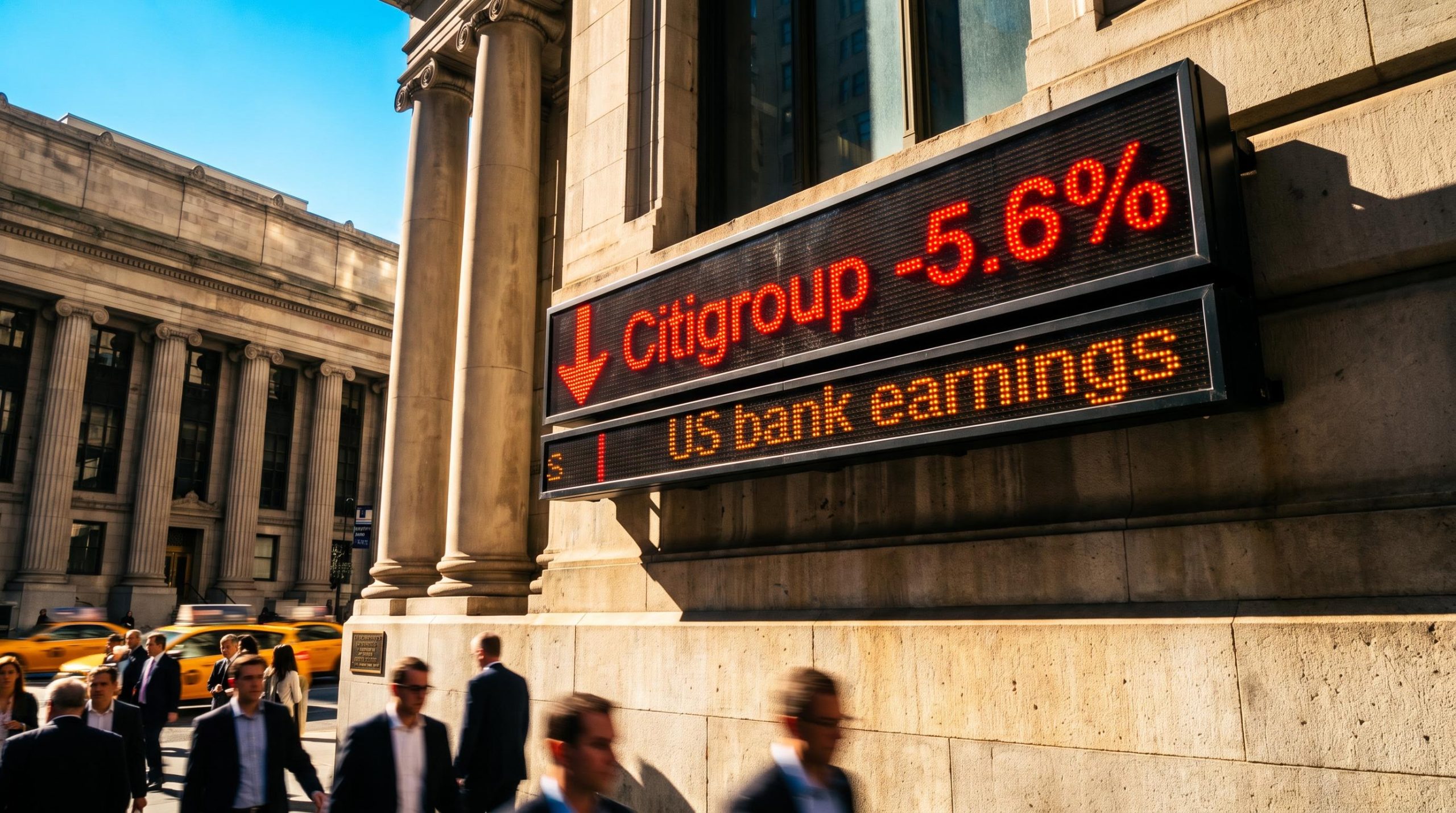
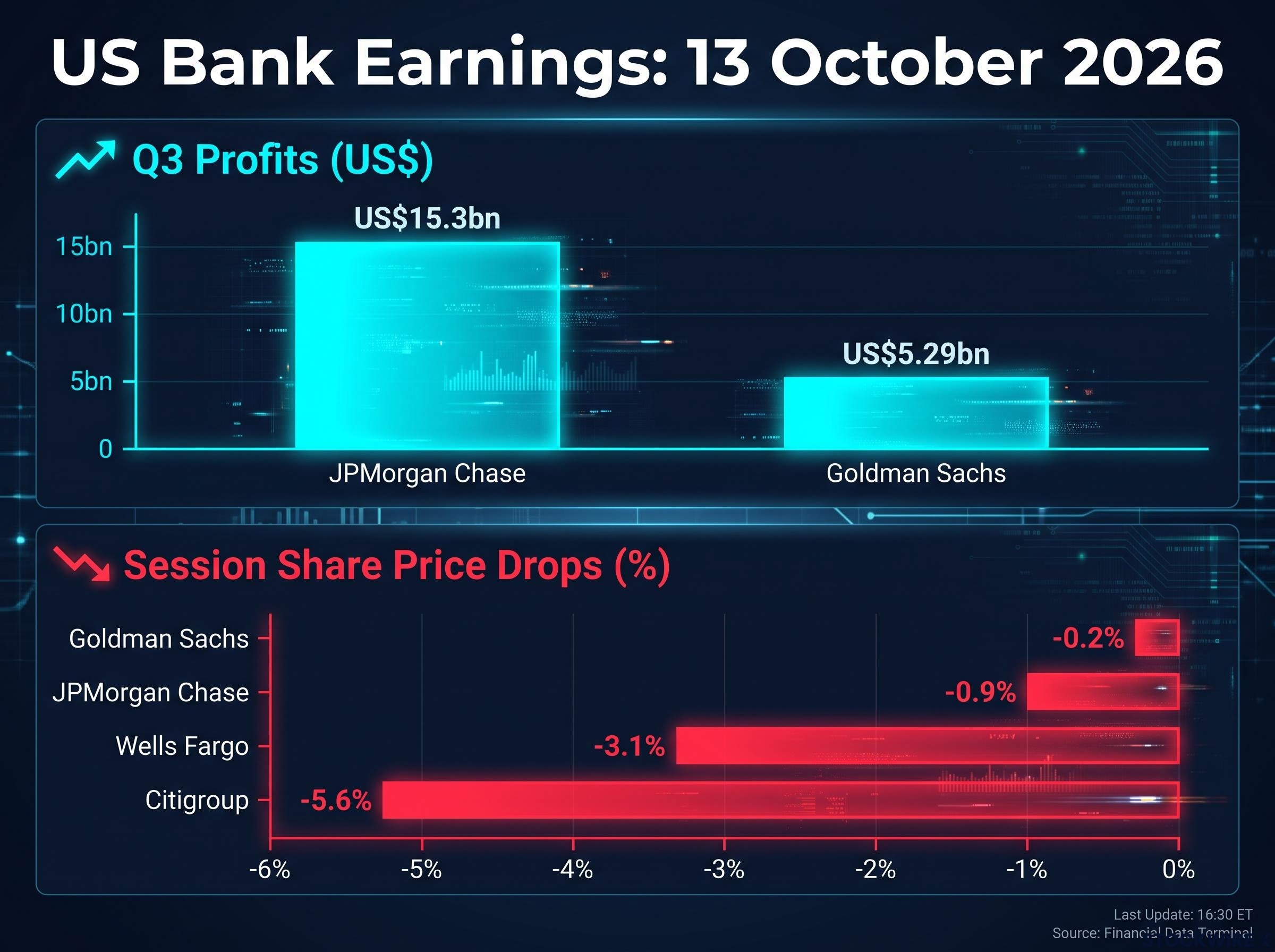
Four of Wall Street’s biggest banks reported third-quarter profits on 13 October 2026, and the US bank earnings showed healthy credit quality and a spending consumer. Shares still slipped. Goldman Sachs fell 0.2%, JPMorgan Chase dropped 0.9%, Wells Fargo lost 3.1% and Citigroup sank 5.6% in the session.
The gap matters on this side of the Pacific. US banks are up about 11.7% in 2026, while Australian banks are down about 3.5%.
One strategist argues Australia’s economy runs roughly 1 to 1.5 years behind the US, which would make these results an early preview of local credit trends.
Here is what the numbers do and do not tell you about National Australia Bank (NAB), Judo Capital and a global financials fund.
What did the four US banks actually report, and why did shares still fall?
The credit picture was reassuring. JPMorgan’s card charge-offs (loans written off as unlikely to be repaid) fell to 2.91% from 3.15%, and Wells Fargo’s dropped to 3.73% from 4.02%. Card spending at JPMorgan rose about 10% year-on-year.
JPMorgan CFO Jeremy Barnum described the consumer as very healthy, crediting a strong labour market. Wells Fargo’s chief executive went further.
Charlie Scharf, Chief Executive Officer, Wells Fargo “While economic uncertainty exists and consumer sentiment remains mixed,” consumers are spending more, delinquencies are low and business balance sheets are strong, according to Scharf, who said credit is good with no signs of change.
Profits followed. JPMorgan earned US$15.3bn against US$14.4bn a year earlier, while Goldman’s revenue jumped 23% on a 21% rise in investment-banking fees.
| Bank | Profit | Credit signal | Session share move |
|---|---|---|---|
| JPMorgan Chase | US$15.3bn (US$5.57 a share) | Provisions down 19% to US$2.74bn | -0.9% |
| Wells Fargo | EPS US$1.87, beat estimates | Card charge-offs 3.73%, provisions higher | -3.1% |
| Goldman Sachs | US$5.29bn (US$17.01 a share) | Not reported | -0.2% |
| Citigroup | Not found | Losses contained, provisions higher | -5.6% |
Where the cracks showed
Citi and Wells Fargo both lifted provisions (money set aside for expected loan losses) year-on-year, so credit risk has not vanished. Wells Fargo’s revenue of US$21.87bn missed consensus, JPMorgan’s fixed-income trading fell 4%, and Goldman’s bond, currency and commodities revenue dropped 24% quarter-on-quarter. Goldman did trade higher early in the session before giving it back.
The split reactions echo July, when business mix rather than headline beats decided winners, with Goldman rallying 9% while Citigroup fell 5.29% on the same day.
Investors are also watching whether higher Treasury yields slow deals and lift funding costs. The falling prices tell you the market is pricing those future risks, not this quarter, so a good result is not the same as a good entry point.
Does the US result read through to NAB and Judo?
The tidy version comes from a strategist identified in the source as Tapper Strickland, speaking on the Mumu podcast. AI investment, high employment and steady wages drive both economies, he argued, with Australia lagging by 1 to 1.5 years. No independent confirmation of that lag was found.
Why the lag thesis is plausible
- Employment drives credit quality in both countries.
- Small and medium-sized enterprise (SME) borrowers are sensitive to rates everywhere.
- Credit deterioration typically shows up well after rates rise.
- Australian business credit grew 9.8% in the year to August versus 6.1% for housing, per Reserve Bank of Australia data. The source cited 10.9% and 7.3%, likely a different month or measure.
Where the comparison breaks down
- Most Australian mortgages are variable-rate and reprice quickly; US mortgages are largely fixed.
- The majors are mortgage-heavy, while US results say more about cards and commercial lending.
- Australian mortgages carry full recourse and stricter serviceability tests.
- The RBA and the Federal Reserve run on different timetables.
State Street Global Advisors has reportedly described Australian banks as well capitalised but in a maturing cycle, though that view could not be independently confirmed.
NAB and Judo side by side
| Stock | Price | Price-to-book | Key issue | What would change the view |
|---|---|---|---|---|
| NAB | $39.25 | About 1.9-1.98 | Resilience largely priced in; P/E 19.27 | A formal trading update showing loan losses rising or holding |
| Judo Capital | $0.89-$0.91 | 0.56 | Loan quality, guidance cut, wholesale funding exposure | Clarity on how its troubled loans perform |
Price-to-book compares a share price with the bank’s net assets per share. Citi lifted its NAB target to $42.10 on 16 September, but at nearly twice book value, you are paying for resilience already assumed.
Citi’s lift is not the consensus view, with several aggregators placing average analyst price targets for NAB below its recent trading price and sells and holds outnumbering buys.
Judo is the opposite bet. Its shares are down about 50.6% this year after three loans worth $70-80m (about 0.5% of the book) deteriorated and FY26 profit-before-tax guidance was cut to $163-169m. At 0.56 times book, you are paid to accept loan uncertainty, and US card data does not resolve it for either lender.
Is a global financials ETF a safer way to play the theme?
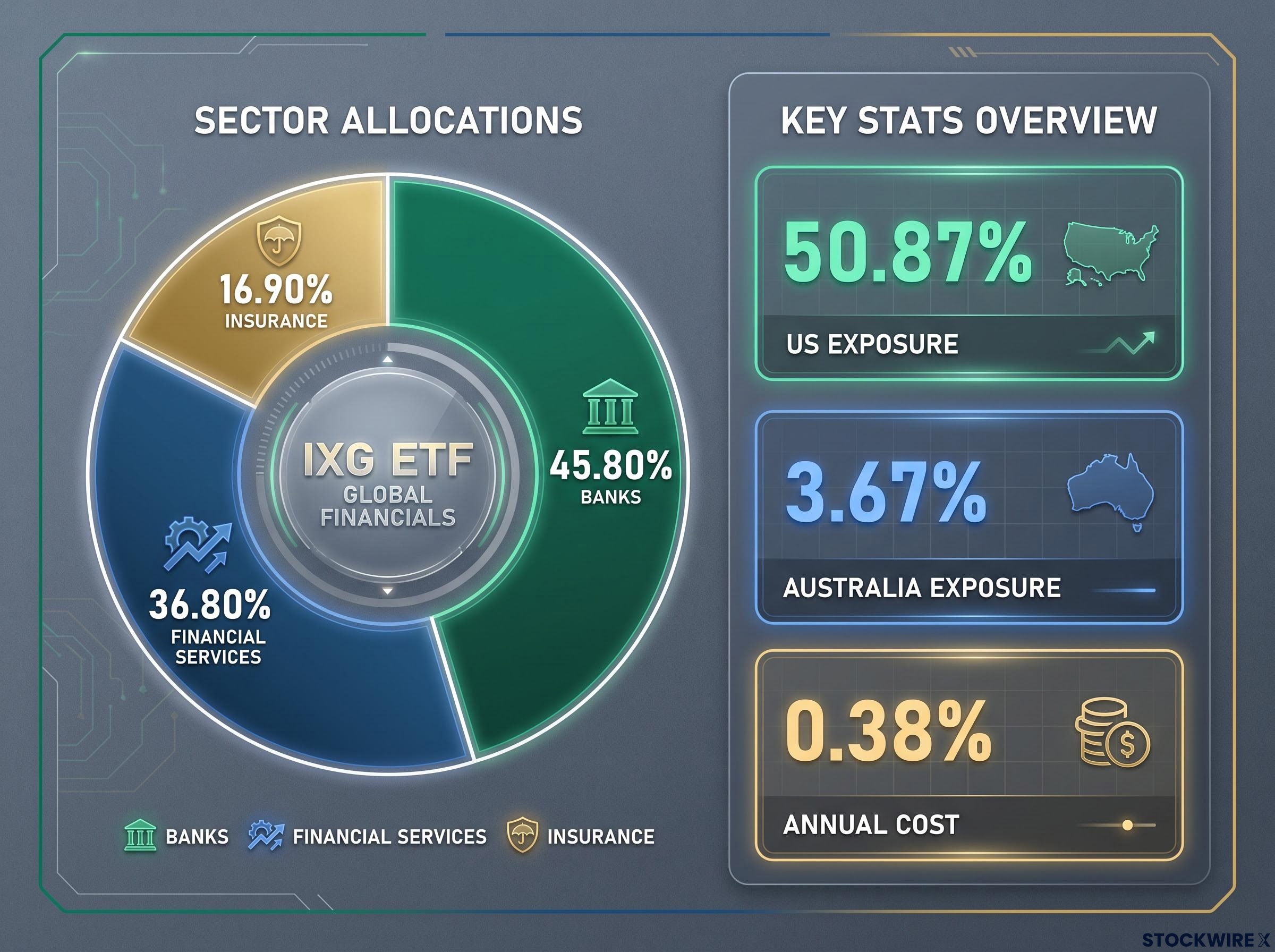
For readers who like the global bank story but not single-lender risk, the iShares Global Financials ETF offers a broader route. Check the ticker: the US-listed fund is IXG, while IXI on the ASX is the Global Consumer Staples ETF.
It holds 222 companies: banks make up 45.80%, financial services 36.80% and insurance 16.90%. That spreads your exposure across asset managers, insurers and payments firms rather than one loan book. The source says it is up about 13% over 12 months, though no independent trailing return was found.
What the ETF cannot do
- 50.87% sits in US stocks, with Australia only 3.67%.
- Returns move with the AUD/USD exchange rate unless hedged.
- It is not established that you would receive an equivalent franking credit outcome.
- It costs 0.38% a year and offers no shelter from a global financials downturn.
| Option | What you get | Main risk | Best suited to |
|---|---|---|---|
| NAB | Direct Australian bank and dividend exposure | Valuation already high | Income-focused holders |
| Judo | Recovery potential from a deep discount | SME credit and funding | Higher risk tolerance |
| IXG | Global, diversified financials | US tilt and currency | Those avoiding single-stock risk |
The fund is a different bet, not a risk-free one. This is general information, not personal advice.
For readers weighing global exposure beyond financials, our full explainer on global quality ETFs shows how ASX-listed funds reduce sector concentration in banks and miners.
What to watch before judging the US-to-Australia read-through
US credit is sound today. Whether that travels to Australia remains an inference with clear weak points, and three signals will test it:
- US card delinquencies and provisions next quarter.
- Australian business credit growth and any Judo loan performance update.
- Bond yields and bank funding costs.
If those hold, the constructive case strengthens. If they crack, your choice between paid-for resilience, discounted risk and global diversification will matter more than any single reporting day.
Big-bank strength also does not settle regional bank risk, where deposit mix and unrealised securities losses make financials a set of separate trades rather than one.
This article is for informational purposes only and should not be considered financial advice. Investors should conduct their own research and consult with financial professionals before making investment decisions. Past performance does not guarantee future results, and forward-looking views are speculative and subject to change.