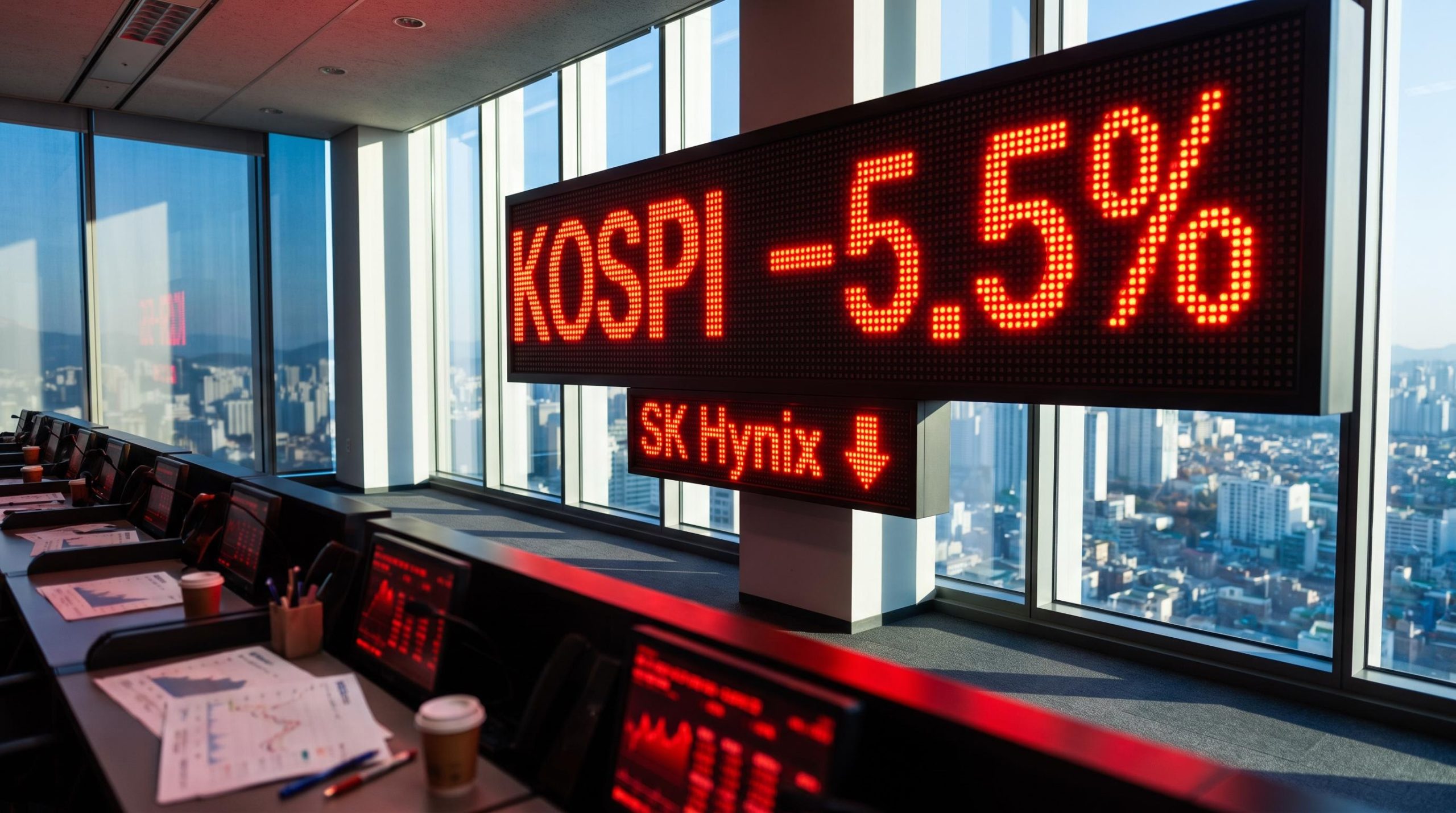
Korea’s Kospi closed down 5.5% on 13 October 2026, its worst session in a chip stock selloff that hit memory makers hardest. SK Hynix fell about 10% and Samsung Electronics about 7%, as fears of an overheating AI trade collided with fresh evidence that China’s DRAM challenger is closing the gap.
The pressure did not start in Seoul. The US Philadelphia Semiconductor Index has now fallen for five straight sessions, losing more than 8% over that run, according to Bloomberg’s original report.
Later in the day, the selling reached Australia, where engineering and AI-linked small caps were dumped in the final hour. Sources differ on several of the day’s figures; the Kospi number used here is Bloomberg’s closing figure.
The real question now is whether this is a sentiment wobble or the start of a sector de-rating, where investors permanently pay less for each dollar of expected earnings. Here is how to tell the difference, and the specific signals that would settle it.
What did the market actually do, and why did Korea take the worst of it?
The same global headlines hit every major Asian chip market on Tuesday. The damage was not evenly shared.
| Market or stock | Reported move | Context |
|---|---|---|
| Kospi (Korea) | -5.5% | Bloomberg closing figure |
| SK Hynix | About -10% | Memory specialist |
| Samsung Electronics | About -7% | Korea’s largest stock |
| Nikkei 225 (Japan) | -2.1% | Another source gave -1.82% |
| Taiex (Taiwan) | -1.8% | Broader chip mix |
| Philadelphia Semiconductor Index (SOX) | -2.7% on 12 October | More than 7% below its October high |
The SOX figures come from different sessions and measurement windows, which explains why one report shows a drop of more than 8% over five sessions and another more than 7% from the monthly high.
Korea’s fall was roughly two and a half times Japan’s because its market leans so heavily on two memory stocks. When Samsung and SK Hynix fall together, the whole index follows. Foreign investors sold a net 4.52 trillion won of Korean shares on the day, and three amplifiers deepened the slide:
- Heavy foreign selling into crowded positions
- Fund rebalancing and options expiry
- The completion of Samsung’s share buyback, which removed a steady buyer
Goldman Sachs analyst Heather Oh had already flagged these technical and corporate events at Samsung. Huh Jae-hwan of Eugene Investment & Securities said a recovery now depends on whether Korean domestic buyers can absorb the foreign selling.
Korean foreign flows have swung violently this year: record net buying of 7.2 trillion won in late July drove the Kospi into a bull market, which makes Tuesday’s 4.52 trillion won of selling a sharp reversal.
If you hold broad Korean or emerging-market exposure, your risk is tied to two memory stocks far more than the index label suggests.
When big ASX news breaks, our subscribers know first
Three triggers, one nervous market: Hock Tan, CXMT and the cost of AI capital
Korea’s concentration explains the size of the fall. It does not explain why the selling started, and three separate pressures converged at once.
What Hock Tan said
At a conference in Singapore on Monday, Broadcom chief executive Hock Tan said: “A lot of investors have no clue what they are investing in.” He said investors had set “very extreme expectations.”
“Almost like they are in a casino.” Hock Tan, Chief Executive Officer, Broadcom, describing what some investors had discovered about the market
Markets read the remark as a warning that funding the AI buildout, not just chip supply, could become the sector’s bigger constraint.
What CXMT has claimed, and what it has not shown
ChangXin Memory Technologies (CXMT), China’s largest maker of DRAM (the standard working memory used in computers and servers), outlined plans for a DDR5 server memory module targeted by the end of 2026. President Cao Kanyu presented it at a Shanghai conference on 9-10 October.
- Claimed: a 4F² cell design that cuts cell area by about one-third, theoretically fitting about 50% more memory cells in the same space
- Not yet shown: yields, production volumes, customer qualification or commercial shipments
The company’s scale is already real. Counterpoint puts CXMT’s global DRAM revenue share at about 10% in Q2 2026, up from 4% a year earlier. TrendForce-related figures give 9.5%, against Samsung’s 39.4%, SK Hynix’s 24.9% and Micron’s 23.3%.
CXMT’s Shanghai listing in July raised $8.6 billion and valued the company at roughly $487 billion on a thin free float, giving the DRAM challenger fresh capital to fund the capacity the market now fears.
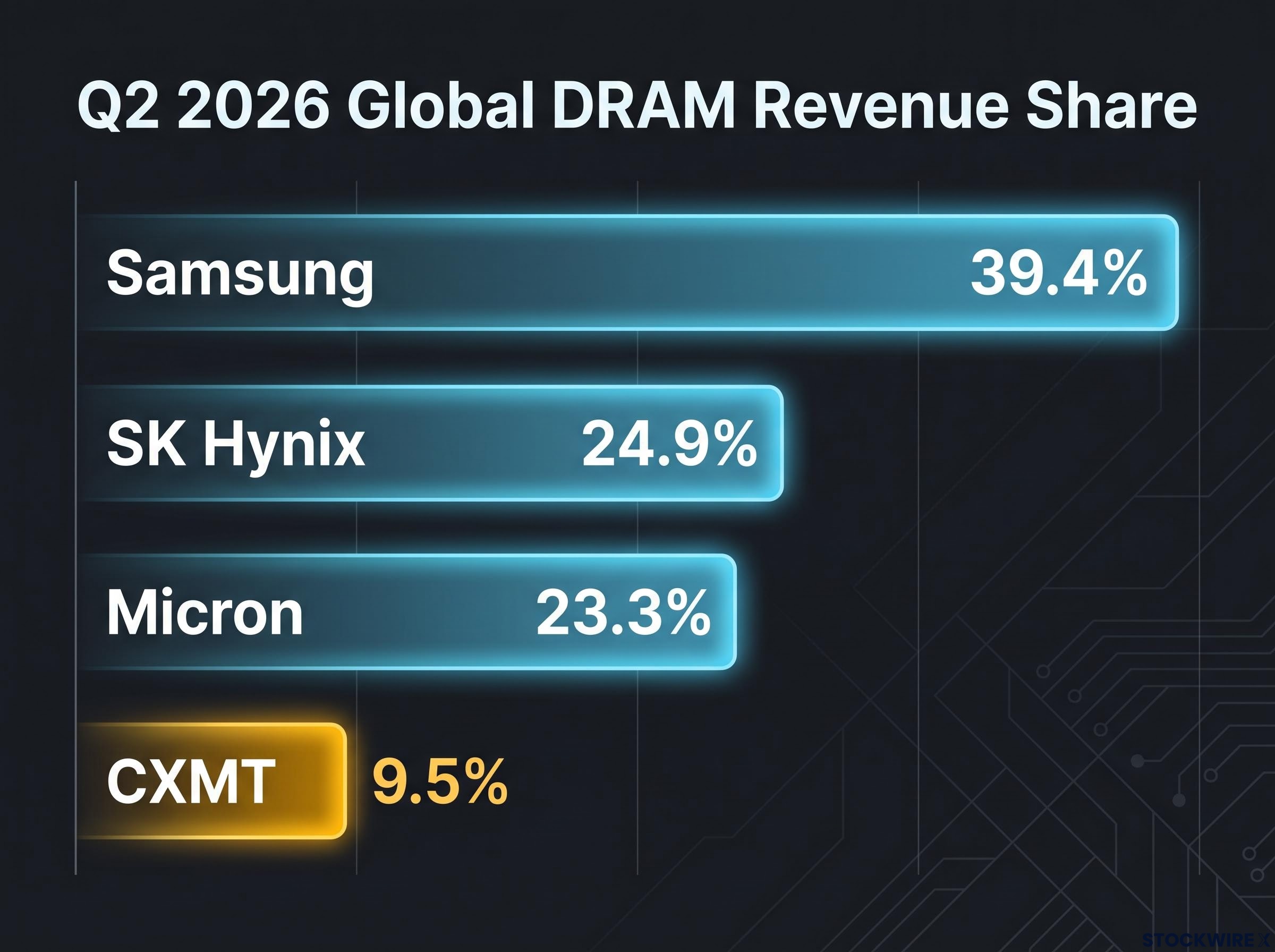
The distinction that matters is HBM versus commodity DRAM. HBM, or high-bandwidth memory, is the stacked memory used in AI accelerators; supply remains tight and CXMT is well behind. Server and commodity DRAM is a far bigger market, where extra Chinese supply could pull contract prices down even while HBM stays scarce.
Why financing costs matter
Blackstone-backed AirTrunk postponed a Singapore real estate investment trust (REIT) listing expected to raise about US$1.5 billion, with a listing now considered by early 2027. Hebe Chen of Vantage Global Prime said the AI machine is still running, but the capital fuelling it is getting more expensive.
The threat here is to memory pricing and margins before AI demand, so a falling price estimate would tell you more than a falling order book.
How the chip stock selloff reached Australian engineering and AI names
Through most of the Australian session, the story looked like a Korean memory problem. Then the final hour arrived.
SKS Technologies was down about 8% at 3 p.m. and closed down 20.5%. The ASX technology sector fell 4.37%.
| ASX company | Closing move |
|---|---|
| SKS Technologies | -20.5% |
| Megaport | -9.9% |
| Southern Cross Electrical Engineering | -8.8% |
| Maas | -6.6% |
| Codan | -6.0% |
| Dicker Data | -4.9% |
| NWH | -4.7% |
None of these companies makes memory chips. Analyst Kerry said the late selling looked like a fund exiting AI-related positions, then posed the open question.
Is it a sentiment wobble, or the start of a de-rating?
Commodities slipped too. Gold fell 0.2% to US$4,160/oz, copper 0.5% to US$6.78/lb and aluminium 0.4% to US$3,019/t, while related ETFs lost about 1-1.5%. With a quiet US lead, Wednesday’s session is expected to be choppy for materials, with energy strong and engineering and AI stocks under scrutiny.
If you own AI-adjacent small and mid caps outside semiconductors, Tuesday showed they trade as part of the same crowded theme and can fall further than the chip names themselves.
Sentiment wobble or de-rating? Four signals that will settle it
Analysts split cleanly on Tuesday, and the disagreement is about duration and transmission rather than direction.
The two readings
Mehrotra forecasts AI demand exceeding memory supply through 2028. Phillip Wool of Rayliant Global Advisors argued the easy profit in Korean memory had already been taken, which points to a positioning reset. Union Bancaire Privée’s Vey-Sern Ling and Bei Fu described jittery investors taking profits in the strongest performers.
The bears see more. Hao Hong of Lotus Asset Management cited fears that CXMT capacity could spark a price war, and the BlackRock Investment Institute downgraded its US equity view to neutral on AI buildout volatility.
| Factor | Bullish reading | Bearish reading |
|---|---|---|
| Demand | AI demand outpaces supply through 2028 | Overinvestment risk in AI capex |
| Supply | CXMT unproven at scale, behind in HBM | Added DRAM triggers a price war |
| Financing | Delays, not cancellations | Rising yields squeeze AI projects |
| Positioning | Profit-taking after a strong run | Start of a margin and multiple reset |
Four signals will separate the two:
- Whether analysts cut memory price and margin estimates
- Whether CXMT’s server product ships and qualifies with customers
- The direction of financing conditions and bond yields
- Whether foreign selling in Korea persists
Precedents
In 2018, memory shares fell before excess supply showed up in earnings, a warning against waiting for reported results. HBM demand is far stronger now, though. The January 2025 DeepSeek selloff produced an immediate rout without any collapse in AI demand.
Memory cycle mechanics explain why 2018 is the relevant precedent: shares tend to peak when producers announce capacity expansion, well before excess supply appears in reported earnings.
This episode blends both, with one new element: a credible Chinese competitor whose advanced server product remains unproven. On balance, the evidence points to a sentiment and positioning shock with real de-rating risk, which makes the next few weeks of estimate revisions more telling than one day’s price action.
Past performance does not guarantee future results. Forecasts cited are speculative and subject to change based on market developments and company performance.
What the selloff changes, and what it does not
Tuesday exposed how crowded memory and AI-linked positioning had become, from Seoul’s index heavyweights to Australian engineering contractors. It did not show that AI demand has stalled, or that CXMT has shipped a competitive server product. HBM remains tight; the exposure sits in commodity and server DRAM pricing.
From here, the useful work is watching evidence: estimate revisions, CXMT qualification news, bond yields and Korean foreign flows, starting with Wednesday’s session. Price alone will not settle the debate.
This article is for informational purposes only and should not be considered financial advice. Investors should conduct their own research and consult with financial professionals before making investment decisions.