Bank of England (BoE) policymaker Megan Greene said on Tuesday that holding back until second-round inflation effects appear would leave the Bank acting too late. The pound barely moved: GBP/USD rose about 0.1% to near 1.3220 after her remarks were released during Asian trading hours on 13 October.
That muted response is the story. Greene was one of three Monetary Policy Committee (MPC) members who voted to lift Bank Rate to 4.00% in September. She has backed a hike at every meeting since June, so her message was consistent with her record rather than new.
Markets already price roughly an 83% chance of a rate rise on 5 November. The open question is how much her latest comments change that picture.
This piece covers what Greene is warning about, whether the market has already priced it in, and the two dates that matter before the next MPC decision.
Why sterling shrugged at a hawkish message
A central banker warns that inflation could take hold and says rates should rise sooner. That would normally lift the currency. Instead, GBP/USD briefly dipped below 1.3200 and then recovered toward 1.3250, according to FXStreet’s Sagar Dua.
Greene’s comments were not soft. She said insufficient proactivity against inflation is a bigger danger than hiking too early. She described UK policy as not especially restrictive with Bank Rate at 3.75%. She also said the International Monetary Fund’s (IMF) latest UK forecasts did not surprise her, and that a revaluation of China’s yuan would add upward pressure to UK inflation.
FXStreet’s Speechtracker scored the remarks 8.2/10, compared with her baseline of 7.7/10. Speechtracker is FXStreet’s tool for grading how hawkish or dovish a policymaker’s comments are. On that measure, her tone was tougher than usual, but not by much.
Pricing explains the calm. Traders already expect an 83% chance of a November hike and two 25 basis point rises by February 2027. A basis point is one hundredth of a percentage point.
Sterling’s main drivers include rate expectations, inflation data and political risk, which helps explain why a hawkish remark already reflected in market pricing can leave GBP/USD close to unchanged.
| Measure | Latest figure | Source/date |
|---|---|---|
| Bank Rate | 3.75% | Bank of England, 17 September 2026 |
| GBP/USD | ~1.3220 (up ~0.1%) | FXStreet, 13 October 2026 |
| Hike probability, 5 November | ~83% | Market pricing, 13 October 2026 |
| Speechtracker score vs baseline | 8.2 vs 7.7 | FXStreet, 13 October 2026 |
For you, the point is that a November hike is mostly priced already. Greene’s words matter more for how far and how fast the Bank tightens after that meeting than for whether it starts.
The relative tightening case for the pound
A more hawkish BoE path raises expected UK yields, which can support sterling if everything else stays the same. Reuters reported that a hawkish BoE outlook and higher energy prices have helped the pound against both the dollar and the euro.
Three factors offset that support: a strong US dollar, hikes already in the price, and concerns about growth. ING’s Francesco Pesole has warned that markets have sometimes priced too hawkish a BoE path. If that pricing reverses, sterling could weaken.
What second-round effects are, and why Greene fears being late
“Second-round effects” was the key phrase in Greene’s remarks. The term describes what happens when an initial energy or food price shock spreads into wider inflation that lasts. The BoE tracks four channels:
- Wage-setting: workers ask for higher pay to cover rising costs, and employers agree.
- Price-setting: firms pass higher wage and input costs on to customers, or raise prices in advance.
- Inflation expectations: households and businesses come to expect high inflation, which makes it self-reinforcing.
- Persistence: a one-off shock turns into a long period of inflation above target.
In a June speech, Greene identified price-setting as a particularly large risk. The September MPC minutes said that risk had grown because energy prices remained high. The minutes also flagged that a new wage round could arrive while CPI is still above target.
Services inflation, private rents and catering prices re-accelerated independently of energy costs in August, which supports the view that domestic price-setting pressure is not simply a one-off energy effect.
Her argument is about risk management. If the Bank waits for proof and turns out to be wrong, correcting the mistake could require much sharper tightening than acting early. The 2021-23 episode shapes this view: energy and supply shocks that looked temporary became persistent as wages and expectations adjusted.
She made a related point in Cape Town on 8 October, according to Reuters. She cautioned against relying on high bond yields to tighten conditions on the Bank’s behalf.
Greene in Cape Town She said it was “quite dangerous” for the Bank to assume high bond yields would do its work in bringing inflation down.
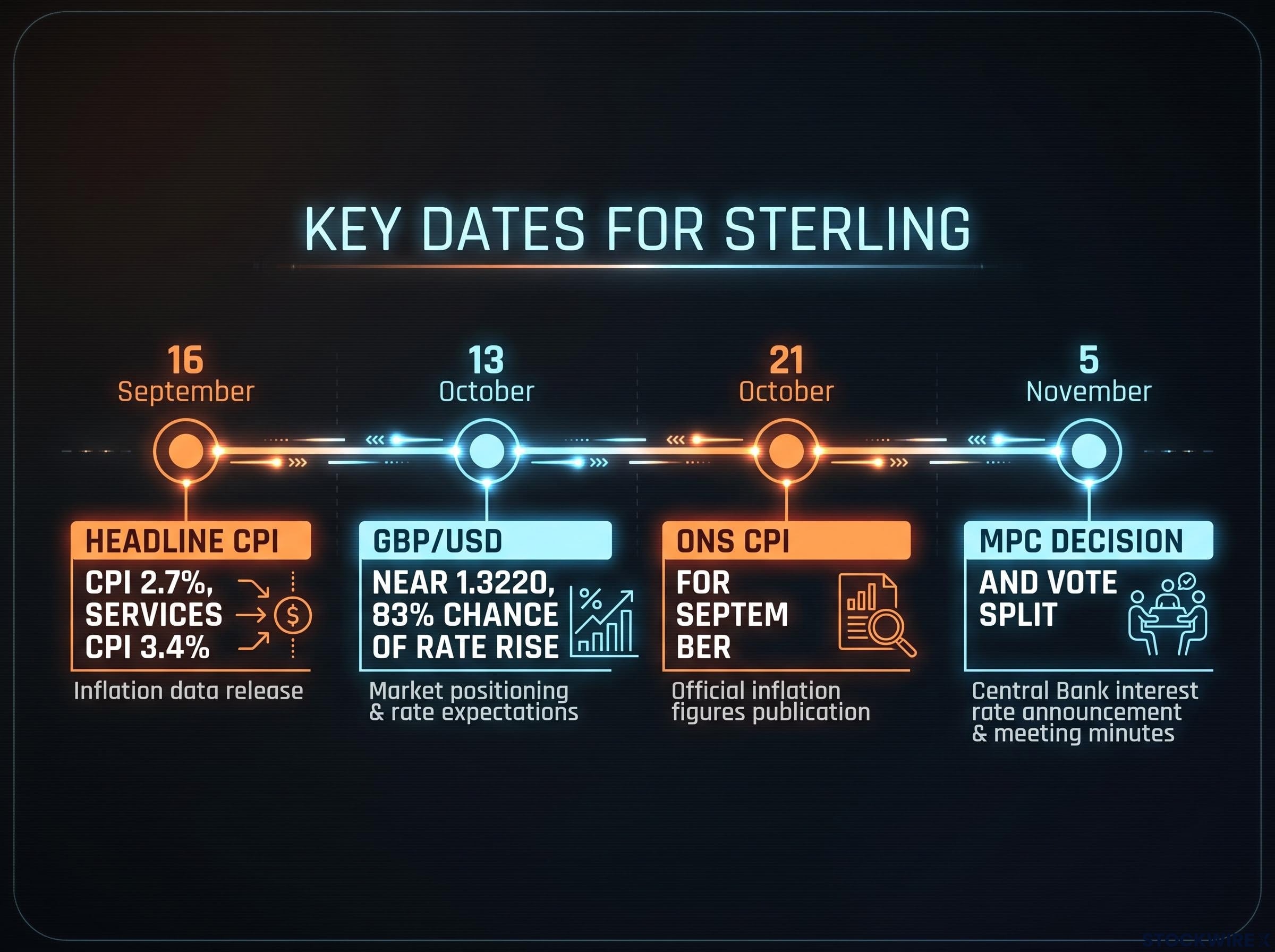
Pay is her main worry. Pay awards are expected at about 3.5% in 2027. Headline CPI was 2.7% in August, with services CPI at 3.4% (ONS, 16 September).
That 2.7% reading is not the number she is watching. Her focus is on what wage rounds and expectations do next. A soft CPI print on 21 October may therefore not soften her stance.
The counter-case: is 3.75% really too loose, and what comes on 5 November?
Greene’s logic is hard to dismiss, but six of her colleagues were not persuaded in September.
| Position | Members | Core reasoning |
|---|---|---|
| Hike to 4.00% | Greene, Mann, Pill | Act before the wage round embeds inflation; Mann sees activity stronger than expected |
| Hold at 3.75% | Bailey, Breeden, Dhingra, Lombardelli, Ramsden, Taylor | Wait for clearer evidence of pass-through to wages, prices and demand |
Governor Andrew Bailey has argued that tighter market conditions have given the Bank time to assess the shock. The disagreement is not about whether inflation is above target. It is about how likely the energy shock is to spread, how soon, and whether 3.75% is already restrictive.
The cautious camp has solid ground. Bank Rate cannot increase energy supply. If expectations remain anchored, a pre-emptive hike could weaken demand and employment for little gain. If the neutral rate is low, 3.75% is already significant restraint. The neutral rate is the level of interest rates that neither speeds up nor slows down the economy.
The IMF’s October outlook has UK growth at 1.3% in 2026, slowing to 1.2% in 2027. It forecasts CPI at about 3.3% and 2.8% over the same years.
The takeaway from the split is that a November hike is likely but not unanimous. Sterling’s next move depends on whether markets read tightening as credible inflation control or as a sign that growth is worsening.
The MPC’s hawkish bloc has grown from one dissenter in April to three, while swap rates feeding mortgage pricing have already risen ahead of any official move.
Dates to watch:
- 21 October: ONS CPI for September
- 5 November: MPC decision and vote split
What Greene’s stance changes, and what it leaves open
Greene’s remarks reinforce a November hike that is already largely priced. The real uncertainty is how much tightening follows. September CPI on 21 October and the size of the vote on 5 November are the two variables most likely to move sterling next. A wider hawkish majority would support the case for further rises, while a narrow split would favour the cautious camp.
One caveat applies. The 13 October comments are known only through FXStreet’s report, so treat their exact framing with some care. Until the vote, you are weighing one persuasive voice, not the committee’s settled direction.
This article is for informational purposes only and should not be considered financial advice. Investors should conduct their own research and consult with financial professionals before making investment decisions. Past performance does not guarantee future results. Financial projections are subject to market conditions and various risk factors.