
Most traders think a bearish view means buying puts and hoping the market falls fast enough to cover the premium. A call credit spread can pay for that downside exposure instead, and most of the real work in these trades happens after you place them, not before.
With the S&P 500 near 7,700-7,800 and the VIX in the mid-teens in early October 2026, many traders are weighing cheap, defined-risk ways to lean bearish without paying up for expensive premium. This is educational context, not trading advice.
Here is how a super bear spread is built, how shifting a butterfly wing changes your downside sensitivity, and how to tell when bearish option spread adjustments beat simply closing the trade.
How does a super bear spread finance its own downside bet?
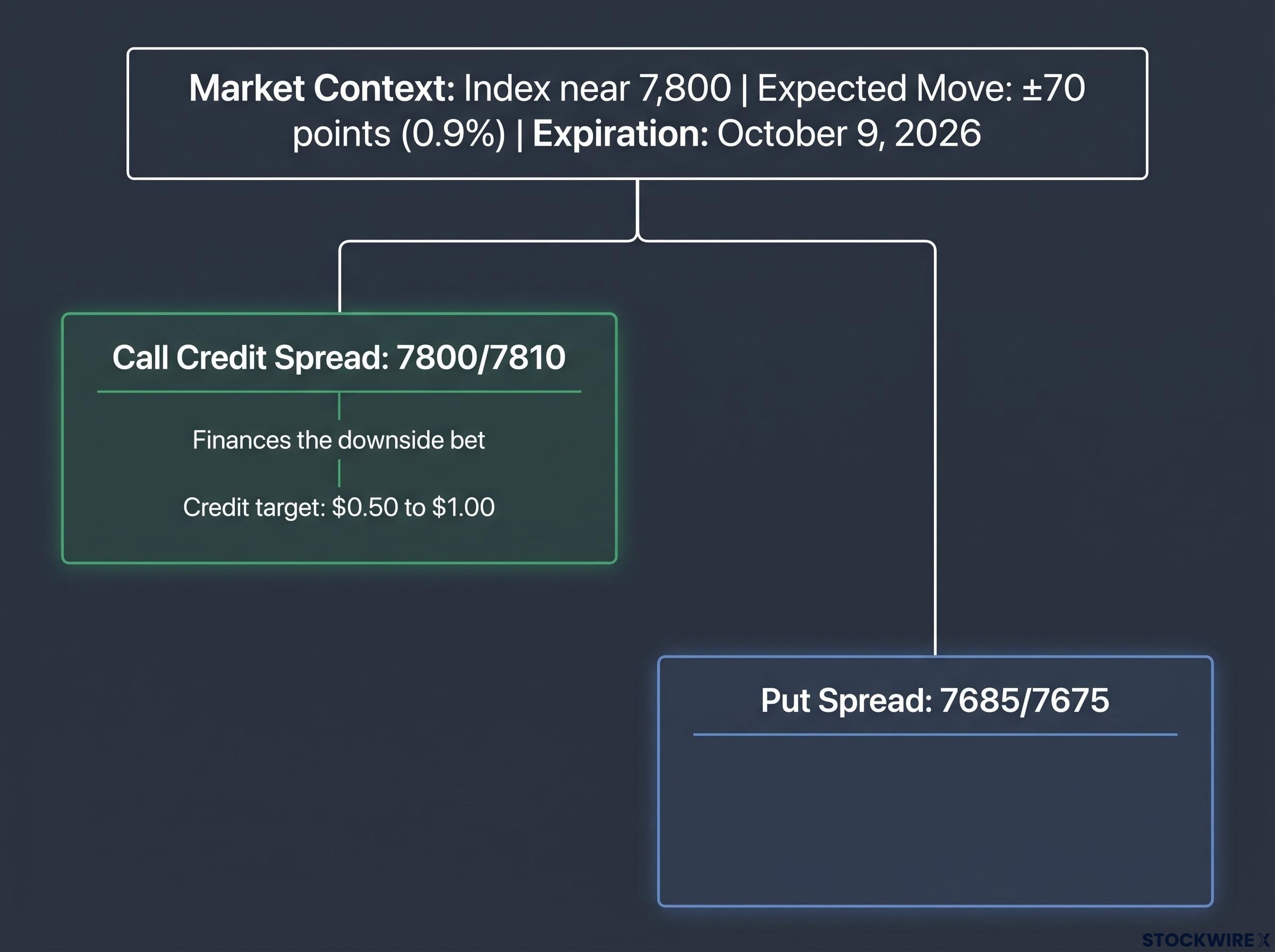
A super bear is a wider, farther out-of-the-money call credit spread that pays for a put debit spread. A call credit spread means you sell one call and buy a higher one, collecting cash upfront. A put debit spread means you buy a put and sell a lower one, paying to profit if the market falls.
The surprising part is the pairing: the cash from the call side funds the put side. For a roughly 7-day trade, a wider structure is favoured because it lifts maximum profit.
Anchor the design to the expected move, which comes from the at-the-money straddle price (the call plus the put at the strike nearest the index). Recent near-term SPX examples showed about ±70 points, or 0.9%, and the short strikes sit outside that range.
The credit target is $0.50 to $1.00. Tastytrade teaches short strikes at 0.20-0.40 delta (a rough gauge of the odds an option finishes in the money) and a credit of about one-third of the width. Per Cboe and OCC/OIC material, maximum loss equals the width minus the credit.
Delta also tells you how your position behaves as time passes: the same 0.20-0.40 delta short strike becomes far more sensitive to each index point as expiration approaches, which is why a 7-day structure demands closer monitoring.
For the October 9, 2026 expiration, with the index near 7,800, one example uses a 7800/7810 call credit spread financing a put spread near 7685/7675.
| Variation | Call spread | Put spread | Relative risk | Trade-off |
|---|---|---|---|---|
| Base | 7800/7810 | 7685/7675 | Moderate | Balanced credit and payoff |
| Outside expected move | 7800/7810 | 7650/7635 | Higher | More downside max profit, needs a bigger drop |
| Lower risk | 5-point wide | 10-point wide | Lower | Smaller credit to finance the put side |
The call credit is small, and that is the price of cheap downside exposure. A sharp rally through the short call is the scenario that actually hurts you.
Rule of thumb Wider, farther-out spreads give a lower credit but a higher probability of profit. Closer spreads give more credit and delta, but a lower probability of profit.
Choosing your width and credit
A 5-point call spread collects less than a 10-point one, so it finances less downside. It also caps your worst case at a smaller number, which is why it suits a lower risk tolerance.
SPX options are cash-settled and European-style, so early assignment is not a concern on the index. Financing a trade does not remove risk. It relocates it.
When big ASX news breaks, our subscribers know first
What actually changes when you shift a butterfly wing or add a second fly?
On screen, the first thing you see is a tighter, more tilted profit tent. The Greeks, the measures of how a position responds to price, time and volatility, explain why.
Delta, gamma, theta and vega each measure a different sensitivity, and the Cboe Greeks primer explains how these four measures combine, so you can see why moving one wing changes your exposure in several ways at once.
Reading the butterfly before you change it
A butterfly has a long wing, a short body and another long wing. Risk is defined, and the payoff chart looks like a tent that peaks at the body strike.
Know that original shape first. Every adjustment redraws it, and you cannot judge the change without the starting picture.
Moving the lower long wing closer to the body reduces far-downside convexity (how fast gains build in a big drop) and concentrates gamma near the short strike. Net theta rises around the body, and long vega falls.
- Shift a wing: tighter, more directional tent
- Add a second fly: a new tent where the market has moved, keeping the original
- Roll out in time: same thesis, longer runway
| Adjustment | Delta | Gamma | Theta | Vega effect |
|---|---|---|---|---|
| Move lower wing closer | More directional near the body | Concentrated near short strike | Higher around the body | Trims long vega |
| Add second butterfly | Flatter near new zone | Larger swings between centres | More decay-harvesting areas | Rises with added structure |
| Roll out in time | Thesis preserved | Calmer near term | Less near-term decay | More vega exposure |
Adding a second fly creates multiple profit peaks. Rolling out preserves your thesis, but some educators warn it can turn a manageable loss into a slower, larger one if the trend has changed.
Broken-wing butterflies and pin risk near the body strike (the risk of the index settling right at your short strike) add further wrinkles.
Every tweak trades something: tail protection for sensitivity, near-term decay for vega. Ask what you are giving up before you click.
How do real adjustments look in practice, from the SPX put fly to WDC?
The logic of each move shows up in the strikes and costs, so follow the numbers.
The index put butterfly wing shift
The butterfly was opened on Friday, October 2, 2026 at 7500/7400/7300, expiring at the end of October. The trigger is a rally: if E-minis rise about 80-100 points, the debit falls and the shift gets cheaper.
- Trigger: E-minis up 80-100 points
- Move: lower wing from 7300 to 7325 or 7350
- New risk: roughly $100 or less extra, cited as $165-$170
- New max profit: about $2,500
The adjusted fly earns more on a sharp drop, such as 100 points lower in E-minis, than the symmetrical version.
Adding to the WDC butterfly
On Western Digital (WDC), the trader added to a call butterfly on the same strike while the stock fell sharply. The first fly cost about $600, and the total reached about $780.
The position needs to be worth about $1,560 to pay for both. If WDC rebounds, closing one leaves the other effectively free.
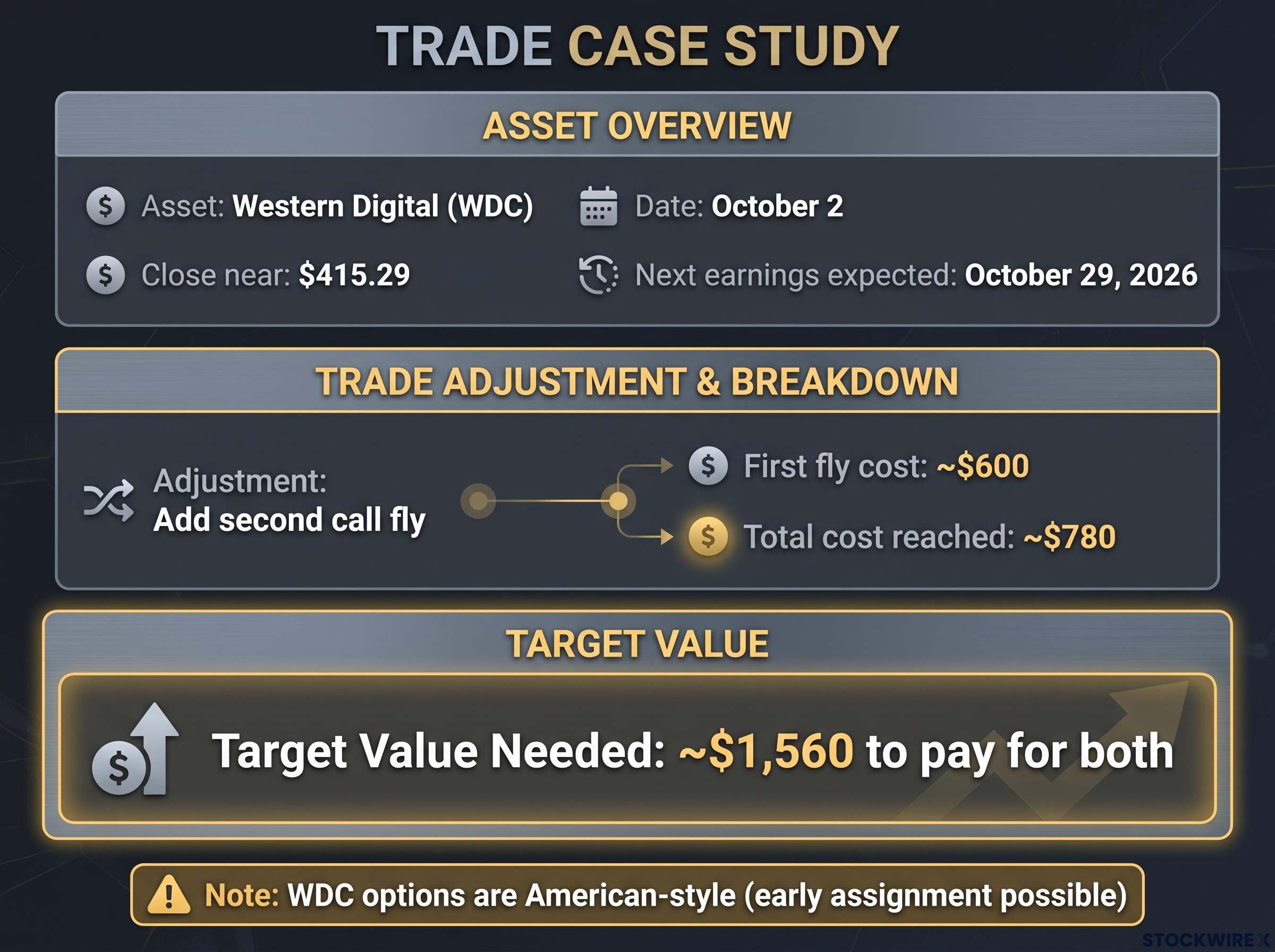
WDC closed near $415.29 on October 2, and next earnings are expected October 29, 2026. WDC options are American-style, so early assignment is possible, and earnings are an event risk.
| Position | Adjustment | Cost or credit | Added risk | Payoff change |
|---|---|---|---|---|
| Index put fly | Lower wing to 7325/7350 | About $165-$170 cited | About $100 or less | Max profit about $2,500 |
| WDC call fly | Add second fly | About $780 total | Extra cost of the add | Needs about $1,560 to cover both |
| Super bear | Widen and roll out one week | About $170 credit | $500 added | Call side closed, new structure |
A prior super bear finished with its call side in the money and was closed. It was widened and rolled out a week, adding $500 of risk for about $170 credit, using varied strikes to avoid duplicating another position. A Nvidia calendar was also swapped to keep some long exposure while trimming the portfolio.
Each step is small and priced in dollars. Hold your own adjustments to that standard: know the added risk, the added payoff and the trigger before acting.
When should you adjust, and when is closing the better call?
Adjusting feels like repair. The evidence is more mixed.
Adjust or close: the evidence
In sharp selloffs (the 2018, 2020 and 2022 episodes), traders rolled put butterflies down and out, shifted wings toward the body, and converted profitable call credit spreads into iron flies or wider condors. In sharp rebounds, closing or reducing after large gains often beat continued adjusting in hindsight.
Planned adjustments generally produced more controlled outcomes than ad hoc ones. Fear-driven tweaks often lagged a simple close.
Write the plan before the trade:
- Set a price trigger
- Set a delta threshold
- Cap the maximum added risk
- Define the thesis-failed exit
Risks that grow with every adjustment
- Gap risk: a small credit against large risk if the index jumps through your short strikes
- Assignment: FINRA and the SEC warn that short in-the-money American-style options can be assigned early
- Pin risk: uncertainty when the price settles near a short strike
- Over-adjusting: extra commissions, slippage and adding risk to avoid booking a loss
Margin is not your ceiling Initial margin is not the maximum economic risk of a spread.
Brokers advise keeping risk small relative to account equity. Position size across the whole portfolio matters more than the probability of profit on any one spread.
Building a bearish spread plan you can follow before the next move
Three ideas carry the guide: finance downside with defined risk, know what each wing shift or add changes in the Greeks, and set adjustment rules before the trade is on.
Watch the index against its expected move, the direction of the VIX, the October 29, 2026 WDC earnings date for equity positions, and where the 10-year yield, near 5.2%-5.3%, heads next.
Your next step is to model the payoff diagram of any structure, write down your trigger and exit rules, and size the trade so a gap through the call wing is survivable.
For readers wanting to pair these structures with a stock portfolio, our dedicated guide to building a bearish options overlay shows how to size a Super Bear and bearish butterflies as a hedge.
This article is for informational purposes only and should not be considered financial advice. Investors should conduct their own research and consult with financial professionals before making investment decisions. Past performance does not guarantee future results, and complex spreads are not suitable for every investor.