A soft non-farm payrolls (NFP) print normally weakens a currency. A disappointing jobs number should signal a slowing economy, a central bank closer to cutting rates, and a reason for yield-seeking capital to look elsewhere. Yet foreign exchange desks are treating the next soft US payrolls report as something closer to a discount sticker on the Dollar than a sell signal.
That inversion is the puzzle worth understanding right now. The US 10-year Treasury yield is trading in a 5.21-5.29% range as of late September 2026, the highest in roughly two decades. A debate in Washington over restricting diesel exports has placed Europe in a structurally weaker energy position. The US Dollar Index (DXY) is hovering near 101.8, close to its yearly high.
These are not three separate headlines. They are a convergent set of forces pushing in the same direction, and together they explain why dips get bought rather than chased. What follows is a framework for understanding which conditions sustain the Dollar’s current bid, and, more importantly, the specific developments that would need to break for that dynamic to reverse. Treat it as analytical equipment, not a forecast.
What 5.2% yields are actually doing to global capital flows
Start with the number that anchors everything else. Across the final week of September and into October, the US 10-year yield clustered tightly at the top of its multi-decade range:
- 5.21% on 30 September 2026 (TradingEconomics), described as the highest since mid-2007
- 5.24% on 28 September 2026 (Federal Reserve FRED data)
- 5.274% in late-September intraday trading (CNBC)
- Approximately 5.29% on 1 October 2026
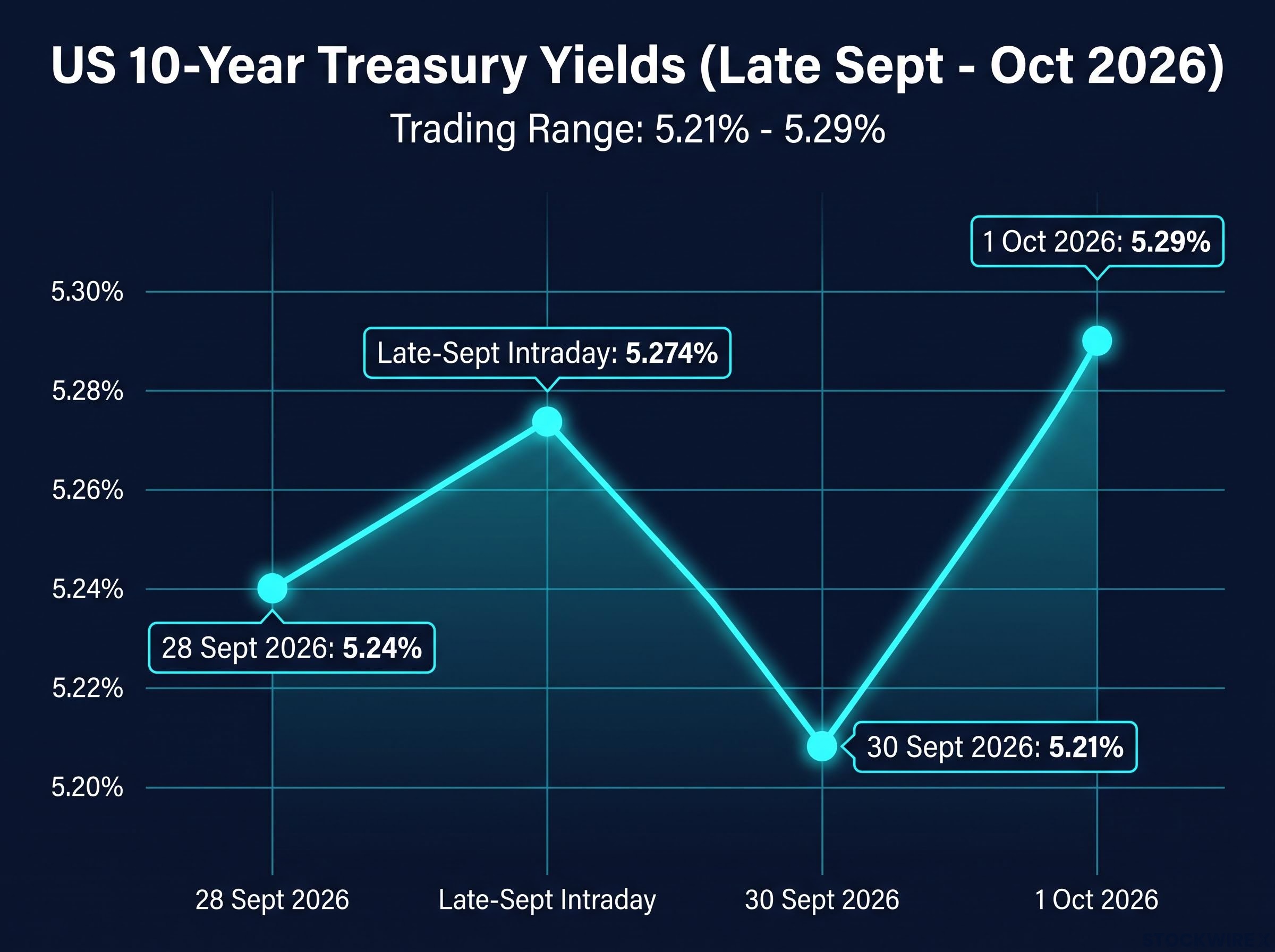
The consistency of that band matters more than any single print. When a government bond from the deepest, most liquid market in the world offers a positive real yield above 5%, and European and Japanese sovereign equivalents offer substantially less, capital does not need much persuading about where to sit.
Real yield dynamics, specifically the gap between the nominal Treasury rate and prevailing inflation expectations, determine whether foreign capital views a yield level as genuinely attractive or merely compensatory, and that distinction is what separates a structural Dollar bid from a cyclical one.
Here is the mechanism that makes this self-reinforcing. A foreign investor who wants to own US Treasuries must first buy Dollars to pay for them. That creates sustained, structural demand for the currency itself, demand that runs independently of whether equities are rising or risk appetite is strong. The yield advantage pulls in capital, and the act of chasing that yield pulls up the Dollar.
Why soft data does not break this dynamic
This is where the NFP paradox resolves. The current policy debate centres on whether the Federal Reserve needs to do more, not less. In that configuration, a softer data point does not compress yields far enough to erase the carry advantage.
Kit Juckes of Société Générale frames the broader logic cleanly.
High US real yields, combined with global risk aversion and a shortage of attractive alternatives, tend to keep the Dollar strong until either yields fall materially or global growth and risk sentiment improve decisively.
What this tells you is that the engine sustaining the Dollar, foreign capital chasing the best-quality positive real yield available, does not switch off because of one disappointing payrolls release. That distinction should change how you read the next NFP. A weak number that leaves yields near 5.2% is a tactical dip. Only a weak number that genuinely drags yields lower is a structural one.
When big ASX news breaks, our subscribers know first
The diesel export debate and what it means for currency markets, not just pump prices
A debate about whether to restrict US diesel exports is, before anything else, a EUR/USD story. The reason is that the incremental energy pain lands on Europe, and foreign exchange markets price that asymmetry long before any barrel actually stops moving.
First, the policy status, precisely. As of late September 2026, nothing has been enacted. No ban, no executive order, no binding rule. The situation sits at the proposal stage, and the White House has pulled back from a full ban toward what Energy Secretary Chris Wright has described as a “simpler, voluntary, cooperative” approach with refiners.
| Date | Policy Stage | Key Actor | Market or Analytical Response |
|---|---|---|---|
| 22 Sept 2026 | Idea backed publicly | President Trump | Treasury examining feasibility of full or partial ban |
| 23 Sept 2026 | Discussed as an option | Energy Secretary Wright | Wright says a ban “would not work”; US diesel futures fall then recover |
| 24 Sept 2026 | Restrictions over ban | EU Commissioner Jorgensen | Brussels calls the plan a “bad idea” |
| 28 Sept 2026 | 90-day ban considered “very seriously” | President Trump | Wright reiterates focus on restrictions, not a full ban |
The transmission into currency markets does not wait for a signed policy. US diesel accounts for over 50% of EU diesel imports and roughly 10% of total EU consumption. That dependence means any serious discussion of restrictions reprices European energy risk faster than it reprices US energy risk.
Diesel supply constraints have been building well before the US export debate surfaced in Washington; global diesel inventories were already running 28.5 million barrels below year-ago levels as of August 2026, and the diesel crack spread was trading at four to five times its historical norm, which is the structural backdrop against which any US export restriction lands.
The analysis sharpens the point. Wood Mackenzie’s 24 September 2026 work concluded that a US diesel export ban would force crude run cuts of at least 2.7 million barrels per day in the Gulf Coast refining region (PADD 3), while pushing Northwest European diesel crack spreads sharply higher as Europe scrambles for non-US barrels.
Argus Media warned that any significant US restriction would likely push European diesel prices and crack spreads to “unprecedented” levels.
Note the counter-intuitive part. The US is not economically helped by restricting its own exports; Wright himself argued it would lift domestic gasoline and jet fuel prices. The Dollar still benefits, because the FX impact is relative, not absolute. What this means for you is that energy policy headlines of this kind function as leading indicators for Dollar/Euro direction, and the signal arrives before the policy does.
Why Europe absorbs the pain first, and what that means for EUR/USD
European vulnerability here is structural, not a run of bad luck. The continent’s industrial base is more energy-intensive, its freight and agricultural sectors lean heavily on diesel, and its indigenous oil and gas resources are limited. When energy prices shock, that structure transmits the pain into economic stress faster and deeper than in the US, which sits on broader domestic supply.
Layer on the geography. Three energy pressure points are now concentrated on the same region at once:
Energy shock transmission into European inflation is already underway independent of the US export debate, with ECB rate expectations rising and markets pricing further hikes driven by refinery destruction in the Gulf region, a backdrop that makes the continent’s currency position structurally weaker even before any US policy decision is formalised.
- Russian export restrictions have already squeezed European diesel supply
- Strait of Hormuz disruptions affect nearly 20% of Europe’s imports (EnergyConnects)
- Potential US diesel limits represent a third simultaneous squeeze on the same continent
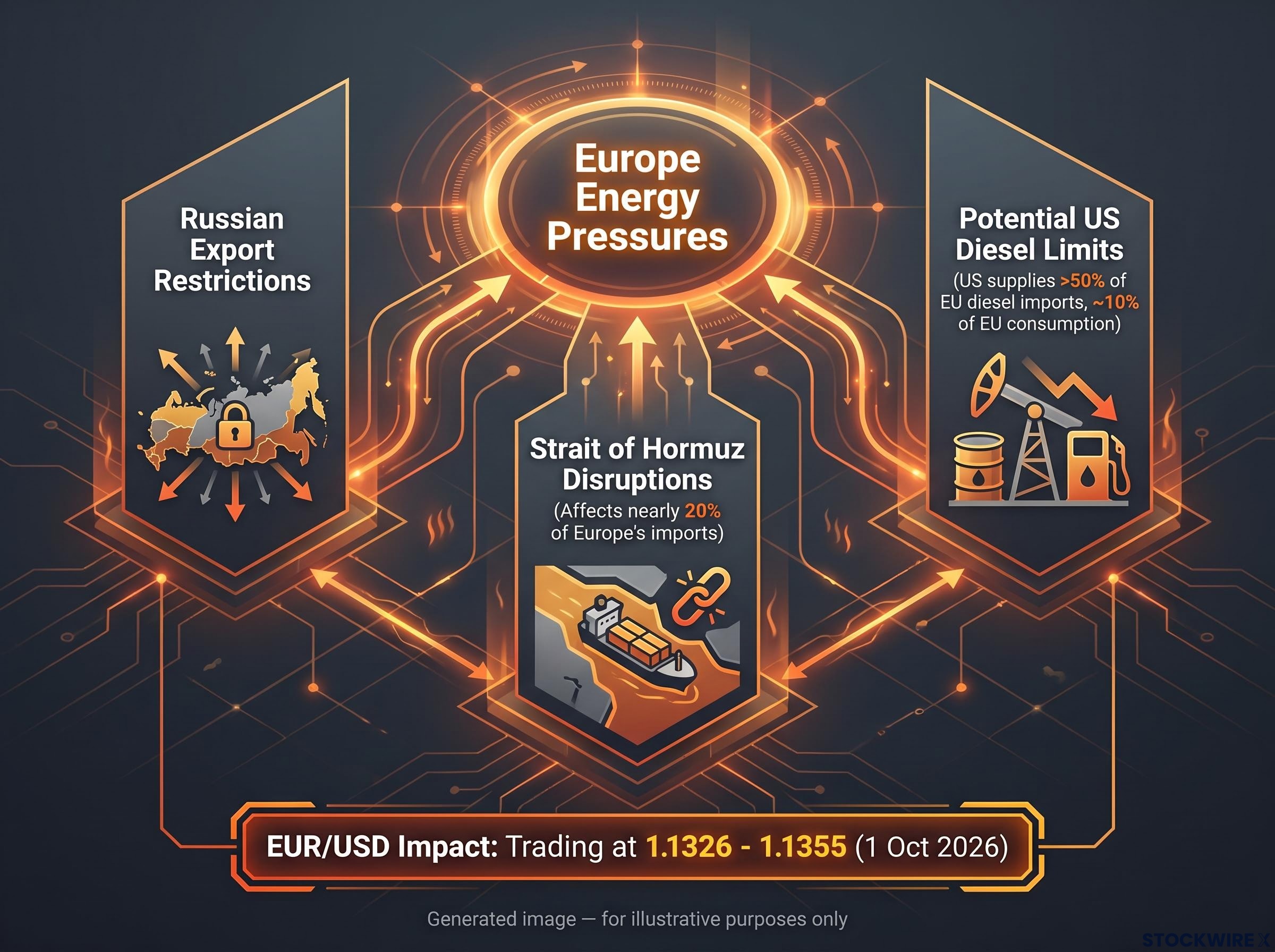
What makes this more than a passing headwind is that the US sits on the supply side of two of those three pressures. EUR/USD was trading at approximately 1.1326-1.1355 on 1 October 2026, held down by exactly this relative-strength story. The Euro and most European currencies are assessed as the primary losers in an FX environment shaped by US energy policy and a wider energy crisis.
The precedent is recent. During the 2022 European energy crisis that followed Russia’s invasion of Ukraine, surging gas and power prices weighed heavily on the Euro against the Dollar. The transmission from energy stress to currency weakness is a path the market has walked before.
The pressure is still building. The Washington Post reported on 29 September 2026 that the EU energy commissioner urged member states to cut gas and electricity consumption “for as long as necessary” as the wars in Iran and Ukraine tighten markets further.
What would have to change for Europe’s FX position to recover
Balance requires naming the other side. Some analysts argue Europe has genuinely improved its resilience through gas storage, diversification away from Russian pipeline supply, and faster renewable deployment, which could soften the worst-case outcome.
Even so, a durable EUR/USD recovery needs two things to move together. The first is energy crisis resolution: higher non-US supply, Middle Eastern stabilisation, and no US diesel restrictions actually enacted. The second is a simultaneous narrowing of the yield differential as the Fed pivots.
Either one alone produces a relief rally, not a trend change. That is why you should read a Euro bounce in the current setup as a potential fading opportunity rather than a reversal, until both conditions align.
What would have to break for the Dollar to lose its structural bid
The honest version of this analysis is not a bullish conclusion. It is a checklist of thresholds. Three specific developments would undermine the Dollar’s structural bid, and each is measurable in real time.
| Reversal Condition | What to Watch | Historical Precedent |
|---|---|---|
| US growth deterioration | Recessionary signals from high real rates triggering Fed easing expectations | 2014-2016 strong-Dollar phase sustained by policy divergence |
| Fed pivot on inflation | Inflation falling convincingly to target, long-duration yields dropping from multi-decade highs | 1980s Volcker rally ended with rate normalisation plus Plaza Accord |
| Energy crisis resolution | Higher non-US supply, Middle East stabilising, no diesel ban enacted | 2022 EUR/USD weakness reversed as energy supply stabilised |
The positioning risk sits underneath all three. Long-Dollar positioning is very crowded, which leaves the currency exposed to sharp corrections if a catalyst flips the narrative. The same dips that are currently treated as buying opportunities can turn into exit signals quickly, particularly if the yield advantage compresses at the same moment.
History offers calibration on what a genuine reversal requires. The 1980s Volcker-era rally ended only when coordinated Plaza Accord intervention coincided with rate normalisation. The 2022 EUR/USD move reversed when energy supply stabilised and the European Central Bank began aggressive tightening.
Historical episodes show that verbal intervention alone rarely succeeds in capping Dollar strength when the underlying yield and risk landscape still favours the Dollar. The Volcker precedent is the clearest reminder: talk did not turn the trade, aligned policy and yields did.
There is a dissenting read worth holding. Some FX strategists note that very high Dollar levels can prompt reserve-management adjustments and trade-pricing shifts into non-Dollar currencies, which at scale could moderate demand even with yields staying high.
The near-term data events, ISM releases, FOMC member speeches, the NFP print, can all move the Dollar tactically. What they cannot do, on their own, is alter the structure. The read for you is that these are catalysts to trade around, not thresholds that mark a top.
Three variables that will determine whether the Dollar trade has further to run
The useful way to leave this is not with a summary but with a watchlist. From starting coordinates of a DXY near 101.8 and EUR/USD around 1.13, three variables will determine whether the trade keeps running.
- US 10-year yields relative to the 5.2% anchor. A supportive reading holds the yield near or above current levels, preserving the carry advantage. A reversal signal is a sustained drop driven by genuine Fed-pivot pricing rather than a single soft print.
- Diesel export policy moving from proposal to enacted restriction. A supportive reading keeps the policy in limbo while Europe’s energy risk stays elevated. A reversal signal is a de-escalation: no restriction enacted, alongside improving non-US supply.
- Incoming US growth data, starting with NFP. A supportive reading sees a soft print absorbed as a tactical dip. A reversal signal is a weak number that actually triggers Fed-pivot pricing and drags yields lower.
All three are currently aligned in the Dollar’s favour, which is why the structural bid persists. This is not a call that the Dollar has topped; it is a map of what a top would look like. No specific 2026 ECB, Fed, or IMF directional forecasts were available to anchor those thresholds, so the discipline is to watch the variables themselves rather than wait for a consensus shift.
Reading the NFP release within the structural framework
Return to where this started. A soft NFP reads as a buying opportunity today precisely because the yield and energy variables have not moved. The paradox only holds while those pillars stand.
When the yield advantage compresses or the energy asymmetry resolves, the NFP reaction will change character, and a soft print will finally read as weakness rather than discount. That change in how the market reacts to the same data is the single clearest early-warning signal worth tracking.
For investors wanting to decode the sub-components that determine whether a soft headline is genuinely bearish or just noise, our dedicated guide to reading the NFP report covers wages, revisions, and the cross-asset reaction sequence in detail.
This article is for informational purposes only and should not be considered financial advice. Investors should conduct their own research and consult with financial professionals before making investment decisions. Past performance does not guarantee future results, and these statements are speculative and subject to change based on market and policy developments.