The Morningstar Global AI Select Index is up more than 60% through the first three quarters of 2026. That is the opportunity. Now the other number: the top 10 AI stocks now account for 36% of the entire US equity universe. That is the risk hiding inside it.
Both statistics describe the same handful of companies, and that is precisely the problem.
You are arriving at a genuine inflection point. Anthropic’s public listing is approaching, OpenAI is seeking private capital at a valuation somewhere between $1.2 trillion and $1.5 trillion, and six separate AI-related selloffs have hit markets since August 2024, every one of which reversed.
The stakes on both sides of the AI trade are higher now than at any earlier point in this cycle.
Here is what you will have by the end: a concrete way to assess whether your own portfolio’s AI exposure reflects a deliberate choice you made, or an invisible accumulation of risk you never consciously signed up for. The difference between agency and drift is the whole point.
Why your index fund is already an AI bet, whether you chose it or not
Index investing is sold as the simplest form of diversification. You buy the whole market, you spread your risk, you stop worrying about individual stocks. That is the pitch, and for decades it was broadly true.
The pitch has quietly stopped matching the reality.
Global indexes are weighted by market capitalisation, which means the biggest companies take up the most space. When AI-linked mega-caps rise, their share of the index rises with them. More of your money flows into them automatically, without you touching anything.
That creates a self-reinforcing loop with three moving parts:
- Rising AI stock prices push those companies to a larger share of the index
- Larger index weights mechanically pull in more passive capital, because index funds must hold what the index holds
- That forced buying lifts prices further, which lifts the weights again
Each turn of the loop makes the concentration worse, and none of it requires a single investor to decide they like AI.
According to Morningstar Indexes strategist Dan Lefkovitz, the top 10 AI-related stocks account for 36% of both the US and emerging-market equity universes, with technology representing over one-third of each benchmark. Morningstar researcher Kenneth Lamont has described AI as the most significant investment theme of the current era.
Record stock market concentration reached a level with no modern precedent by May 2026, with five US companies controlling roughly 30% of total US equity market capitalisation and the top 10 S&P 500 stocks representing around 40% of index weight, figures Goldman Sachs and Morgan Stanley describe as extreme by any measure.
That 36% figure appearing in two separate markets is not a coincidence. It is a structural feature of how cap-weighted indexes are built when one theme dominates earnings expectations everywhere at once.
The hidden bet Charles Schwab, in its 10 August 2026 note “Equity Diversification in an Era of Concentration”, argued that when a narrow cluster of AI-linked mega-caps dominates index weights, broad passive investors may be far more exposed to a single thematic bet than they realise.
What 36% of your benchmark actually means in practice
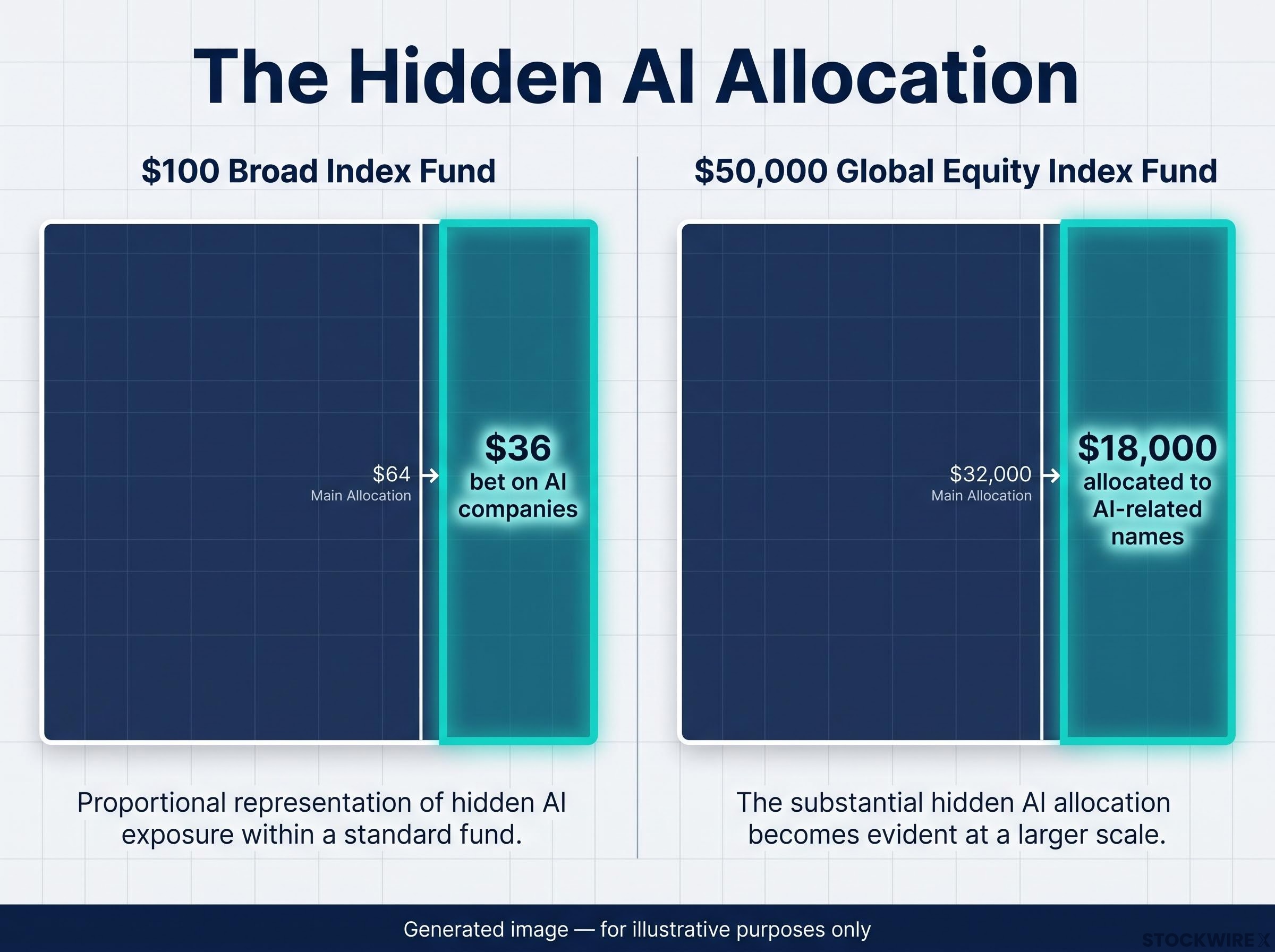
Translate the abstraction into your own money. If you hold $50,000 in a standard global equity index fund, roughly $18,000 of it is effectively allocated to AI-related names.
You did not choose that $18,000 allocation. It is not actively managed, it does not flex to your risk tolerance, and it pays no attention to your time horizon.
Put differently: for every $100 you hold in a broad index fund, about $36 is a bet on a handful of AI companies continuing to deliver. You may never have consciously placed that bet, but you are holding it all the same.
When big ASX news breaks, our subscribers know first
Six selloffs, six recoveries: the pattern that makes AI so hard to exit
Here is the record. Since August 2024, AI-linked equities have suffered six distinct selloffs, and every single one reversed.
| Date | Trigger | Recovery |
|---|---|---|
| August 2024 | Broad market volatility | Yes |
| January 2025 | DeepSeek disruption | Yes |
| November 2025 | Market pullback | Yes |
| February 2026 | The “AI Loser” trade | Yes |
| June 2026 | Valuation concerns | Yes |
| September 2026 | Safety concerns linked to Anthropic’s CEO | Yes |
Six different triggers, six recoveries. Betting against AI has, so far, been an expensive habit.
Analysts point to three mechanisms behind the speed of these rebounds. The first is fundamental: demand for AI compute, cloud services, and model-training infrastructure remains strong enough to support earnings forecasts, so investors treat dips as entry points rather than exits.
The second is positioning. Derivatives strategists at Goldman Sachs, JPMorgan, and Bank of America point to options positioning and dealer hedging that can amplify rebounds once markets stabilise, while trend-following and volatility-targeting funds pile back in as volatility fades. Because AI leaders dominate index weights, benchmark-sensitive managers become forced buyers on any stabilisation.
The third is scarcity. With few comparable quality-growth names available, capital keeps rotating back into the same AI leaders even after steep falls.
Now the other side. Strategists at Morgan Stanley and independent research houses warn that rapid V-shaped recoveries can be a symptom of bubble behaviour, driven by momentum and fear of missing out rather than fundamental resilience. On that reading, the recoveries mask fragility rather than proving strength.
Regulatory risk sits alongside earnings deceleration as a mechanism that could break the selloff-and-recovery pattern: BCA Research’s June 2026 report classified this risk as political rather than technological, projecting scenarios for aggressive bipartisan regulation by 2027 and tax hikes from 2029 if mass layoffs or AI-linked incidents mobilise voters.
The structural warning Charles Schwab cautioned on 10 August 2026 that an unexpected deceleration of AI-related capital spending could prevent the fast rebounds investors have come to expect, because the earnings shock would spread across the whole benchmark at once.
Here is the tension you need to sit with. Six recoveries tell you the market has consistently rewarded buying AI dips. They tell you nothing about whether the seventh selloff follows the same script. The two interpretations of this record point in opposite directions, and recent history alone cannot settle which one is right.
What Anthropic’s IPO and OpenAI’s valuation tell us about where the AI trade goes next
Two events are about to turn private AI valuations into public tests. Treat them as a referendum on whether the growth story has further to run, because the verdict is genuinely contested.
Anthropic confidentially submitted a draft Form S-1 registration statement to the SEC on 1 June 2026. As of late September 2026, no public S-1 had appeared on EDGAR, meaning no confirmed ticker, listing date, or deal terms are yet available. A Reuters report carried by CNBC on 5 September 2026 suggested marketing could begin in mid-October at the earliest, with the listing potentially landing days before the US midterm elections in November. A Wall Street Journal report referenced by Time on 22 September 2026 suggested the company was shifting staging to November to include third-quarter financials.
Whenever it lands, this will be the first time a frontier AI company is priced by public markets in real time. That reaction functions as a live stress test of the entire AI growth premium.
OpenAI tells a complementary story from the private side. Its completed March 2026 round raised $122 billion at an $852 billion valuation. The round now under discussion targets somewhere between $1.2 trillion (Bloomberg and the Financial Times) and $1.5 trillion (Forbes and the New York Times), a roughly 41% premium in about six months.
Even the professionals disagree Yahoo Finance noted on 16 September 2026 that Bloomberg and the FT cite around $1.2 trillion while the NYT mentions $1.5 trillion. When the smartest money cannot agree what the leading AI company is worth, the margin for error is doing the talking.
That jump from $852 billion to a $1.2-$1.5 trillion target is not just a bigger number. It tells you private investors are pricing continued AI dominance at a pace that leaves almost no room for earnings disappointment before a significant rerating becomes likely.
AI IPO valuation analysis from June 2026 found that only 39% of organisations deploying AI report measurable positive EBIT impact, creating a critical gap between the 88% adoption rate and actual earnings conversion that directly challenges the revenue assumptions embedded in both Anthropic’s and OpenAI’s private-market pricing.
PitchBook senior research analyst Harrison Rolfes has flagged the friction points public investors will have to price for Anthropic:
- Insufficient computing infrastructure
- Energy resource constraints
- Competitive pressure
- Safety-related concerns
SpaceX as a calibrating example: when IPO hype meets index reality
Before you assume a headline valuation reshapes your portfolio, look at SpaceX. According to Morningstar, it reached a market capitalisation of roughly $2 trillion after its IPO.
Yet as of 25 September 2026, SpaceX represented only about 0.12% of the Morningstar US Total Market Index, ranking as the 135th largest constituent. A limited free float, the proportion of shares actually available to public investors, kept its effective index weight small.
The lesson for Anthropic is a moderating one. The listing will generate enormous coverage, but its weight inside a diversified portfolio, and therefore its direct impact on your returns, may be far smaller than the headlines suggest.
How to think about your own AI exposure without overreacting in either direction
You now know the uncomfortable starting point: roughly 36% of your benchmark is already AI-linked before you make a single active decision. So the first question is not whether to own AI. It is how much AI you are holding on top of what the index already forces on you.
Run a three-step audit in one sitting:
- Check the AI weight baked into your existing index holdings, starting from that 36% benchmark figure
- Inventory any direct AI stock picks, sector ETFs, or active growth funds layered on top
- Assess factor overlap across all of it using four dimensions: growth, momentum, interest-rate duration, and R&D intensity
That third step is where most people get caught out. Research from BlackRock and Vanguard shows that AI-heavy leaders tend to share the same factor exposures: growth, momentum, high duration to interest rates, and high R&D intensity.
This matters more than it sounds. Owning five different AI stocks is not the same as holding five diversified positions. In a sustained selloff driven by rising interest rates or tighter regulation, all five can fall together for the same underlying reason.
Two failure modes sit on either side of a sensible position, and both are mistakes.
| Failure Mode | What It Looks Like | The Risk You Are Running |
|---|---|---|
| Overconcentration | Index funds plus direct AI stocks plus a tech ETF, all stacked, often without the investor noticing | A single theme driving most of your returns, with correlated positions that drop simultaneously in a downturn |
| Complete avoidance | Deliberately dodging AI names entirely, sitting in value or income strategies | Sacrificing six consecutive recovery-driven gains and lagging a cap-weighted benchmark you are measured against |
Schwab’s framing captures the trap neatly: plenty of investors believe they are diversified while their returns are effectively tied to one theme. And remember the asymmetry. As a passive index holder, you already carry the benchmark concentration whether you want it or not, so any AI-specific allocation layers risk on top rather than building it from scratch.
A precedent worth remembering During the dot-com period of 1999-2000, technology and telecom weights in US indexes surged, then delivered sharp drawdowns when earnings failed to justify the valuations. The Nifty Fifty of the late 1960s and Japan’s late-1980s concentration followed similar arcs. High index concentration in a perceived sure thing has precedent, and the precedent is not reassuring.
Dot-com era concentration peaked at roughly 27% for the top 10 S&P 500 names, a figure the current cycle has already surpassed by a wide margin, with the Shiller CAPE ratio at 40-41 placing today’s valuations among the three most extreme episodes in 155 years of market data.
The question AI stocks are really asking your portfolio
Three tensions run through everything above. Extraordinary AI returns, that 60%-plus index gain, sit against structural concentration risk captured by the 36% figure. A perfect six-for-six record of selloff-and-recovery sits against the open question of whether that pattern can hold. And Anthropic’s listing sits in front of you as the near-term test of whether public markets will ratify private valuations.
The useful move is to stop asking “should I own AI stocks?” You cannot answer that from outside your own portfolio. Ask instead: do I know how much AI exposure I actually hold, and does it match my risk tolerance? That one you can answer today.
Three variables will shape the case through the rest of 2026 and into 2027:
- How public markets receive the Anthropic IPO
- Whether OpenAI completes its next private round and how it eventually reaches liquidity
- Whether AI-related capital spending holds at current levels or decelerates in the way Schwab flagged
The exposure is already in your portfolio, chosen or not. These three events will determine whether that implicit bet pays off or forces a reassessment.
This article is for informational purposes only and should not be considered financial advice. Investors should conduct their own research and consult with financial professionals before making investment decisions. Past performance does not guarantee future results, and financial projections are subject to market conditions and various risk factors.