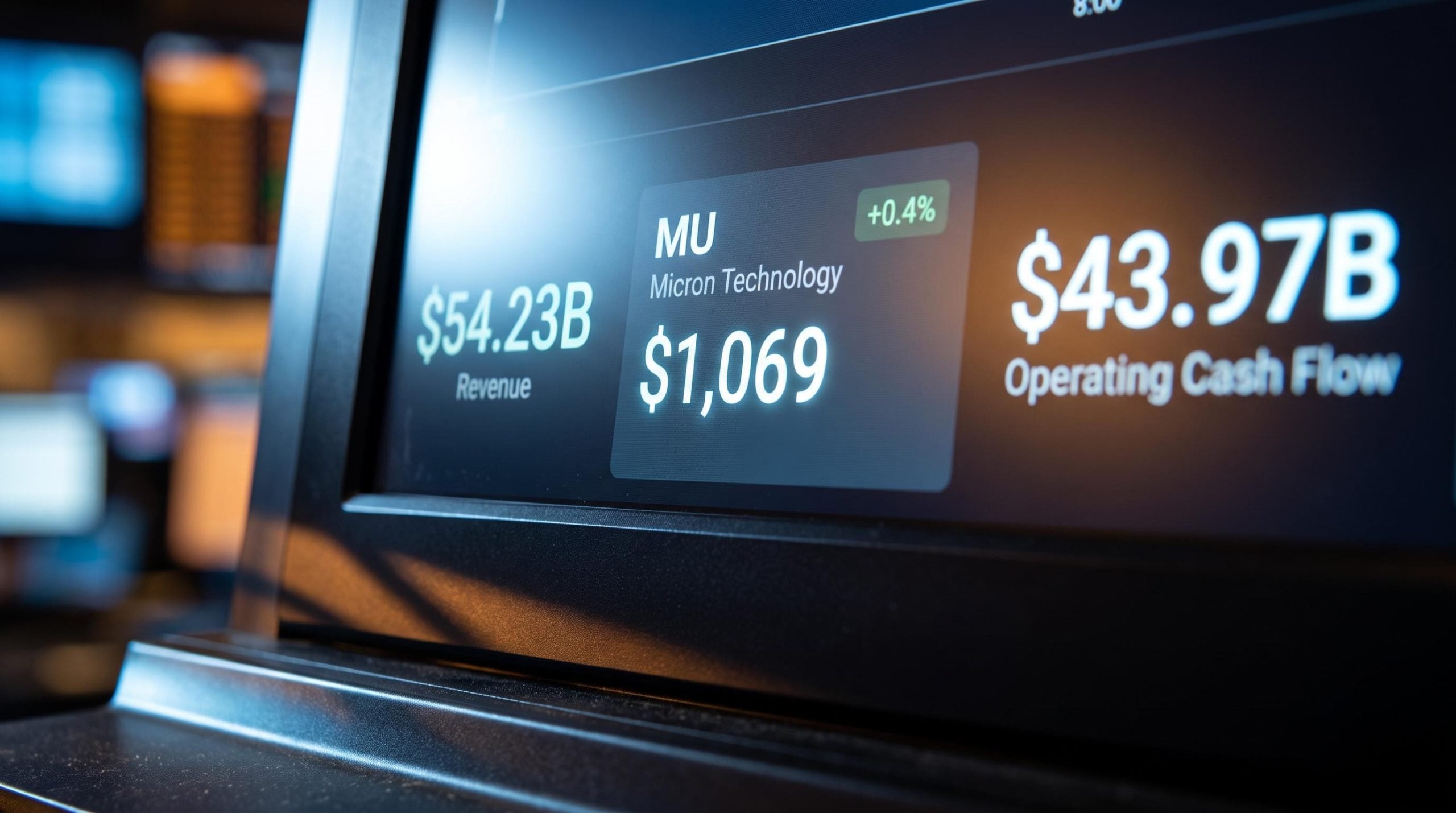
Micron Technology just delivered one of the most emphatic quarterly beats the semiconductor industry has on record, with revenue up more than 350% year-over-year and forward guidance that cleared every number the Street had modelled. The stock barely moved.
That tension is the whole story. When a company posts a result this strong and the shares respond with a shrug, the interesting question stops being “how good was the quarter” and becomes “why didn’t it matter more.”
Here is the context that makes the non-reaction rational rather than strange. Micron had already tripled in 2026, every major sell-side firm had pre-modelled a beat-and-raise, and the options market had priced a contained post-earnings move before a single figure was published. When all of that is true, an earnings report stops being a catalyst and becomes a confirmation.
This is a practical framework for reading earnings reactions in high-momentum stocks, built around Micron’s fiscal Q4 2026 print as the live case. By the time you finish, you will have a mental model you can apply to the next semiconductor earnings cycle, not just a recap of what Micron reported.
A beat that rewrote the record books, in numbers
Start with the scale, because the scale is the setup for everything that follows.
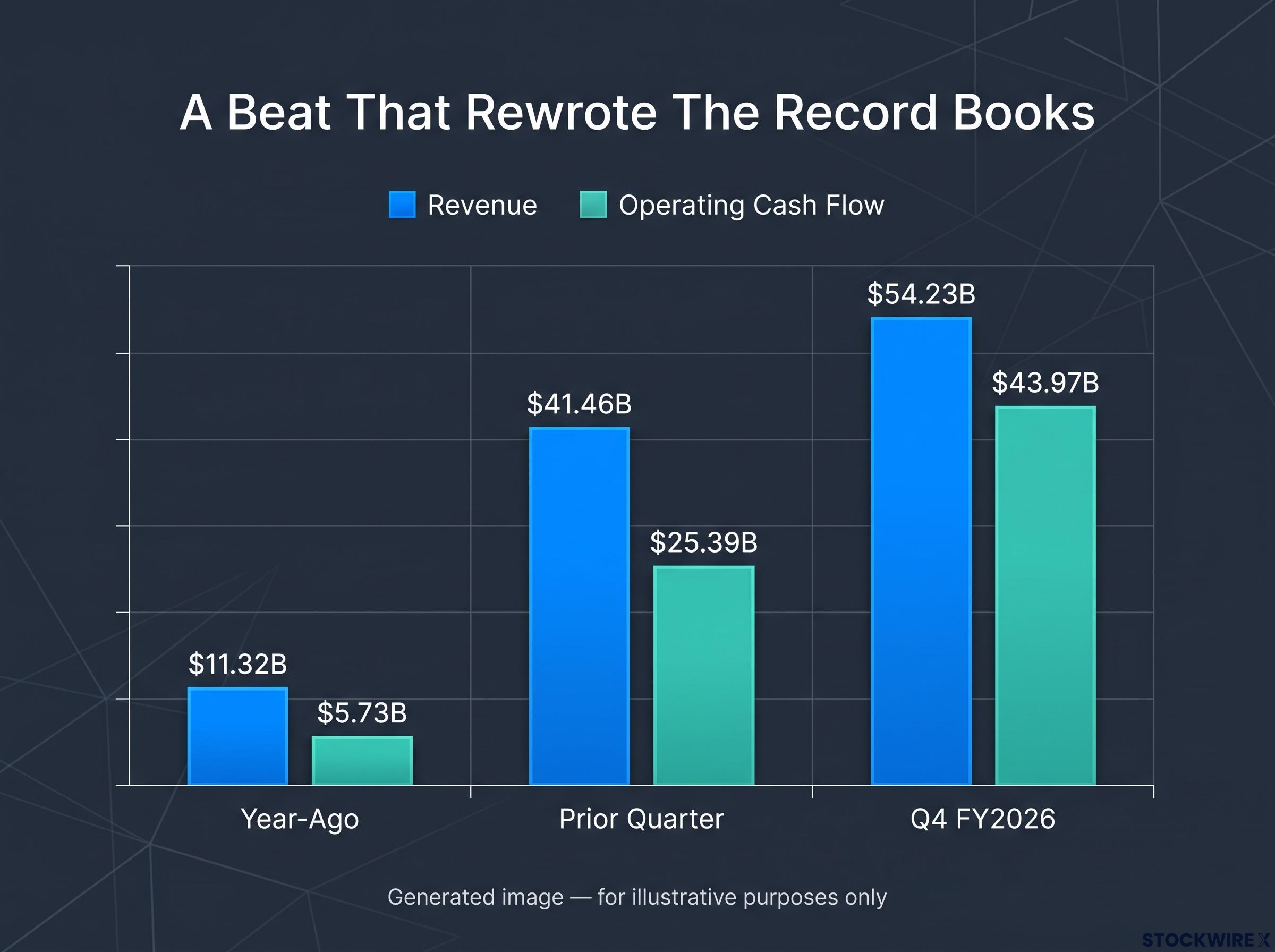
Micron reported fiscal Q4 2026 revenue of $54.23 billion for the quarter ended 3 September 2026. That is up from $41.46 billion in the prior quarter and $11.32 billion in the year-ago period. The sequential jump alone is the kind of move most large-cap companies do not produce in a decade.
Non-GAAP earnings came in at $33.42 per share, against a consensus of roughly $31.80. That is a beat of approximately 5%. On a GAAP basis, diluted EPS was $32.87 and net income reached $37.70 billion.
The cash generation is arguably the most telling figure in the release. Operating cash flow hit $43.97 billion, up from $25.39 billion the prior quarter and $5.73 billion a year earlier.
| Metric | Q4 FY2026 Actual | Q4 FY2026 Consensus | Prior Quarter |
|---|---|---|---|
| Revenue | $54.23B | ~$51.51B | $41.46B |
| Non-GAAP EPS | $33.42 | ~$31.80 | n/a |
| Operating cash flow | $43.97B | n/a | $25.39B |
On a headline basis, non-GAAP EPS grew more than 1,000% year-over-year. That number flatters the quarter, because the year-ago period sat at a cyclical trough, so treat the comparison as a reminder of where the business came from rather than a clean growth rate.
The element that carried the most weight was the forward guidance.
Q1 FY2027 guidance Revenue: $60 billion to $63 billion Adjusted EPS: $37.15 to $39.15 (midpoint approximately $38.15)
That guidance implies continued acceleration, not a plateau. Hold onto just how strong all of this is, because what the stock did next is where the analytical puzzle begins.
When big ASX news breaks, our subscribers know first
Why the stock barely moved after a record quarter
With numbers like those, you would expect the shares to spike. They did not.
Micron closed near $1,065 on 30 September 2026, then traded in a narrow after-hours band: dipping to roughly $1,040, reaching a high near $1,078, and settling around $1,069, up about 0.4%. Reporting across outlets variously described the move as “little changed,” “risen modestly,” or even slipping despite the beat.
A record quarter produced a flat tape. That is not an anomaly. It is the predictable outcome when expectations have already run ahead of results, and five mechanisms explain why.
The expectations gap is the core mechanism here: stock prices respond to the difference between results and prior consensus, not to whether earnings are objectively strong, which is why a 27.1% blended EPS growth quarter in Q1 2026 still produced frequent negative post-earnings reactions across the index.
The five mechanisms behind the muted reaction
- Elevated expectations. Koyfin-based consensus data showed Wall Street forecasts sitting above Micron’s own guidance midpoints before the print. When a beat is already the base case, the actual beat produces confirmation rather than repricing. The result was priced before it arrived.
- Valuation saturation. Micron had risen roughly 237-275% year-to-date, a figure broadly characterised as having “more than tripled in 2026” (sources differ on the precise percentage). After a move of that magnitude, a strong quarter tends to produce consolidation, not another vertical leg. The debate had already shifted from whether the cycle exists to how much of it was priced.
- Options pricing. The options market’s implied expected move heading into the print was approximately $75. The actual swing fit comfortably inside that band, which means traders had already calibrated for a contained reaction and got exactly that.
- Historical pattern. Micron’s stock finished lower one week after earnings in five of the previous eight reporting periods, by roughly 2-2.1%. Even clean prints have a statistically mixed short-term track record, so caution about chasing the stock was itself a learned behaviour.
- Supercycle narrative absorption. When investors already label a company a memory-supercycle beneficiary, incremental good news reads as confirmation of a thesis already in the price, not a fresh reason to re-rate.
JPMorgan captured the setup neatly in its pre-earnings note, describing Micron as “positioned for beat-and-raise.” When the beat-and-raise is the consensus across buy-side and sell-side models alike, the outcome has little incremental surprise left to deliver.
That contained reaction stands in sharp contrast to the prior guidance surprise in June 2026, when Micron’s $50 billion Q4 guidance landed nearly $7 billion above the Wall Street consensus and produced an immediate 12% after-hours surge, illustrating how much the magnitude of the expectation gap shapes the market’s response.
What this tells you is that the flat reaction was not a failure of the quarter. It was a rational response to a situation where expectations had already done the repricing work before the report ever landed. The quarter was the evidence; the stock had already reached its verdict.
NBER research on analyst expectations and stock returns establishes that when optimistic analyst forecasts are already embedded in a stock’s price, the confirmation of those forecasts produces minimal incremental repricing, precisely the dynamic Micron’s flat tape illustrated.
What the analyst community actually disagrees about
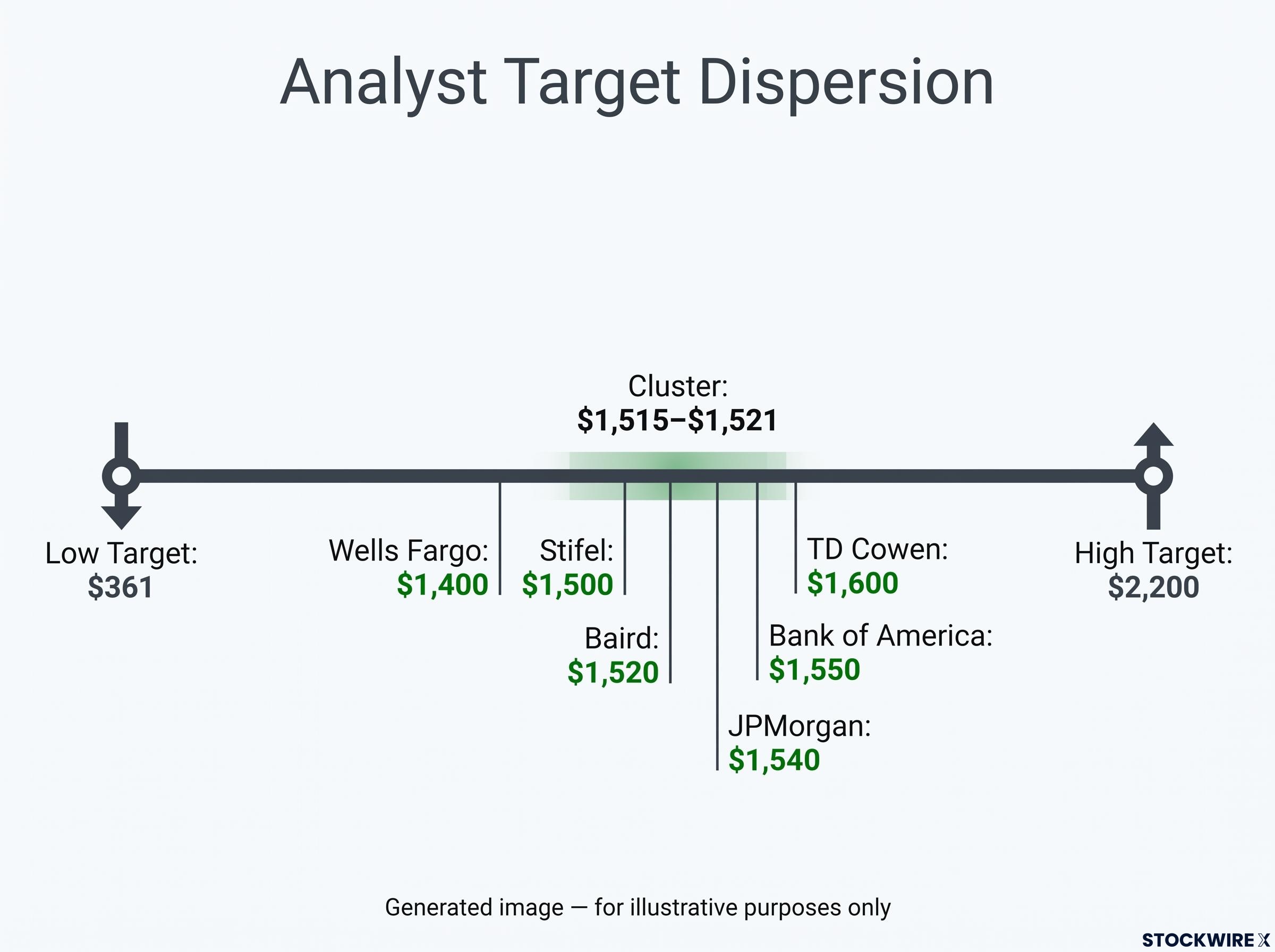
If the professionals all agreed, the target dispersion would be narrow. It is not. Across 40-plus analysts, 12-month targets clustered around $1,515-$1,521, but the range ran from a low near $361 to a high near $2,200.
That spread tells you the disagreement is real. The fault line is not whether AI drives Micron’s growth. It is how long elevated demand and pricing can last before normalisation, and how aggressively capacity expansion might compress margins later in the cycle. Three camps have reached different conclusions for different reasons.
The first camp sees a durable AI memory supercycle. Baird raised its target to $1,520 from $1,280, TD Cowen held a $1,600 Buy, and JPMorgan lifted its target to $1,540 from $550. Their thesis is that agentic AI demand, data-centre build-outs, and PC and server refresh cycles sustain elevated bit demand and pricing for several more years.
Baird attributed its target hike directly to a “surge in agentic AI demand” for Micron’s memory products.
The structural compounder re-rating argument gained its most visible expression when UBS tripled its price target to $1,625 in May 2026, explicitly rejecting the trough-adjusted commodity multiple that had historically governed Micron’s valuation in favour of a framework anchored to long-term supply agreements and agentic AI demand.
The second camp is bullish but cycle-aware. Bank of America reiterated Buy at $1,550, Stifel maintained Buy at $1,500, and Wells Fargo trimmed its target to $1,400 while keeping Overweight. These analysts stress execution, near-term shipment constraints, and structured supply agreements as the variables that determine whether the supercycle thesis actually holds.
The third camp is more sensitive to valuation and macro risk. It is best read through the dispersion itself: Wells Fargo cutting its target in the same window that Baird raised its own by $240 shows that even bulls disagree substantially on how to price cycle risk.
| Firm | Rating | Price Target | Core Thesis |
|---|---|---|---|
| Baird | Outperform | $1,520 | Surge in agentic AI demand |
| TD Cowen | Buy | $1,600 | Mid-cycle in demand growth |
| JPMorgan | Overweight | $1,540 | Positioned for beat-and-raise |
| Bank of America | Buy | $1,550 | Sustained AI-driven demand |
| Stifel | Buy | $1,500 | Supply support amid shipment constraints |
| Wells Fargo | Overweight | $1,400 | Strong fundamentals, cautious on valuation |
Note that confirmed post-earnings target revisions had not been widely reported as of early October 2026, so these figures reflect positioning entering the print. The takeaway for you is that the consensus average is the least useful number here. The central question about Micron is not whether to own it but what the correct duration of this cycle is, and that question has no consensus answer.
Reading Micron’s earnings reaction as a framework, not a one-off
The value in all this is not the Micron verdict. It is the method, which transfers to any high-momentum earnings event where the market’s reaction defies the headline.
Before the next one, run three checks.
- Where do consensus expectations sit relative to the company’s own guidance? If the Street is already above management’s midpoints, a beat is the base case, and a beat that was expected moves nothing.
- How much of the cycle is already priced into the stock? A name that has tripled has absorbed most of the near-term bull case. The move you are underwriting is the increment beyond what is already in the price, not the headline growth.
- What is the options market’s implied move versus historical post-earnings swings? Micron’s implied move of roughly $75 told you the range the market expected. When the actual move lands inside that band, the market got what it priced, and there is no surprise to trade.
Micron’s own history makes the stakes concrete. Following a prior earnings-cycle all-time high, the stock declined approximately 37% over the subsequent weeks. A great quarter does not automatically mean a great entry.
Practitioners framed entry conditions in exactly those terms after this print, flagging support levels of $110 and $115 contingent on buyers stepping in, with roughly $125 below prevailing levels treated as a threshold beyond which buyer support was considered less likely.
Key risks that could alter the trajectory before Q1 FY2027
- Geopolitical exposure. Taiwan-related tensions remain a live risk for the semiconductor supply chain, and no quarter insulates Micron from a policy or supply shock.
- Cyclical normalisation. Memory is a cyclical business. The roughly 37% post-peak decline after a prior high is concrete evidence that boom pricing can reverse, not theoretical caution.
- Shipment constraints. Stifel flagged that supply agreements provide revenue support even amid near-term shipment constraints, meaning logistics and customer timing could temper reported growth.
- Valuation dispersion. Targets ranging from $361 to $2,200 signal genuine disagreement on sustainable earnings power across the cycle.
- Macro and capex sensitivity. If AI-related capex or data-centre build-outs decelerate, margins could normalise faster than the most bullish targets imply.
The clean forward anchor is the Q1 FY2027 guidance: $60-63 billion in revenue and an adjusted EPS midpoint near $38.15. Whether that demand rate holds is the variable that decides which camp is right.
What a record quarter without a rally actually tells you about where Micron stands
The muted reaction is a signal, not a non-event. Markets are no longer debating whether Micron can execute. They are debating how long the execution window stays open and at what margins, and that is a harder, slower question to price.
The market’s attention has shifted from whether Micron can deliver to how long it can sustain delivery.
The near-term test is specific. If Micron hits or exceeds its $60-63 billion Q1 FY2027 revenue guidance, the supercycle camp gains another data point. If demand softens or shipment constraints bite, the cycle-aware camp gets its evidence.
The memory supercycle structure underpinning analyst optimism differs materially from prior DRAM upcycles, with SK Hynix and peers shifting to foundry-style multi-year supply agreements extending through 2028-2030, a regime change that converts volatile spot revenue into visible cash flows and gives the ‘durable AI supercycle’ camp its strongest analytical foundation.
Consensus targets sit around $1,515-$1,521, but the dispersion matters more than the average, and the average hides the actual disagreement.
Here is the clean read. A stock that has tripled in a year and barely moves on a record beat is not broken. It is a stock where the next catalyst has to come from either a fundamental surprise that exceeds already-elevated expectations, or a broader re-rating of the sector. Both are possible. Neither is guaranteed.
This article is for informational purposes only and should not be considered financial advice. Investors should conduct their own research and consult with financial professionals before making investment decisions. Past performance does not guarantee future results, and financial projections are subject to market conditions and various risk factors.