Buying the seven biggest technology names has been the default way to play artificial intelligence for the past two years. Through most of 2026, that trade has quietly stopped working.
The market has moved on. Capital is rotating away from the front-end platforms that dominated headlines and flowing instead into the physical machinery that keeps AI running: the fibre, the power generation, the substations, and the secondary sectors feeding the build-out.
This matters because the assumption underpinning most AI portfolios, that the biggest names carry the least risk and the most upside, no longer holds. A basket of mega-caps that once moved as a single unit is now splitting apart, rewarding some names and punishing others.
This explainer gives you a working framework for reading where the next wave of capital is heading. It covers why the monolithic tech trade has broken, where corporate money is being deployed right now, the physical constraints that could stall the whole theme, and how to build an AI investment strategy that reaches beyond the obvious software winners into the sectors quietly capturing the value.
The end of the monolithic mega-cap trade
For a while, the so-called Magnificent Seven behaved like one stock. Sentiment lifted them together and sold them off together, with little regard for what any individual company actually earned.
That has changed. Individual AI-related names are now trading on their own merits, differentiated by realised cash flows and the capital intensity of their businesses rather than a single collective narrative.
The Magnificent Seven underperformance through mid-2026 was not simply a rotation story; Deutsche Bank identified four simultaneous structural headwinds including extreme crowded positioning, a shift to a ‘show me’ credibility test on capex, a more hawkish Fed compressing growth multiples, and rising chip costs squeezing platform margins.
The clearest evidence sits in the index data. The equal-weight S&P 500 has outperformed the standard cap-weighted S&P 500 in 2026, rising more than 13% against a 8.5% gain for the cap-weighted version, according to Reuters. That gap of over 4.5 percentage points tells you leadership has broadened well beyond the largest names.
The mega-cap basket itself has lagged. The MAGS ETF, an equal-weighted proxy for the Magnificent Seven, returned roughly 8.43% year-to-date as of 29 September 2026, while the broader S&P 500 returned 13.15% over the same window, per PortfolioLab data.
| Benchmark | 2026 YTD return | What it tracks |
|---|---|---|
| Equal-weight S&P 500 | 13%+ | All 500 names weighted equally |
| Cap-weighted S&P 500 | 8.5% | Weighted toward the largest companies |
| MAGS ETF | 8.43% | Equal-weighted Magnificent Seven proxy |
The dispersion within the group is just as telling. Apple gained roughly 25% year-to-date through late September 2026, while Tesla fell more than 15% over the same stretch, according to State Street Global Advisors, whose commentary described the group as “no longer moving as one trade.”
What this means for you is direct: blindly buying a basket of mega-cap tech no longer guarantees you outperformance. Your portfolio now has to answer to a market that demands proof of earnings and a defensible competitive edge, not just exposure to a theme.
The shift from narrative to earnings
The market is now sorting winners from losers on realised results. Companies delivering strong cash flows and defensible moats are being rewarded, while those facing slowing growth or margin pressure are being marked down regardless of their AI association.
There are two ways to read this. One is healthy price discovery, where the market finally differentiates based on earnings and capital requirements. The other is speculative excess unwinding, as prior enthusiasm gets tested against the reality that AI build-out is a long, capital-hungry undertaking. Either way, the passive index-heavy approach that worked in 2024 now carries structural risk it did not before.
When big ASX news breaks, our subscribers know first
The physical infrastructure funding the next phase
The AI story is often told in software terms. The money, increasingly, is being spent on concrete, copper, fibre, and fuel cells.
The rotation makes sense once you follow the capital. Front-end platforms are still fighting over consumers, but the companies building the plumbing for global data centres are locking in guaranteed revenue no matter which app ultimately wins.
The AI infrastructure investment case is reinforced by the unit economics of frontier model developers: OpenAI reported $13.07 billion in 2025 revenue against a $20.92 billion operating loss, a gap that clarifies why capital is migrating toward the physical layer where revenue is contractually locked rather than contested.
Megaport, an ASX-listed provider of networking, storage, and GPU services to data centres, offers a clean example. The company announced three AI-related contracts collectively worth $1 billion, and the revised numbers moved sharply.
- Total contract value across the three deals: $1 billion
- Upfront payment component to fund the build-out: over $320 million
- Revised FY2027 revenue guidance: $800 million, up from a prior $690 million
- Existing computing annualised recurring revenue: roughly $200 million per year
Megaport shares rose between 9% and 12% during the local session following the announcement, according to the company’s own disclosure.
Power generation tells a similar story. Bloom Energy, which supplies on-site electricity generation directly at customer locations, closed near $291.25 on 29 September 2026, up approximately 235% year-to-date, per Morningstar and StockAnalysis.com data. Data centre power demand is the primary driver, and demand has held firm even as some individual projects are paused.
Infrastructure enablers capture durable economic value while platforms fight for initial dominance. The company laying the fibre and generating the power gets paid regardless of which software wins the consumer battle.
What this shows you is where the most reliable growth currently sits: in the picks and shovels of the digital economy. It gives you a way to participate in the theme without staking your outcome on a single software winner.
Physical limits and grid vulnerabilities
The infrastructure trade has an obvious appeal. It also has a hard ceiling that most headline-chasing participants are ignoring: there may not be enough power.
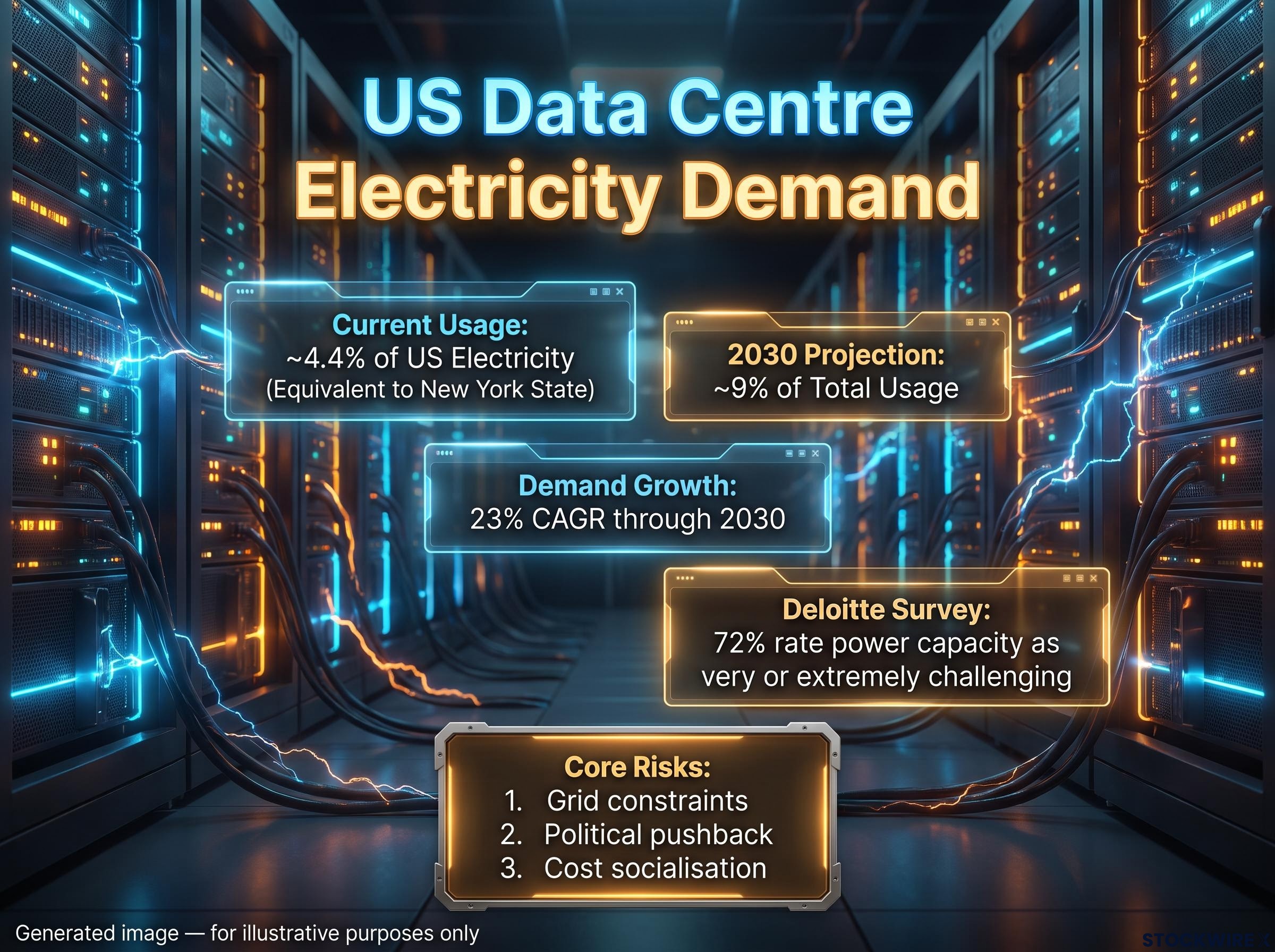
The scale of the problem is becoming clear. US data centre electricity demand is projected to nearly double to around 9% of total national usage by 2030, up from roughly 5% today, according to Allianz Research.
That is not a distant abstraction. Existing data centres already consume approximately 4.4% of US electricity, equivalent to the entire usage of New York State, according to McKinsey and GARP analysis.
The people building this infrastructure know it. In a Deloitte survey, 72% of respondents rated power and grid capacity as very or extremely challenging for AI data centre development.
The power grid bottleneck
The technical risks are specific. Concentrated, power-electronics-based loads from AI campuses can threaten grid stability and power quality, including sensitivity to voltage sags, dips, and frequency deviations, according to technical research cited by UN News, which warned of voltage oscillations and cascading failures when infrastructure cannot keep pace.
The DOE resource adequacy guidance frames the federal response to grid strain from large-scale electricity consumers, including the Speed to Power Initiative, which is designed to accelerate grid interconnection and ensure reliability as data centre campuses come online at scale.
There is a political dimension too. As large AI campuses drive up capacity-market prices, those costs get socialised across all ratepayers, and household electricity bills face upward pressure. The Belfer Center and ITIF both flag this as a source of local opposition and tighter regulation.
The core risks for anyone holding data centre exposure break down into three:
- Grid constraints: insufficient generation and transmission capacity to power new campuses on schedule.
- Political pushback: community resistance over land use, water stress, and rising energy bills.
- Cost socialisation: the risk of regulatory intervention as ratepayers absorb the cost of AI-driven demand.
What you must factor in is that a company’s growth story is only as good as its access to power. If the underlying grid cannot secure the electricity, your investment could stall regardless of how strong the demand looks on paper.
Finding value beyond traditional technology sectors
The obvious response to power constraints is to worry. The smarter response is to notice who profits from solving them.
The bottleneck creates the opportunity. As AI data centres scale, the primary indirect beneficiaries are increasingly found outside pure technology: in utilities, industrials, energy, and specialised real estate.
US data centre electricity demand could grow at an estimated 23% compound annual rate through 2030, according to McKinsey and GARP data. That level of growth positions regulated utilities and independent power producers as direct beneficiaries, not bystanders.
The scale of current AI capital deployment contextualises why regulated utilities and independent power producers are being repriced: US IT hardware and software spending reached 4.9% of GDP in Q1 2026, surpassing both the dot-com era peak and the cloud buildout peak, and the majority of that capital is flowing into physical infrastructure rather than software licensing.
The line between traditional power and digital infrastructure is blurring fast. Allianz and Lawrence Berkeley National Laboratory point to demand for substations, controls, storage, and campus-level energy management tightly coupled to data centres, turning grid equipment makers into growth assets. Firm low-carbon generation, including nuclear, hydro, and gas, is being pulled into the same story to maintain reliability.
The software sector recovery
Software has had a rougher ride. Software-as-a-service names suffered drawdowns of 30% to 40% during a stretch dubbed the “SaaS apocalypse,” as markets feared AI would erode their business models.
Since then, the sector has staged a selective partial recovery. Markets are now repricing realistic productivity benefits rather than assuming blanket destruction, rewarding companies with proven spillovers in areas such as healthcare and consumer goods. Sectors including healthcare, consumer, and communications are viewed as potential beneficiaries of AI productivity gains, though their share prices have not yet fully reflected that upside.
What this maps out for you is where the crowd has not yet arrived. Your most rewarding opportunities may now sit in previously overlooked sectors like utilities and grid equipment, which means looking beyond a standard tech allocation to capture the full theme.
Positioning your portfolio for the infrastructure era
The investment landscape has fragmented into distinct tiers, and that fragmentation looks structural rather than temporary. You now have platforms fighting for dominance, enablers building the physical plumbing, and traditional sectors being pulled into the growth story.
When you evaluate new opportunities in this environment, three criteria matter most: realised cash flow over narrative, a defensible physical or infrastructure moat, and a valuation that leaves room for error.
History offers a useful guide here. The late-1990s internet build-out saw front-end platform valuations overshoot while backbone and infrastructure providers ultimately captured a large share of durable long-run economic value. The same pattern may be forming now, with the enablers quietly compounding while the platforms fight it out.
For readers wanting to map these tiers to a concrete allocation framework, our dedicated guide to picking the right AI layer covers all six segments of the AI value chain, including semiconductors, cybersecurity, and energy, with guidance on which layers carry early-mover pricing and which still offer reasonable entry points.
This article is for informational purposes only and should not be considered financial advice. Investors should conduct their own research and consult with financial professionals before making investment decisions. Past performance does not guarantee future results. Financial projections are subject to market conditions and various risk factors.