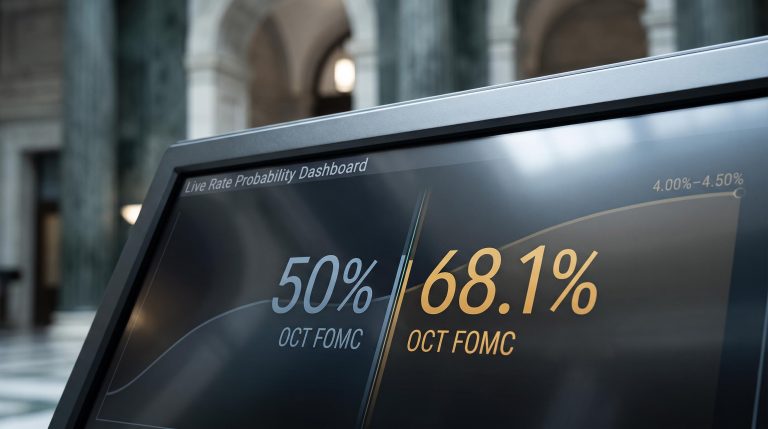
Equity markets have spent much of this year celebrating fresh records, and the mood among stock investors reads as confident. The trouble is that the bond market is telling a completely different story.
Long-end government bond yields across the US and Australia have climbed to levels not seen in nearly two decades, in some cases echoing peaks last recorded before the Global Financial Crisis. The bond yields equity impact question is no longer academic: fixed income is flashing warning signals that the stock market appears to be shrugging off.
That divergence is arriving at an awkward moment. In the US, consumer confidence has collapsed to its lowest reading since 2014, while Australian underlying inflation remains stubbornly above target. Borrowing costs are rising just as the economic foundation beneath them shows cracks.
This piece lays out a framework for reading what fixed income is signalling, why equities have so far ignored it, and how to stress-test your own exposures before the two markets are forced to reconcile.
The collision of multi-decade yields and macro fragility
The numbers on the screen right now are the kind that make experienced fixed-income traders sit up. As of late September 2026, the US 10-year Treasury yield is trading in the 5.21-5.24% range, its highest level since 2007. The US 30-year yield has pushed toward 5.6%, the highest since 2002 on an intraday basis, and Australia’s 10-year government bond yield sits at 5.38%, a level unseen since the Global Financial Crisis.
| Yield Type | Current Yield (Late Sept 2026) | Historical Context |
|---|---|---|
| US 10-year Treasury | 5.21-5.24% | Highest since 2007 |
| US 30-year Treasury | Near 5.6% | Highest since 2002 (intraday); 2004 on a closing basis |
| Australian 10-year | 5.38% | Echoes GFC-era peaks |
These are not marginal moves. They represent a wholesale repricing of the cost of money across the developed world.
What makes this repricing dangerous is what is happening alongside it. The Conference Board’s US consumer confidence index has fallen to 81.9 in September 2026, its lowest reading since 2014 and well below the roughly 89 that had been expected. The University of Michigan’s sentiment gauge slid to 48.1 over the same period, weighed down by anxiety over prices and jobs.
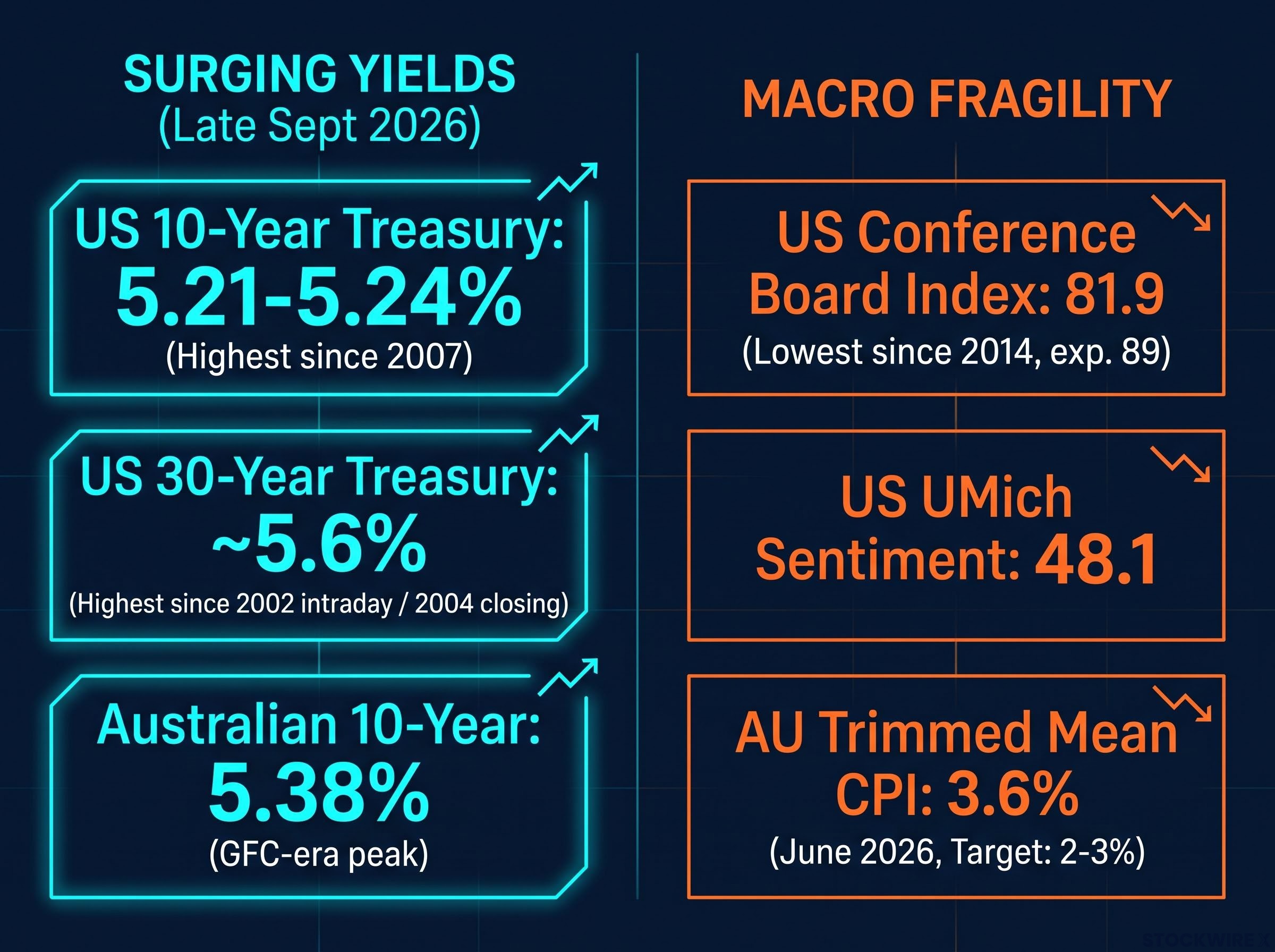
Across the Pacific, the picture is different but no less awkward for policymakers. Australia’s trimmed mean CPI, the Reserve Bank’s preferred measure of underlying inflation, registered 3.6% year-on-year in the June 2026 quarter, unchanged from the prior reading and still above the midpoint of the 2-3% target band.
The ABS trimmed mean CPI data for mid-2026 confirms that underlying inflation has not retreated meaningfully toward the RBA’s target midpoint, a persistence that has kept the Bank’s policy options constrained even as global growth signals deteriorate.
Put those two dynamics side by side and the tension becomes obvious. Borrowing costs are climbing to multi-decade highs at the very moment consumers are pulling back and inflation is refusing to fully cooperate.
For your portfolio, that combination matters more than any single headline index level. Rising financing costs squeeze corporate margins from one side while weakening demand erodes revenue from the other. Corporate earnings are set to face pressure from both directions, which means the true risk sits beneath the surface of the equity benchmarks, not in the reassuring numbers on the front page.
When big ASX news breaks, our subscribers know first
The mechanics of the bond market warning
To understand why bond traders are nervous on behalf of equity holders, you need to understand a single idea: the discount rate. Every stock is worth the present value of its future cash flows, and those future cash flows are discounted back to today using a rate anchored on the risk-free government bond yield. When that yield rises, the present value of tomorrow’s profits falls. The maths is unforgiving.
Through the low-rate 2010s, nominal yields sat near the floor and real yields (the yield after subtracting inflation) were often close to zero. Today the world looks radically different, with nominal yields in the 4-5% range and real yields around 2%. That shift alone reprices what every future dollar of earnings is worth.
According to strategy commentary from major asset managers including BlackRock and Vanguard, three specific levers are doing the damage:
- Term premium expansion: After a decade of suppressed term premium, investors now demand far more compensation for holding long-dated sovereign debt. That pushes long-end yields higher even when central banks leave policy rates unchanged.
- Real yield increases: Inflation-adjusted yields have risen sharply versus the 2010s, lifting the real discount rate applied to distant cash flows and hitting long-duration growth stocks hardest.
- Equity risk premium compression: The spread between the earnings yield on stocks and real bond yields has narrowed to historically tight levels.
Term premium expansion is doing the heaviest lifting in the current repricing: the ACM model estimates the US 10-year term premium at 70-80 basis points in mid-to-late 2026, a structural swing of roughly 220-230 basis points from its negative reading in March 2020, confirming a complete regime reversal in how investors price long-duration sovereign risk.
That last lever is the one that should give every equity holder pause. The equity risk premium is the extra return you demand for accepting the volatility of shares rather than parking money in a guaranteed government bond. When it compresses, you are no longer being adequately paid for that risk, which forces a hard question about what you are genuinely willing to pay for future growth.
Duration risk brings the theory into painful focus. Holders of long-dated government bonds have suffered severe mark-to-market losses as yields climbed, even though the credit risk on those bonds is minimal. If the supposedly safe asset can inflict losses like that, long-duration growth stocks and heavily levered sectors, both of which lean on cheap discount rates, are exposed to the same mathematical repricing.
Duration risk translates abstract yield moves into concrete portfolio losses: a bond fund carrying a duration of 17, comparable to long-dated Treasuries, loses approximately 85,000 dollars on a 500,000-dollar holding from a single one-percentage-point rate rise, compared to 30,000 dollars for a duration-6 fund carrying the same ‘bond fund’ label.
Why equity markets are ignoring the fixed-income signal
Here is the paradox at the heart of this market. Bond investors are pricing a world of persistently higher inflation and elevated policy rates, while equity investors keep paying up for optimistic growth as though the discount rate barely moved. Both cannot be right forever.
Several large investment-bank strategy desks have characterised a notable disconnect: fixed income is pricing a regime of structurally higher rates and inflation, while equities continue to price a benign, growth-friendly outcome with limited valuation pressure. The gap shows up most clearly in equity risk premia that many strategists judge too tight for the macro uncertainty on offer.
The stock market has not crashed, and there are genuine reasons why. Understanding them is what separates a considered position from blind faith.
The bullish case for nominal growth
The most credible bullish argument is that equities can absorb higher yields if earnings hold up. In this reading, elevated yields simply reflect stronger nominal GDP, and companies with pricing power can pass through higher costs and wages, keeping valuations aloft.
There is also evidence of selective rotation already underway. Investors have leaned toward quality balance sheets, strong free-cash-flow generators, and sectors that benefit from higher nominal growth such as certain industrials, energy, and financials. A third argument holds that the brutal move from near-zero to mid-single-digit yields has already happened, so future rate moves may be smaller and less disruptive than the initial jump.
The catch is that equity investors frequently fixate on earnings momentum while treating discount-rate shifts as background noise. That focus works right up until it does not.
The hidden toll of refinancing cycles
Beneath the index-level calm sits a slower-moving threat. As higher yields and wider credit spreads persist, leveraged corporates face rising coupons every time existing debt rolls over. That resets financing costs higher, pressures margins, and can force deleveraging or dilutive equity issuance.
The most acute vulnerability sits in lower-rated credit, real estate, and rate-sensitive infrastructure, along with private-market vehicles built on cheap funding. If defaults rise or appetite for financially engineered equity stories fades, the strain spills over from private markets into listed equities.
The read you should take from this is uncomfortable but clear. The market’s resilience is essentially a heavy bet on a soft landing, and that bet leaves almost no margin of safety if rates stay elevated for longer than the consensus currently assumes.
Navigating a structural regime change versus a cyclical peak
The most important debate for your positioning is not whether yields matter. It is whether today’s levels represent a permanent reset or a temporary overshoot. Analysts split into two sharply different camps, and each demands a different portfolio.
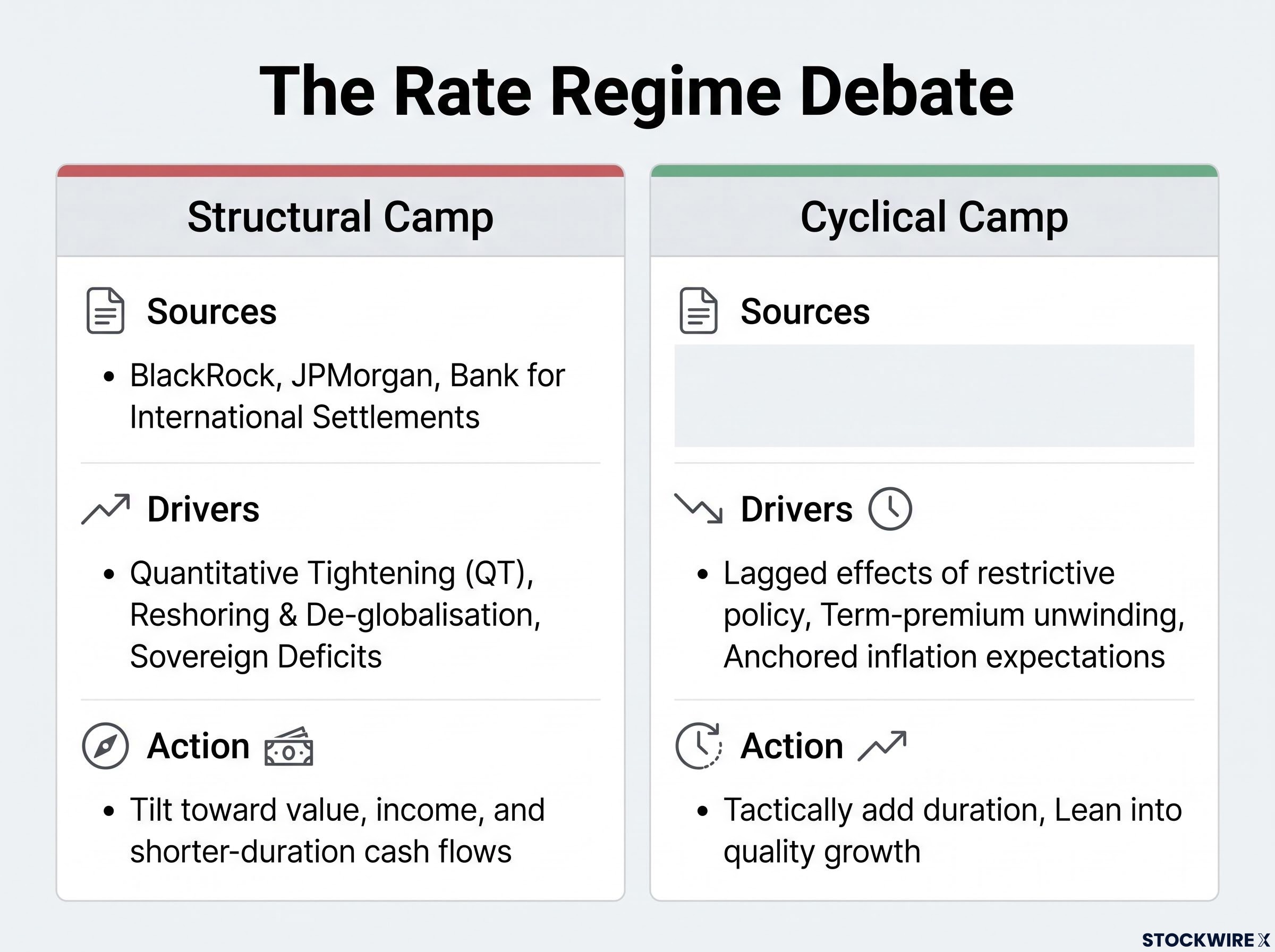
The structural camp, drawing on research from houses including BlackRock, JPMorgan, and the Bank for International Settlements, argues that elevated long-end yields are here to stay. Their case rests on quantitative tightening (QT), which removes central banks as a key buyer of long-dated bonds; reshoring and de-globalisation, which raise structural inflation; and swelling sovereign deficits that require relentless issuance. If they are right, equities must permanently re-rate lower, and the sensible response is a durable tilt toward value, income, and shorter-duration cash flows.
The structural camp’s thesis gains force from historical pattern analysis: 150 years of inflation cycle data shows that inflation moves in sustained generational regimes rather than mean-reverting cycles, and if that pattern holds, the current structural inflation regime could persist for approximately two decades, a timeline that makes the cyclical-overshoot reading look like the more comfortable but less defensible assumption.
The cyclical camp sees an overshoot. In their view, the lagged effects of restrictive policy will eventually slow growth and inflation, term-premium exaggeration driven by positioning and fiscal headlines will unwind, and anchored inflation expectations will pull yields back down. If they are right, the smart move is to tactically add duration and lean into quality growth ahead of a rate-relief rally.
The honest answer is that the market itself cannot decide. That uncertainty is precisely why you should audit your portfolio to survive either outcome rather than betting the house on one.
Lessons from previous rate shocks
History offers three clear reference points, and the lessons are consistent across all of them.
- The 1994 bond shock: A sharp, unexpected Fed tightening triggered a violent bond sell-off and heavy losses for leveraged investors. The lesson: rapid duration repricing can destabilise markets even when the real economy looks resilient, and hidden leverage amplifies the damage.
- The 2013 taper tantrum: When the Fed signalled it would slow asset purchases, long-term yields jumped and rate-sensitive equities, emerging markets, and high-yield credit sold off. The lesson: balance-sheet policy such as QT can lift term premia even without policy-rate moves.
- The 2022 rate-hiking cycle: Aggressive tightening produced simultaneous drawdowns in both bonds and equities, breaking the traditional negative correlation between them. The lesson: high-duration assets are acutely vulnerable when real yields rise, and diversification within duration matters.
The through-line is unmistakable. Concentrated exposure to long-duration assets, whether bonds or equities, is the recurring point of failure in every episode, and static lower-for-longer assumptions have repeatedly proven dangerous.
Past performance does not guarantee future results. Financial projections are subject to market conditions and various risk factors, and the historical episodes above are illustrative rather than predictive.
Positioning for the inevitable cross-asset reconciliation
The central argument comes down to this: the gap between bond-market reality and equity-market optimism will eventually close, and betting on a permanent lower-for-longer world is no longer a defensible strategy for this decade.
That does not mean abandoning equities. It means being ruthlessly selective. Companies with strong balance sheets, genuine pricing power, and shorter-duration cash flows are far better placed than those whose valuations quietly depend on cheap discount rates and easy refinancing.
The practical task now is monitoring the signals that will define the next phase. Watch central bank communication from the Federal Reserve and the RBA for any shift in the higher-for-longer stance, track real yields as closely as headline rates, and reassess your duration exposure across both asset classes rather than assuming the old correlations still hold.
For investors ready to act on that audit, our dedicated guide to bond portfolio management covers how BlackRock, PIMCO, Vanguard, and J.P. Morgan Asset Management are positioning duration in 2026, with specific instruments for shortening exposure across government and corporate fixed income.
This article is for informational purposes only and should not be considered financial advice. Investors should conduct their own research and consult with financial professionals before making investment decisions.
The reconciliation is coming. The only real question is whether your portfolio is built to meet it on your terms or on the market’s.