

OncoSil™ real-world data earns oral presentation at EANM 2026
OncoSil Medical (ASX: OSL) will present initial real-world outcomes from its OSPREY Registry at the Annual Congress of the European Association of Nuclear Medicine (EANM 2026) in Vienna, Austria, running from 17–21 October 2026. The data has been selected for an oral presentation on 20 October 2026, delivered by Dr S. Prado Wohlwend of Hospital Universitario y Politécnico La Fe, Valencia, Spain.
The abstract, titled “Initial Outcomes from the OSPREY Registry of Patients with Unresectable Locally Advanced Pancreatic Cancer Treated with EUS-Guided Phosphorus-32 Microparticles plus Gemcitabine-Based Chemotherapy in Routine Clinical Practice” (abstract number OP-619), marks a meaningful recognition of the growing clinical evidence base behind the OncoSil™ device. Three additional scientific abstracts were also accepted as e-posters at the congress.
When big ASX news breaks, our subscribers know first
OSPREY Registry — what the real-world data shows
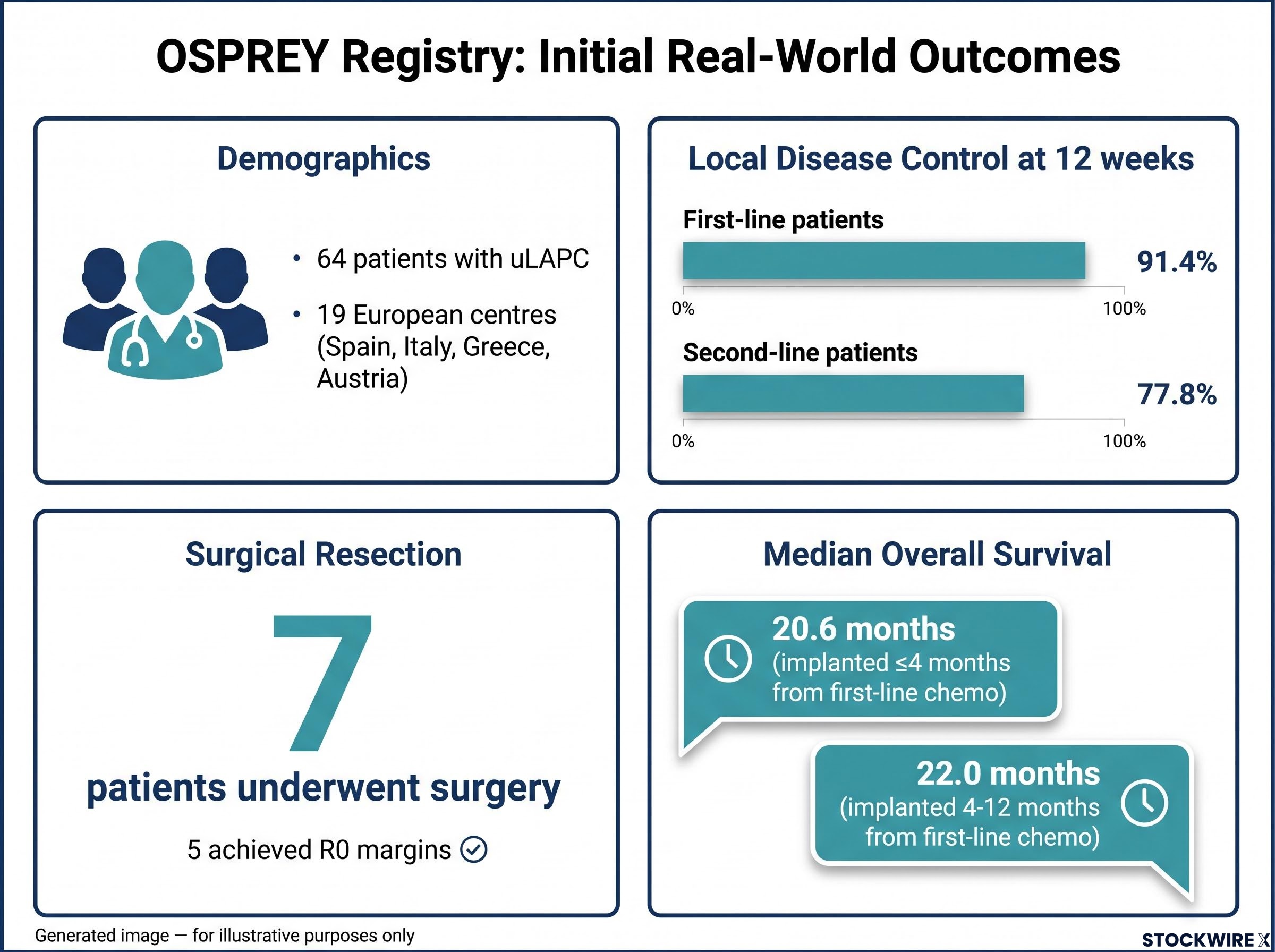
The OSPREY Registry enrolled 64 patients with unresectable locally advanced pancreatic cancer (uLAPC) across 19 European centres in Spain, Italy, Greece, and Austria. The safety profile was notably clean: the registry reported no Grade 3 or higher or serious adverse device effects, no acute complications, no pancreatitis, and no hospital admissions related to treatment.
Local disease control at 12 weeks post-implant was as follows:
- First-line patients: 91.4%
- Second-line patients: 77.8%
Seven patients subsequently underwent surgical resection, with five achieving R0 margins (complete removal of tumour). In a disease where surgery is rarely possible, this outcome is particularly notable. Median overall survival figures from the registry were:
- 20.6 months (95% CI 16.9–20.1) from diagnosis for patients implanted ≤4 months from starting first-line chemotherapy
- 22.0 months (95% CI 17.2–22.7) from diagnosis for patients implanted 4–12 months from starting first-line chemotherapy
The authors concluded that EUS-guided implantation of OncoSil™ in combination with chemotherapy was safe and well tolerated, and appeared to support local disease control and downstaging to surgical resection in a proportion of patients.
Nigel Lange, CEO and Managing Director, OncoSil Medical
“These initial real-world results are particularly encouraging, demonstrating a favourable safety profile, high levels of local disease control and surgical resection in a proportion of patients across multiple European centres.”
| Metric | Result | Patient Group | Centre Count | Outcome Note |
|---|---|---|---|---|
| Local disease control at 12 weeks | 91.4% | First-line patients | 19 centres | Spain, Italy, Greece, Austria |
| Local disease control at 12 weeks | 77.8% | Second-line patients | 19 centres | Spain, Italy, Greece, Austria |
| Surgical resection achieved | 7 patients (5 with R0 margins) | All enrolled patients | 19 centres | R0 = complete tumour removal |
| Median overall survival | 20.6 months (95% CI 16.9–20.1) | Implanted ≤4 months from first-line chemo | 19 centres | From diagnosis |
| Median overall survival | 22.0 months (95% CI 17.2–22.7) | Implanted 4–12 months from first-line chemo | 19 centres | From diagnosis |
Understanding pancreatic cancer and why local treatment matters
Unresectable locally advanced pancreatic cancer (uLAPC) describes tumours that cannot be surgically removed, making local disease control especially important for managing patient outcomes. Pancreatic cancer affects approximately 500,000 people globally each year and carries a poor prognosis, largely due to late-stage diagnosis.
OncoSil™ is a single-use brachytherapy device that delivers beta radiation via Phosphorus-32 (³²P) microparticles directly into the tumour through EUS-guided placement, limiting radiation exposure to surrounding organs. The device holds CE Marking approval for the EU and UK, and has received FDA approval under a Humanitarian Device Exemption (HDE) for the treatment of unresectable, non-metastatic distal cholangiocarcinoma (dCCA), as an adjunct to systemic therapy, in the United States. It is currently approved for sale in 30+ countries.
Peer-reviewed histopathological analysis published in Pathology International confirmed zero migration of Phosphorus-32 microparticles beyond tumour tissue in all evaluated surgical specimens, providing independent scientific validation of the localised mechanism of action that underpins the device’s favourable safety profile across the OSPREY cohort.
Achieving R0 resection, which refers to complete removal of the tumour with clear margins, is rare in uLAPC and associated with meaningfully better survival outcomes. The fact that five of seven patients in the OSPREY Registry who underwent surgery achieved R0 margins adds weight to the registry’s clinical findings.
Broader evidence base building ahead of EANM
Beyond the oral presentation, a second abstract relevant to the OncoSil™ device was accepted as an e-poster at EANM 2026. Researchers from Bilkent City Hospital in Ankara, Türkiye reported early clinical experience in seven patients with pancreatic adenocarcinoma treated with EUS-guided intratumoral Phosphorus-32 microparticle injection in combination with FOLFIRINOX-based neoadjuvant chemotherapy.
Key findings from the Türkiye data included:
- Treatment was technically feasible in all seven patients
- No treatment-limiting toxicity or treatment-related adverse events were reported
- Five of seven patients (71%) subsequently underwent surgical resection
- At a median follow-up of 11 months, all seven patients were alive, with median overall and progression-free survival not yet reached
The authors noted that the small sample size precludes definitive conclusions regarding oncological efficacy, and the findings should be considered preliminary.
Collectively, the presentations at EANM 2026 provide an opportunity to increase awareness of OncoSil™ within the international nuclear medicine community. The OSPREY Registry contributes growing real-world clinical data across multiple European centres, while the additional abstracts offer complementary clinical experience and research into quantitative imaging and dosimetry. Nigel Lange noted the company was also pleased to see “a broader body of independent research into 32P microparticle therapy and associated imaging technologies being presented at EANM,” adding that the studies collectively reflect increasing scientific and clinical interest in targeted ³²P therapy.
The TRIPP-FFX trial endpoints, met in June 2026 with an 82.2% local disease control rate at 16 weeks and 18.3-month median overall survival in the FOLFIRINOX arm, sit alongside the OSPREY real-world data as complementary pillars of the growing controlled and post-market evidence base for the device.
Don’t Miss the Next Healthcare Breakthrough on ASX
Big News Blast delivers FREE breaking ASX healthcare news directly to your inbox within minutes of release, complete with in-depth analysis. Join 20,000+ investors already staying ahead of the market. Click the “Free Alerts” button at StockWire X to start receiving alerts the moment market-moving news breaks.