

Peer-reviewed study confirms OncoSil microparticles remain confined to tumour tissue
OncoSil Medical (ASX: OSL) has announced the publication of new peer-reviewed histopathological findings in Pathology International, representing the first reported histopathological evaluation of implanted OncoSil microparticles in surgically resected pancreatic cancer specimens. The study, conducted by investigators from Royal Adelaide Hospital and University of Adelaide, examined surgical specimens from patients with locally advanced pancreatic cancer (LAPC) who received EUS-guided OncoSil microparticle implantation plus chemotherapy prior to surgical resection.
The median overall survival from chemotherapy commencement in the eight patients evaluated was 24 months.
The publication provides first histopathological evidence validating the device’s mechanism of action, adding to the growing body of evidence supporting the device’s use in pancreatic cancer treatment.
When big ASX news breaks, our subscribers know first
What is brachytherapy and why does localised delivery matter?
Brachytherapy is a form of internal radiation therapy where radioactive sources are placed directly inside or near the tumour. This contrasts with external beam radiotherapy, which must pass through healthy tissue to reach the cancerous area.
Localised delivery is particularly critical for pancreatic cancer because the pancreas sits near vital organs including the stomach, liver, intestines and major blood vessels. External radiation in this anatomical location carries significant risk of collateral damage to healthy tissue.
OncoSil addresses this challenge using Phosphorus-32 microparticles delivered via endoscopic ultrasound guidance directly into the tumour. If the radioactive particles remain where implanted, it supports a favourable safety profile and differentiates OncoSil from external beam alternatives that carry higher collateral tissue risk.

Key findings from the histopathological study
The peer-reviewed study confirmed the following critical observations:
- OncoSil microparticles were present within tumour tissue in all evaluated specimens.
- No evidence of migration was observed beyond the tumour implantation site.
- No microparticles were identified within surrounding healthy pancreatic tissue, blood vessels, lymphatic vessels, adjacent lymph nodes or nearby organs.
- Findings support highly localised delivery of beta radiation directly to tumour tissue while minimising exposure to surrounding healthy tissue.
- The study provides pathological evidence supporting the favourable retention characteristics of the OncoSil device and its potential safety advantages.
The “no migration” finding is the core validation point, demonstrating the device works as intended and supporting the safety thesis that underpins its clinical use.
Implications for future development
The researchers concluded that the observed distribution profile may support optimisation of future dosing and implantation strategies to further enhance therapeutic effect. The study suggests future investigations may explore increased dose density and additional implantation sites within larger tumours.
This opens a pathway to potentially improved efficacy without requiring fundamental device changes.
TRIPP-FFX trial endpoints confirmed an 82.2% local disease control rate at 16 weeks alongside an 18.3-month median overall survival in the OncoSil plus FOLFIRINOX arm, providing the clinical efficacy foundation that will underpin a label expansion submission planned for late 2H CY26.
CEO commentary on the findings
Nigel Lange, CEO & Managing Director
“This publication provides important histopathological evidence that implanted Phosphorus-32 microparticles remain confined within tumour tissue, supporting the highly localised mechanism of action of the OncoSil device. The findings provide further scientific validation of the technology and add to the growing body of evidence supporting its use in pancreatic cancer treatment.
We congratulate Dr Amanda Lim and her co-investigators at the Royal Adelaide Hospital and the University of Adelaide on this important contribution to the pancreatic cancer literature and thank them for their continued commitment to advancing the understanding of OncoSil therapy.”
OncoSil’s current regulatory and commercial position
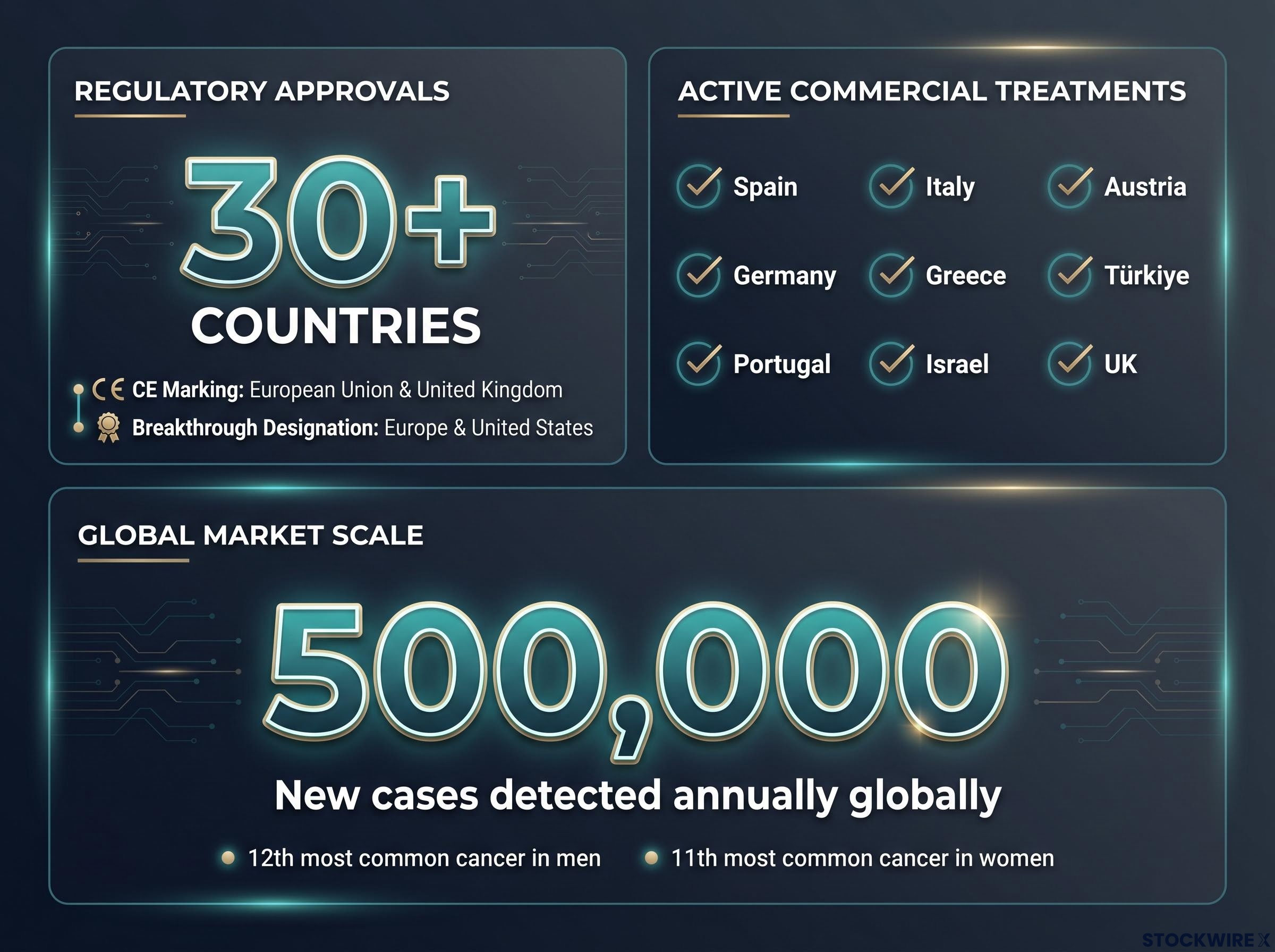
OncoSil holds CE Marking approval, providing marketing authorisation in both the EU and UK. The device has achieved breakthrough device designation in both Europe and the United States.
The company currently holds approvals in 30+ countries including European Union, United Kingdom, Australia, Türkiye and Israel. Commercial treatments using the device have already been undertaken in Spain, Italy, Austria, Germany, Greece, Türkiye, Portugal, Israel and the UK.
| Region | Regulatory Status | Breakthrough Designation | Commercial Activity |
|---|---|---|---|
| European Union | CE Marking approved | Yes | Active (multiple countries) |
| United Kingdom | CE Marking approved | — | Active |
| United States | Not yet approved | Yes | Not yet commenced |
| Australia | Approved | — | Not specified |
| Türkiye & Israel | Approved | — | Active |
The target market represents significant commercial opportunity. Pancreatic cancer is the 12th most common cancer in men and 11th most common in women globally, with 500,000 new cases detected annually. The disease is typically diagnosed at a later stage and carries a poor prognosis for long-term survival, creating urgent demand for effective localised treatment options.
The publication adds to the evidence base that could support further regulatory approvals and accelerated commercial expansion.
The FDA Humanitarian Device Exemption review entered its final administrative stage in June 2026, with the agency confirming all substantive questions resolved and a 2H CY2026 approval decision targeted, which would open the world’s largest medical device market to a platform already commercially active across 30+ countries.
Publication details
The full citation for the study is: Lim AH, Ruszkiewicz A, Rodgers N et al. Pathology International 2026; 76: e70131.
Pathology International is a peer-reviewed international pathology journal. The study represents the first reported histopathological evaluation of the distribution of implanted OncoSil microparticles and their decayed forms in surgically resected pancreatic cancer specimens.
Get Biotech Breakthroughs Before the Market Reacts
Join 20,000+ investors receiving FREE breaking ASX healthcare news within minutes of release, complete with in-depth analysis. Click the “Free Alerts” button at Big News Blast to stay ahead on the next potential biotech winner the moment announcements drop.