
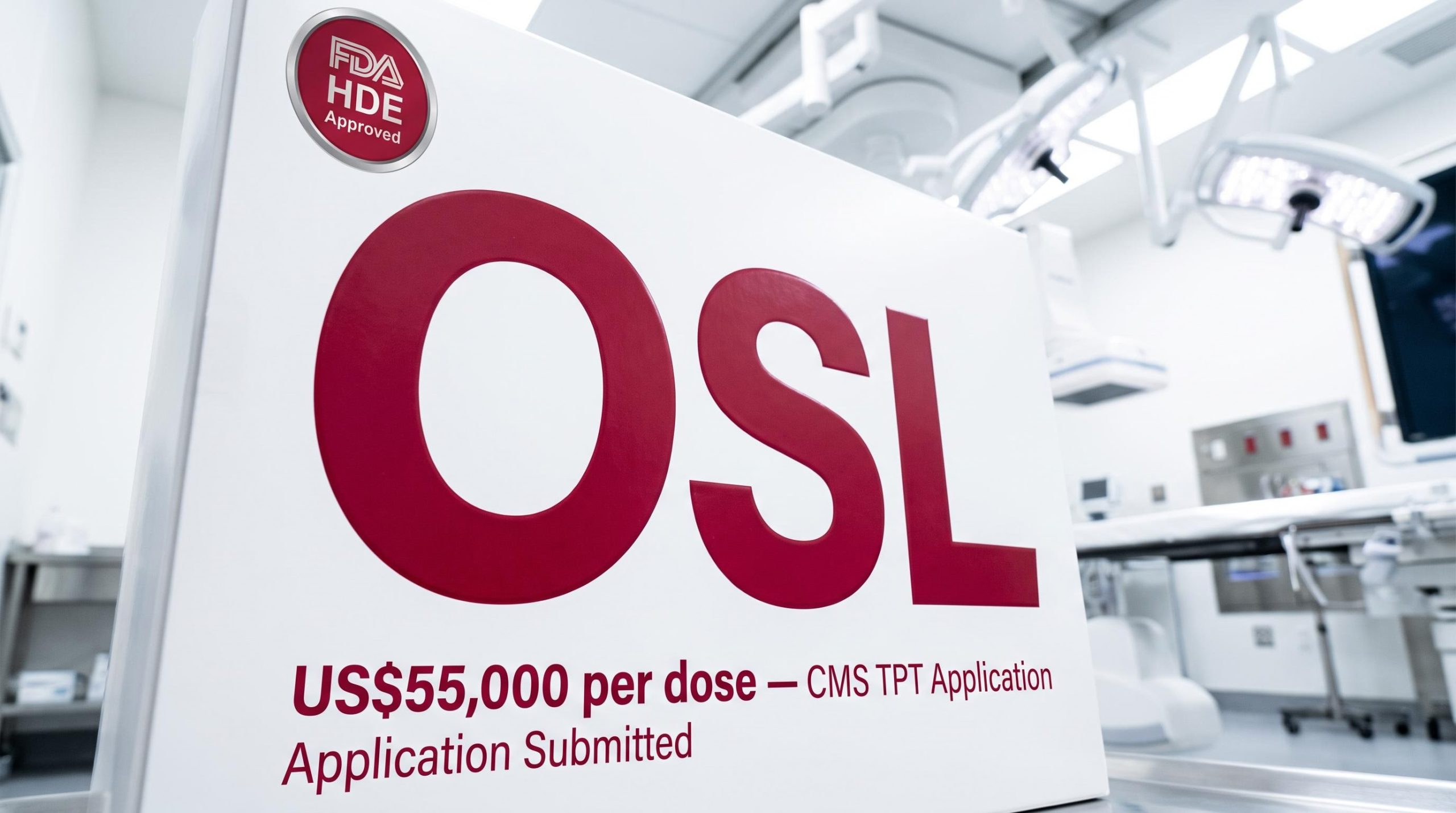
OncoSil files US Medicare reimbursement application at US$55,000 per dose
OncoSil Medical (ASX: OSL) has submitted a Transitional Pass-Through (TPT) Payment status application to the U.S. Centers for Medicare & Medicaid Services (CMS), seeking Medicare reimbursement for its OncoSil™ device. The application was filed on 1 September 2026 (US time).
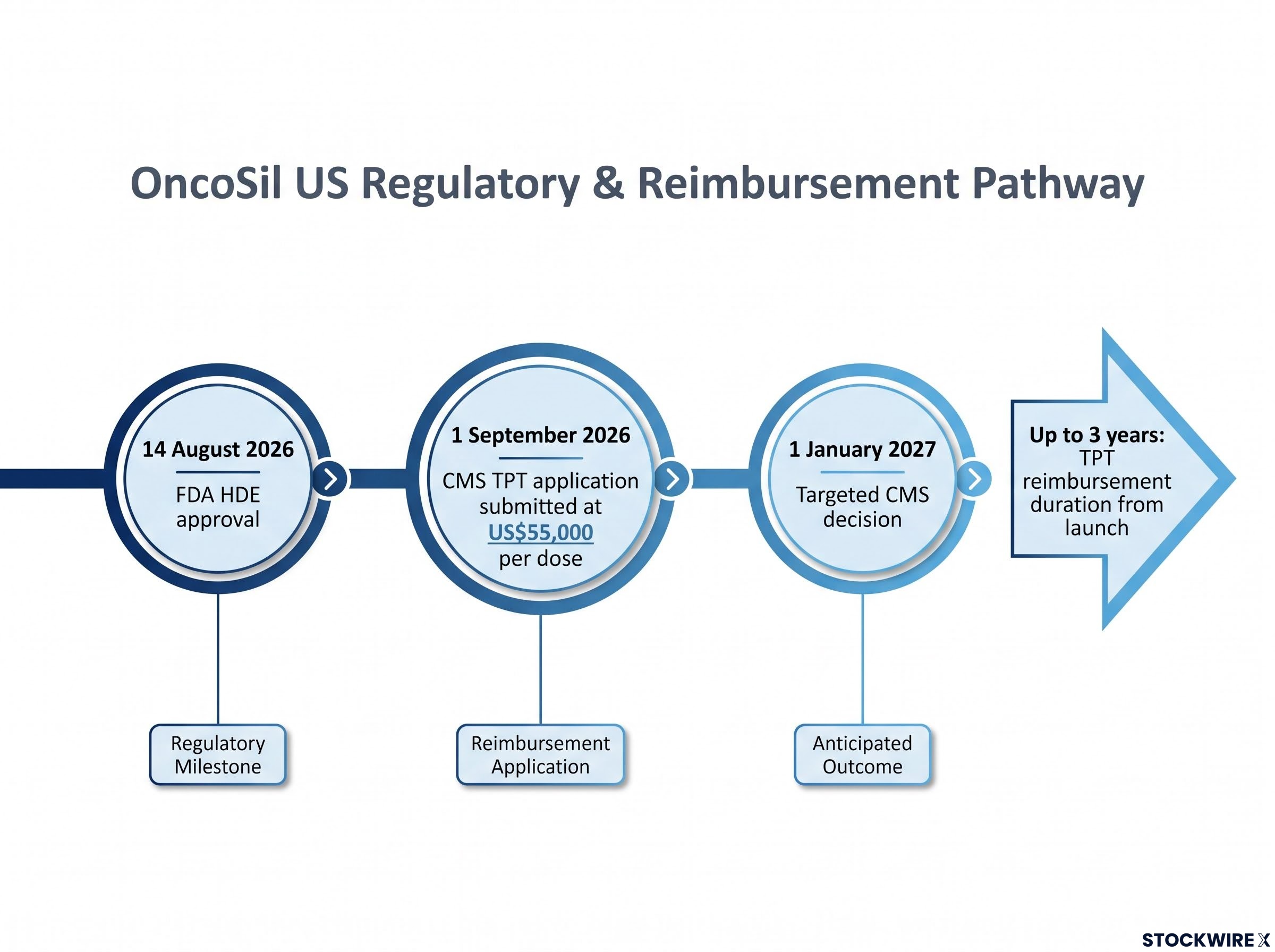
The submission seeks separate, supplemental Medicare reimbursement in the unresectable, non-metastatic distal cholangiocarcinoma (dCCA) indication, at a proposed price of US$55,000 per dose. A CMS decision, and effective date if granted, is targeted for 1 January 2027.
The application builds directly on the FDA’s grant of Humanitarian Device Exemption (HDE) approval on 14 August 2026.
The FDA HDE approval for dCCA, granted on 14 August 2026, established OncoSil as the first and only FDA-approved Class III device for distal cholangiocarcinoma, with the US addressable market estimated at approximately A$80 million per annum based on around 1,000 eligible patients.
When big ASX news breaks, our subscribers know first
What the TPT application means for OncoSil’s US launch
The application was filed with the U.S. Centers for Medicare & Medicaid Services, the federal agency that administers Medicare. If granted, TPT status would provide supplemental Medicare reimbursement for the OncoSil™ device for up to three years from launch, according to the company.
The company positions the submission as a step in supporting hospital adoption economics during early commercialisation. TPT reimbursement, if approved, is expected to give academic medical centres the reimbursement certainty required to adopt the device early in the launch phase.
The table below summarises the key details and their potential relevance to investors.
| Detail | Figure / Date | Investor Impact |
|---|---|---|
| Application submitted | 1 September 2026 (US time) | Advances US reimbursement pathway |
| Proposed price per dose | US$55,000 | Sets reimbursement benchmark |
| CMS decision targeted | 1 January 2027 | Near-term catalyst |
| TPT duration if granted | Up to 3 years from launch | Supports early adoption economics |
The proposed US$55,000 per dose figure establishes an initial reimbursement benchmark for the device in the US market, while the targeted CMS decision date represents a defined near-term milestone for investors to monitor.
CEO commentary
Nigel Lange, CEO & Managing Director
“The submission of our CMS Transitional Pass-Through application is the next critical step in our US commercialisation strategy, building directly on last month’s FDA HDE approval. Securing TPT status would give academic medical centres the reimbursement certainty they require to bring OncoSil™ to patients with dCCA quickly and lays the foundation for broader US payer coverage as we scale.”

Understanding Medicare pass-through reimbursement
Transitional Pass-Through (TPT) payment status is a time-limited supplemental Medicare payment made above the standard procedure reimbursement. It is designed to provide additional payment for newer medical technologies during their early period on the market.
Why does this matter for a newly approved device? Hospitals typically require reimbursement certainty before adopting a novel therapy. TPT is intended to bridge that gap during early commercialisation, helping to support hospital and physician adoption.
It is also worth clarifying the regulatory pathway involved. A Humanitarian Device Exemption (HDE) is an FDA pathway for devices treating rare conditions, and differs from a standard premarket approval. The dCCA indication addressed here is a rare form of bile duct cancer, often diagnosed at an advanced stage.
For investors, the distinction is a practical one: regulatory approval alone does not guarantee commercial uptake in the US market. Reimbursement is a separate and important driver of adoption.
The post-approval study and path to wider US distribution
The post-approval study (PAS) is a mandatory condition of the HDE approval. It is designed to confirm the safety and probable benefit of the OncoSil™ device in real-world clinical use across a broader population than was studied pre-approval.
Key parameters of the study include:
-
A multicentre, prospective design
-
Enrolment of 30 patients across five academic medical centres
-
A follow-up period of approximately 24 months from the last patient enrolled
-
FDA consent required before the company may expand distribution beyond the five PAS centres
The sequencing here is important. TPT reimbursement, if granted, is expected to support adoption at the academic medical centres participating in the PAS, facilitating early clinical utilisation following HDE approval.
The company has stated it will engage with the FDA on pathways to widespread US distribution of the device following completion of PAS enrolment. Broader US payer coverage is anticipated to build over time, contingent on the PAS process. Widespread distribution beyond the five PAS centres has not yet been approved.
Why US reimbursement is the near-term priority
Securing durable US reimbursement is described by the company as a critical near-term priority ahead of commercial launch. TPT status, if approved, would provide a time-limited supplemental payment above standard procedure reimbursement, intended to support adoption during the PAS period and establish a foundation for long-term US payer coverage.
OncoSil operates within Interventional Oncology. The OncoSil™ device is a single-use brachytherapy (internal radiation) device that delivers a pre-determined dose of Phosphorous-32 (³²P) beta radiation directly into cancerous tissue, with the aim of sparing surrounding critical organs.
The company’s existing commercial footprint provides context for the US opportunity:
-
Breakthrough Device designation in both the United States and Europe
-
Approved for sale in 30+ countries, with commercial treatments already undertaken across Europe, Türkiye and Israel
-
CE Marking held in the European Union and the United Kingdom
The US therefore represents a large, additional addressable market layered onto an established global commercial presence. For investors, the CMS decision targeted for 1 January 2027 marks the next defined catalyst in that US strategy, though the outcome remains subject to CMS approval.
For readers interested in the scientific basis underpinning the device’s mechanism of action, our deep-dive into the OncoSil microparticle localisation study covers the peer-reviewed histopathological findings confirming zero particle migration beyond tumour tissue, along with median survival data from the evaluated surgical cohort.
Don’t Miss the Next Healthcare Breakthrough on ASX
Get FREE breaking ASX healthcare news delivered to your inbox within minutes of release, complete with in-depth analysis. Join 20,000+ investors already staying ahead of the market with Big News Blast. Click the “Free Alerts” button to receive real-time alerts the moment market-moving announcements hit.