The Reserve Bank of Australia has raised the cash rate by 25 basis points to 4.60%, a level Australian borrowers have not seen since around November 2011. That single number carries real weight for anyone holding a mortgage, an ASX portfolio, or both.
The timing makes today unusually dense. On 29 September 2026, the rate decision, the Australian Bureau of Statistics (ABS) August household spending data, and nearly $6 billion in dividend distributions from Commonwealth Bank of Australia (CBA) and Woodside all land in the same session.
For self-directed investors, that convergence is not noise. It is three separate readings on the same economy, arriving at once.
Here is what the confirmed 4.60% cash rate actually means across the parts of the market most exposed to it, with the sector-level evidence already visible in the trading that led up to the decision.
What the RBA just decided, and why the fourth hike landed today
The RBA Board met on 29 September 2026 and lifted the cash rate target by 25 basis points to 4.60%, effective 30 September 2026. The media release landed at 2:30 pm AEST, exactly where markets expected it.
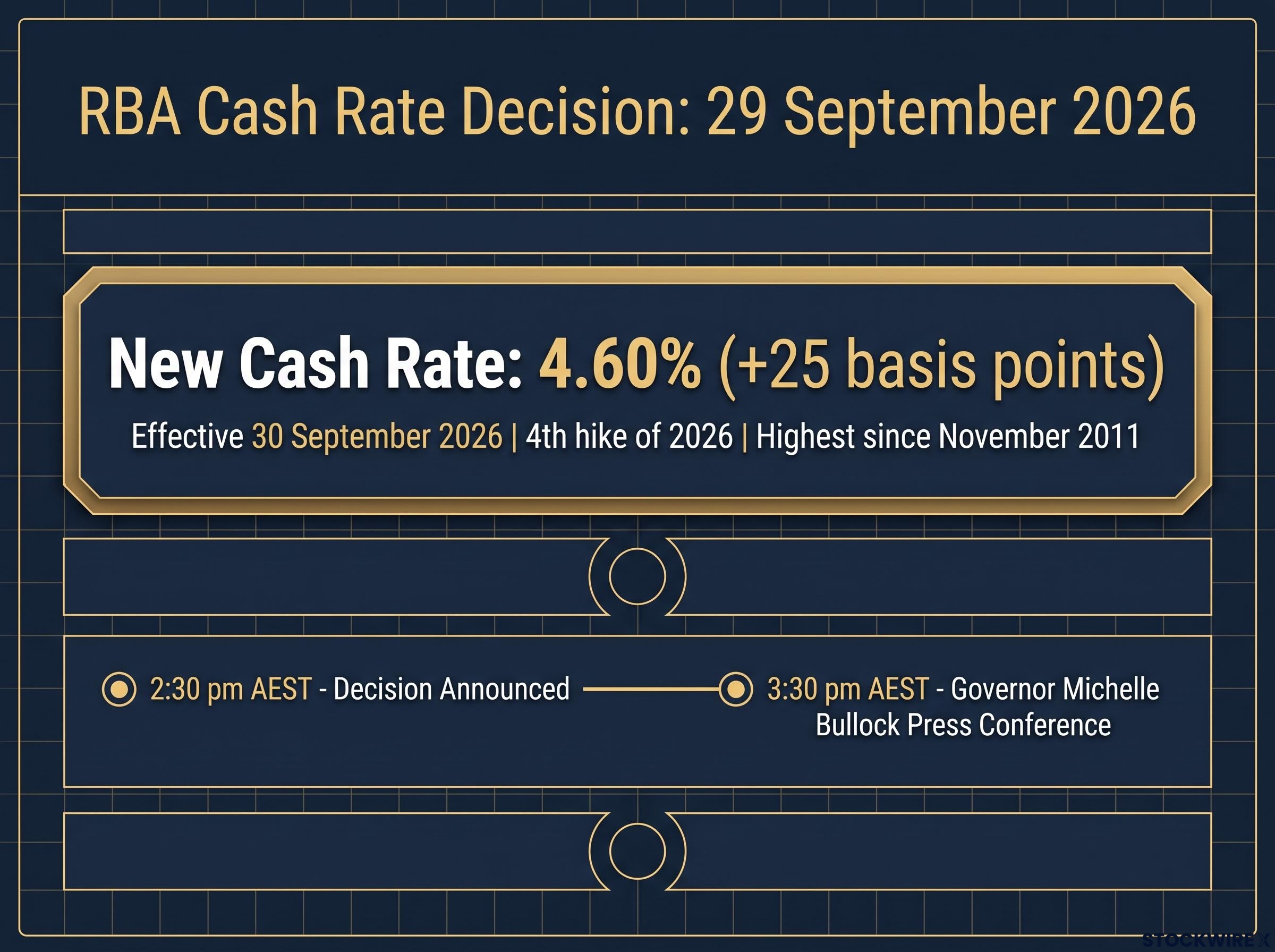
This is the fourth hike of the 2026 calendar year, and it pushes the cash rate to its highest point in roughly a decade and a half.
A 15-year high. At 4.60%, the cash rate now sits at a level last seen around November 2011. Most owner-occupiers who entered the market in the past decade have never held a mortgage in conditions like these.
The decision surprised almost no one. Markets had assigned a probability of roughly 90-93% to a 25 basis point move before the announcement, which tells you the debate was never really about whether the RBA would act, but about what would justify it.
Three forces made a pause difficult for the Board to defend.
The August 2026 board minutes had already confirmed that a 25-basis-point hike was genuinely on the table before the board held, which means the inflation outlook entering today’s meeting carried active tightening bias rather than residual caution, a distinction that shapes how investors should read any guidance Bullock offers at 3:30 pm.
| Driver | Evidence | Market implication |
|---|---|---|
| Persistent inflation and rising energy costs | SBS and Seeking Alpha both frame the move as a response to inflation running hotter than policymakers wanted, with energy costs a key pressure | Rate-sensitive valuations stay compressed while inflation risk dominates growth concerns |
| Resilient domestic demand | The RBA’s August Statement on Monetary Policy described June-quarter spending growth as “resilient”, supported by discretionary purchases | Consumer-facing sectors face no near-term relief from a demand collapse the RBA can point to |
| No consumption breakdown | August household spending was flat month-on-month but up 6.8% year-on-year, roughly A$82.3 billion | Annual resilience gave the Board grounds to keep tightening rather than hold |
The August spending print is worth sitting with, because it did the opposite of what a flat number usually does. Spending was 0.0% month-on-month, yet +6.8% on the year.
That combination is exactly what the Board needed. Demand had stalled without breaking, so there was no evidence of the consumption collapse that would have justified stepping aside.
For investors, understanding why the RBA moved now rather than paused is the foundation for reading everything else today correctly, including what Governor Michelle Bullock signals in her press conference at 3:30 pm AEST.
When big ASX news breaks, our subscribers know first
How the ASX 200 positioned itself before the decision came through
The sessions leading into the announcement did not tell a story of broad strength or broad weakness. They told a story of rotation.
In the 27 September session, the ASX 200 touched an intraday high near 8,680 before closing around 8,665, after a prior close of roughly 8,679 on 28 September. Futures pointed to a flat open on 29 September, up about 0.1%.
Beneath that placid surface, capital was moving with intent. Banks and insurers led, and they led for a reason: higher rates tend to widen the margin between what lenders charge and what they pay for funding.
Westpac and ANZ each climbed around 1.6%, while Suncorp gained approximately 2.7%. That is the clearest bet on the board, positioning for a sustained high-rate environment where net interest margins hold up.
Utilities and selective property came next. AGL rose about 1.4% on defensive income appeal and gas-price dynamics, while Stockland advanced roughly 1.7%.
The property picture is where the market showed its discipline. Goodman Group slipped about 0.3% even as Stockland rallied, and that split matters more than either number alone.
The divergence tells you the market is not treating real estate investment trusts as one uniform category. Investors are separating names by refinancing exposure and lease structure, not simply by asset class, which is a signal for anyone holding property exposure to look through the sector label to the balance sheet underneath.
The bank versus REIT divergence visible in today’s pre-decision session is not a new phenomenon: at 4.35%, CBA was already reporting 5% profit growth while names like Mirvac faced a two-sided squeeze from rising borrowing costs and higher discount rates eroding asset valuations, confirming the structural nature of the split rather than a one-session anomaly.
Healthcare also drew buyers, with Cochlear singled out as a strong gainer, and Wisetech Global stood out as the lone information technology name to rise, up about 1.6%.
| Sector / Stock | Pre-decision move and signal |
|---|---|
| Banks (Westpac, ANZ) | Each up ~1.6%; clearest positioning for margin support in a high-rate environment |
| Insurers (Suncorp) | Up ~2.7%; benefits from higher yields on invested float |
| Utilities (AGL) | Up ~1.4%; defensive income and lower refinancing risk than growth names |
| Property (Stockland vs Goodman) | Stockland up ~1.7%, Goodman down ~0.3%; selective, not uniform, REIT strength |
| Healthcare (Cochlear) | In demand; defensive earnings appeal |
| IT outlier (Wisetech Global) | Up ~1.6%; exception to broad IT weakness |
| Energy (Karoon Energy) | Down ~12.3% on a production-guidance cut; company-specific, not a sector read |
| Miners and industrials | Broadly weak on softer base-metal prices and funding-cost pressure |
The pre-decision rotation is not just historical colour. It is a live map of where the market judges risk to concentrate when rates stay high, and it gives you a framework for stress-testing your own sector weightings.
Sectors facing pressure in a 4.60% cash rate environment
The underperformers shared a common thread. Energy, miners, industrials, and most IT names all sit in territory where higher funding costs either squeeze margins directly or shrink the present value of future earnings.
Miners struggled against weaker base-metal prices, industrials were broadly soft, and the bulk of the IT sector lagged as investors discounted long-dated growth more heavily.
Energy needs a caveat. The sector’s weakness was distorted by Karoon Energy, which fell around 12.3% after cutting production guidance, a company-specific event rather than a rate signal.
Ahead of the 29 September open, overnight gains in crude were expected to soften that energy pressure. That is worth distinguishing clearly: a bounce driven by oil prices is temporary relief, not a reprieve from the structural headwind that higher rates apply to the sector.
What the household spending data reveals about where this is heading
On the surface, the August spending print looks benign. Household spending was flat at 0.0% month-on-month, sitting at roughly A$82.3 billion, after +1.1% in July and +0.9% in June.
That flat result actually undershot expectations. Analysts had pencilled in around +0.3%, so demand cooled faster than the market anticipated even before today’s hike.
Peel back one layer, though, and the picture turns less comfortable.
The number that matters: -0.3%. Strip out fuel, and August household spending fell approximately 0.3% month-on-month. The headline stability is a fuel-price artefact, not evidence of a resilient consumer.
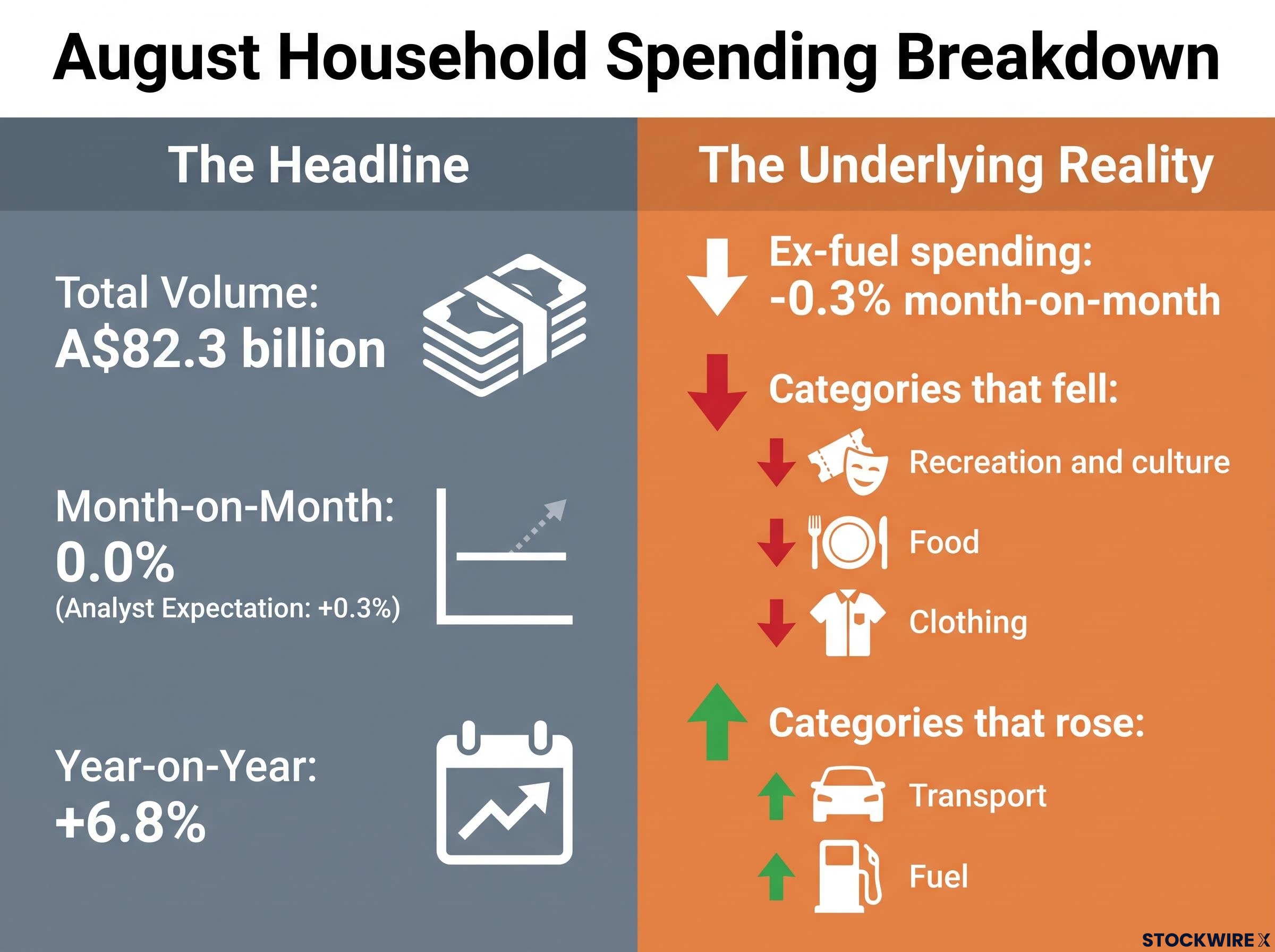
The category detail confirms where the strain is landing. Households are already rebalancing their budgets away from the things they want and toward the things they cannot avoid.
Spending fell in these discretionary areas:
- Recreation and culture
- Food
- Clothing
Spending rose in these categories:
- Transport
- Fuel
That is a household budget under pressure, cutting the optional to cover the essential. Bloomberg and Briefs.co both read the flat August print, arriving after two solid months, as an early sign of weakening demand starting to show through, and Dow Jones commentary links it to cost-of-living strain beginning to weigh.
The +6.8% annual figure means consumption has not collapsed in aggregate, and that resilience is precisely what handed the RBA its justification to keep tightening. But the annual number and the monthly detail are pointing in different directions.
Underlying inflation at 3.6% trimmed mean in July, holding above the RBA’s 2-3% target band despite sequential headline moderation, is precisely the dynamic that kept rate cut expectations off the table heading into today’s decision and reinforced the Board’s justification for a fourth consecutive hike.
For equity investors with consumer-facing exposure, the ex-fuel figure is the one to hold onto. When you remove fuel costs, Australian households are already pulling back on the discretionary categories that sustain retail and consumer-facing earnings, and that softening was in motion before today’s rate rise adds further debt-servicing pressure on top.
If fuel costs moderate in coming months, the underlying discretionary weakness stops hiding behind the headline and starts showing up plainly in the data, and in the earnings of the companies exposed to it.
The 15-year rate context that most current borrowers have never navigated
Numbers like 4.60% are easy to read as simply higher than recent norms. The lived reality is different, and that difference is the point.
The last time the cash rate sat at this level was around November 2011. For the majority of owner-occupiers who entered the market during the ultra-low-rate stretch from roughly 2012 to 2022, that means their entire borrowing experience has never included a rate at or above where the RBA has now set it.
This is not a return to a familiar environment slightly above what borrowers remember. For most current mortgage holders, 4.60% is a rate level that simply did not exist during the years they made their borrowing decisions.
What higher rates do to household budgets
The mechanics are direct. Higher debt-servicing costs compress disposable income, which leaves less for the discretionary spending that flows through to consumer-facing earnings.
The sharpest adjustment falls on borrowers rolling off low fixed rates onto variable rates set against this new benchmark. That is where mortgage stress tends to concentrate, and the aggregate effect is already visible in the ex-fuel spending decline.
The Australian dollar offered little cushion, trading just below 70.20 US cents around 7:00 am on 29 September ahead of the announcement.
The strain this creates on household budgets is only beginning to surface. Which is why “high for longer” is not an abstract slogan here: it describes a structurally different set of conditions for household finances, consumer spending, and every rate-sensitive equity valuation on the ASX.
What today’s dividend distributions add to the picture
There is a second thread running through today’s session, and it sits in tension with the first. As the rate decision reprices the investment environment, billions in capital are flowing back to shareholders.
CBA and Woodside alone were set to distribute close to $6 billion on 29 September 2026. Several other names paid out on the same day, and a group of REITs traded ex-dividend.
Companies distributing dividends today included:
- Commonwealth Bank of Australia and Woodside (combined ~$6 billion)
- Promedica
- Super Retail Group
- TPG Telecom
- Netealth
REITs trading ex-dividend on the same day included:
- Arena REIT
- Centuria Industrial REIT
- Charter Hall Retail REIT
That timing creates a specific dynamic. Capital is being returned to investors at precisely the moment higher rates are repricing where that capital can go next.
If you are receiving dividends from yield-focused holdings today, you face an immediate reinvestment decision in a market where rate-sensitive sector valuations are already adjusting in real time. The rotation visible in bank and utility pricing is the backdrop against which that decision has to be made.
What the 4.60% decision changes, and what it leaves unresolved
Three things are now settled. The cash rate is 4.60%, the fourth increase of 2026. The market has already begun repositioning toward the sectors that hold up best when rates stay high. And the consumer spending data shows the leading edge of demand softening beneath a stable headline.
What remains open is the more important question: is 4.60% the peak, or a waypoint?
Ceiling or step? The single most important read today is not what 4.60% means in isolation, but what Governor Bullock signals at 3:30 pm about whether the Board views this rate as the ceiling or one more step up.
The answer will emerge from a handful of variables worth tracking closely:
- Press conference guidance: what Governor Michelle Bullock signals at 3:30 pm AEST about the forward rate path
- Next ABS spending data: whether September’s release confirms the ex-fuel softening or reverses it
- Fixed-rate rollover pace: how quickly borrowers moving off low fixed rates onto variable rates feed additional stress into spending
- Sector rotation: whether the pre-decision move into banks, insurers and utilities continues or unwinds
Investors who understand what is still unresolved are better placed to interpret the press conference and the data that follows, rather than reacting to headlines without a framework to hang them on.
For investors wanting to decode what Governor Bullock’s language choices at 3:30 pm actually signal beyond the headline rate, our dedicated guide to reading RBA forward guidance walks through the specific statement phrasing shifts that have historically distinguished a genuine tightening bias from a neutral hold, with worked examples from the August 2026 decision.
This article is for informational purposes only and should not be considered financial advice. Investors should conduct their own research and consult with financial professionals before making investment decisions. Past performance does not guarantee future results. Financial projections are subject to market conditions and various risk factors.