
The two most recognisable names in artificial intelligence are also two of the biggest money-losing companies on the planet. In 2025, OpenAI and Anthropic together posted net losses approaching $80 billion, even as their revenues broke records and their valuations climbed into the hundreds of billions.
That contradiction sits at the heart of the AI company profitability question, and it defines the state of capital markets in late 2026. Private valuations have detached from present-day fundamentals, infrastructure spending is running at a scale usually reserved for national utility projects, and gross margins remain thin or negative.
Here is the framework you need to judge which story you are actually backing: a generational infrastructure buildout that will reward patience, or a misallocation of capital priced for a profitability that may never arrive.
Revenue records mask structural loss engines
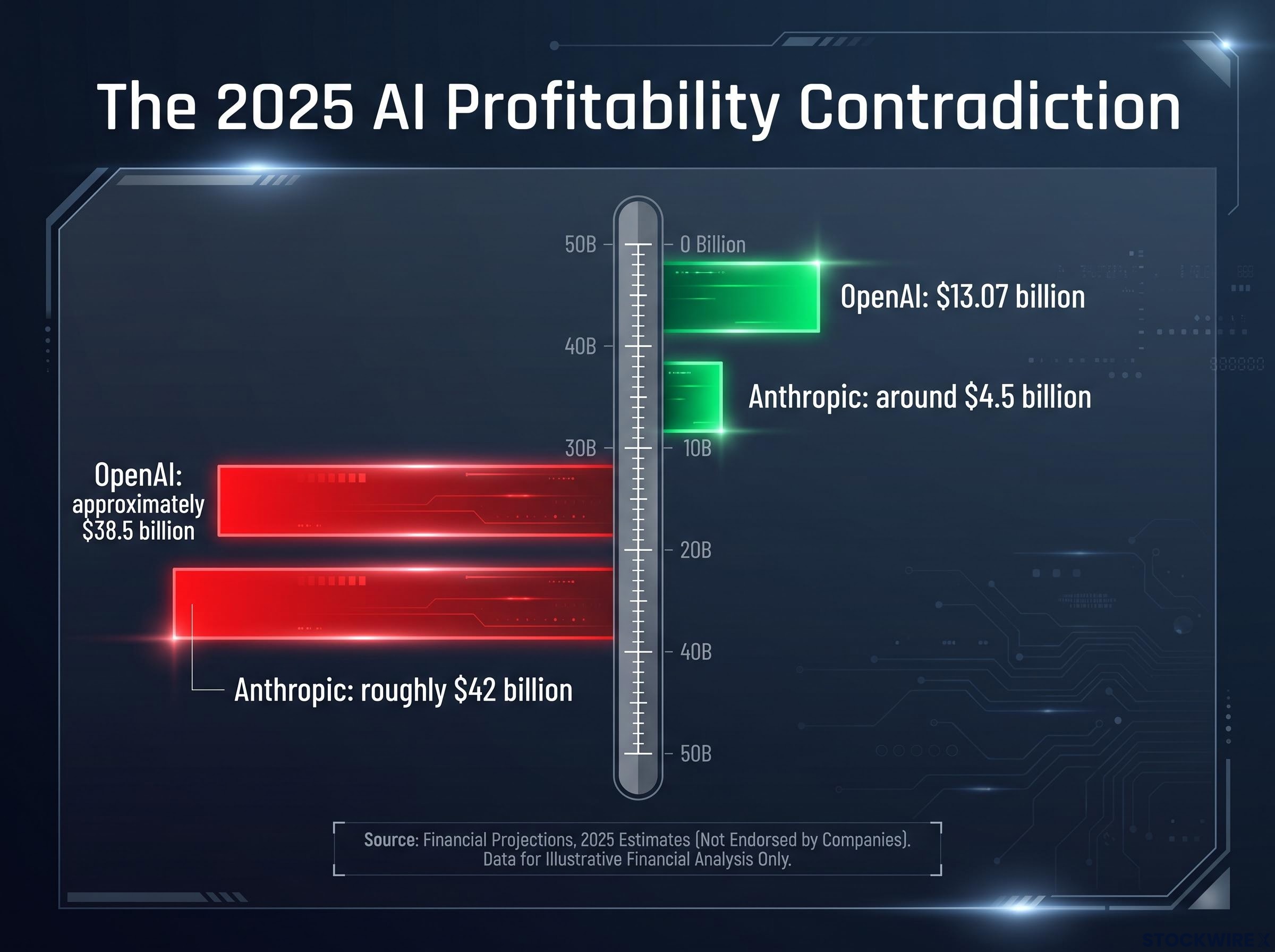
Start with the top line, because the growth genuinely is extraordinary. According to audited 2025 financials originally surfaced by blogger Ed Zitron and independently verified by the Financial Times, OpenAI recorded $13.07 billion in revenue for the year, up from roughly $3.7 billion in 2024. Anthropic, on a generally accepted accounting principles (GAAP) basis, brought in around $4.5 billion.
Then look one line down, and the picture inverts.
OpenAI’s 2025 net loss came in at approximately $38.5 billion, more than double its revenue. Anthropic’s net loss was even larger at roughly $42 billion, driven overwhelmingly by the cost of compute, the raw processing power needed to train and run large models. A company can grow revenue at a blistering pace and still burn more cash than it collects, and both of these firms are doing exactly that.
The audited OpenAI financials verified by the Financial Times place the 2025 net loss at $38.53 billion attributable to the company, a figure that landed with considerable force precisely because it came alongside revenue of $13.07 billion, making the scale of the loss-to-revenue ratio impossible to dismiss as an accounting artefact.
The run rates make the growth look even more dizzying. By mid-2026, OpenAI’s annualised recurring revenue was reported at approximately $40 billion, a projection from recent monthly figures rather than booked annual revenue. Anthropic’s run-rate revenue reportedly crossed $100 billion by September 2026, a milestone that helped justify its $965 billion post-money valuation in the Series H round in May 2026.
| Metric | OpenAI | Anthropic |
|---|---|---|
| 2025 revenue | $13.07 billion | ~$4.5 billion (GAAP) |
| 2025 net loss | ~$38.5 billion | ~$42 billion |
| Mid-2026 estimated run rate | ~$40 billion ARR | Crossed $100 billion (Sep 2026) |
Here is what the loss engine reveals. Anthropic’s gross margin, defined as revenue minus compute costs, sits at roughly 40%. That is thin for a software business, and it exists because every query answered consumes expensive processing capacity. The economics do not resemble traditional software, where the marginal cost of serving one more customer is close to zero.
The pressure is already reaching users. OpenAI has been reported to reduce token availability and model quality for subscription customers toward the end of the month, a visible sign of cost discipline being pushed onto the people paying $20 a month.
What these numbers show you is stark. Buying into today’s market leaders means underwriting historic financial losses, which forces one uncomfortable question: can these platforms ever price their products high enough to cover what it costs to run them?
When big ASX news breaks, our subscribers know first
Understanding the physical infrastructure gap
Before scrutinising whether the losses are defensible, it helps to understand the theory that defends them. The bull case rests on a concept known as the J-Curve.
A J-Curve describes an investment that loses money heavily in its early phase, then curves sharply upward into profit once the groundwork pays off. Applied to transformative technology, the argument is that AI’s enormous upfront costs are front-loaded infrastructure spending, and the returns arrive later once organisations rebuild their workflows around the technology.
The distinction that matters here is between software and physical hardware. Traditional software scales almost for free. AI does not, because it depends on vast, capital-intensive data centres full of specialised chips. That is why strategy consultants and infrastructure investors treat the current phase less like a software launch and more like the historical buildout of railways, electricity grids, or broadband, where capital was laid down years before the productivity showed up.
The scale of that buildout is where the numbers stop being abstract.
The race to fund the compute layer
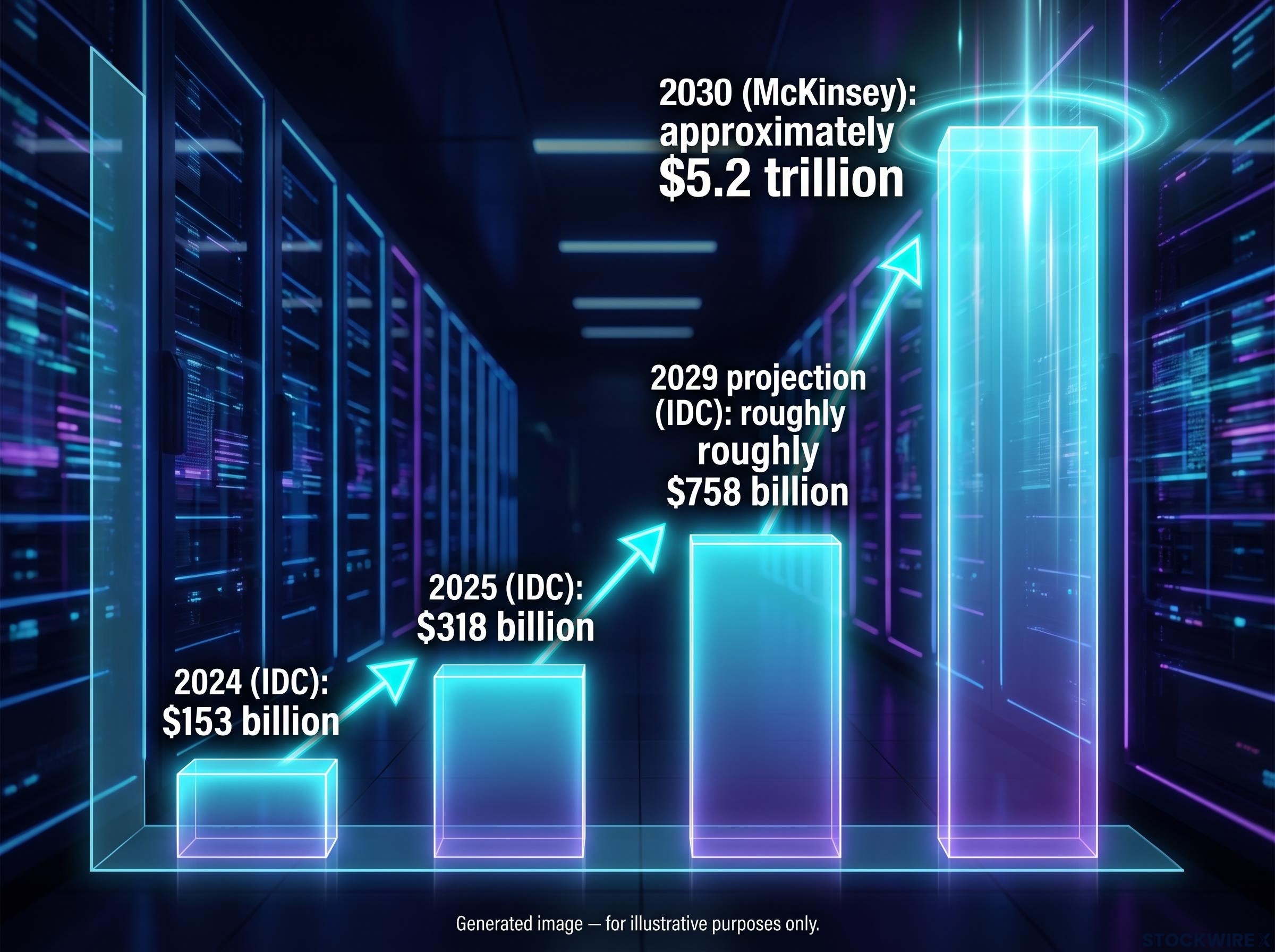
Spending is already immense. According to IDC tracking, full-year 2025 AI infrastructure spending reached $318 billion, more than double the $153 billion recorded in 2024. IDC projects this figure could climb to roughly $758 billion by 2029.
The scale becomes concrete when examined at the firm level: hyperscaler capital expenditure reached $130 billion in Q1 2026 alone across Amazon, Microsoft, Alphabet, and Meta, with full-year 2026 combined guidance approaching $725 billion and a $1 trillion annual run rate projected for 2027.
The longer-range forecasts are larger still. McKinsey estimates that companies across the compute value chain will need to invest approximately $5.2 trillion in data centres by 2030 to meet AI demand alone. KKR, citing McKinsey, puts the figure at almost $7 trillion, a scale it compares to the combined economic output of Japan and Germany.
This is where the capital flow becomes fragile. Money raised in venture rounds is being channelled almost directly into physical hardware, and the original source reporting projects OpenAI alone may lay out around $278 billion in cash through 2030, most of it on computing infrastructure. That creates a dependency: these firms need continuous access to capital markets simply to keep the lights on.
Understanding this thesis helps you separate speculative software hype from the physical hardware reality that will ultimately dictate long-term returns. The question is no longer whether the technology works. It is whether the capital holds.
The enterprise productivity reality check
The J-Curve theory assumes the productivity payoff is coming. The evidence on the ground, so far, is thin.
In a background note prepared for an informal meeting of EU finance ministers in September 2024, the International Monetary Fund (IMF) projected that AI could lift European productivity by only around 1% over a five-year horizon. Set that against multi-trillion-dollar infrastructure forecasts, and the mismatch is glaring. Spending is measured in trillions; measured productivity gains, at least in Europe, are measured in single percentage points.
The friction is not just in the headline numbers. Enterprise integration carries hidden costs: licensing fees, change-management overhead, the time developers spend on prompt engineering to get usable outputs, and the labour of correcting model errors. These costs rarely appear in the marketing but reliably appear on the invoice.
One case study makes the point in cash terms.
A team of developers at the London Stock Exchange reportedly spent approximately £150,000 on AI tools in a single month, while generating only £50,000 of value from their output over the same period.
That is a threefold negative return, and it is not an isolated anecdote. Post-2024 enterprise surveys consistently show that only a small share of firms have deployed generative AI at scale, with most still stuck in pilots where the return on investment is uncertain or unmeasured. The strongest results tend to come from firms that invest heavily in process redesign and data quality, not from those simply buying access to a frontier model.
The London Stock Exchange case is representative of a wider pattern: enterprise AI pilot failure rates run at 70-80% by most estimates, with poor data integration identified as the primary cause rather than model quality or tooling gaps, a finding that directly challenges the assumption that better frontier models will automatically convert into enterprise productivity gains.
The gap between infrastructure spending and actual corporate productivity tells you something the valuations do not. Enterprise software budgets will not expand infinitely to rescue vendor margins. If average returns stay low or confined to a narrow band of tasks, the demand needed to justify today’s capex may simply fail to materialise on schedule.
Commoditisation and the open-source threat
Even if enterprises eventually find the returns, a second problem waits: the vendors may not be able to charge enough to profit from them. The reason is open-source.
Fast-improving open-source models are stripping pricing power from the major proprietary labs. Models from Chinese developers such as DeepSeek and Western releases like Meta’s Llama series have converged toward the capabilities of frontier proprietary systems, and they can be run on a customer’s own hardware or on cheaper cloud options with no per-token licensing fee. As capabilities converge, base models start to look like a commodity rather than a premium product.
The competitive pressure is not purely domestic: open-weight model competition from Chinese developers is accelerating the pricing floor collapse, with Moonshot AI’s Kimi K3 scoring within 0.5 percentage points of OpenAI’s flagship model on leading benchmarks and scheduled for free public release, converting a pricing competitor into a zero-cost alternative.
The appeal goes beyond cost. For enterprises in regulated sectors, and particularly for European and government users, self-hosting open-source models keeps sensitive data on-premises and sidesteps dependence on US-based labs. With Europe already viewed as trailing in AI development, calls for technological sovereignty are giving open-source deployment a strategic, not just financial, rationale.
Enterprises are shifting behaviour to match. The most common reasons they are moving workloads away from expensive proprietary application programming interfaces (APIs) toward open-source alternatives break down as follows:
- Lower inference costs, since routine tasks can run on cheaper internal infrastructure rather than paying premium per-token API rates.
- Data sovereignty and regulatory compliance, keeping sensitive information in-house or in sovereign clouds.
- Avoiding vendor lock-in, preserving the ability to switch providers and strengthening negotiating leverage.
- Customisation, allowing firms to fine-tune models on their own data without relying on a third party.
The result is a downward spiral for inference pricing. Buyers now have a credible free alternative, which caps how much proprietary labs can charge. Executives at those labs increasingly pitch their value on integration, reliability guarantees, and safety tooling rather than raw model quality, an implicit admission that base-model access alone is no longer easy to defend.
For an investor, the read is direct. The availability of capable free models means proprietary platforms face a severe pricing ceiling at precisely the moment their loss-making financials most need higher prices. Valuing these firms like traditional monopoly software businesses ignores the deflationary force pressing down on the one lever they need to pull.
Allocating capital in a high-cost ecosystem
The tension running through all of this is real and unresolved. The infrastructure buildout may genuinely be a generational, utility-scale investment. The software layer sitting on top of it faces structural profitability problems that the capex thesis does not solve.
That splits the decision for investors along the value chain. Hardware and infrastructure providers capture spending regardless of which model wins, because every query consumes compute no matter who supplies it. Model developers, by contrast, are exposed to commoditisation, thin margins, and a dependence on continuous capital-market confidence to fund losses that dwarf their revenue.
Enterprise software monetisation patterns matter here because the assumption behind frontier lab pricing models is that software margins will eventually normalise toward the SaaS benchmark; BCG research found early AI adopters delivered 3.6x higher three-year total shareholder return than laggards, but the gains accrued to platforms with deep system-of-record integration rather than to base-model providers.
The next 12-18 months are where the gap between revenue and compute costs either narrows or breaks. Watch whether inference pricing stabilises, whether enterprise returns start showing up in measured productivity, and whether capital markets keep underwriting multi-billion-dollar annual losses. If confidence wavers before margins turn, repricing could be sharp.
This article is for informational purposes only and should not be considered financial advice. Investors should conduct their own research and consult with financial professionals before making investment decisions.
Past performance does not guarantee future results. Financial projections are subject to market conditions and various risk factors, and the forward-looking forecasts cited here are speculative and subject to change based on market developments and company performance.