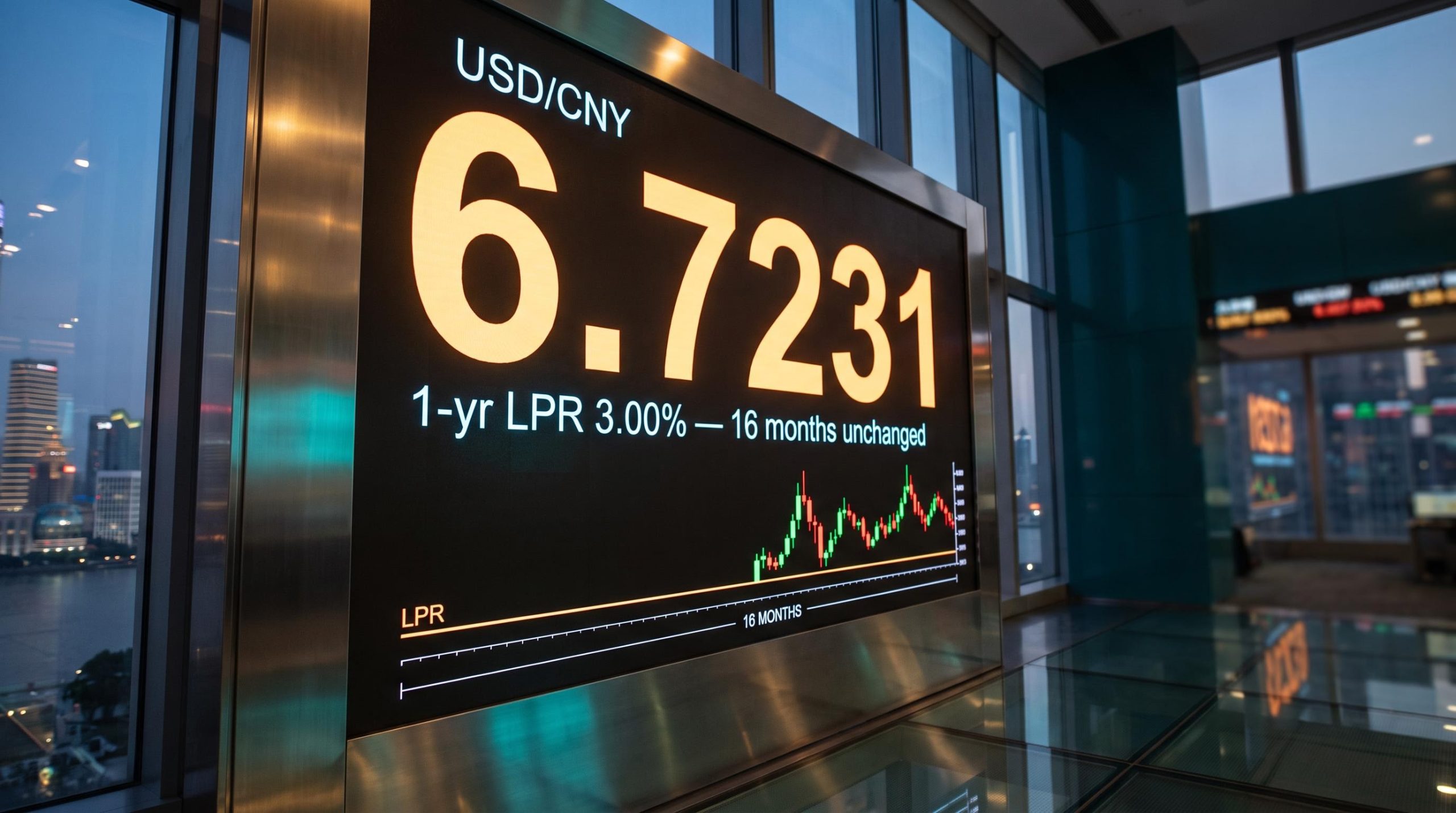
The People’s Bank of China (PBoC) has left its benchmark lending rates untouched for 16 straight months, a stretch that ended most recently on 20 September 2026. Yet describing the central bank as passive would be a mistake. The rates are frozen; the policy machinery underneath them is running constantly.
That tension matters right now for a specific reason. USD/CNY is hovering around 6.72, a US-China trade truce has just been extended by two months to 10 January 2027, and average tariffs on Chinese exports to the United States still sit at 36.5%. The PBoC is threading a narrow path between supporting a slowing economy and defending the yuan against the capital-outflow pressure that rate cuts would invite.
If you hold any exposure to emerging markets, Asian currencies, or globally connected supply chains, this configuration reaches into your portfolio. Here is what the PBoC’s toolkit actually contains, why cuts have not arrived despite the growth headwinds, what the yuan’s current level is signalling, and how that combination should shape your positioning in EM assets over the next three months.
What the PBoC actually does when it does not cut rates
Here is the apparent contradiction. The headline lending rate has not budged since mid-2025, yet the PBoC has been injecting liquidity, adjusting operational anchors, and steering funding conditions the entire time. The resolution is simple once you see it: benchmark lending rates are only one lever, and not even the most active one.
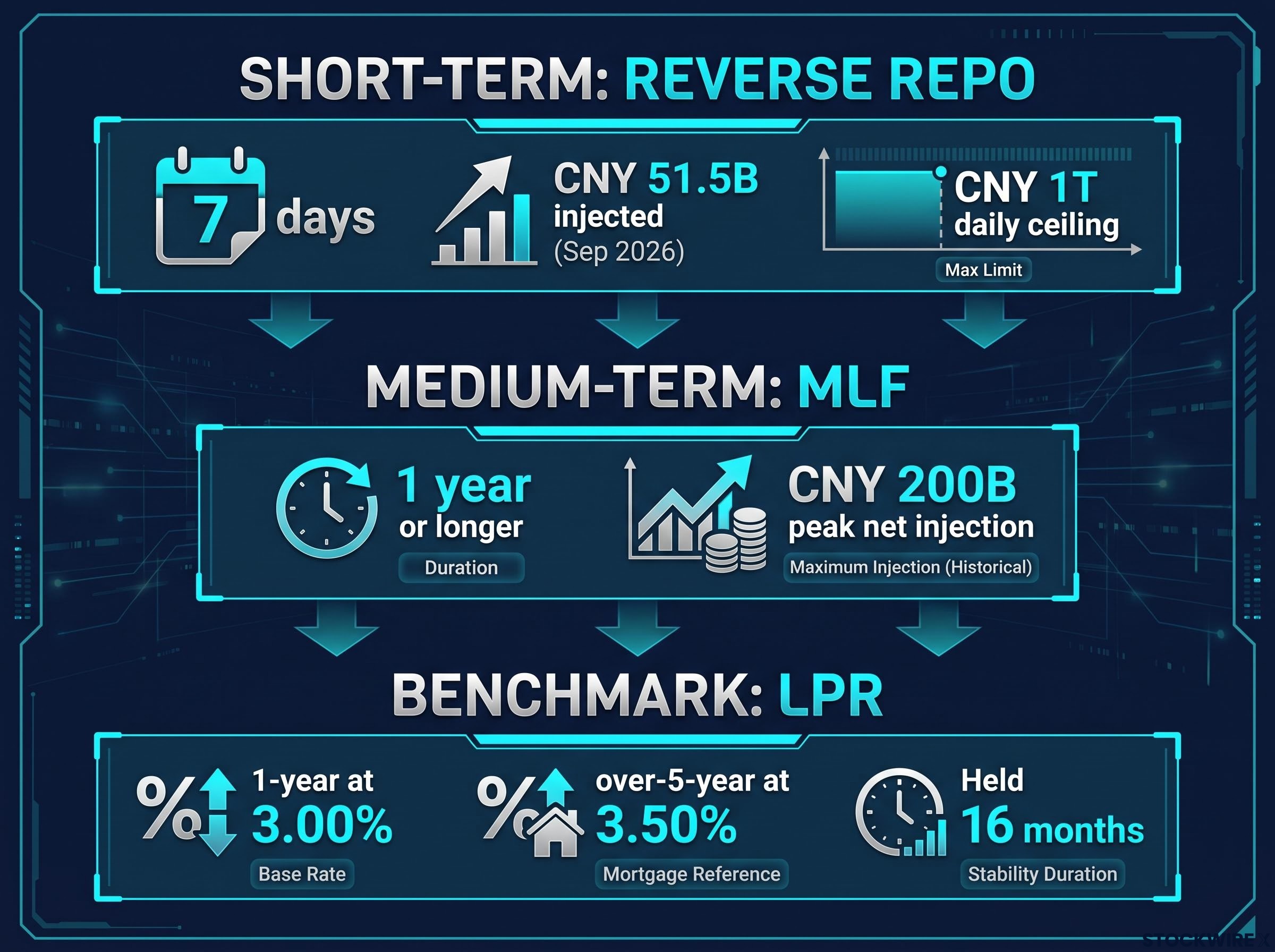
The 1-year Loan Prime Rate (LPR) sits at 3.00% and the over-5-year LPR at 3.50%, both held steady through the 16th consecutive monthly review. The LPR is the rate commercial banks quote to their best borrowers, and it anchors mortgage and corporate loan pricing across China.
But the LPR is derived, not decided in isolation. Two instruments do the real operational work: reverse repo operations and the Medium-term Lending Facility (MLF).
Reverse repos: the PBoC’s daily liquidity dial
A reverse repo is a short-term operation where the PBoC buys securities from commercial banks and agrees to sell them back a week later, at a set 7-day rate. This injects cash into the interbank market, the place where banks lend to each other, and directly influences how cheap or expensive short-term funding is.
The scale signals intent. The original source reports the PBoC raised its daily reverse repo ceiling to CNY 1 trillion, a marker of how much liquidity it stands ready to inject if needed. Against that ceiling, the CNY 51.5 billion in reverse repo injections recorded for September 2026 (per Trading Economics) is a measured deployment, not an aggressive one.
The MLF: the hidden anchor for all Chinese lending rates
The MLF provides collateralised funding to banks at maturities of a year or longer, at a rate the PBoC sets. Analysts describe it as the de facto policy rate in China’s current framework, because banks use MLF costs as the floor from which they calculate their LPR quotes.
That makes net MLF volume a quiet but powerful lever. The original source reports a CNY 200 billion net MLF injection during a peak period, which shifts medium-term funding conditions for banks even when the MLF rate itself stays put.
| Tool | Purpose | Typical maturity | Recent volume / signal | What it anchors |
|---|---|---|---|---|
| Reverse repo | Short-term interbank liquidity | 7 days | CNY 51.5B injected (Sep 2026); CNY 1T daily ceiling | Money-market funding costs |
| MLF | Medium-term bank funding | 1 year or longer | CNY 200B net injection (peak) | LPR pricing floor |
| LPR (1-yr / 5-yr) | Loan pricing benchmark | N/A (quoted rate) | Held 16 months | Mortgage and corporate loans |
The takeaway for you is direct. If you track only LPR announcements, you are reading one line of a much longer balance sheet, and you risk confusing “no rate cut” with “no policy response.” The two are not the same.
When big ASX news breaks, our subscribers know first
Why the PBoC is holding rates steady despite growth headwinds
The rate freeze is not a failure of nerve. It reflects a specific set of trade-offs, and each one is a genuine dilemma rather than a simple choice.
Three interlocking constraints make rate cuts risky:
- Yuan depreciation and capital outflows. Higher domestic rates preserve part of the yield gap versus the US dollar. Cut too far, and you narrow that gap, encouraging money to leave and pressuring USD/CNY, already above 6.72.
- Financial-stability and bank-margin concerns. IMF analysis and research desks at UBS and Nomura have flagged China’s high corporate and local-government leverage alongside property-sector stress. Deep cuts would compress bank net interest margins and risk propping up unviable projects.
- Weak transmission to the real economy. Even if the PBoC cut aggressively, state-led credit allocation and cautious borrowers mean the easing may not reach private-sector lending efficiently.
The external backdrop sharpens each of these. Average US tariffs on Chinese goods stand at 36.5% and Chinese tariffs on US goods at 31%, according to Al Jazeera citing a July 2026 Congressional Research Service report. Trade friction that persistent leaves little room to weaken the currency without inviting further conflict.
Analysts at Societe Generale characterised the US-China situation as a fragile ceasefire rather than a breakthrough on structural issues.
There is a competing view worth weighing. Some growth-focused economists argue the PBoC is being overly cautious, warning that real borrowing costs remain too high relative to nominal growth and that the economy risks drifting into deflation. The counter-argument holds that the binding constraints are structural, so even deeper cuts would not translate cleanly into consumption or investment.
The PBoC’s preference for quantity-based and targeted tools sits inside this debate deliberately. BIS research notes the central bank has long leaned on reserve-requirement changes, window guidance, and relending facilities rather than frequent benchmark-rate moves.
The PBoC governance structure sits at the root of this dynamic: Governor Pan Gongsheng holds both the CCP Committee Secretary and Governor roles simultaneously, meaning every rate announcement carries a political directive alongside its monetary signal, a feature with no direct equivalent at the Fed or ECB.
For you as a global investor, the yuan at 6.72 alongside a 16-month rate freeze is not a distress signal. It reads as a policy floor: a level below which the PBoC judges that rate cuts would trigger currency and stability consequences worse than slower growth itself. Understanding that changes what you watch for. A sustained yuan strengthening or a US rate pivot would shift the calculus, and those are the conditions under which a cut finally becomes plausible.
What the yuan’s position near 6.70-6.72 is telling currency markets
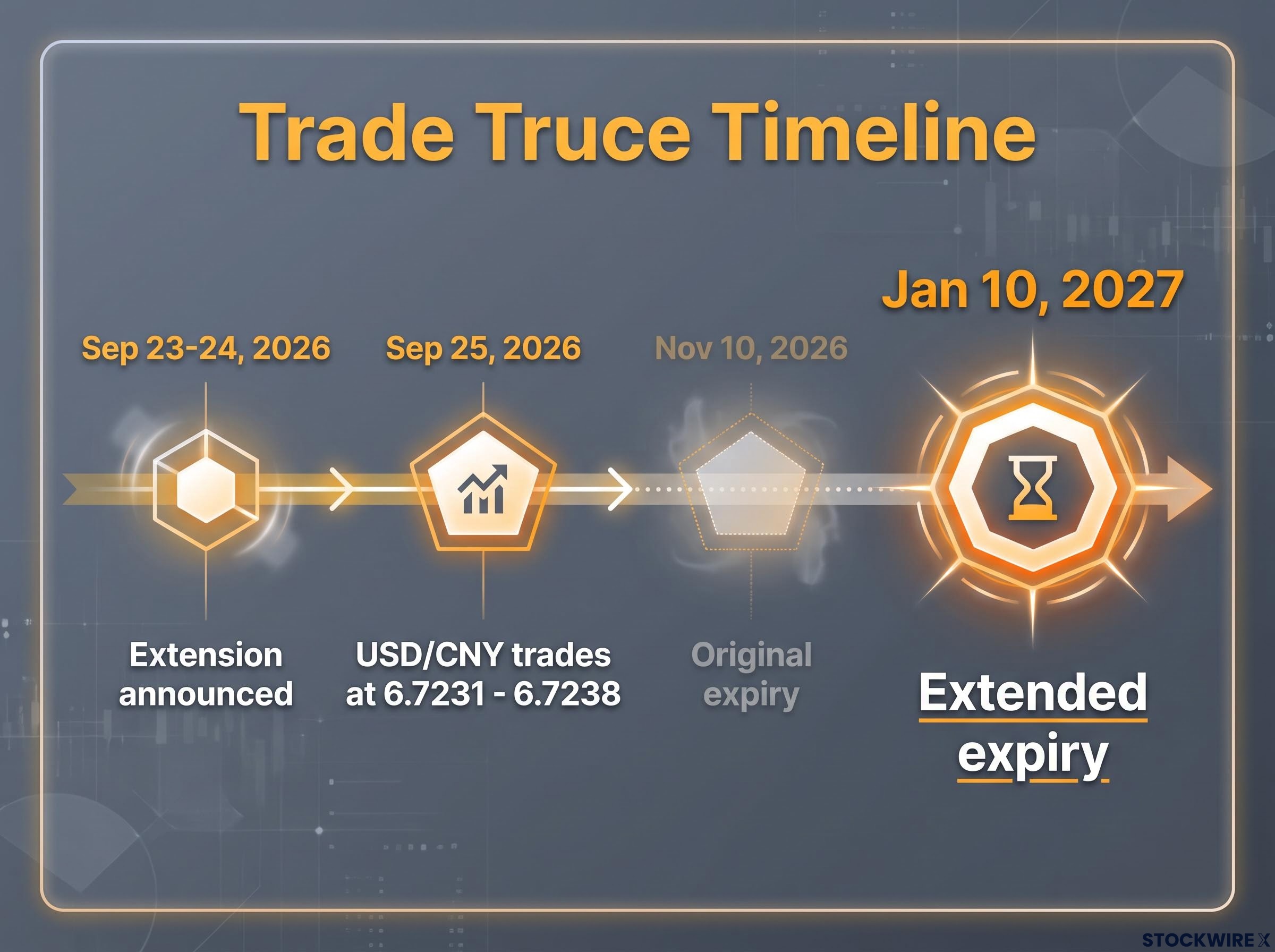
Start with the number on the screen. USD/CNY traded at 6.7231 to 6.7238 on 25 September 2026, per Trading Economics, after testing the 6.70 threshold amid volatility and stabilising near 6.71. That level is not an accident of free-floating markets. It is engineered.
What managed stability means in practice
China runs a managed float, not a freely floating currency. Each morning the PBoC sets a daily reference fix around which the yuan is allowed to trade within a band, and it reinforces that guidance through the same liquidity operations covered earlier.
The daily reference fix operates through a countercyclical adjustment factor that allows the PBoC to publish a rate stronger or weaker than market inputs alone would produce, and the gap between the published fix and model-implied values is the closest real-time readout of how much weight Beijing is placing on currency stability at any given moment.
The distinction matters for how you interpret the price. In a free float, 6.72 would simply reflect supply and demand. Here, it reflects supply, demand, and a central bank actively deciding that this is roughly where the yuan should sit.
That decision connects directly to the trade truce. With tariffs averaging 36.5% on Chinese exports and no structural deal in place, allowing the yuan to slide would risk fresh friction with Washington. Holding it steady supports the currency’s role as a partial regional reserve and funding currency.
The timing is not coincidental. The trade truce was extended to 10 January 2027, from an original 10 November 2026 expiry, in an announcement Reuters reported around 23-24 September 2026.
The trade truce extension dropped average tariffs from 57% to 47% while leaving Chinese electric vehicles at roughly 102.5% total duties and China’s rare-earth export concessions explicitly revocable on 10 January, confirming that the structural disputes driving PBoC caution on the yuan remain entirely unresolved.
US Treasury Secretary Scott Bessent said the extension was intended to “give more time to work on a potentially bigger trade deal.”
That framing tells you the stability is provisional and open-ended. It has a defined expiry date.
The risks that could break the range
Managed stability accumulates tension even as it delivers short-term predictability. History shows how that tension releases. The 2015 PBoC mini-devaluation, and the sharp yuan moves during the 2018-2019 trade war, both rippled into EM currencies and risk assets.
Several specific triggers could push USD/CNY materially out of its current band:
- A breakdown in the trade truce before January 2027
- Renewed tariff escalation or aggressive rhetoric from either side
- A sharp strengthening of the US dollar or a hawkish Fed pivot
- An unexpected PBoC signal that rate cuts are coming
The practical read for you is this. The yuan’s tight range is the PBoC’s public signal that it will absorb short-term volatility rather than let the exchange rate become a new flashpoint. If you hold yuan-denominated assets, you are benefiting from an implicit stability guarantee, but one with a hard expiry: 10 January 2027. Any deterioration in trade talks before that date is the scenario to hedge against.
What this configuration means for global and emerging-market investors
Pull the three threads together: a frozen LPR, active but calibrated liquidity operations, and a managed yuan. As a combination, this favours selective participation, argues against aggressive unhedged bets, and leaves the post-January path genuinely uncertain.
That points toward a middle path. Neither piling into unhedged yuan and Chinese equity exposure nor avoiding the region entirely is the defensible stance. Selective, hedged exposure is.
The spillover dimension is why this matters even if you hold no Chinese assets directly. When China signals growth concern or its currency wobbles, adjacent Asian currencies and global risk sentiment tend to follow. The 2018-2019 trade war showed that even tactical pauses were fragile, and markets reacted sharply to any hint of yuan weakness.
Past easing phases offer a useful precedent. Through 2018-2020, the PBoC stabilised domestic liquidity with reserve-requirement cuts and targeted facilities without dramatic benchmark-rate moves, yet global markets still responded to yuan signals rather than to the LPR itself.
Chinese government bond yields broke below 1.70% in August 2026 while the yuan simultaneously hit its strongest level since February 2023, a configuration that signals the PBoC faced no trade-off between domestic stimulus and FX stability at that moment and that sets a useful baseline for reading how much the current tariff environment has since tightened that constraint.
| Scenario | Yuan direction | Likely PBoC response | EM impact | Investor implication |
|---|---|---|---|---|
| Truce holds to Jan 2027 | Stable near 6.70-6.72 | Continued managed float, calibrated liquidity | Supportive, low volatility | Selective exposure viable |
| Truce collapses early | Depreciation pressure | FX intervention, liquidity defence | Risk-off, EM FX pressure | Hedges essential |
| US dollar strengthens | Weaker yuan bias | Firmer daily fix, guidance | Broad EM FX weakness | Reduce unhedged CNY beta |
| PBoC signals rate cut | Depreciation risk rises | MLF or LPR adjustment | Volatility spike | Reassess exposure quickly |
For the next three months, a practical risk-management approach looks like this:
- Run scenario analysis for the specific yuan-depreciation triggers listed above, so a move does not catch you unprepared.
- Hedge via options on EM FX rather than leaving yuan-correlated positions naked.
- Diversify across Asian currencies, paying particular attention to exposures that move with the CNY.
The mental model to hold is a holding pattern with a known expiry. The frozen LPR, the managed yuan at 6.72, and the truce running to 10 January 2027 create a window of relative stability worth participating in carefully, not ignoring. But treat that January date as a hard deadline for reassessing your exposure.
This article is for informational purposes only and should not be considered financial advice. Investors should conduct their own research and consult with financial professionals before making investment decisions.
Past performance does not guarantee future results, and any forward-looking scenarios here are speculative and subject to change based on market developments.
Reading the PBoC through the next three months
The value of understanding the toolkit is that you can now separate signal from noise. Not every data point out of Beijing carries the same weight, and knowing which is which keeps you from overreacting to routine operations or underreacting to a genuine turn.
Watch three categories of signal in the run-up to January:
- Rate tool signals. Any change to the MLF rate, the reverse repo rate, or the LPR announcement. These would mark a real policy shift.
- Yuan price signals. Movement outside the roughly 6.70-6.75 range, or a daily fix that diverges meaningfully from market expectations.
- Trade and political signals. Tariff announcements, summit communiques, or the emergence of an AI or tech dialogue framework that never materialised at the October 2025 Busan meeting.
The distinction between policy-significant and operational-noise events is where your edge sits. A daily reverse repo volume fluctuating within the existing CNY 1 trillion ceiling is administrative housekeeping. An MLF rate cut, an LPR adjustment, or a widening of the yuan band would be genuine inflection points.
The 1-year and over-5-year LPRs have now held at 3.00% and 3.50% for 16 consecutive months, which is why any move at all would be a significant signal rather than a routine adjustment.
Bessent’s framing of the extension as aimed at “a potentially bigger trade deal” is the political variable to track. Should a structural tariff reduction or an AI dialogue framework take shape before 10 January 2027, the PBoC’s constraint set would change materially, and so should your read on where the yuan and Chinese rates head next.