
The Fed just raised rates unanimously for the first time in more than three years, and one of Europe’s largest banks responded by cutting its EUR/USD target within days.
That reaction is worth understanding. It reveals something the rate headline alone does not: central bank credibility, not just where rates sit, is what drives a currency pair over a multi-year horizon.
Commerzbank analyst Thu Lan Nguyen trimmed the bank’s EUR/USD year-end 2026 forecast to 1.15, down from 1.17, after the Federal Open Market Committee (FOMC) delivered a 25 basis point hike on 16 September 2026. But the bank’s 2027 target of 1.18 tells a different story, one where dollar strength fades as political pressure on Fed independence becomes a structural drag.
Making sense of that requires unpacking three forces at once: where US rates are heading, whether the Fed can be trusted to follow through, and what structural weaknesses the dollar carries into 2027.
Here is a framework for reading the EUR/USD outlook through 2027, grounded in Commerzbank’s analysis, the Fed’s own projections, and the growing body of evidence that institutional credibility now matters as much to this pair as the gap between interest rates.
What the Fed’s September hike actually changed for EUR/USD
The hike itself was a surprise. Commerzbank had expected the Fed to hold, so when the FOMC lifted its target range to 3.75-4.00 percent on 16 September 2026, the first increase since July 2023, it landed on the hawkish side of what markets were pricing.
ECB-Fed policy divergence was the dominant EUR/USD narrative heading into September, with the ECB nearly fully priced to hike while markets assigned only a 40 percent probability to a Fed move, a setup that made the Fed’s unanimous September hike a larger positional shock than the rate change alone would suggest.
The number mattered less than the unanimity behind it. Every voting member backed the move, and new Chair Kevin Warsh pointed to that unanimous vote as evidence of the institution’s resolve, a deliberate signal that the Fed would not bend to external pressure.
That signal is what moved the pair. A central bank that raises rates together, without dissent, tells markets its guidance can be trusted. Traders read that as lower policy risk, and the dollar strengthened accordingly.
Why a unanimous vote moves markets differently than a split decision
When an FOMC vote splits, it exposes internal disagreement. Markets read the dissent as a sign that the next move is contested, which makes forward guidance less reliable and forces traders to demand a premium for that uncertainty.
A unanimous decision does the opposite. It anchors expectations, narrows the range of plausible next steps, and reduces the volatility cushion traders build into their pricing. That is precisely why the September vote supported the dollar out of proportion to its 25 basis points.
The forecast revision followed directly from that logic.
Commerzbank’s revised call EUR/USD year-end 2026 target cut to 1.15 from 1.17. The 0.02 difference is effectively a credibility premium on the dollar: the price of the Fed proving, through a unanimous vote, that it still means what it says.
The pair is expected to sit close to 1.15 through year-end with little further movement. For you as a reader, the lesson generalises: when the Fed surprises markets with resolve, the dollar benefits more than the rate change alone would justify. Currency markets price predictability, not just percentages, and knowing how to read that distinction is how you stay ahead of consensus.
When big ASX news breaks, our subscribers know first
How the Fed’s rate path sets up EUR/USD through 2027
The September hike is one step in a longer sequence, and the shape of that sequence is what pushes Commerzbank’s 2027 target above its 2026 one.
The Fed’s own Summary of Economic Projections (SEP), the quarterly document where each official pencils in where they expect rates to go, laid out the path. The median projection points to one more hike toward 4.00-4.25 percent by the end of 2026, with a median end-2026 rate of 4.1 percent, followed by a prolonged hold through 2027. Cuts are possible before end-2027, but no clear majority commits to them.
The dispersion is the part worth pausing on. Individual official projections spread across a rough 3-5 percent band for both end-2026 and end-2027. That is not a technical footnote: it tells you that even inside the Fed, the path from here is genuinely uncertain, and that the pair’s 2027 trajectory depends as much on what the Fed does not do as on what it does.
A fiscal risk premium in long-term Treasury yields, where rising US 10-year rates near 4.77 percent were read by multiple analyst teams as a debt-sustainability concern rather than an investment signal, illustrates why the normal yield-strength relationship for the dollar has become less reliable than it was in prior cycles.
Commerzbank’s base case sits comfortably inside this path but applies a longer lens. Its key assumptions are straightforward:
- Middle East tensions ease gradually, allowing current inflation pressure to fade over the coming year.
- With inflation subsiding, no further hikes are needed beyond the anticipated December 2026 move.
- Rates then hold flat through 2027, with cuts possible but not certain before year-end.
Here is how that maps onto the currency targets.
| Horizon | Fed Funds Projection | Commerzbank EUR/USD Target | Notes |
|---|---|---|---|
| End-2026 | 4.1% median | 1.15 | December hike assumed |
| End-2027 | Prolonged hold | 1.18 | Cuts possible but not certain |
The gap between the two targets is the whole story. A near-term hike keeps the dollar supported into year-end. A prolonged hold at 4.00-4.25 percent is dollar-neutral at best, and it turns dollar-negative the moment markets start pricing cuts into 2027. Understanding that timeline is what separates a reactive EUR/USD view from a strategic one.
The mechanics of central bank credibility loss and what it does to a currency
Rates explain part of the trajectory. The other part is credibility, and the mechanism there is worth understanding on its own terms.
The principle is this: when markets suspect a central bank can be pressured into politically-timed rate cuts, they stop trusting its commitment to controlling inflation. Investors then demand a risk premium on that currency, because real returns look shakier and inflation expectations climb. The currency weakens even if the current rate has not moved.
Two documented cases show the mechanism in action. Over the past decade, the Turkish government repeatedly dismissed central bank governors who resisted cutting rates, subordinating policy to presidential preference. The Turkish lira suffered sharp and repeated depreciations as investors priced in higher inflation and capital-flight risk.
Argentina tells a similar story at a different speed. A long history of politicised rate decisions and monetary financing of fiscal deficits produced chronic inflation and serial peso collapses. In both cases, persistent doubt about central bank autonomy translated directly into elevated risk premia and a structurally weak currency.
These are not historical curiosities. They are the mechanism diagram for what erosion of central bank independence does, playing out at different scales depending on how strong the underlying institutions are.
The channels through which it works are consistent:
- Higher inflation expectations, as markets anticipate looser policy than a rule-bound central bank would deliver.
- Erosion of policy predictability, as forward guidance loses reliability once rates look politically negotiable.
- Risk premia in bond and currency markets, widening spreads against peers seen as more independent.
The Congressional Research Service, in a January 2026 brief, set out why this matters for the institution being tested.
Independence “fosters a less political, longer-term approach yielding better outcomes such as lower inflation,” according to the Congressional Research Service.
What the US political pressure on the Fed has actually looked like
The US case is a pattern of pressure, not a single event, and the credibility cost accumulates across it.
A Department of Justice criminal investigation of then-Chair Jerome Powell was reported in January 2026, with subpoenas Powell described as a “pretext” to force sharp rate cuts. That investigation was dropped in April 2026, but it had already created friction. Separately, the administration attempted to dismiss Governor Lisa Cook, a move the courts blocked pending due process, and from March 2026 the executive branch pushed to bring Fed bank-oversight rules under White House review.
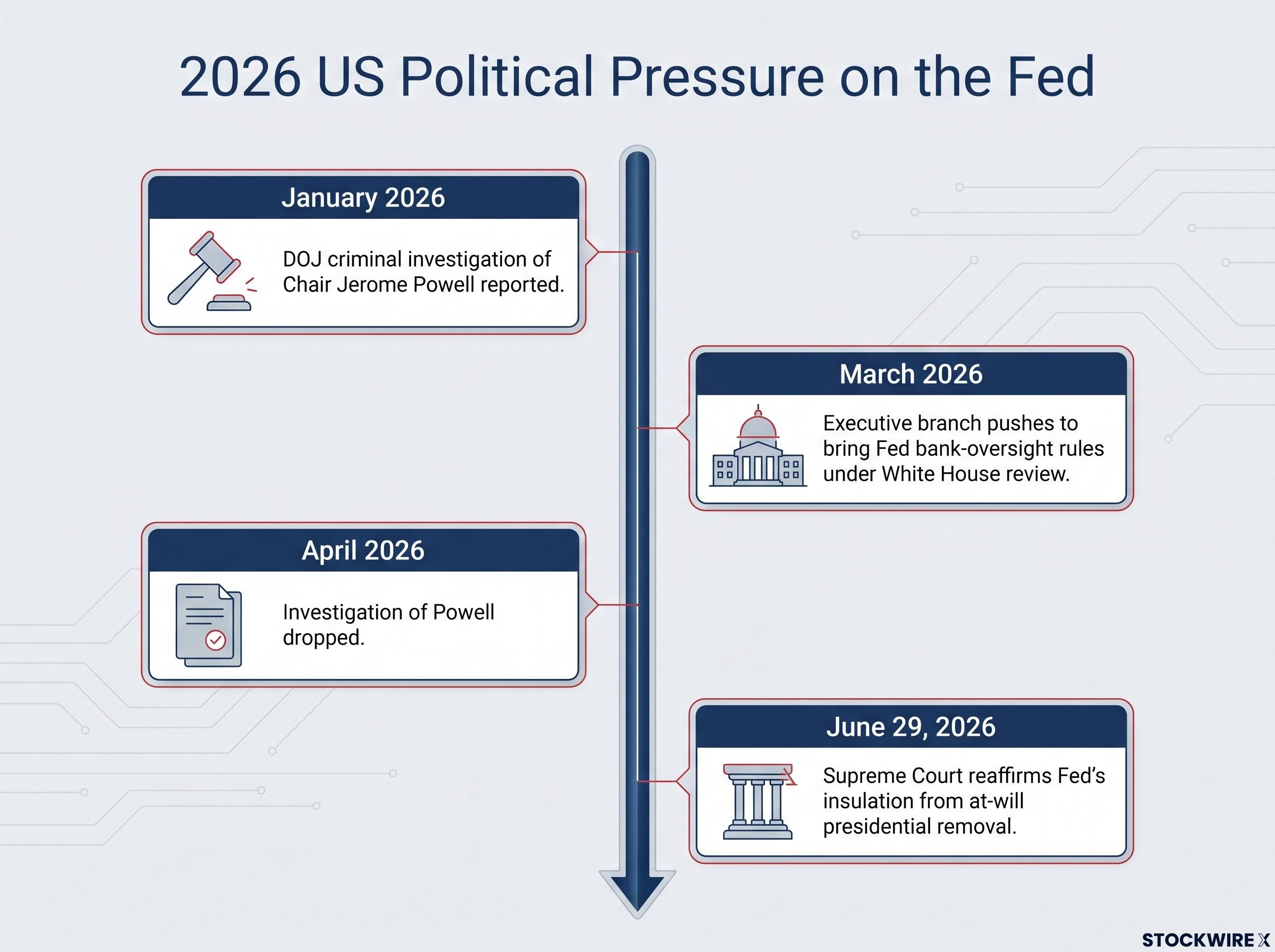
The Supreme Court weighed in on 29 June 2026, reaffirming the Fed’s insulation from at-will presidential removal while stripping similar protections from most other independent agencies. That reaffirmed the Fed’s formal independence, but it also left the institution increasingly isolated as a target.
For you, this is the vocabulary for reading future interference events as currency signals rather than headlines. Commerzbank explicitly cites these dynamics as justifying a “slight risk premium” on the dollar, even while near-term Fed credibility supports it.
Where major institutions stand on EUR/USD and what separates them
The forecast range across major banks is not noise around a shared number. It is a genuine analytical disagreement about whether US exceptionalism outlasts this rate cycle.
| Institution | End-2026 | End-2027 | Primary Driver | Verification |
|---|---|---|---|---|
| Commerzbank | 1.15 | 1.18 | Political risk premium on USD | Confirmed |
| Bank of America | 1.15 | 1.20 | Resilient US growth and yields | Confirmed |
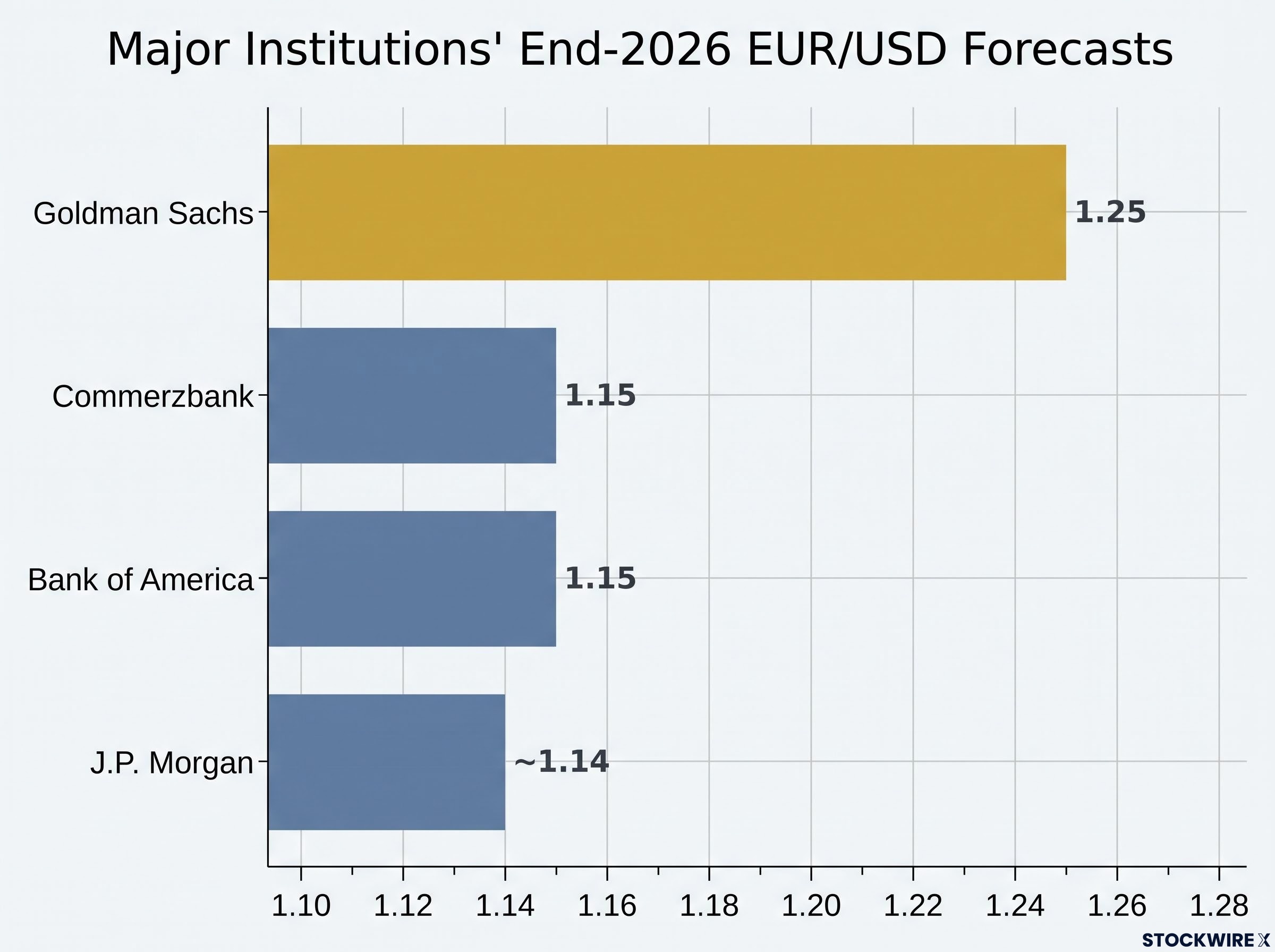
| J.P. Morgan | ~1.14 | 1.13 (Mar 2027) | US exceptionalism, safe-haven demand | Confirmed |
| Goldman Sachs | 1.25 | n/a | Dollar softening as spreads narrow | Unverified |
J.P. Morgan sits at the dollar-bullish end, projecting the pair to fall from 1.17 in June 2026 toward 1.13 by March 2027, hovering between 1.13 and 1.15 across the intervening quarters. Goldman Sachs, by contrast, is reported at 1.25 for end-2026, though that figure comes from a RoboForex consensus compilation of 9 September 2026 and has not been independently confirmed. Treat it, and the similar unverified figures for Deutsche Bank, UBS, Morgan Stanley, and ING, with appropriate caution.
Commerzbank sits between these poles, more euro-friendly than J.P. Morgan but well short of the Goldman cluster. The split reflects two competing frameworks:
- The US exceptionalism camp (J.P. Morgan, Bank of America): stronger US growth, a persistent yield advantage, and safe-haven demand keep the dollar resilient and limit how far the euro can climb.
- The dollar softening camp (Goldman Sachs, broader consensus): as rate spreads narrow and global growth normalises, the dollar gives ground gradually, lifting EUR/USD toward the 1.20-1.25 region.
The distance between J.P. Morgan at 1.13 and Goldman at 1.25 for the same horizon is not a rounding error. It reflects opposite answers to a single question: does US exceptionalism survive the rate cycle? When you form your own EUR/USD view, you are implicitly picking a side in that debate, and mapping the spread lets you match a bank’s number to a macro thesis rather than treating any single figure as consensus.
The risks that could break the baseline in either direction
Every forecast above assumes a base case that could break. The useful way to hold the uncertainty is as a tug-of-war between forces pulling in opposite directions.
Factors that could push EUR/USD above 1.20:
- Unexpected ECB hawkishness if eurozone inflation proves sticky.
- Accelerated Fed cuts triggered by a sharp US slowdown or recession.
- Further erosion of Fed credibility, adding to the dollar’s structural risk premium.
Factors that could hold it below 1.15:
- Stronger-than-expected US growth or stubborn inflation forcing additional hikes.
- Energy-market shocks, which hit the eurozone harder given its import dependence.
- Eurozone fragmentation risk, from incomplete fiscal union to Italian and other sovereign debt flare-ups.
Eurozone fragmentation risk has taken a concrete form in 2026: France’s 10-year yield overtook Italy’s for the first time since roughly 2005, with the France-Germany spread widening to levels last seen in 2012, a dynamic that adds a measurable sovereign-debt premium to European assets even before any escalation in fiscal stress.
The energy asymmetry deserves emphasis. Commerzbank notes that improving US-Iran relations and falling energy prices could push EUR/USD lower, because energy shocks weaken the euro more than the dollar. Commerzbank nonetheless considers any dollar gains arising from that scenario to be temporary rather than a lasting shift in direction.
The most important risk to internalise is a paradox.
Political instability can strengthen the dollar in the near term through safe-haven flows, even as it erodes the currency’s credibility over the medium term. Commerzbank frames the latter as a “slight risk premium” that accumulates over time.
That paradox is why a directional EUR/USD call needs a view on timing, not just fundamentals. The same political event that should logically weaken the dollar through credibility loss can temporarily push it higher through safe-haven demand. Knowing which risks are directionally asymmetric for the eurozone versus the US is what lets you stress-test any institutional forecast against your own scenarios, rather than treating a projection as a prediction.
What Commerzbank’s EUR/USD framework tells you about the road to 2027
Commerzbank’s move from 1.15 to 1.18 looks modest. It is actually a specific claim about which force wins, and when.
The view has three parts working in sequence. The September hike restored near-term credibility, so the dollar is supported into year-end. The prolonged hold erodes the yield advantage over 2027, turning the dollar neutral to mildly negative. And political risk accumulates as a structural discount, weakening the dollar modestly by end-2027.
That is why the 1.18 target sits below the Goldman Sachs and broader consensus cluster near 1.20-1.25. Commerzbank is betting the dollar’s political headwinds are real but not catastrophic, arriving slowly enough that yield support dominates in 2026 and credibility erosion dominates in 2027.
The durable takeaway is not a number, it is a set of variables to monitor:
- Fed rate decisions versus the SEP. Watch whether the Fed hikes in December and how firmly it holds through 2027; deviations reset the yield story that anchors 2026.
- Developments in political pressure on Fed independence. Track investigations, dismissals, and regulatory encroachment, because each adds to the cumulative credibility discount.
- Eurozone energy and fragmentation dynamics. Watch energy shocks and sovereign-debt stress, the asymmetric risks most likely to cap euro strength.
Track those three, and you can update your EUR/USD view as new information arrives rather than waiting for the next research note.
For readers wanting to understand the structural forces compounding the credibility discount over a longer horizon, our deep-dive into dollar reserve-currency risks examines the OMFIF sovereign-institution survey data showing net-negative dollar allocation intent for the first time on record.
This article is for informational purposes only and should not be considered financial advice. Investors should conduct their own research and consult with financial professionals before making investment decisions.
Past performance does not guarantee future results. Financial projections are subject to market conditions and various risk factors, and the forward-looking statements above are speculative and subject to change based on market developments.