Money markets now put the odds of a Bank of England rate rise in November at 77%. A Reuters poll of professional economists, looking at exactly the same inflation data, sees no hike at all.
Both camps are reading the same numbers. They have reached opposite conclusions. That disagreement is the whole story.
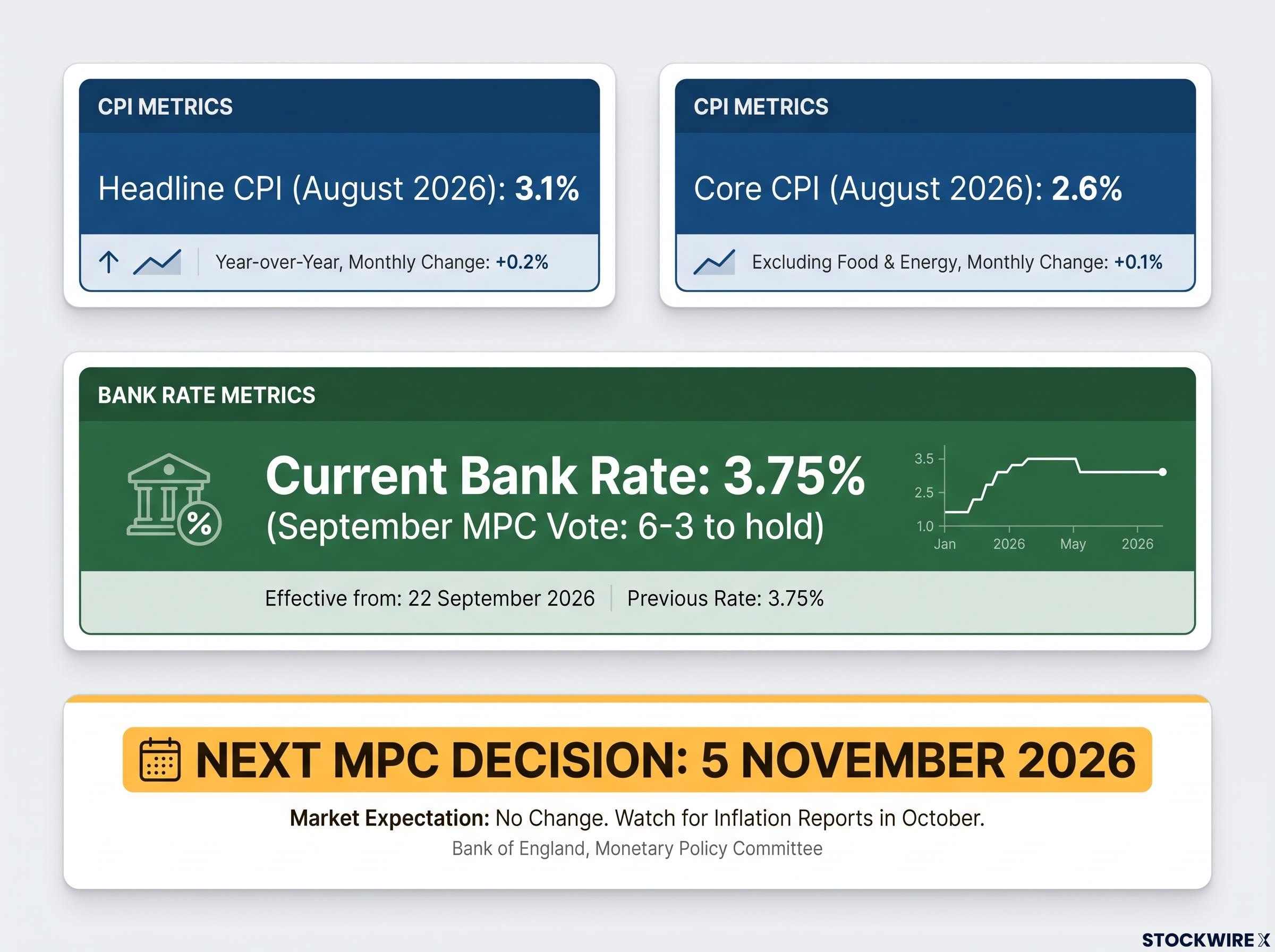
UK headline inflation climbed to 3.1% in the year to August 2026, pushed up by war-linked oil and fuel costs, and the Monetary Policy Committee (MPC) voted 6-3 to hold Bank Rate at 3.75% at its September meeting. The next decision lands on 5 November 2026.
What each side believes about oil-driven inflation determines whether UK borrowers face another round of mortgage cost increases, or whether the current rate plateau holds.
This piece maps the specific numbers behind the market-versus-economist split, explains how a geopolitical oil shock travels into BoE policy expectations, and sets out what each scenario means for UK households before the November vote.
What money markets are actually pricing ahead of November
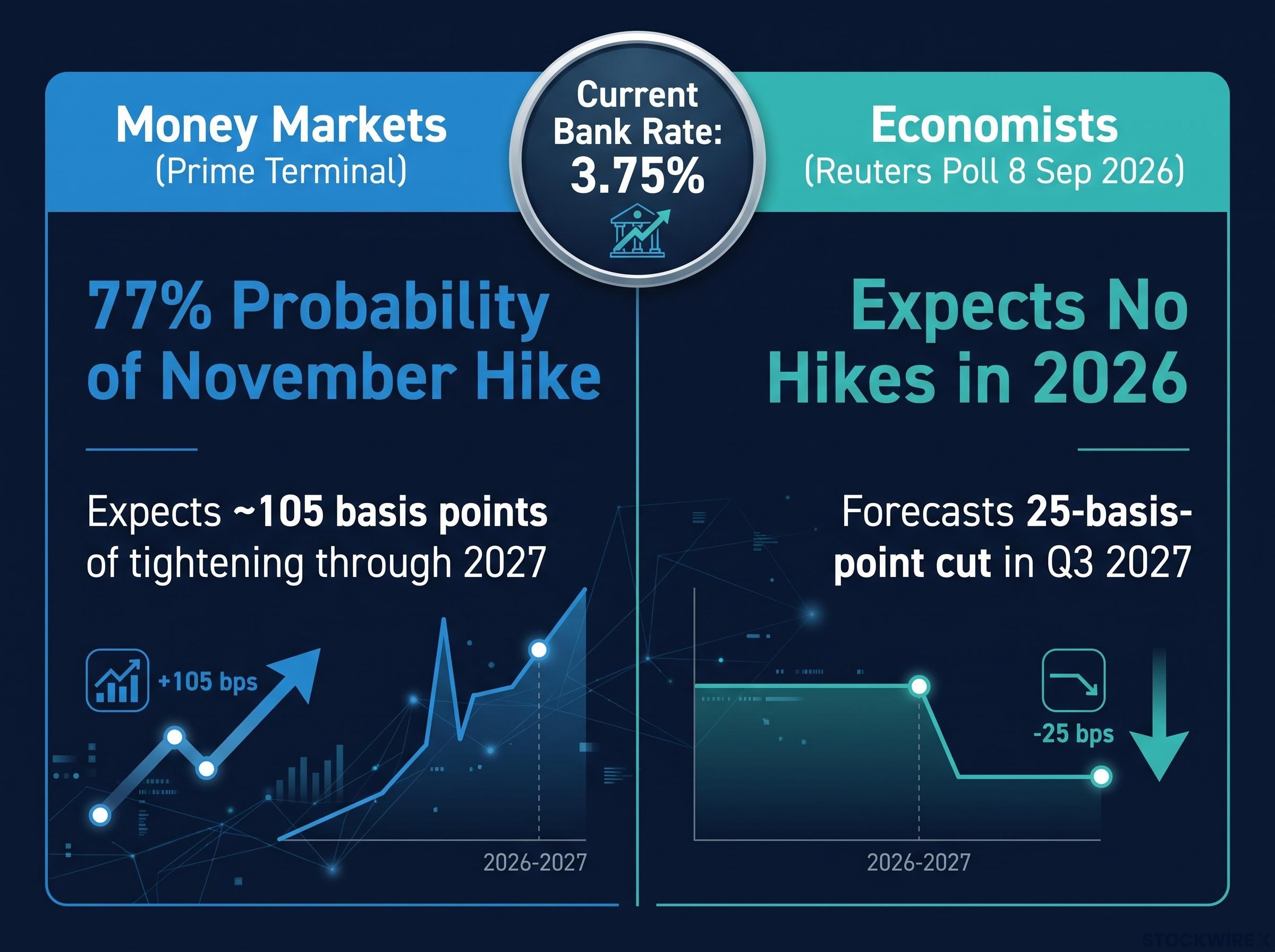
Start with the headline number. Prime Terminal data puts the probability of a rate increase at the November MPC meeting at 77%. That is not a coin-flip; that is conviction.
Money markets are pricing a 77% probability that the Bank of England raises Bank Rate at its 5 November 2026 meeting, according to Prime Terminal.
Work outward from that figure and the picture sharpens. Markets are currently pricing roughly 33 basis points of BoE tightening for the remainder of 2026, and a cumulative 105 basis points of tightening through 2027. In plain terms, investors are betting Bank Rate ends this cycle materially higher than the 3.75% it sits at today.
The MPC hawkish bloc had already grown from one dissenter to three across just three meetings before the September vote, and five-year swap rates crossed 4.52% in that period, meaning mortgage repricing was well underway before the Committee formally held at 3.75%.
A separate snapshot tells a slightly milder version of the same story. Reuters reported on 8 September 2026 that markets were pricing three 25-basis-point hikes through mid-2027, starting in November, which adds up to around 75 basis points cumulatively.
These two figures, 75 and 105 basis points, are not a contradiction to explain away. They are two readings taken at different moments using different methods. The Reuters figure carries an early-September date; the Prime Terminal number reflects a more recent position.
The gap between them is itself a signal. Market conviction has hardened since early September, so the higher Prime Terminal figure is the more current read on where positioning now sits.
| Measure | Reuters (8 Sep 2026) | Prime Terminal (current) |
|---|---|---|
| Implied hikes | Three 25bp hikes through mid-2027 | Consistent with a November move |
| Cumulative tightening | ~75bp by mid-2027 | ~105bp through 2027 |
| Terminal rate implication | ~4.50% by mid-2027 | Higher, given deeper tightening |
| Snapshot date | 8 September 2026 | More recent |
Why does the pricing matter before the MPC has even voted? Because lenders adjust ahead of decisions, not after them. What the market has already priced in tells you where mortgage and savings rates are heading before a single MPC member raises a hand.
When big ASX news breaks, our subscribers know first
Why economists expect something different entirely
The professional forecasters are not hedging politely. They are pointing in the opposite direction.
The Reuters poll of 8 September 2026 found economists expect no hikes at all, with Bank Rate held at 3.75% for the rest of 2026 and through at least mid-2027. The median forecast then calls for a 25-basis-point cut in Q3 2027.
Sit with that for a moment. Markets are pricing rate rises; economists are pricing an eventual cut. This is not a difference of degree. It is a difference of direction.
The MPC’s own September vote leans toward the economist camp. The Committee split 6-3 to hold at 3.75%, a majority content to wait rather than move against war-driven price pressure.
So how can both groups read the same 3.1% CPI print and disagree so completely? The answer sits in the detail of the data, not the headline.
Core CPI, which strips out energy, food, alcohol and tobacco, held at 2.6% year-on-year in August 2026, unchanged from July. That stability is the single most important number for understanding the economist position. It tells you inflation is running hot in the headline but is not yet broad-based, which is precisely the condition under which the MPC has signalled it can afford to be patient.
The MPC’s patience rests on a distinction the July data made clearly: the energy-driven headline spike in CPI does not represent a deterioration in medium-term inflation, and the majority of the Committee voted explicitly on that basis when holding at 3.75% in late July.
Markets are pricing a more mechanical response: CPI is above target, so rates should rise. Economists are pricing persistence: an energy-specific spike that fades is not the kind of inflation that justifies a tightening cycle. Trading Economics’ econometric model sits between the two, projecting Bank Rate near 4.00% in 2027 and around 3.50% in 2028.
What could stop the BoE following the market
Several factors could keep the MPC from delivering the tightening markets have priced:
- An oil price reversal, which would ease the energy component pushing CPI higher
- Slowing UK growth and fiscal strain against what The Telegraph has framed as a “challenging” Budget
- Household borrowing stress, as higher rates bite on mortgage holders and consumer demand
- The likely temporariness of the energy shock itself, which underpins the economist call for a 2027 cut rather than a hiking cycle
Knowing that the two camps disagree about inflation persistence, not inflation levels, gives you a framework. Every new CPI or energy-price release before 5 November either confirms the case for a hike or undermines it.
How a war in the Middle East moves mortgage rates in Manchester
The connection between an oil disruption in the Gulf and a monthly payment on a Manchester mortgage feels remote. It is not. The chain is short, and every link is doing visible work right now.
It starts with oil. War-linked disruption pushes up crude and fuel prices, and those costs flow straight into the energy and fuel components of UK inflation. That is why headline CPI accelerated to 3.1% in August while core CPI stayed put at 2.6%: the pressure is energy-specific, not economy-wide.
Oil price transmission channels into CPI operate at two speeds: the direct energy component hits within weeks, while indirect pass-through via logistics, agriculture, and manufacturing supply chains builds over a 6-12 month lag, a distinction that explains why headline and core inflation can diverge so sharply during a geopolitical supply shock.
From there, higher headline CPI raises the question the MPC exists to answer. Is inflation heading back to the 2% target, or getting stuck above it? Markets answer by pricing a higher expected path for Bank Rate.
Here is where the mechanics matter. Money markets price future Bank Rate through instruments such as overnight index swaps and short sterling futures, contracts whose prices imply where investors expect rates to sit at future meetings. These markets update in real time as inflation data and geopolitical news arrive.
The final link is the one that reaches your front door. Lenders reprice mortgages and deposits in anticipation of expected policy, not just in response to actual MPC votes.
Financial markets move ahead of MPC decisions, not after them. When investors price a 77% chance of a November hike, lenders begin adjusting their rates before the Committee has voted.
Laid out in sequence, the transmission chain runs:
- Oil and fuel prices rise on war-linked disruption
- The energy component of UK CPI climbs
- Headline CPI accelerates, reaching 3.1% in August 2026
- Markets price a higher expected path for Bank Rate
- Lenders adjust mortgage and savings rates ahead of the MPC
- The MPC votes on 5 November 2026
There is a live wildcard in the chain. Reports of a potential phased US-Iran agreement circulated during the week ending 25 September 2026, raising the question of whether the energy price impulse persists or fades. If oil eases, the whole sequence loses momentum.
For you, the practical takeaway is direct. If you hold a tracker or variable-rate mortgage, the market’s 77% conviction is already shaping your financial environment, regardless of what the MPC decides in November.
What a November hike, or a hold, means for UK borrowers and savers
A 25-basis-point move sounds abstract until it hits a monthly payment. Split the stakes between the two household groups and the abstraction disappears.
Start with borrowers. A hike would lift Bank Rate from 3.75% to 4.00%, and tracker and variable-rate mortgages adjust automatically, so those payments would rise the moment the MPC moved. New fixed-rate deals feel it too, because lenders reprice fixed products in anticipation of expected policy rather than waiting for the vote.
Now savers. A higher Bank Rate tends to lift interest on cash and term deposits, which sounds like unambiguous good news. It is not quite that clean: banks do not always pass on the full increase, so any benefit is incremental and far from guaranteed.
Put both sides together and you get a double squeeze. Households are already absorbing higher energy and fuel bills from war-linked oil prices, and a November hike would stack higher debt-servicing costs on top.
| Impact area | November hike scenario | November hold scenario |
|---|---|---|
| Bank Rate level | Rises to 4.00% | Holds at 3.75% |
| Tracker mortgage impact | Payments rise automatically | Payments unchanged from current level |
| Fixed-rate mortgage market | New deals repriced higher | Pricing pressure eases if odds fall |
| Savings account impact | Some incremental uplift, not guaranteed full pass-through | Rates broadly steady |
The households most exposed to the combined pressure are clear:
- Tracker mortgage holders, who feel any Bank Rate move immediately
- Borrowers whose fixed-rate deals are expiring soon and must remortgage into the current environment
- Variable-rate borrowers with high loan-to-income ratios, where debt-servicing costs bite hardest
Here is the part headline coverage tends to miss. Even under a hold, the pressure does not lift. Economists do not expect a cut below 3.75% until Q3 2027 at the earliest, which means elevated rates are effectively locked in for at least nine more months. The difference between a hike and a hold in November is real, but narrower than it looks, because in either case the rate environment stays materially above pre-tightening levels through mid-2027.
What the market-economist divide tells you about navigating this rate cycle
Step back from the individual numbers and the most useful signal is not any single figure. It is the width of the gap between them.
A 77% market probability of a hike sitting alongside a median economist forecast of no move, and an eventual cut in Q3 2027, describes a genuinely wide range of outcomes. That width is the honest picture of where UK monetary policy stands in late September 2026, and it is worth more than any false precision either camp offers on its own.
The November decision is really a test of one question. Does war-driven, energy-specific inflation justify further tightening? Core CPI at 2.6% is the variable on which the two camps split, and how it moves before the vote will decide which side looks right.
The Bank’s own inflation peak forecast was revised from around 3.2% in Q4 2026 to ‘somewhat over 4%’ in early 2027, a near full-percentage-point upward shift that signals a conditional pause rather than a settled policy stance and helps explain why markets are not taking the hold at face value.
Watch three signals, and note which way each pushes the odds:
- September CPI: an acceleration above 3.1% lifts the odds of a hike; a deceleration lowers them
- Oil prices and Middle East developments: moderation, including any US-Iran agreement, pulls the odds down; renewed disruption pushes them up
- MPC communications in October: hawkish signals from policymakers raise the odds; cautious ones ease them
If the September CPI print lands at 3.2% or above, the 77% market probability will likely climb higher, and the economist consensus becomes the minority view in practice, not just in theory.
The decision that matters to you, whether to fix, extend a fixed term, or hold variable exposure, cannot be answered by the 77% figure alone. Treating market pricing as a forecast rather than a probability is the trap. The 23% on the other side is a substantial scenario, and the economist consensus points the opposite way entirely, so both belong in any personal financial call before 5 November.
This article is for informational purposes only and should not be considered financial advice. Investors should conduct their own research and consult with financial professionals before making investment decisions. Past performance does not guarantee future results. Financial projections are subject to market conditions and various risk factors, and forward-looking statements are speculative and subject to change based on market developments.