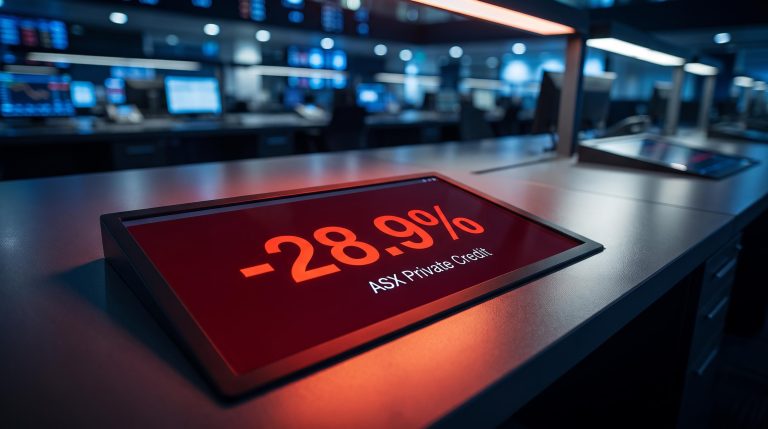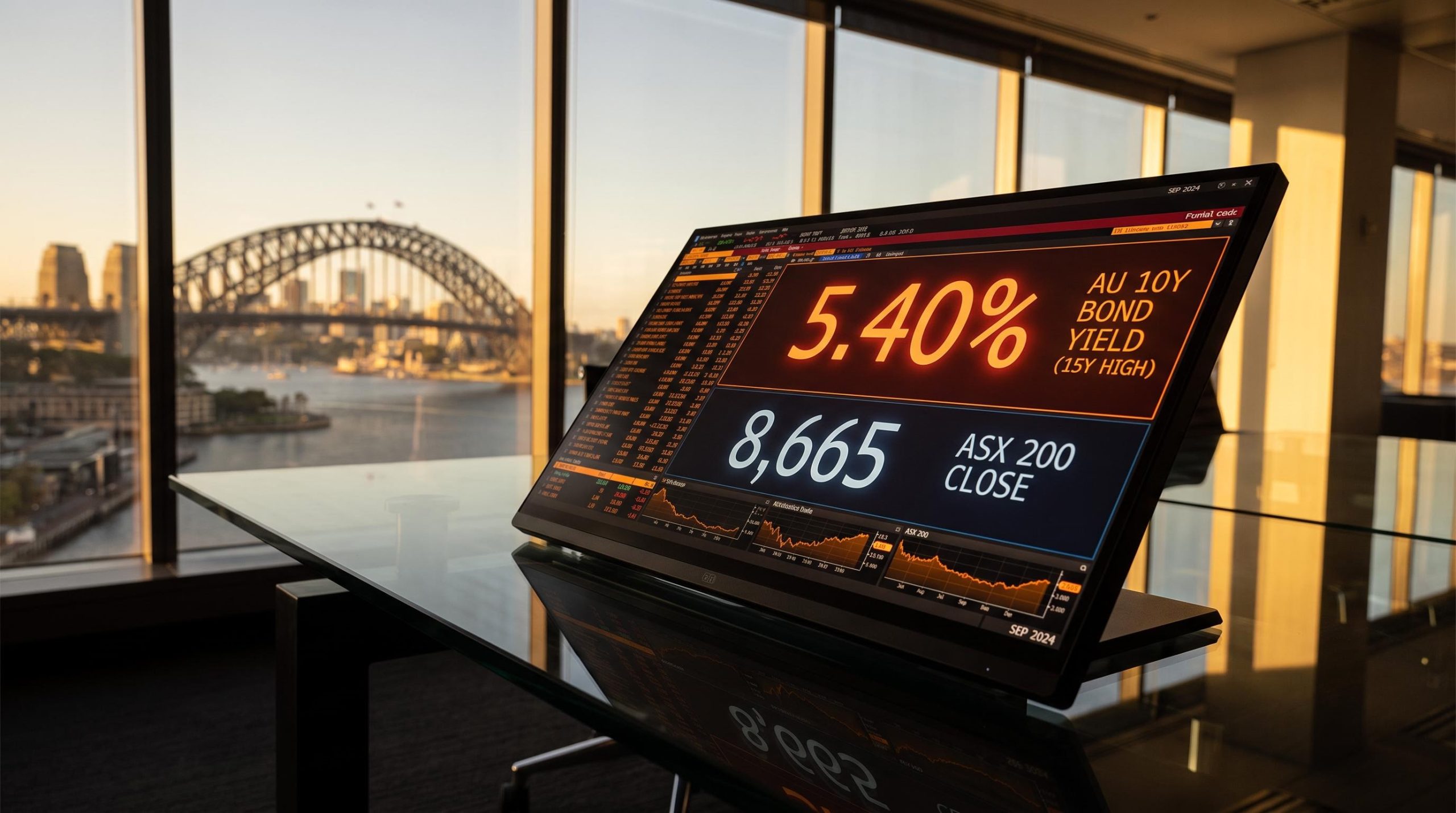
Australian equities have just wiped out roughly 4.5% across a bruising four-week September slide, abruptly ending a five-month winning streak. The trigger sits in the bond market, where the 10-year government yield has rocketed past 5.16% to its highest level since April 2011.
This is not an isolated ASX problem. It is a direct transmission of global central bank tightening and surging oil prices crashing into a domestic market bracing for one of its most consequential weeks in recent memory.
That week arrives now. Tuesday brings a near-certain Reserve Bank of Australia (RBA) rate decision landing on the same day as roughly $6.5 billion in dividend payouts, followed by Wednesday’s inflation print on the final trading day of the quarter.
Here is the framework for understanding how these cash distributions, the imminent rate call, and fresh CPI data will interact to drive portfolio volatility through the end of the quarter, and why the current ASX 200 outlook hinges far more on the risk-free rate than on any single company’s earnings.
How the global yield shock engineered the September sell-off
The ASX 200 shed another 37 points on Friday, 25 September 2026, a 0.4% decline that closed the index at 8,665 and stretched the losing streak to four consecutive weeks. After five straight months of gains, the reversal has been sharp.
The mathematics behind it are more important than the headline. When the risk-free rate climbs, the present value of future company earnings falls, and that gravitational pull hits longer-duration sectors hardest.
The mechanics are well-established: a rising risk-free rate compresses equity valuations through the discount-rate channel, reducing the present value of future cash flows even when the underlying businesses are growing and meeting their earnings targets.
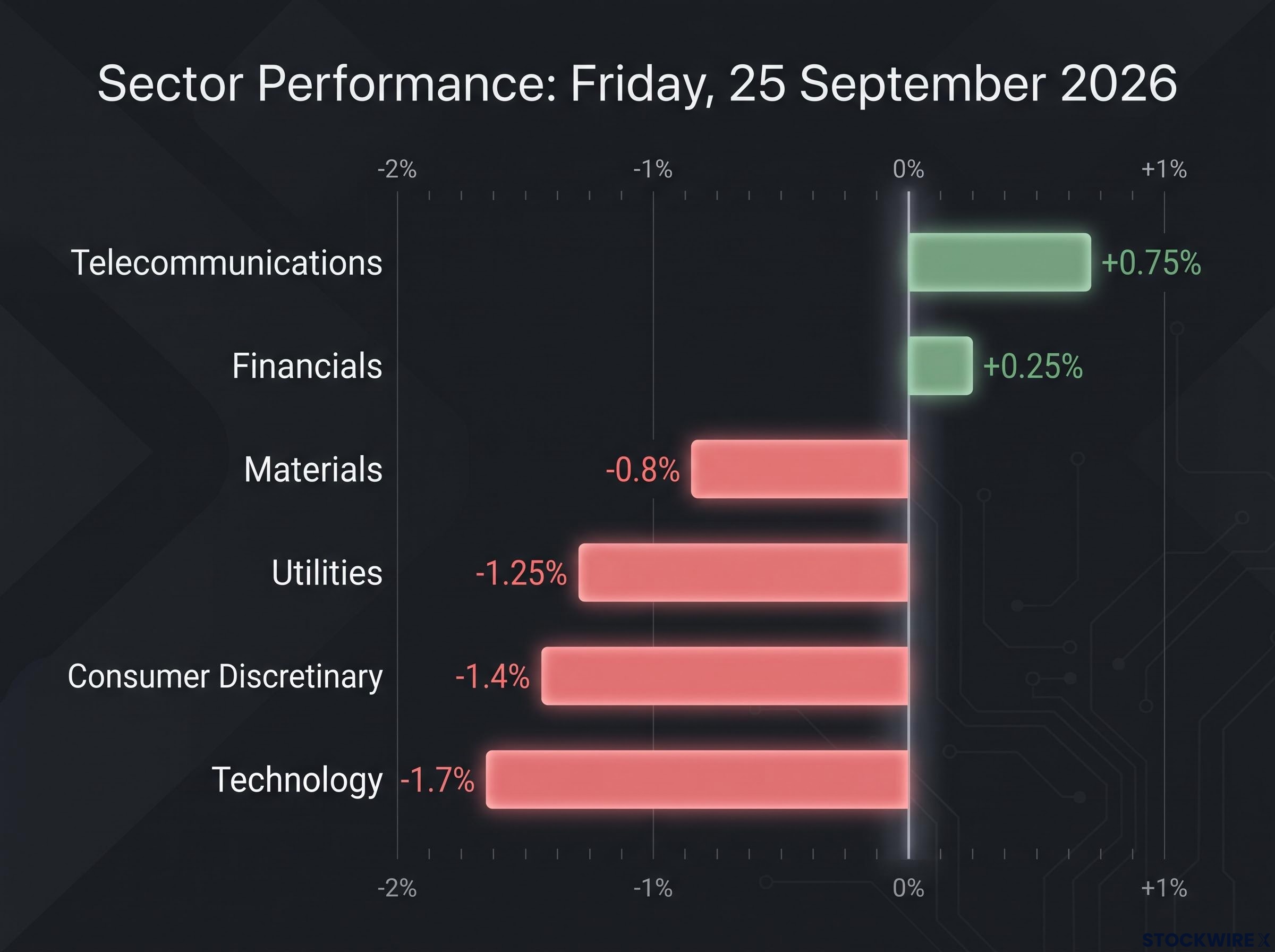
You could see exactly that logic play out across Friday’s session:
- Technology shares fell approximately 1.7%, the heaviest sector drop.
- Consumer discretionary stocks declined around 1.4%.
- Utilities dropped roughly 1.25%.
- Materials fell as a group by about 0.8%.
- Financials, including the major banks, rose 0.25%.
- Telecommunications gained 0.75%, the strongest performer of the day.
The pattern is not random. Technology and consumer discretionary names carry earnings weighted far into the future, so a higher discount rate erodes their valuations more than it does a defensive telco throwing off steady cash today.
What sits underneath all of it is the bond market. According to TradingEconomics, the Australian 10-year yield rose toward 5.40%, a fresh 15-year high, driven by soaring oil prices, heightened inflation concerns, and expectations of further global policy tightening. Commonwealth Bank commentary put the yield above 5.19%, flagging that investors are growing worried about global bond markets.
ABC News characterised the surge in the 10-year yield to 5.16%, its highest since April 2011, as a “once-in-a-generation” bond-market environment.
The move is being imported. Bloomberg noted Australian yields climbed to decade-plus highs while tracking overnight moves in US Treasuries, as a spike in crude deepened inflation worries worldwide.
Here is what that means for you directly. A risk-free rate above 5% fundamentally changes how your equity portfolio is valued, which means your growth and technology holdings face intense downward pressure regardless of how well the underlying businesses are actually performing. Much of your recent portfolio pain is a mechanical valuation adjustment, not a verdict on the companies you own.
When big ASX news breaks, our subscribers know first
Pricing the RBA tightening cycle into year-end
The past four weeks explain the damage already done. Tuesday introduces a fresh source of it.
The current decision sits within a consecutive sequence of moves: the RBA tightening cycle has already delivered three straight hikes since January 2026, with each meeting reinforcing the Board’s stated commitment to returning inflation to the 2-3% target band before any pause is considered.
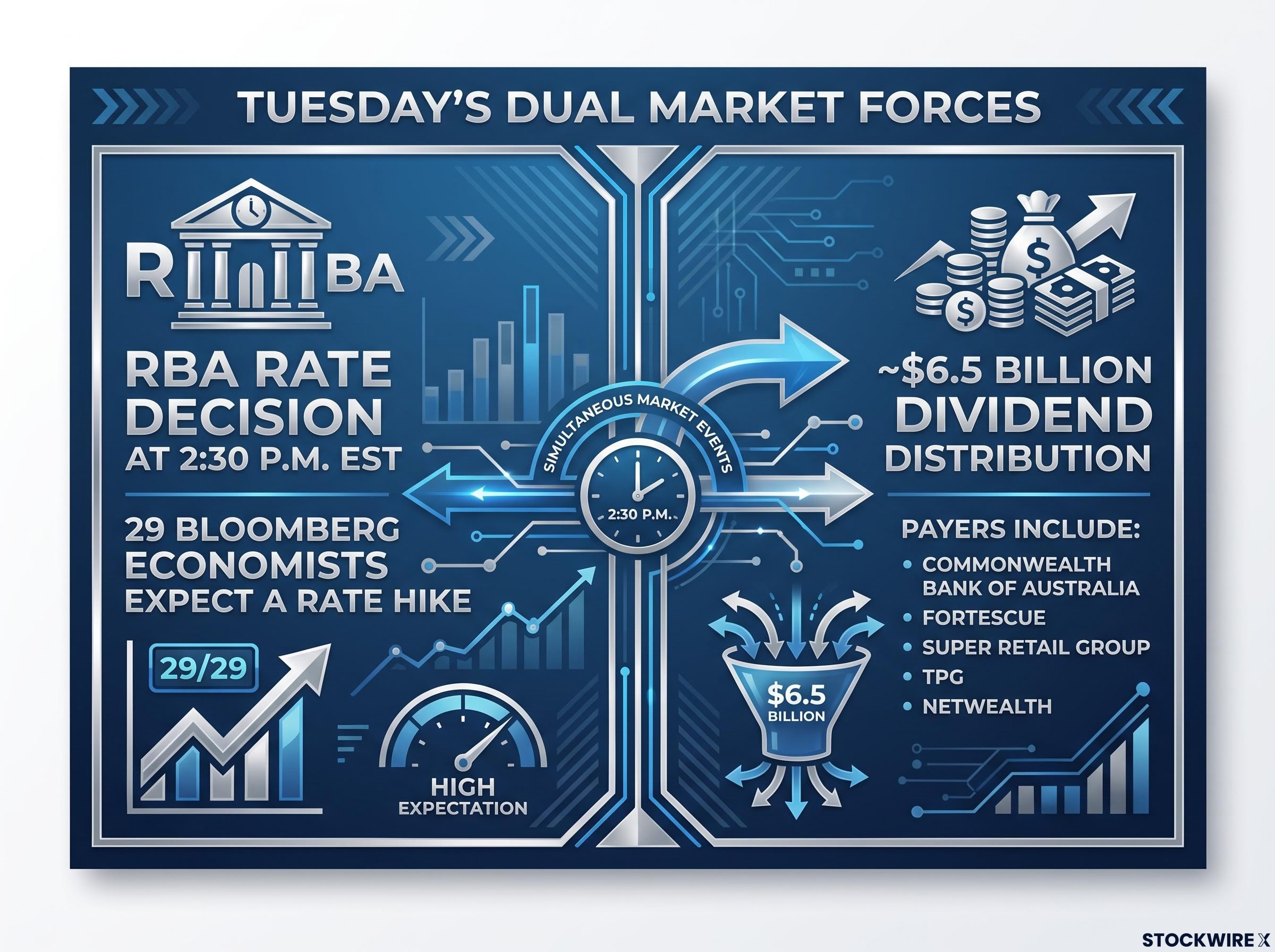
The RBA hands down its decision at 2:30 p.m. EST, and the consensus is about as firm as it gets. All 29 economists surveyed by Bloomberg expect a rate hike, a unanimity that corresponds to a market-implied probability of up to 90%. TradingEconomics separately pegged the odds of a 25 basis point move at between 74% and 85%, with the oil shock strengthening the tightening case.
Anything other than a hike would blindside the market.
The bigger concern is what comes after. Traders are not pricing a single move; they are pricing two, with a November hike on Melbourne Cup Day heavily built into expectations. That leaves the market absorbing not just Tuesday’s decision but the trajectory it signals.
Sector winners and losers
The split runs along the same fault line that defined September. Higher policy rates lift discount rates and increase the competition equities face from bonds, which pressures technology, consumer discretionary, and other longer-duration sectors.
Banks and insurers sit on the other side of the trade. They can expand margins by earning more on higher-yielding assets, which is part of why financials held firm on Friday while the rest of the market slipped.
The pain flows through the real economy too. Janus Henderson’s September view documented rising fixed-rate mortgage costs and higher funding costs for lenders, dynamics that dampen housing turnover and squeeze household budgets heading into year-end.
If your portfolio leans heavily toward consumer discretionary names or debt-reliant property trusts, prepare for further margin compression as rising borrowing costs bite deeper into both household spending and corporate balance sheets. The defensive harbour, for now, sits with the financials and the income-generating names that benefit from the very rates hurting everyone else.
Understanding index mechanics on a multi-billion dollar dividend day
Tuesday carries a second event that will confuse anyone reading the index at face value. Roughly $6.5 billion in dividends is expected to be distributed on the same day as the rate decision, with heavyweights including Commonwealth Bank of Australia and Fortescue among the payers, alongside names such as Super Retail Group, TPG and NetWealth.
Here is why that matters mechanically. When a company pays a cash dividend, that money leaves its balance sheet, and its share price is adjusted downward by roughly the dividend amount when it trades ex-dividend.
The ex-dividend price mechanics that will distort Tuesday’s index reading follow a well-documented pattern: research across more than 500 large-cap stocks confirms ex-dividend price drops average approximately 99.8% of the payout size, making the adjustment a near-perfect reclassification of company value rather than a loss of market wealth.
The chronology works like this:
- The company sets aside cash to pay its declared dividend.
- On the ex-dividend date, its share price drops by approximately the dividend value, because new buyers no longer receive that payout.
- The aggregate of these drops mechanically lowers the price component of the index.
- Days later, the cash lands in institutional and retail brokerage accounts.
- A portion gets recycled back into the market through dividend reinvestment plans (DRPs) and fresh buying, supporting liquidity.
A DRP simply lets shareholders reinvest their cash dividend into more shares automatically, often at a small discount, keeping capital circulating within the market rather than sitting idle.
This is where the optics get distorted. When institutions and retail investors recycle those dividends into other ASX names, the reinvestment flows can cushion price declines in later sessions, either masking or amplifying whatever the underlying sentiment happens to be.
The practical takeaway is this. You must separate a mechanical index drop, caused by billions in corporate cash going ex-dividend, from genuine fundamental selling driven by fear. If the ASX 200 opens artificially red on Tuesday morning, a chunk of that colour is arithmetic, not panic, and reacting to it as though it signals distress is exactly the error to avoid during a high-volatility week.
The convergence of CPI data and quarter-end window dressing
If Tuesday is about policy and mechanics, Wednesday is where the tension peaks. The monthly CPI inflation update arrives as the immediate scorecard on the RBA’s decision, telling the market whether Tuesday’s hike looks justified or already insufficient.
The trimmed mean inflation reading will be the figure that matters most to the RBA when Wednesday’s CPI lands, not the headline rate; the April 2026 print already showed the trimmed mean ticking higher to 3.4% even as headline CPI fell, confirming that underlying price pressures remain entrenched above the 2-3% target band.
Wednesday also happens to be the final trading day of both September and the third quarter of 2026. That timing layers a second force on top of the inflation data: quarter-end window dressing.
Window dressing is the practice where fund managers rebalance their portfolios before reporting to clients, trimming their worst-performing holdings and adding to names that have held up. In a quarter defined by yield-driven weakness in growth stocks, that means more selling pressure concentrated on exactly the rate-sensitive sectors already under strain.
The Australian dollar, meanwhile, has held near 70.2 US cents through the volatility, a relative anchor amid the bond-market storm.
Stack the forces together and the picture is clear.
| Day and catalyst | Likely market impact |
|---|---|
| Tuesday: RBA rate decision (2:30 p.m. EST) plus ~$6.5B dividend distribution | Policy shock hits rate-sensitive sectors; mechanical index drop from ex-dividend adjustments distorts the headline read |
| Wednesday: Monthly CPI print on final day of Q3 2026 | Inflation scorecard on the hike collides with institutional rebalancing, driving erratic intraday swings |
Here is what this means for your own activity. Because institutional managers will be aggressively rebalancing on Wednesday to clean up their books before client reporting, expect erratic price swings that have nothing to do with fundamental company value. Planning any trades around these known liquidity chokepoints, rather than into them, is how you avoid being caught on the wrong side of forced flows.
Navigating the third-quarter transition
The through-line across this week is a single tension: 15-year high bond yields have already repriced the market lower, and a near-certain RBA hike on Tuesday adds fresh weight rather than relief.
The $6.5 billion dividend injection offers a genuine but limited counterforce. Reinvestment flows can support liquidity and soften individual sessions, yet they cannot reverse the macro pressure until inflation itself begins to cool. That verdict rests with Wednesday’s CPI print and the data that follows.
The next real horizon line is the November RBA meeting on Melbourne Cup Day, where a second hike is already heavily priced. Between now and then, the direction of Australian equity valuations will be set less by corporate results and more by the path of yields and inflation.
This article is for informational purposes only and should not be considered financial advice. Investors should conduct their own research and consult with financial professionals before making investment decisions.
Past performance does not guarantee future results, and these forward-looking scenarios are speculative and subject to change based on market developments and policy decisions.