
When Bathla, a Sydney residential property developer, entered voluntary administration on 25 August 2026, the most striking detail was not the size of the debt. It was the shape of it.
Roughly 40 private credit funds simultaneously held loans to a single developer, with individual exposures ranging from $1.5 million to $340 million, and not one of them could see the full picture of what the others had lent.
That structural blindness produced an immediate, measurable stress event for ASX-listed alternative asset managers. Stocks with private credit exposure under UBS coverage fell an average of 28.9% year-to-date by late September, against a 3.4% gain for the ASX 200 over the same window. This was not a generalised property downturn. It was a concentrated failure in one specific corner of private credit.
After reading this, you will be able to distinguish which ASX-listed fund managers faced genuine impairment risk from those hit mainly by contagion-driven sentiment, and you will know what to look for when evaluating any private credit fund carrying a development loan book.
How $3.08 billion in private credit ended up inside one developer’s collapse
Start with the numbers, because they accumulate into a picture the participants themselves never had.
The administrators’ report, produced after Teneo was appointed, put Bathla’s total liabilities at $3.2 billion, of which $3.08 billion was owed to private credit firms. Ongoing reconciliation has since lifted consolidated creditor claims to approximately $3.4 billion.
The breakdown matters, because it shows how heavily this collapse sits on private lenders rather than banks or the tax office.
| Creditor category | Approximate claim |
|---|---|
| Secured lenders | $3.08 billion |
| Australian Taxation Office | $145 million |
| Employees | $4 million |
| Total (ongoing reconciliation) | ~$3.4 billion |
Now the structure. That debt was routed through roughly 542 special purpose vehicles (SPVs), one per project or financing tranche, spread across the 40-odd lenders. The named financiers form a roll-call of the non-bank sector:
- Centuria Bass Credit
- CVS Lane Capital Partners
- PAG Asia Capital
- Balmain
- Ray White Capital
- Keyview
- La Trobe Financial
- Credit Connect
ASIC Commissioner Simone Constant did not mince words about what administrators walked into.
ASIC Commissioner Simone Constant described Bathla’s financing as a “tangled setup.”
The dispersion is the point. With 40 lenders scattered across 542 legal entities, no single lender, regulator, or administrator held a consolidated view of total exposure before the collapse. That gap, between the complexity of the structure and the information available to anyone inside it, is what turned a large developer insolvency into a sector-wide stress event.
What administrators found when they looked inside
Then the reconciliation began, and the numbers got worse.
Administrators identified more than $730 million (approximately $736 million) in overstated receivables on Bathla’s books. Until that discrepancy is resolved, no reliable recovery estimate is possible, and no deed of company arrangement (DOCA), restructuring, or asset sale timeline can be meaningfully assessed.
The scale of the untangling is why the NSW Supreme Court granted a 12-month administration extension in mid-September 2026, with Teneo securing $4.7 million in emergency funding to keep operations stable. All figures remain subject to administrator reconciliation as of 25 September 2026.
When big ASX news breaks, our subscribers know first
Why private credit platforms were built for exactly this kind of exposure
None of this was reckless in isolation. It was a system working as designed, right up until it wasn’t. Three structural forces stacked on top of each other:
- The retreat of the major banks from construction lending.
- The yield imperative driving investors into development finance.
- A macro backdrop that raised borrowing costs at the worst possible moment.
Take the bank retreat first. After the banking royal commission and the regulatory tightening that followed, Australia’s major banks pulled back their appetite for cyclical, capital-intensive residential construction loans. That opened a funding gap, and private credit platforms, facing far fewer regulatory constraints on concentration or disclosure, moved to fill it.
Data tracking non-bank construction lending growth shows the sector’s share of residential construction finance rising from around 17% in December 2019 to more than 40% by 2026, a structural shift driven directly by the major banks pulling back after the royal commission and private credit platforms expanding to fill the gap.
Then the yield imperative. Wholesale and institutional investors wanted returns above traditional fixed income, and development finance offered exactly that: high interest rates wrapped in first-mortgage security. Managers scaled their loan books aggressively to meet the demand, competing for deal flow and accepting increasingly complex security structures to win it.
The macro backdrop turned the screw. The official cash rate reached 4.35% (effective 12 August 2026) following a succession of RBA tightening moves, and another rise remained on the table before year-end. Borrowing costs across the sector climbed just as a major loan book buckled.
Private credit spillover risk has attracted coordinated regulatory attention well beyond Australia; the ECB has mapped approximately 425 billion euros in exposure across European insurers, banks, and pension funds, with modelling showing that second-round equity revaluation losses can exceed the initial direct credit hit in a severe shock scenario.
Australia’s 10-year government bond yield climbed to 5.40% over the preceding month, its highest reading since April 2011, sitting around 5.36% to 5.39% on 24 September 2026.
The Federal Budget added further strain. The government axed the capital gains tax discount on investment properties and wound back negative gearing entitlements for established residential housing, carving out new builds from both measures. News.com.au characterised the fallout as a “concerning week” for an industry it sized at roughly $200 billion (a figure not independently confirmed).
Housing credit contraction is compounding the stress on development loan books from two directions: NAB is forecasting only 2.5% housing credit growth for FY27 while mortgage application volumes fell approximately 15-16% quarter-on-quarter, conditions that shrink the pool of end buyers that developers need to service and repay their private credit facilities.
Here is the read for you. The same conditions that made development lending attractive as a yield product also manufactured acute concentration risk, because every platform was chasing the same borrower profile for the same reasons. Screening a fund for Bathla-specific exposure is necessary. It is nowhere near sufficient.
What private credit risk actually means for investors in development loan funds
To understand why this collapse spread, you need a clearer mental model of what you actually own when you hold one of these funds.
Private credit development lending is straightforward at the surface. It is non-bank lending to property developers, typically structured as first-mortgage debt through SPVs, paying interest above bank rates in exchange for illiquidity and complexity. The trouble sits in two features you may not have priced.
Private credit funds hold around 26% of Australian residential development debt according to CBRE, meaning retail private credit risks are embedded in diversified income funds that many investors assume carry only modest concentration exposure.
The first is the liquidity mismatch. Investors are offered regular or frequent redemption windows from funds whose underlying assets are long-dated construction loans. Those loans cannot be readily sold or refinanced in a stressed market, so when redemption demand spikes, the fund gate is the structural consequence, not a management failure.
The second is what “secured” actually buys you. Here is the gap between what the label signals and what it delivers in a multi-SPV insolvency:
- What “secured” signals to a retail investor: a full, timely recovery backed by a first mortgage over real property.
- What “secured” means when a 542-SPV borrower defaults: hundreds of discrete entities to untangle, subordinated tranches competing for residual value, and administrators requiring months or years to establish the actual asset base before any waterfall can be calculated.
ASIC has landed on precisely this concern.
ASIC Deputy Chair Sarah Court described the collapse as “troubling” and raised whether investors in secured property loan funds understand how security rankings work when a large developer fails.
Commissioner Constant added that the market lacks even basic data on aggregate exposures, which makes valuing loans or modelling recoveries close to guesswork.
The three funds that restricted withdrawals
The theory became documented fact within weeks.
CVS Lane Capital Partners suspended withdrawals from two funds, the CVS Lane First Mortgage Fund and its Property Finance Fund, citing exposure across nine loans. Centuria Bass Credit paused redemptions after a spike in withdrawal requests.
The most analytically significant case is MA Financial Group. It imposed severe withdrawal limits on its $2.3 billion secured property loan fund despite having no direct Bathla exposure at all.
That is the liquidity mismatch in its purest form. The gate was not triggered by impaired loans. It was triggered by the structural impossibility of meeting redemption demand from assets that cannot be liquidated quickly, regardless of their credit quality. If you assumed “secured” meant safe and “monthly redemption” meant liquid, you are holding a different product than the one you thought you bought.
How the equity market priced the damage, and what investors missed
The equity market did not treat this as one story. It priced two things at once: direct loan impairment and sentiment contagion, and the data lets you tell them apart.
ASX private credit-exposed stocks under UBS coverage fell an average of 28.9% year-to-date by late September 2026, against a 3.4% gain for the ASX 200 over the same period.
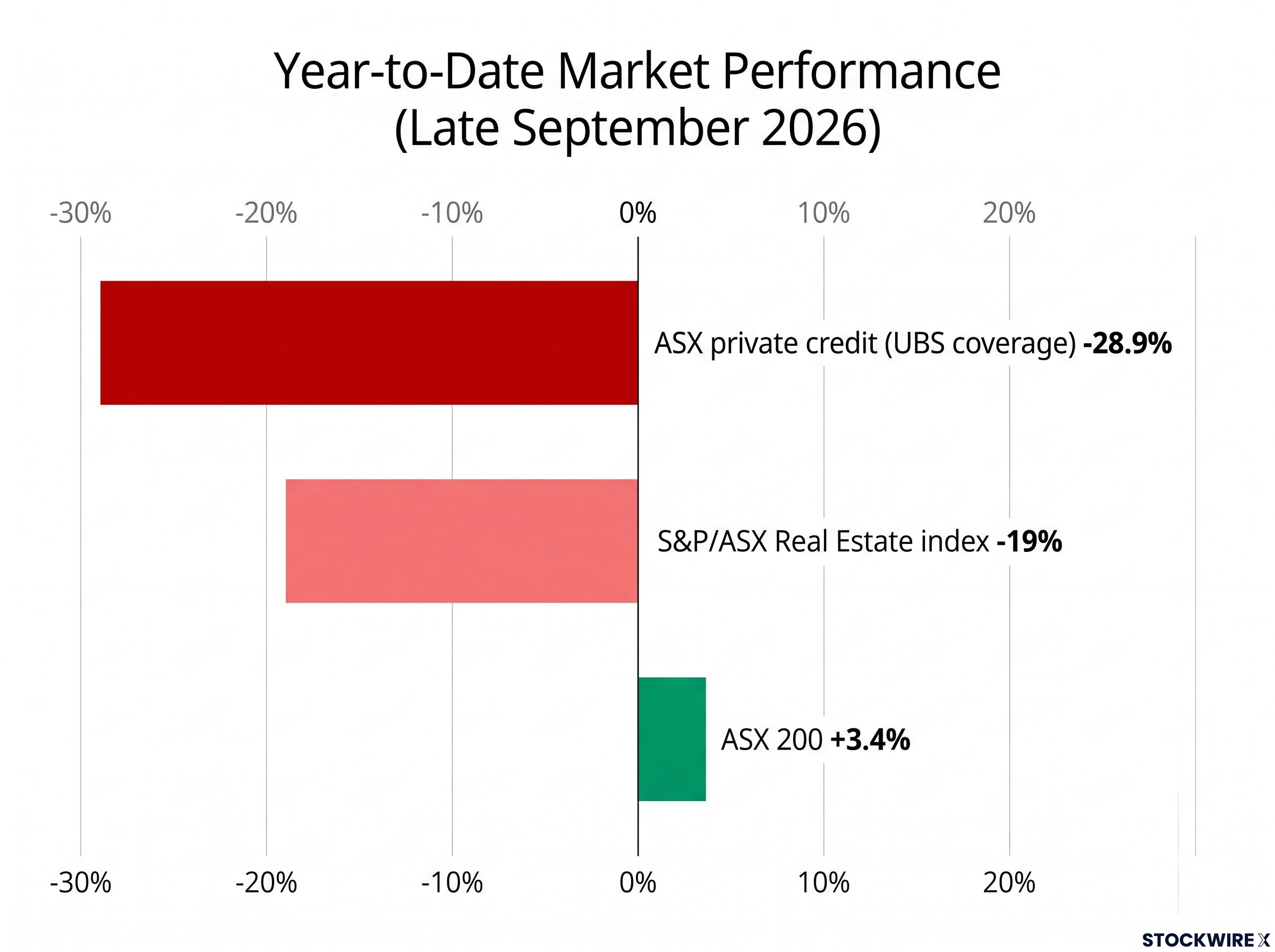
Forward price-to-earnings multiples for that group contracted 36%, landing at an average of 11.1x. The wider S&P/ASX Real Estate index fell roughly 19% year-to-date, its lowest since December 2023.
But the average conceals a split. Look at where the four named managers actually sat.
| Manager | Relative performance | Bathla exposure | Index tracked |
|---|---|---|---|
| Centuria Capital (CNI) | Steeper than peer average | Indirect / sector | Private credit group |
| MA Financial Group (MAF) | Steeper than peer average | No direct exposure | Private credit group |
| HMC Capital (HMC) | In line with wider sector | Indirect / sector | Wider real estate index |
| Pinnacle Investment (PNI) | In line with wider sector | Indirect / sector | Wider real estate index |
CNI and MAF underperformed the peer average materially. HMC and PNI broadly tracked the wider real estate index. That divergence tells you the market has begun pricing asset-specific impairment risk rather than writing the whole sector down uniformly, and that distinction is where the analytical work sits for anyone deciding whether current valuations represent distress or value.
The unpriced variable is enforcement. ASIC has signalled a materially tougher posture:
- Multiple investigations are underway across private credit managers.
- Surveillance covers both wholesale and retail funds where governance standards have fallen short.
- Product design is under scrutiny, specifically the liquidity mismatch between redemption terms and illiquid loan books.
The market has not yet resolved whether enforcement risk is fully reflected in these valuations. For you, that is the swing factor: the 28.9% average hides a wide spread of outcomes shaped by loan book composition and governance quality, and ASIC’s timeline may decide whether prices stabilise or slide further.
What the Bathla stress test changes for private credit investors going forward
Leave this analysis with a view on Bathla exposure alone and you have done half the work. The other half is a framework.
Three variables will most likely determine outcomes over the next 6 to 12 months:
- The pace and severity of ASIC enforcement actions.
- The administrator’s ability to untangle the 542-SPV structure and establish real recovery waterfalls.
- Whether the RBA delivers another cash rate rise before year-end.
On the first, the gap between current market pricing and eventual enforcement outcomes is the key unpriced risk. On the second, the 12-month court extension and the unresolved $730 million-plus in overstated receivables mean any credible recovery estimate is still months away. On the third, the next RBA decision is scheduled for 29 September 2026, with sustained rate pressure the scenario that keeps borrowing costs elevated across the sector.
ASIC’s financial reporting priorities for FY2026-27 target asset impairment and financial instrument measurement specifically, the two accounting domains most exposed to management bias in a private credit book where loan valuations are infrequent and model-based rather than market-tested.
When you next evaluate a private credit manager, screen against four points:
- Loan book concentration by individual borrower and by sector.
- Structural match between the fund’s redemption terms and the liquidity of its underlying loans.
- Disclosure quality on individual loan exposures, frequency included.
- Governance standard, measured against the bar ASIC has now set publicly.
Be honest about what remains open. Recovery rates, administration outcomes, and enforcement penalties are all unresolved as of 25 September 2026, and any decision made now is made under material uncertainty about the final scale of losses.
What has changed permanently is the information environment. ASIC has signalled it will act, redemption gates are a documented risk rather than a theoretical one, and the standard of due diligence expected of investors in these products has been reset upward by the evidence of the past month.
This article is for informational purposes only and should not be considered financial advice. Investors should conduct their own research and consult with financial professionals before making investment decisions. Past performance does not guarantee future results, and forward-looking statements are speculative and subject to change based on market developments.