
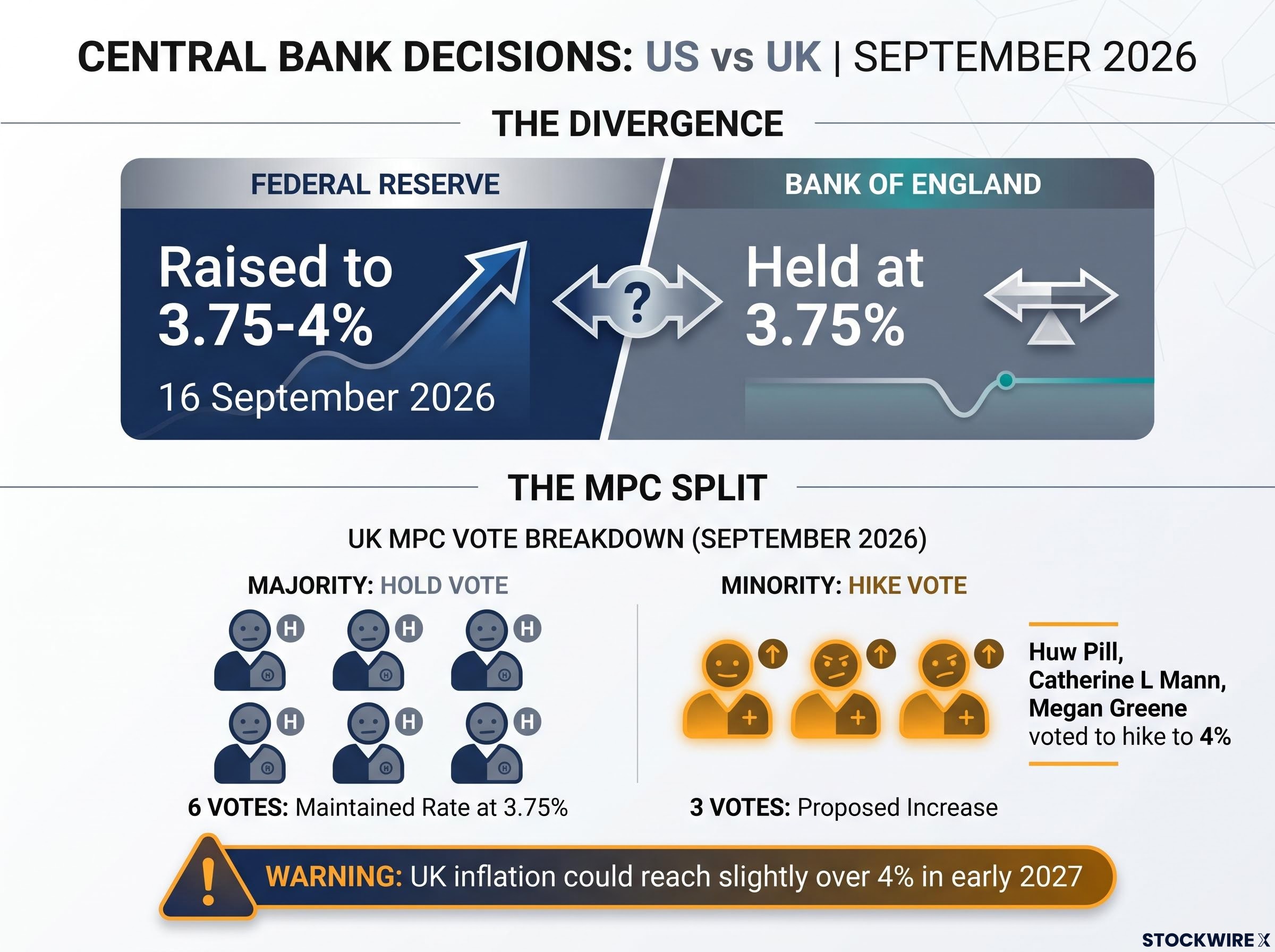
On 16 September 2026, the Federal Reserve raised its target range for the federal funds rate to 3.75-4%. Twenty-four hours later, the Bank of England held Bank Rate at 3.75%. One percentage point now sits between the two central banks’ floor and ceiling, and that gap is the question this piece exists to answer.
The timing alone is striking, but the substance is what matters. The BoE’s hold came with an explicit warning that UK inflation could climb to slightly over 4% in early 2027 if energy prices stay elevated, and three of the nine Monetary Policy Committee (MPC) members voted to hike immediately. This was not a consensus hold. It was a contested one, taken a day after the world’s most influential central bank moved firmly in the opposite direction.
That contest is where the real story of Bank of England independence lives. This piece gives you a framework for reading future BoE decisions through the lens of Fed policy, for knowing when sterling dynamics should sharpen your attention, and for telling the difference between genuine independence and shared-shock coincidence.
How Fed tightening reaches the UK without a single BoE vote being cast
Start with a simple mechanism. When the Fed tightens relative to the BoE, the gap between US and UK short-term interest rates widens. Dollar assets become relatively more rewarding to hold, and capital gravitates toward them.
That flow of capital tends to push sterling lower against the dollar. A weaker pound is not an abstraction. It raises the sterling price of everything the UK buys in dollars, and that is where the inflation begins.
Energy and commodities are priced in dollars. So when the pound falls, the cost of imported fuel rises even if the barrel price on global markets has not moved at all. Given the BoE’s own warning about energy prices, this is not a theoretical channel; it is the one Threadneedle Street is watching most closely.
The stagflationary feedback loop in sterling is self-reinforcing: pound weakness raises the cost of dollar-priced energy imports, feeding back into UK CPI at precisely the moment the BoE is trying to avoid the hike that might arrest the currency’s slide.
There is a second, quieter route. UK gilt yields can rise in sympathy with US Treasury yields, even without any formal co-ordination between the two central banks.
When that happens, UK financial conditions tighten on their own. Mortgage rates and corporate borrowing costs drift up regardless of what Bank Rate is doing, which means the Fed can effectively tighten UK conditions without the BoE lifting a finger.
Here is the shape of the transmission in scannable form:
- Rate differential: wider US-UK rate gaps draw capital toward dollar assets and weaken sterling.
- Import prices: a weaker pound raises the sterling cost of dollar-denominated energy and commodities, feeding UK inflation.
- Gilt-yield sympathy: UK yields can rise alongside US Treasuries, tightening UK financial conditions without any BoE decision.
The academic anchor for this argument is economist Hélène Rey, whose work on the global financial cycle shows that US monetary policy moves capital flows and asset prices worldwide, even in economies with flexible exchange rates. Analysis from the IMF and BIS supports the same conclusion.
The BoE’s own warning UK inflation could reach slightly over 4% in early 2027 if high energy prices persist, and rates “might have to go up if the Iran war drags on.”
What this means in practice is that every time the Fed tightens, UK mortgage holders and importers feel a version of it, whatever the MPC decides. That pressure is the constraint the BoE was navigating in real time when it chose to hold.
When big ASX news breaks, our subscribers know first
What the data actually say about how often the BoE follows the Fed
The instinct is to treat this as binary. Either the BoE sets its own path, or the Fed sets it for them. The numbers say neither.
Research by MPC member Megan Greene, cited in a speech earlier in 2026, put a figure on it. Before 1999, a global interest rate factor explained roughly 10% of the variation in domestic policy rates across countries. Since 1999, that share has risen to about 38%.
That jump is real, and it is worth sitting with. A 38% explanatory share means the global factor, Fed policy included, shapes BoE decisions far more than it did a generation ago. It is also, crucially, not a majority. The remaining 62% of the rate-setting equation is where domestic conditions live, and that is the space the BoE still controls.
| Period | Global rate factor’s explanatory share | Implication for BoE independence |
|---|---|---|
| Pre-1999 | ~10% of domestic rate variation | Global forces marginal; domestic conditions dominant |
| Post-1999 | ~38% of domestic rate variation | Constrained but not captured; meaningful domestic discretion remains |
The 38% figure describes the average. To see what genuine divergence looks like at full stretch, you need a specific episode.
The Brexit test: what a genuine divergence looks like
After the June 2016 Brexit referendum, the BoE did the opposite of what a Fed-follower would do. It cut Bank Rate and deployed additional easing, including Term Funding and renewed asset purchases, even as the Fed was approaching a gradual tightening cycle.
The cost of that divergence was visible. Sterling weakened, imported inflation rose, and the pound’s fall showed up in UK prices exactly as the transmission mechanism predicts.
The BoE judged UK growth and employment risks to be the dominant consideration and accepted the imported inflation as the price. It resumed hiking roughly a year later, once the immediate shock had passed. That episode is the benchmark against which the September 2026 hold should be read: proof that the BoE will diverge when domestic shocks demand it, and proof that divergence is not free.
It also complicates any simple narrative of mechanical following. In both the pre-GFC and post-COVID hiking cycles, the BoE actually moved ahead of the Fed, not behind it.
The case for holding and the case for hiking: how the MPC split reveals the real tension
A 6-3 vote is not a rubber stamp. It is a snapshot of genuine disagreement among people looking at the same data, and it tells you the September decision was a close call rather than a clear one.
Services inflation re-acceleration in August 2026, with private rents and catering prices rising independently of energy costs, removed a key plank from the majority’s case for holding and narrowed the data gap between the six and the three dissenting MPC members.
The case for holding, articulated by Standard Chartered’s Christopher Graham in analysis published via FXStreet on 25 September 2026, rests on domestic conditions. The argument runs as follows:
- UK demand looks softer than US demand, so matching Fed hikes risks being unnecessarily contractionary.
- The UK housing market is sensitive to higher mortgage rates, and credit conditions are already tight.
- Domestic data, not the mechanical pressure to match the Fed, should be the ultimate determinant of Bank Rate.
The three dissenters, Huw Pill, Catherine L Mann, and Megan Greene, all voted for an immediate hike to 4%. Their case is not reflexive Fed-following. It responds to the same risks the BoE itself flagged:
- Energy-price persistence could push inflation over 4% in early 2027, exactly as the Bank warned.
- If markets read the Fed’s inflation resolve as firmer than the BoE’s, UK inflation expectations could drift, threatening credibility.
- Acting now is less disruptive than a sharper, later hiking cycle if imported inflation takes hold.
Then there is the quantitative tightening (QT) paradox, and it is telling. Quantitative tightening is the process of a central bank shrinking the pile of government bonds it bought during easing programmes, which drains money from the financial system.
The MPC held Bank Rate and paused active gilt sales for six months, easing near-term pressure. At the same time, it confirmed a long-term plan to reduce its gilt holdings to zero, unwinding at an annual average of £46 billion, including £20 billion in active sales once they resume.
The BoE’s rate-rise warning Rates “might have to go up if the Iran war drags on.”
Read those two moves together and the message becomes clear. The BoE bought itself near-term flexibility without abandoning the medium-term tightening signal.
The 6-3 split and the QT contradiction-in-tandem tell you the BoE is not confident this is the right call. It is buying time to see whether domestic data or imported inflation wins the next round of incoming evidence, which makes a hawkish-biased hold a very different signal from a unanimous one.
Three academic frameworks, one policy question: how to think about BoE constraint
The disagreement inside the MPC mirrors a deeper disagreement among economists about what co-movement in rates actually means. Three frameworks each illuminate a different part of the September picture.
The first reading is the most constraining. Hélène Rey and analysts at the IMF and BIS argue that flexible exchange rates provide less insulation than textbook theory suggests. When the Fed tightens hard, the BoE’s viable range of choices narrows, because divergence brings currency depreciation, imported inflation, and capital outflows.
Rey’s global financial cycle research provides the academic foundation for this constraint, demonstrating that US monetary policy transmits through capital flows and asset prices across economies with flexible exchange rates, narrowing the practical policy space available to central banks like the BoE.
The second reading is the most reassuring for BoE credibility. Economists including Maurice Obstfeld and Jordi Galí, alongside framing reflected in Mark Carney’s speeches, argue that co-movement reflects shared shocks rather than policy following. Synchronised supply-chain disruptions, energy spikes, and global demand cycles produce correlated rate responses without implying that anyone is shadowing anyone.
Here are the three lenses in brief:
- Genuine interdependence (Rey): US policy sets a floor for global financial conditions. Implication: the BoE’s choices narrow sharply when the Fed tightens.
- Shared shocks (Obstfeld, Galí, Carney-era): Correlated rates reflect common external shocks, not dependence. Implication: the BoE’s domestic mandate remains intact.
- Hybrid (Greene): Global factors explain more than they used to, but not most. Implication: the BoE has less room than before, but real discretion remains.
Which of these you find most persuasive determines how you read the next Fed hike, either as a near-automatic signal to expect a BoE follow, or as one input among many into a genuinely domestic process.
Where the Greene finding leaves us in September 2026
Greene’s 10%-to-38% finding is the quantitative bridge between the two extremes, and it is the most useful lens for current conditions. It says the BoE is constrained but not captured.
That maps directly onto the September decision. The hold was not a declaration of full independence; it was an exercise of the discretion that still exists within the constraint set.
It also signals when that discretion narrows. If sterling falls sharply, energy prices stay elevated, and UK inflation tracks toward the 4%+ warning, the Fed’s next move becomes far harder for the BoE to absorb without responding.
What the BoE’s next move will actually depend on
Stop watching the headline decision and start watching the inputs. Three variables will determine whether the tightening bias converts into an actual hike.
| Variable to watch | What the data shows now | What would trigger a BoE response |
|---|---|---|
| UK energy prices | Elevated; the BoE’s stated inflation trigger | Sustained high prices pushing CPI toward 4%+ in early 2027 |
| Sterling vs the dollar | Under pressure from the widened US-UK rate gap | A sharp fall lifting imported inflation materially |
| UK wage and demand data | Softer than US demand; supports the hold | Re-acceleration that gives domestic cover for a hike |
The Fed’s December meeting is the sequencing factor. Standard Chartered projected an additional 25 basis point hike at the December FOMC, though that projection has not been independently confirmed. If it materialises, the sterling channel pressure on the BoE intensifies for its subsequent meeting.
The reading logic runs in this order:
- The Fed’s December decision sets the external backdrop.
- Sterling’s reaction to that decision gauges the imported-inflation pressure.
- The BoE’s January-February assessment weighs that pressure against fresh UK data.
Do not overlook the QT timeline either. The six-month pause on active gilt sales ends around March 2027, creating a decision point that is independent of Bank Rate. If the BoE restarts active sales while holding the rate, it is tightening indirectly, and markets will price that accordingly.
Watch those three variables alongside the December Fed decision and you will have a materially better read on the BoE’s next move than anyone relying solely on post-meeting headlines.
For investors wanting to track the three data variables that will determine the BoE’s next move before headlines move markets, our dedicated guide to reading BoE rate decisions explains how CPI components, wage data, and MPC vote splits combine into a practical pre-decision framework.
Independence in a constrained world: what the September decisions actually settled
The September episode neither proves full BoE independence nor disproves it. The BoE held Bank Rate at 3.75% while the Fed raised to 3.75-4%, exercising the discretion that domestic conditions justified, but doing so within a constraint set shaped by Fed policy, sterling dynamics, and global risk premia. Greene’s 38% global factor share is the number that captures it: constrained, but not captured.
The forward-looking implication is straightforward. If UK domestic data deteriorate, or if the Fed hikes again before year-end, the gap between constrained and unconstrained independence closes, and the tightening bias the MPC is carrying activates.
The principle to take with you is this. Reading the BoE means watching both Threadneedle Street and Constitution Avenue, not because the Bank follows the Fed, but because the range of choices open to the MPC is partly set by what the Fed has already done.
For investors wanting to model the asymmetric risk around the BoE’s next move, our full explainer on the BoE pricing gap examines why the swaps curve’s implied 50-75 basis points of further tightening may be too aggressive given the current vote split and negative output gap.
This article is for informational purposes only and should not be considered financial advice. Investors should conduct their own research and consult with financial professionals before making investment decisions. Past performance does not guarantee future results, and financial projections are subject to market conditions and various risk factors.