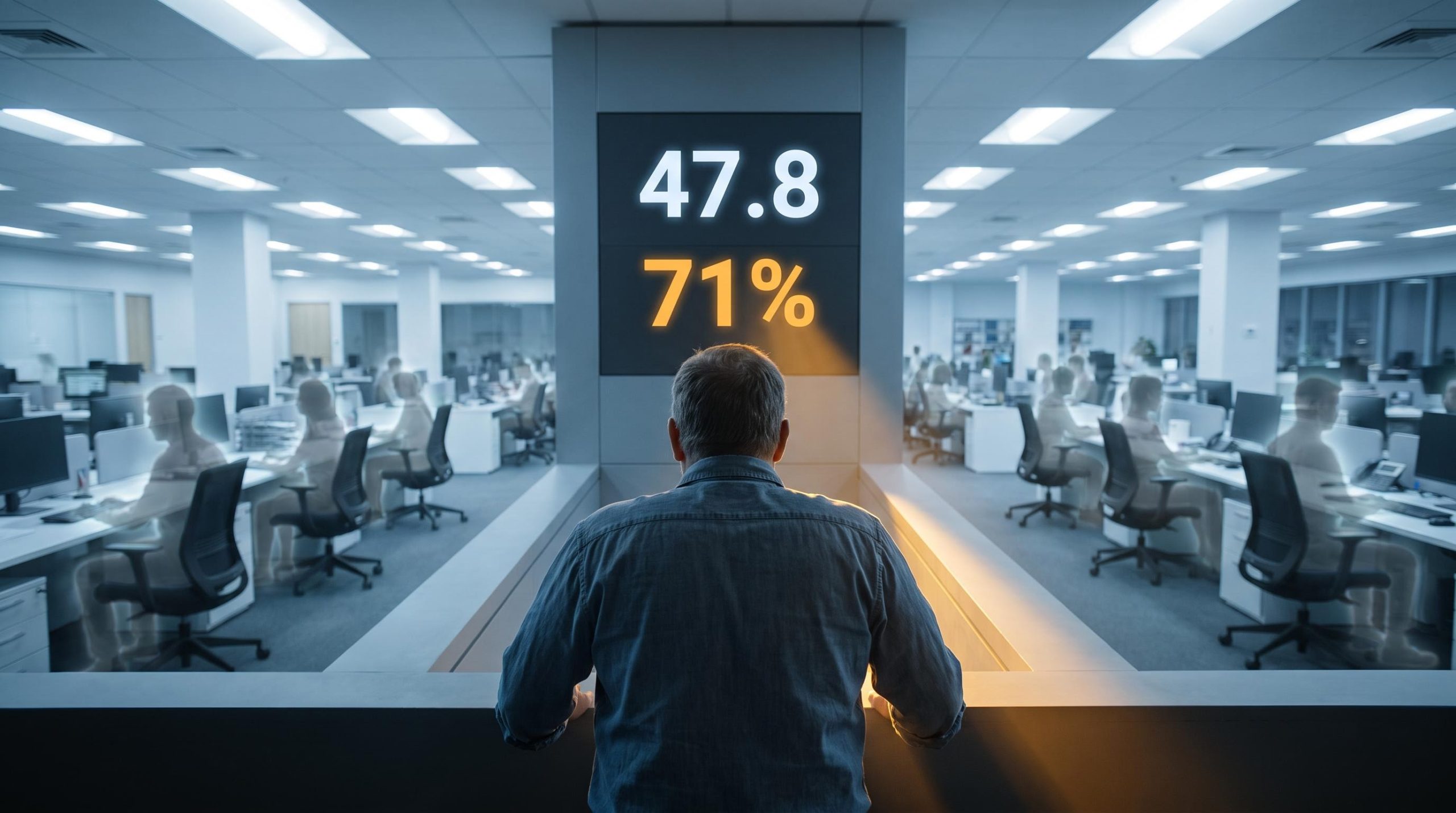
American consumer sentiment has fallen to 47.8 on the University of Michigan index, a reading normally seen only when the economy is already contracting. Yet by conventional measures, the labour market has not collapsed. That is the gap at the centre of this story.
The standard playbook for restoring confidence assumes people are reacting to what is happening in their paychecks right now. It reaches for rate cuts and cash transfers to loosen budgets under stress. When the anxiety is instead rooted in what people fear will happen to their jobs over the next decade, those tools misfire.
AI job fears are the variable that makes this confidence trough structurally different from the ones that came before. Here is what the data actually tells you about why sentiment has fallen this far, and why pulling it back up will require something conventional policy has not yet delivered.
A confidence collapse hiding in plain sight
Consumer sentiment did not fall off a cliff overnight. It slid, and the slide is the story.
The University of Michigan Consumer Sentiment Index moved through the following readings over the past year:
- September 2025: 55.1
- July 2026: 55.2
- August 2026: 51.7
- September 2026 (preliminary): 47.8, released on 11 September 2026
Read those numbers in sequence and the acceleration is unmistakable. Sentiment held roughly flat for most of a year, hovering around 55, before shedding more than seven points between July and September 2026 alone. The bulk of the deterioration happened over a single summer.
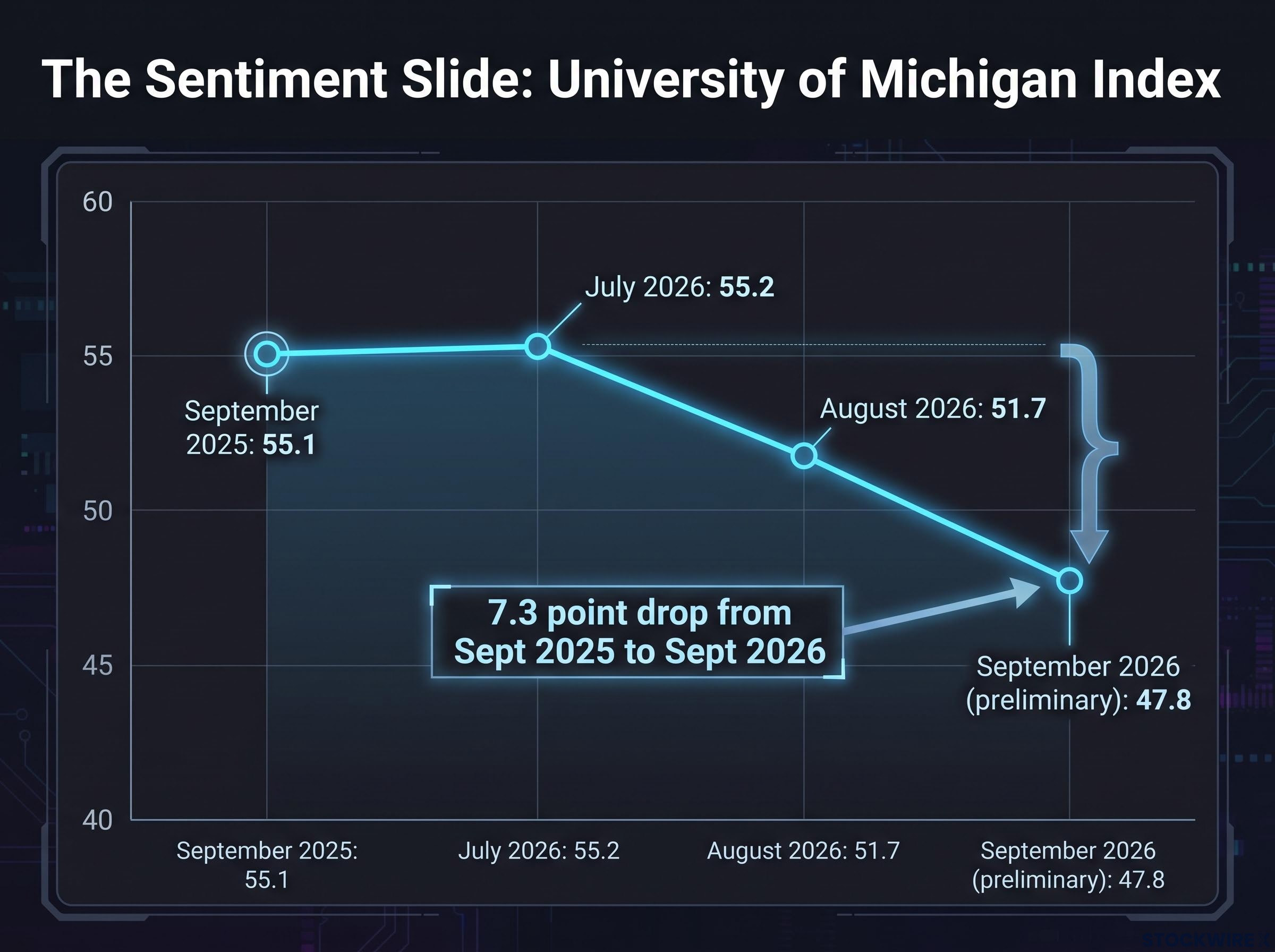
The year-on-year comparison sharpens the picture further. At 47.8, the index sits 7.3 points below where it was in September 2025.
The preliminary September 2026 reading of 47.8 is near a record low for the University of Michigan index, placing it in territory the survey has historically only touched during deep recessions.
That last point is what should give any forecaster pause. A reading this low is not the signal of a cautious consumer trimming discretionary purchases at the margin. It is the signal of a population as pessimistic as it typically gets during outright downturns.
Sentiment readings near record lows have historically been contrarian signals as often as they have been recession precursors, a distinction that matters for anyone calibrating how much weight to place on the 47.8 headline versus the underlying labour market and credit data.
Consumer spending accounts for roughly two-thirds of U.S. GDP. A sentiment reading this depressed, if it holds, feeds directly into growth forecasts, corporate earnings expectations, and the odds that any policy response actually works.
So the burden of proof now sits with anyone claiming a normal recovery is around the corner. Understanding what is actually driving the drop is the prerequisite for judging when it might reverse.
When big ASX news breaks, our subscribers know first
Why 71% of Americans now expect AI to cost them jobs
The sentiment data tells you people are anxious. The survey data tells you what they are anxious about.
According to Pew Research Center, 71% of U.S. adults now expect AI to result in fewer jobs over the next 20 years. That figure, from a June 2026 survey, is up 7 percentage points from 64% in 2024. The majority view is not just large; it is growing.
Dig into how workers feel about their own positions and the anxiety becomes personal. Pew found in February 2025 that 52% of U.S. workers were worried about future AI use in the workplace, and 32% believed AI would reduce their own job opportunities specifically.
Research by Anna Wong, Chief U.S. Economist at Bloomberg Economics, adds a hard-data dimension to the fear. Her work found that unemployment rates rise progressively across industries as those industries become more exposed to AI, which means the concern tracks a measurable pattern rather than pure speculation.
| Survey Source | Date | Finding | Share of Respondents |
|---|---|---|---|
| Pew Research Center | June 2026 | Expect AI to cause fewer jobs over next 20 years | 71% |
| Pew Research Center | 2024 | Expected AI to cause fewer jobs (prior reading) | 64% |
| Pew Research Center | February 2025 | U.S. workers worried about future AI use at work | 52% |
| Pew Research Center | February 2025 | Workers expecting fewer personal opportunities | 32% |
| Bloomberg Economics (Anna Wong) | Recent research | Unemployment rises with industry AI exposure | Qualitative finding |
When seven in ten Americans expect fewer opportunities because of a technology already deployed and accelerating, that is not a fringe worry a communications team can manage away. It is a structural shift in how people perceive the security of their own labour, and it feeds directly into how cautiously they spend today.
A global pattern, not a U.S. anomaly
This is not a quirk of the American political or media environment. In a Pew global report published on 17 September 2026, majorities in 34 of 37 surveyed countries said they expect AI to cause job losses over the next 20 years.
Concern also ran higher in high-income countries than in middle-income ones. That pattern matters, because it suggests the anxiety reflects something people genuinely perceive about the technology rather than a story confined to one country’s headlines.
AI job exposure is distributed sharply unevenly across income tiers and geographies: Bank of America’s research estimates high-income countries face 33.5% exposure versus 11% in low-income ones, a skew that helps explain why anxiety tracks higher in wealthier economies where cognitive tasks dominate.
The mechanism: how job fears short-circuit spending before jobs are actually lost
The puzzle from the introduction has a mechanical answer. AI anxiety depresses spending through a specific chain, and following it explains why the usual policy levers keep missing.
Start with the nature of the fear itself. A conventional recession scare is tied to an identifiable shock, a downturn people expect to end. AI anxiety is different: it concerns an open-ended, structural threat with no obvious expiry date, so households treat even strong current earnings as fragile and prioritise building buffers over spending.
That baseline caution then gets amplified. Behavioural finance describes two forces at work here. Availability bias means vivid, prominent stories, in this case AI layoff headlines, weigh more heavily on decisions than they should. Loss aversion means the pain of a potential job loss is felt more sharply than the pleasure of an equivalent gain. Together they magnify the spending impact of AI anxiety well beyond what aggregate job-loss numbers alone would predict.
Now bring in the policy response, and the chain breaks in a predictable place. The three-step mechanism runs like this:
- Forward-looking anxiety builds. Households worry not about this month’s pay but about whether their role exists in five years, so precautionary saving rises.
- Behavioural amplification magnifies it. Availability bias and loss aversion inflate the felt threat, deepening the pullback in discretionary spending.
- Conventional stimulus fails to address the root cause. One-time transfers loosen short-term budgets but leave long-term employability fears untouched.
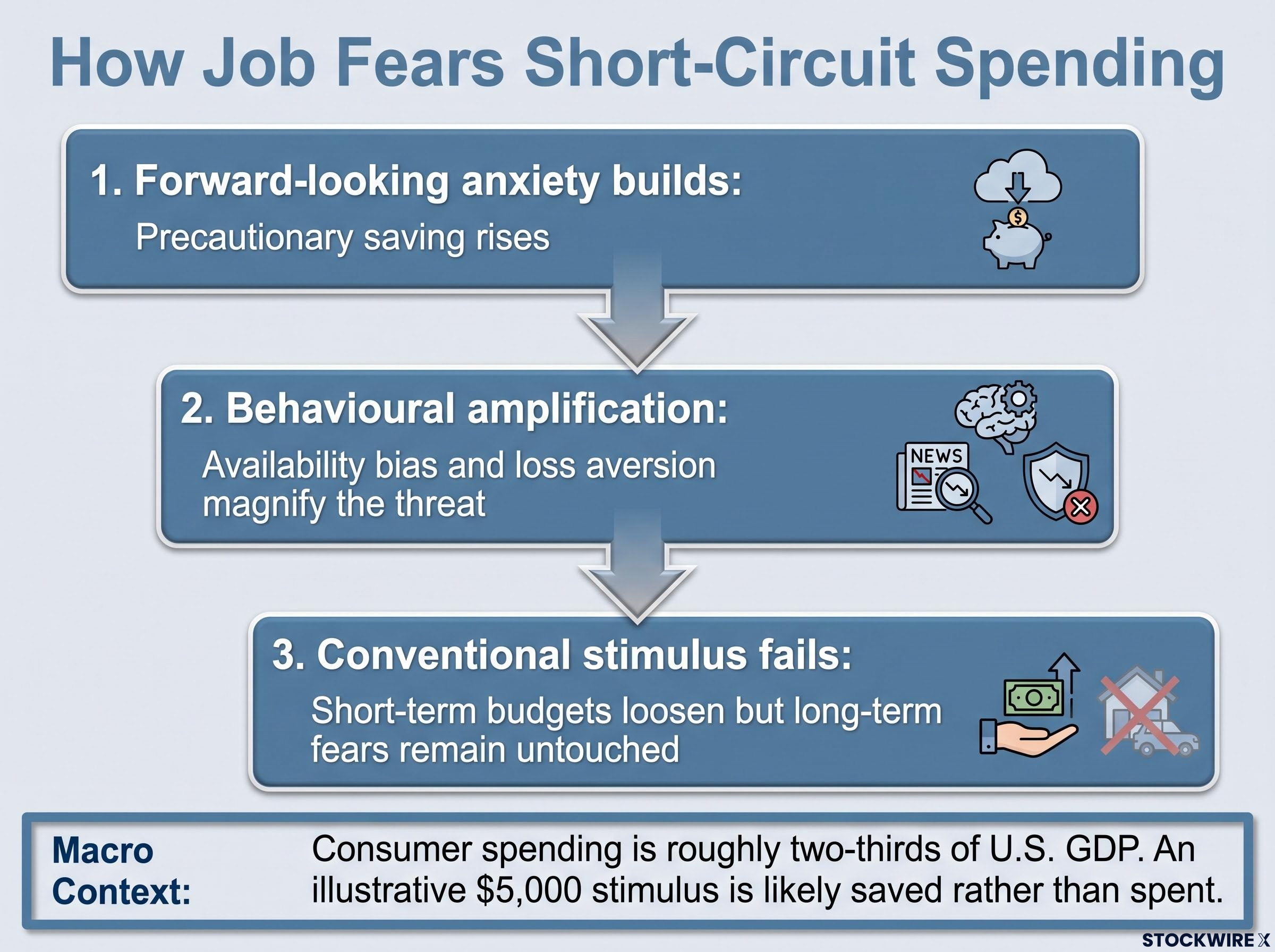
An illustrative direct payment of roughly $5,000 per person has been cited as one potential stimulus mechanism. Under structural AI anxiety, the demand response from a transfer like that is expected to be weaker than in a typical cyclical downturn, because a household worried about the existence of its job in five years is likely to save the cash or pay down debt rather than spend it.
Inflation compounds the problem. If those transfers are perceived as pushing prices higher, real purchasing power falls and trust in policy tools erodes, deepening the sense that policymakers cannot touch the underlying threat.
There is precedent for anxiety running ahead of the actual shock.
Sentiment effects can precede and sometimes exceed the measurable employment shock. Narratives about robots, offshoring, and computers moved saving and spending behaviour in affected communities well before, and sometimes beyond, the job losses that eventually materialised.
That is the practical takeaway for anyone watching the current policy debate. A stimulus check aimed at a household fearing for its long-term employability tends to sit in savings rather than flow through the economy, which is why a recovery driven by structural anxiety could take far longer than cycle-based models suggest.
The divergence between survey-measured anxiety and observed behaviour captures the same tension as spending resilience despite sentiment collapse: Bank of America card transactions posted their strongest year-over-year growth in more than four years in June 2026, even as sentiment approached record lows.
Are the fears proportionate? What the evidence actually shows
Before assuming this anxiety is either fully justified or overblown, it is worth sitting with the genuine disagreement among economists. Both sides have real evidence.
The rational case versus the overstated case
The case that fears are rational:
- NBER-affiliated automation studies show that robot adoption has reduced manufacturing employment and wages in affected regions, evidence that technology shocks carry real, localised, long-lasting costs.
- McKinsey Global Institute analysis finds a substantial share of tasks across occupations is technically automatable, with millions of workers potentially needing occupational transitions by 2030.
- Brookings Institution research emphasises that mid-skill routine jobs and specific communities are disproportionately exposed, making the fear rational for those groups even if aggregate employment holds.
The case that fears are overstated:
- Economists including David Autor argue that general-purpose technologies, from electrification to computers, have historically reallocated and transformed jobs rather than produced permanent mass unemployment.
- Federal Reserve and academic analysts note that most occupations are bundles of tasks, only some easily automated, so AI is more likely to augment work than eliminate it wholesale.
- AI may raise demand for complementary human skills such as judgment, empathy, and complex interaction, which resist automation.
The historical record cuts both ways. Computerisation eliminated many routine roles, yet it also created entirely new occupations and industries, a point optimists lean on heavily.
Where the two camps agree
Here is the analytically productive ground. Both sides acknowledge that transition costs, worker insecurity, and distributional harm are real, even while they contest the aggregate employment outcome.
Several policy analyses reframe the central risk not as absolute job scarcity but as distributional damage: wage polarisation, geographic divergence, and the cost of moving between roles. That reframing suggests raw fears of mass unemployment may be somewhat misfocused, while the underlying economic insecurity is well-founded.
For you as an individual, the distributional finding is the one that matters most. Even if AI never produces mass unemployment, the uneven spread of costs and transitions means the person carrying this anxiety may be entirely rational to feel it, even as national statistics look stable.
That distinction also matters for judging policy. It is worth remembering that only about a quarter of U.S. adults believe AI will positively affect how people do their jobs, which tells you optimistic narratives have not reached mainstream opinion. Solutions calibrated to a mass-unemployment problem will not fix a distributional one.
What would actually need to change for sentiment to recover
If the diagnosis is structural, the treatment cannot be purely cyclical. Rate cuts and one-time transfers address the surface layer while leaving the confidence deficit intact, which is why recovery requires interventions matched to the actual source of the anxiety.
Institutions including Brookings, McKinsey Global Institute, and the OECD point to a coherent set of structural responses rather than a scattered wishlist:
- Reskilling and lifelong learning: systems that move workers into roles complementary to AI rather than in direct competition with it.
- Strengthened labour protections: wage insurance and portable benefits that reduce the personal downside of a job transition, addressing the precautionary-saving instinct directly.
- Inclusive AI adoption: incentives for firms to deploy AI to enhance productivity and safety rather than solely to substitute labour.
- Work-linked income support: earned-income tax credits and job guarantees in high-value public services, which tie support to participation and skill-building rather than one-off cash.
- Regulatory and governance clarity: transparency about automation plans and worker participation in technology decisions, easing anxiety driven by opacity rather than by the technology itself.
Earned-income tax credits and public-service job guarantees are specifically identified as preferable to one-off transfers, precisely because they connect support to work and skills instead of relaxing a budget for a single quarter.
The private sector layer is easy to underrate. With only around a quarter of adults viewing AI as positive for how people work, there is a wide gap between the technology’s stated promise and the public’s lived expectation.
Until households are shown credible evidence that AI is functioning as a productivity and job-creation driver rather than solely an elimination force, sentiment is unlikely to recover no matter what fiscal policy delivers. This is the variable that institutional policy alone cannot substitute for.
For anyone tracking when confidence might credibly turn, the honest answer is that the timeline depends less on the next Federal Reserve decision and more on whether households start to see AI as working for them. That is a years-long narrative shift, not a quarterly event.
This article is for informational purposes only and should not be considered financial advice. Investors should conduct their own research and consult with financial professionals before making investment decisions. Past performance does not guarantee future results, and forward-looking statements are subject to market conditions and various risk factors.
The confidence recovery that requires more than a rate cut
AI job anxiety is not a standard cyclical confidence problem, so the recovery cannot follow a standard cyclical path. Conflating the two produces policy responses, and investment-timeline assumptions, that are set up to disappoint.
The through-line is consistent. Sentiment sitting near a record low at 47.8, survey evidence showing 71% of Americans expecting fewer jobs and that figure still rising, a mechanism in which forward-looking fear blunts the spending multiplier, all point to a structural response that has not yet been deployed at scale.
Watch three things as leading indicators of a genuine turn: credible reskilling programmes operating at scale, employer communication that demonstrably shows AI augmenting rather than replacing workers, and Pew-style survey readings where the majority view stops getting worse.
The conditions for recovery are definable. None of them are yet present at the scale required. That is reason enough to treat near-term consumer recovery projections with proportionate scepticism.
For investors tracking what the sentiment deterioration means for equity positioning, our full explainer on consumer sector mispricing examines why the Consumer Discretionary index has fallen to a 20-year low relative to the S&P 500 despite spending data that does not confirm the collapse equities are pricing.